


Data Science Articles
Accountant vs Data Analyst Salary in India After Switching Careers - Best Guide
Finance Managers: Could Data Science Be Your Next Career Move?
Insurance Claims Executive to Data Analyst: Is It a Good Switch?
Banking Executive (Loans, KYC) to Data Analyst: Skills and Career Path


Get In Touch For Details! Request More Information

What is the Data Science Life Cycle in 2026? A Complete 9-Stage Guide for Beginners
Oct 14, 2026 7 Min Read 12221 Views
(Last Updated)
Ever wondered why so many promising data science projects never make it past a Jupyter notebook? The difference between a project that dies in experimentation and one that ships real business value almost always comes down to following a structured process.
The data science life cycle is a structured, iterative process that transforms raw data into actionable insights, covering nine stages: problem definition, data collection, data cleaning and preparation, exploratory data analysis, feature engineering, modeling, model evaluation, deployment, and monitoring and maintenance. Each stage builds on the previous one, and the process often loops back as new data or findings emerge.
This guide breaks down all nine stages in detail, the popular frameworks that structure them, the tools used at each step, and where most projects actually go wrong.
Table of contents
- TL;DR Summary
- What is the Data Science Life Cycle?
- Steps in the Data Science Life Cycle
- Here is a quick overview of all nine stages of the data science life cycle before we explore each one in detail:
- Data Science Life Cycle vs ML Lifecycle vs MLOps Lifecycle
- Popular Frameworks for the Data Science Life Cycle
- Tools Used Across the Data Science Life Cycle
- Members involved in the Data Science Life cycle
- Real-World Example: Data Science Life Cycle in Action
- 💡 Did You Know?
- Common Mistakes in the Data Science Life Cycle
- Conclusion
- FAQs
- What are the 9 stages of the data science life cycle?
- What is the most time-consuming stage in the data science life cycle?
- What is the difference between the data science life cycle and the machine learning lifecycle?
- Which framework is most widely used for the data science life cycle?
- What are the 5 phases of the data science life cycle?
TL;DR Summary
- What it is: a 9-stage, iterative process for turning raw data into actionable business insights
- The stages: problem definition, data collection, cleaning, EDA, feature engineering, modeling, evaluation, deployment, and monitoring
- Where most time goes: data cleaning and preparation alone typically consume 60-80% of total project time
- Popular frameworks: CRISP-DM remains the global standard; TDSP is gaining ground in India’s Azure-based teams
- Where it’s related but distinct: the ML lifecycle and MLOps lifecycle are narrower subsets that zoom into the modeling and deployment stages specifically
What is the Data Science Life Cycle?
The data science life cycle is a systematic approach to managing data science projects. It encompasses a series of stages that guide data scientists from the initial problem definition to the final deployment and monitoring of solutions. It includes the typical stages involved in the data science life cycle. Let’s explore them:
Before we move into the next section, ensure you have a good grip on data science essentials like Python, MongoDB, Pandas, NumPy, Tableau & PowerBI Data Methods. If you are looking for a detailed course on Data Science, you can join HCL GUVI’s Data Science Course with Placement Assistance. You’ll also learn about the trending tools and technologies and work on some real-time projects. Additionally, if you want to explore Python through a self-paced course, try HCL GUVI’s Python course.
Steps in the Data Science Life Cycle
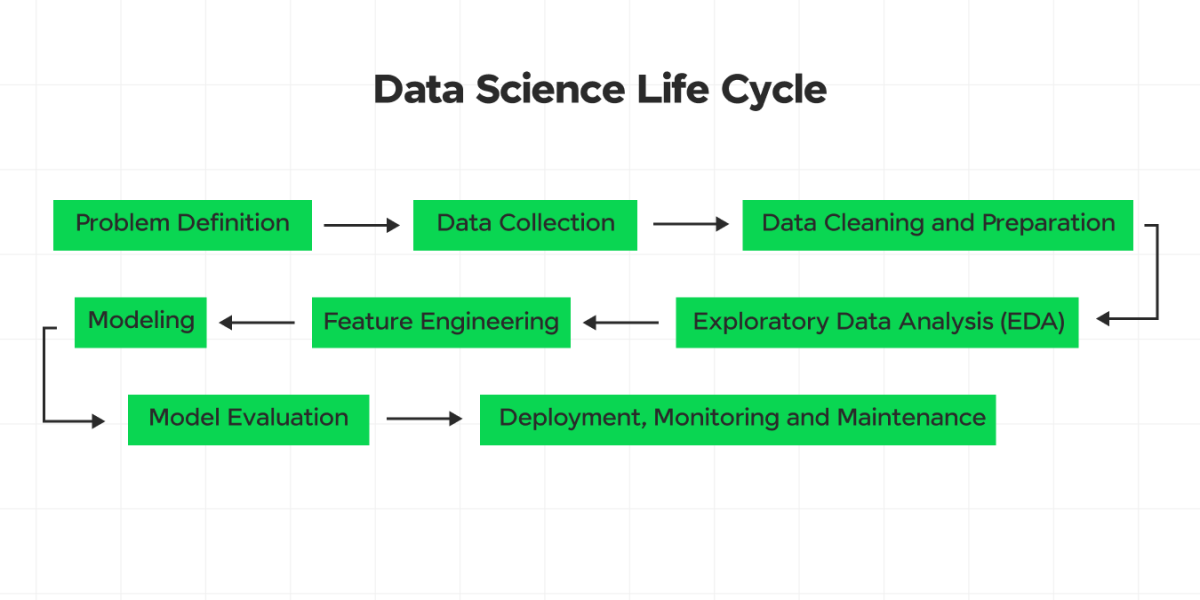
Here is a quick overview of all nine stages of the data science life cycle before we explore each one in detail:
| Stage | What Happens |
|---|---|
| 1. Problem Definition | Understand the business goal and define what needs to be solved |
| 2. Data Collection | Gather relevant data from internal and external sources |
| 3. Data Cleaning and Preparation | Fix errors, handle missing values, and format data for analysis |
| 4. Exploratory Data Analysis (EDA) | Uncover patterns, trends, and relationships in the data |
| 5. Feature Engineering | Create and select the most useful variables for modeling |
| 6. Modeling | Build predictive or descriptive models using machine learning |
| 7. Model Evaluation | Assess model performance using metrics and validation techniques |
| 8. Deployment | Implement the model in a production environment |
| 9. Monitoring and Maintenance | Track model performance over time and retrain when needed |
1. Problem Definition
The first step in data science projects is to clearly define the problem you are trying to solve. This involves engaging with business stakeholders to understand their needs, challenges, and objectives. By conducting thorough stakeholder interviews, you can gather the necessary information to articulate a clear and concise problem statement.
This statement outlines the business objectives and sets the criteria for success. Additionally, formulating hypotheses that can be tested through data analysis is essential at this stage.
For instance, a retail company may want to predict which products will be popular in the next season to optimize their inventory levels.
If you’re looking for a complete guide on how to start your career as a data scientist, we have A Complete Data Scientist Roadmap for Beginners, where you’ll read about the major concepts you should know to become a data scientist.
2. Data Collection
Once the problem is defined, the next step is to gather the relevant data needed to address it. Identifying data sources is crucial; these sources could include internal databases, APIs, web scraping, or external datasets.
The process of data acquisition involves collecting data from these sources and ensuring it is in a format that can be processed. Often, this stage also involves integrating data from different sources to create a unified dataset.
For example, to predict product popularity, you might collect sales data, customer demographics, and social media trends.
Common data collection tools and sources to use in data science life cycle in 2026:
- Internal databases: SQL, PostgreSQL, MySQL, MongoDB
- APIs: REST APIs, Google Analytics API, Twitter/X API
- Web scraping: BeautifulSoup, Scrapy, Selenium
- Cloud data warehouses: AWS S3, Google BigQuery, Azure Data Lake
- Third-party datasets: Kaggle, UCI Machine Learning Repository, government open data portals
3. Data Cleaning and Preparation
Data cleaning and preparation is a critical stage where you ensure that the data is accurate, complete, and ready for analysis. This process involves handling data, missing values, removing duplicates, and correcting any errors in the data.
Transforming data into the required formats or structures is also necessary to facilitate analysis. Feature selection, where you choose relevant variables that will be used in the analysis, is another important aspect of this stage.
For instance, you might handle missing sales records, normalize product names, and convert dates into a standard format.
Data scientists typically spend 60 to 80% of their total project time on data cleaning and preparation. This makes it the most time-consuming stage of the entire life cycle and one of the most important skills to develop.
4. Exploratory Data Analysis (EDA)
Exploratory Data Analysis (EDA) is the stage where you delve into the data to uncover patterns, relationships, and initial insights. Conducting descriptive statistics helps in understanding the basic properties of the data, such as mean, median, and standard deviation.
Data visualization techniques, such as charts, graphs, and plots, are invaluable for visualizing data distributions and relationships. Correlation analysis helps in identifying relationships between different variables.
For example, visualizing sales trends over time and analyzing the correlation between customer age and purchasing behavior can provide valuable insights.
Popular EDA tools:
- Python libraries: Pandas, Matplotlib, Seaborn, Plotly
- BI tools: Tableau, PowerBI, Looker
- Notebooks: Jupyter Notebook, Google Colab
5. Feature Engineering
Feature engineering involves creating and selecting the most relevant features for modeling. This process includes generating new features from existing data, such as creating a “season” variable from dates.
Transforming features through scaling, encoding categorical variables, and normalization is also necessary. Selecting the best features using techniques like variance thresholding, correlation analysis, or feature importance from models ensures that the most informative variables are used.
For instance, you might create features like “days since last purchase” and one-hot encode product categories.
6. Modeling
In the modeling stage, you build predictive or descriptive models using statistical and machine-learning techniques. Selecting appropriate algorithms, such as regression, classification, or clustering, is the first step.
Training the models on the training dataset involves applying these algorithms to learn from the data. Hyperparameter tuning, where you optimize model parameters to improve performance, is also crucial.
For example, you might train a random forest model to predict product demand based on historical sales data.
Common modeling algorithms and when to use them in the data science life cycle:
| Algorithm Type | Examples | Best Used When |
|---|---|---|
| Regression | Linear Regression, Ridge, Lasso | Predicting continuous values (price, sales) |
| Classification | Random Forest, XGBoost, SVM | Predicting categories (spam or not spam) |
| Clustering | K-Means, DBSCAN | Grouping similar customers or products |
| Time Series | ARIMA, Prophet, LSTMs | Forecasting future values over time |
| Deep Learning | CNNs, RNNs, Transformers | Image, text, and complex pattern recognition |
7. Model Evaluation
Model evaluation is the stage where you assess the performance of your models to select the best one. This involves using performance metrics such as accuracy, precision, recall, F1 score, RMSE, or AUC-ROC.
Validation techniques like cross-validation and train-test split help ensure the robustness of the model. Analyzing model errors to understand their sources and implications is also essential.
For instance, evaluating the random forest model using cross-validation and assessing its performance with accuracy and F1 score can help in selecting the best model.
Quick reference: which metric to use when:
| Metric | Use For |
|---|---|
| Accuracy | Balanced classification problems |
| Precision and Recall | Imbalanced datasets (fraud detection, medical diagnosis) |
| F1 Score | When both precision and recall matter equally |
| RMSE / MAE | Regression problems (predicting a number) |
| AUC-ROC | Binary classification with probability scores |
8. Deployment
Deployment involves implementing the model in a production environment where it can generate real-time insights. This stage includes exporting the trained model in a format that can be deployed, such as PMML or ONNX.
Developing APIs to integrate the model with existing systems is necessary for seamless operation. Integration testing ensures that the model works correctly within the production environment.
For example, deploying the demand prediction model as an API allows the inventory management system to call it and update stock levels accordingly.
Popular deployment tools and platforms used in the data science life cycle in 2026:
- Model serving: Flask, FastAPI, TensorFlow Serving
- Cloud deployment: AWS SageMaker, Google Vertex AI, Azure ML
- Containerization: Docker, Kubernetes
- MLOps platforms: MLflow, DVC, Weights and Biases
9. Monitoring and Maintenance
The final stage of the data science life cycle is monitoring and maintenance. Continuously tracking the model’s performance over time using predefined metrics helps ensure its ongoing effectiveness. Periodically retraining the model with new data is necessary to maintain accuracy.

Setting up alert systems for significant drops in performance or other anomalies ensures timely intervention.
For example, monitoring the demand prediction model’s accuracy and retraining it monthly with new sales data helps keep it accurate and reliable.
A common challenge at this stage is model drift, which happens when the real-world data your model encounters starts to differ significantly from the data it was trained on. For instance, a product recommendation model trained before a major economic shift may start producing irrelevant suggestions. Regular monitoring and retraining schedules prevent this from silently hurting business outcomes.
Data Science Life Cycle vs ML Lifecycle vs MLOps Lifecycle
These three terms get used almost interchangeably, but they describe different scopes of work, and knowing the distinction helps you understand where your role actually fits.
| Term | Scope | Primary Focus | Who Owns It |
|---|---|---|---|
| Data Science Life Cycle | The full journey from business problem to deployed insight | Problem framing, data work, modeling, and communicating results | Data scientists, analysts, business stakeholders |
| ML Lifecycle | The narrower technical path a machine learning model follows | Data prep, training, validation, and deployment of a specific model | Data scientists, ML engineers |
| MLOps Lifecycle | Operationalizing and maintaining ML models at scale in production | Automation, monitoring, versioning, and retraining pipelines | MLOps engineers, ML engineers, DevOps teams |
The data science life cycle is the broadest of the three, it includes stages like problem definition and stakeholder communication that the other two don’t cover in depth.
The ML lifecycle is essentially a zoomed-in view of stages 5 through 7 of this guide. The MLOps lifecycle picks up from stage 8 onward, focused specifically on keeping deployed models reliable over time.
If deployment and monitoring is the part that interests you most, MLOps Roadmap 2026: A Step-by-Step Guide goes much deeper into that specific path.
Popular Frameworks for the Data Science Life Cycle
Several data science frameworks provide structured approaches to managing data science projects. Some popular ones include:
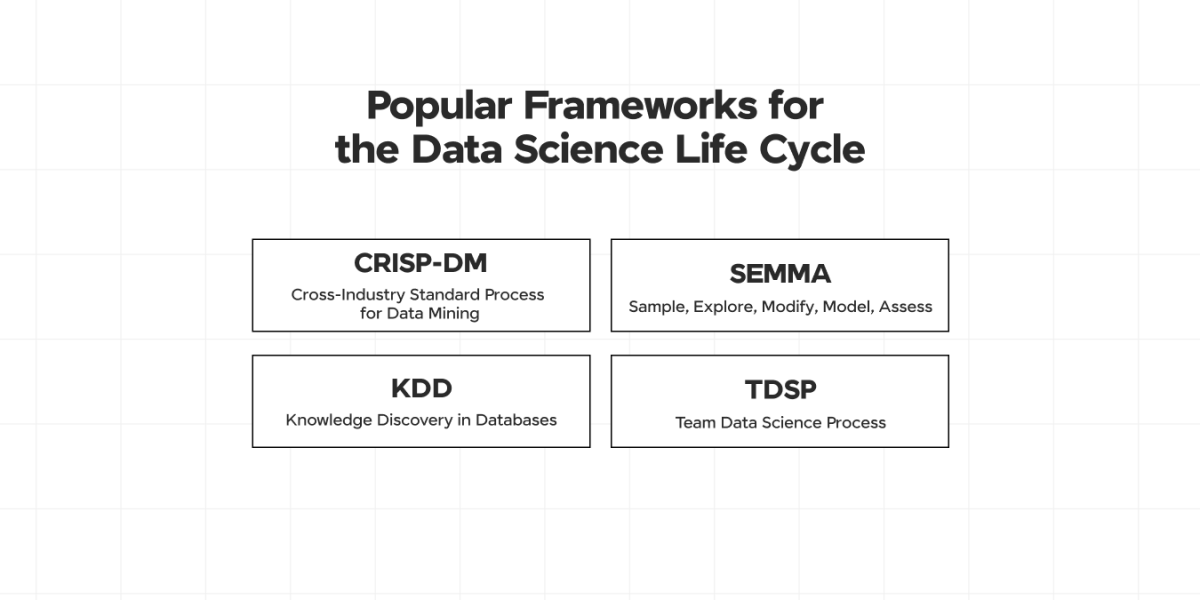
| Framework | Full Name | Key Focus | Best For |
|---|---|---|---|
| CRISP-DM | Cross-Industry Standard Process for Data Mining | Six-phase iterative process | Industry standard, most widely used |
| SEMMA | Sample, Explore, Modify, Model, Assess | Iterative modeling with SAS tools | SAS-based environments |
| KDD | Knowledge Discovery in Databases | Data preparation and mining emphasis | Research and academic projects |
| TDSP | Team Data Science Process | Collaborative team workflows | Enterprise and Microsoft Azure teams |
CRISP-DM remains the most widely adopted framework globally in 2026. Its six phases, Business Understanding, Data Understanding, Data Preparation, Modeling, Evaluation, and Deployment, map closely to the nine stages we covered above and are recognized by most enterprise data teams.
TDSP, created by Microsoft, has gained significant traction in India as more organizations adopt Azure-based data infrastructure. It adds project structure, standardized documentation, and built-in collaboration features on top of the CRISP-DM approach.
Tools Used Across the Data Science Life Cycle
Here is a complete reference of tools used across the data science life cycle :
| Stage | Popular Tools in 2026 |
|---|---|
| Problem Definition | Confluence, Notion, Jira (for project planning) |
| Data Collection | SQL, Python (requests, BeautifulSoup), Apache Kafka, Airflow |
| Data Cleaning | Pandas, NumPy, OpenRefine, dbt |
| EDA | Matplotlib, Seaborn, Plotly, Tableau, PowerBI |
| Feature Engineering | Scikit-learn, FeatureTools, AutoML tools |
| Modeling | Scikit-learn, TensorFlow, PyTorch, XGBoost, LightGBM |
| Model Evaluation | Scikit-learn metrics, MLflow, Neptune.ai |
| Deployment | FastAPI, Docker, AWS SageMaker, Google Vertex AI |
| Monitoring | Evidently AI, Arize AI, Grafana, Prometheus |
Members involved in the Data Science Life cycle
Data science projects typically involve a variety of roles, each contributing unique expertise:
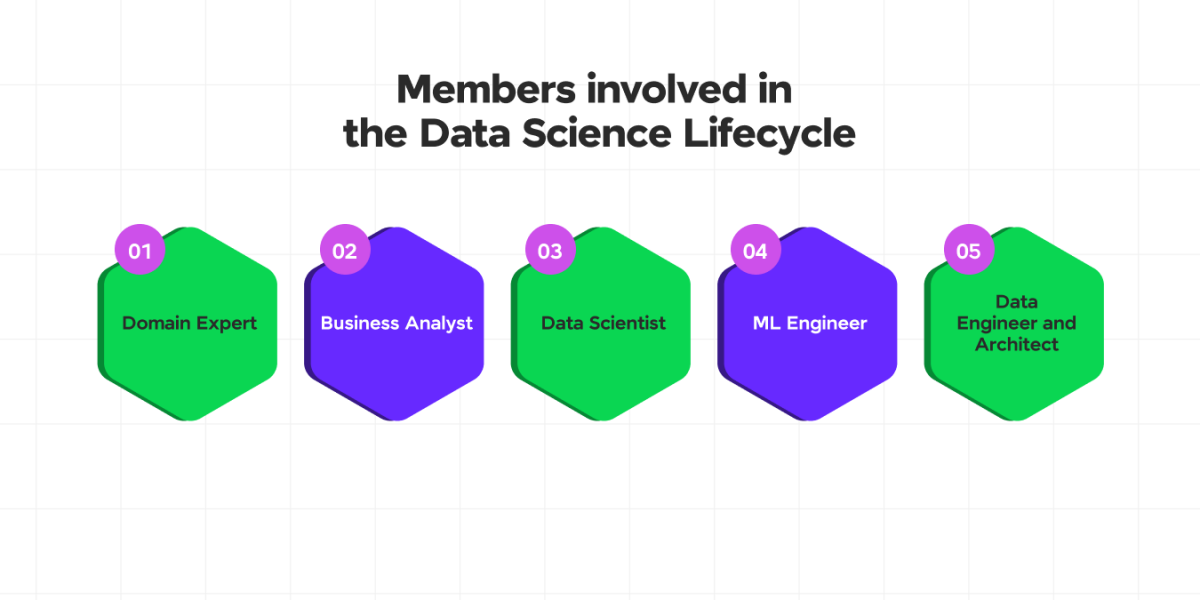
- Data Scientists: They are responsible for data analysis, modeling, and deriving actionable insights.
- Data Engineers: They handle the data pipeline, ensuring data is collected, stored, and made accessible for analysis.
- Business Analysts: They bridge the gap between technical teams and business stakeholders, translating business needs into technical requirements.
- Domain Experts: They help in providing subject matter expertise to ensure the data science solutions are relevant and accurate for the specific field.
- Project Managers: They oversee the project’s progress, manage timelines, and coordinate between different team members.
Also, work on some great Data Science Course using the steps involved in the data science life cycle to achieve an error-free application.
Kickstart your Data Science journey by enrolling in HCL GUVI’s Data Science Course where you will master technologies like MongoDB, Tableau, PowerBI, Pandas, etc., and build interesting real-life projects.
Alternatively, if you would like to explore Python through a Self-paced course, try HCL GUVI’s Python Certification course.
Real-World Example: Data Science Life Cycle in Action
To make all of this concrete, here is how a real e-commerce company might apply the entire data science life cycle to one business problem:
Business Goal: Reduce customer churn by identifying customers likely to stop purchasing.
| Stage | What Actually Happens |
|---|---|
| Problem Definition | Define churn as “no purchase in 90 days.” Set success metric as 15% churn reduction. |
| Data Collection | Pull 2 years of transaction history, login data, support tickets, and email open rates. |
| Data Cleaning | Remove duplicate records, fill missing demographics, standardize date formats. |
| EDA | Discover that customers who contact support 3+ times churn at 2x the average rate. |
| Feature Engineering | Create features like “days since last purchase,” “average order value,” “support ticket count.” |
| Modeling | Train a gradient boosting classifier (XGBoost) to predict churn probability. |
| Model Evaluation | Achieve AUC-ROC of 0.87. Validate with 5-fold cross-validation. |
| Deployment | Deploy model as an API that scores customers daily and flags high-risk accounts. |
| Monitoring | Track churn rate monthly. Retrain every quarter with fresh transaction data. |
💡 Did You Know?
- CRISP-DM, one of the most widely used data science frameworks, was introduced in 1996 and is still considered an industry standard in 2026.
- The global data science platform market was valued at roughly USD 96 billion in 2023 and is projected to reach around USD 471 billion by 2030, growing at a CAGR of approximately 26%, according to Grand View Research.
Common Mistakes in the Data Science Life Cycle
- Skipping or rushing problem definition. Jumping straight into data collection without a clearly agreed business objective is one of the most common reasons projects fail to deliver value that stakeholders actually wanted.
- Treating data cleaning as a quick step. Since it typically consumes 60-80% of project time, underestimating it in project timelines is a near-guaranteed way to blow deadlines.
- Building models before finishing EDA. Jumping to modeling without properly understanding the data’s patterns and quirks often produces models that look fine on paper but fail on real-world data.
- Evaluating models on a single metric. Relying only on accuracy, for instance, can hide serious problems on imbalanced datasets where precision and recall matter more.
- Deploying without a monitoring plan. A model that performs well at launch can silently degrade due to model drift; skipping this final stage is one of the most costly mistakes in the entire life cycle.
Conclusion
This guide has clearly explained the steps required in the data science life cycle and guides data scientists from problem definition to solution deployment and monitoring. You would also have learned about popular frameworks used to streamline the process in the data science life cycle. Also, the stakeholders or members needed to perform the operation and complete the project efficiently.
FAQs
1. What are the 9 stages of the data science life cycle?
The nine stages are problem definition, data collection, data cleaning and preparation, exploratory data analysis, feature engineering, modeling, model evaluation, deployment, and monitoring and maintenance.
2. What is the most time-consuming stage in the data science life cycle?
Data cleaning and preparation is the most time-consuming stage, typically taking up 60 to 80% of a data scientist’s total project time.
3. What is the difference between the data science life cycle and the machine learning lifecycle?
The data science life cycle covers the full journey from business problem to deployed insight, including stakeholder communication. The ML lifecycle is narrower, focusing specifically on data prep, training, and validating a single model.
4. Which framework is most widely used for the data science life cycle?
CRISP-DM (Cross-Industry Standard Process for Data Mining) remains the most widely adopted framework globally, with its six phases mapping closely to the nine stages of the data science life cycle.
5. What are the 5 phases of the data science life cycle?
A common five-phase view groups the nine stages into: Problem Definition, Data Collection and Preparation, Data Exploration and Analysis, Model Building and Evaluation, and Deployment and Maintenance.
Success Stories

About the Author
Jebasta
I translate the language of data into stories that anyone can understand. As a writer with a data science background, I simplify analytics, AI, and decision-making so beginners and enthusiasts can confidently explore the world of data.
View all posts by Jebasta
Connect with me @











Did you enjoy this article?