


Data Analysis Articles
BPO Experience for Data Analyst Jobs Does It Count When Applying? - Best Guide
Can a BPO Team Leader Become a Data Analyst?
BPO vs Data Analyst Salary in India: What Changes After the Switch?
How to Switch From BPO to Data Analytics in 2026: Best Skills, Roadmap & Jobs


Get In Touch For Details! Request More Information
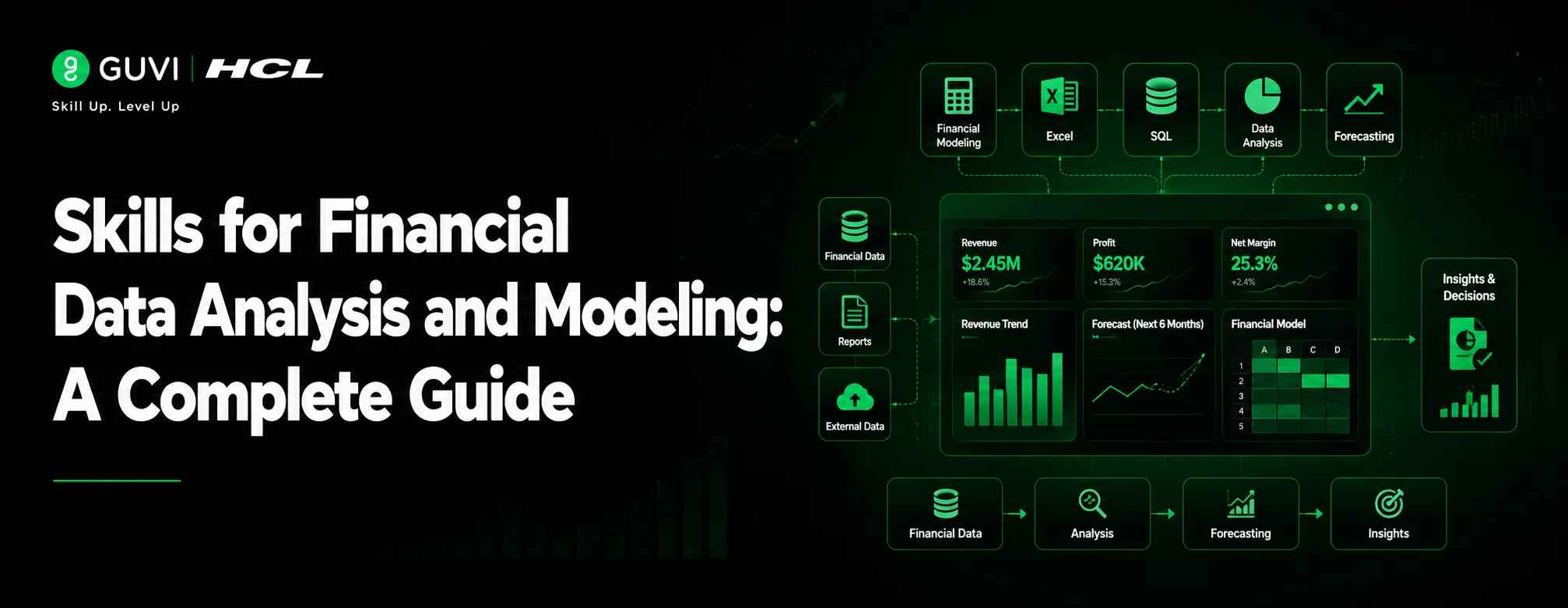
Skills for Financial Data Analysis and Modeling: A Complete Guide
Sep 08, 2026 4 Min Read 1383 Views
(Last Updated)
Table of contents
- TL;DR Summary Box
- Quick Answer
- What Does Financial Data Analysis Actually Involve?
- Core Technical Skills
- Excel (Still, Genuinely, Non-Negotiable)
- SQL
- Statistics and Forecasting
- Python or R (Increasingly Common, Not Always Required)
- Financial Domain Knowledge You Can't Skip
- Reading Financial Statements
- Core Financial Ratios
- Valuation Basics
- Regulatory and Reporting Awareness
- Soft Skills That Matter More Than People Expect
- Tools of the Trade
- A Step-by-Step Path to Build These Skills
- Financial Analyst vs. General Data Analyst
- Common Mistakes Beginners Make
- What to Do Next
- Conclusion
- FAQs
- Q: Do I need a finance degree to become a financial data analyst?
- Q: Is Python necessary for financial data analysis?
- Q: What certification is most useful for corporate finance roles?
- Q: How is this different from a general data analyst role?
- Q: What's a good first project to build a portfolio?
TL;DR Summary Box
- Financial data analysts need a mix of spreadsheet modeling, SQL, statistics, and financial statement literacy.
- Excel remains the single most-used tool in finance roles, even alongside newer tools like Python.
- Understanding core financial concepts (ratios, valuation basics, forecasting) matters as much as technical tool skills.
- Certifications like CFA or FMVA can strengthen a candidacy but aren’t always required to start.
- Communication skills are critical most financial analysis exists to inform a decision someone else will make.
Quick Answer
Financial data analysis skills combine technical ability and financial literacy: spreadsheet modeling (Excel), SQL for pulling data from financial systems, statistical analysis for forecasting and risk assessment, and a working understanding of financial statements and valuation concepts. Strong analysts also need to communicate findings clearly to non-technical stakeholders like executives or clients.
What Does Financial Data Analysis Actually Involve?
Here’s a question worth sitting with: when a company decides whether to open a new location, cut a budget line, or raise prices, who actually crunches the numbers behind that decision?
Usually, it’s a financial data analyst.
The role covers building models that forecast revenue, analyzing variance between budgeted and actual spending, and turning raw transaction data into something a CFO or department head can act on.
💡 Pro Tip: Job titles vary wildly in this space “Financial Analyst,” “FP&A Analyst,” “Business Analyst,” and “Financial Data Analyst” often describe overlapping work. Read the actual responsibilities in a posting, not just the title.
Core Technical Skills
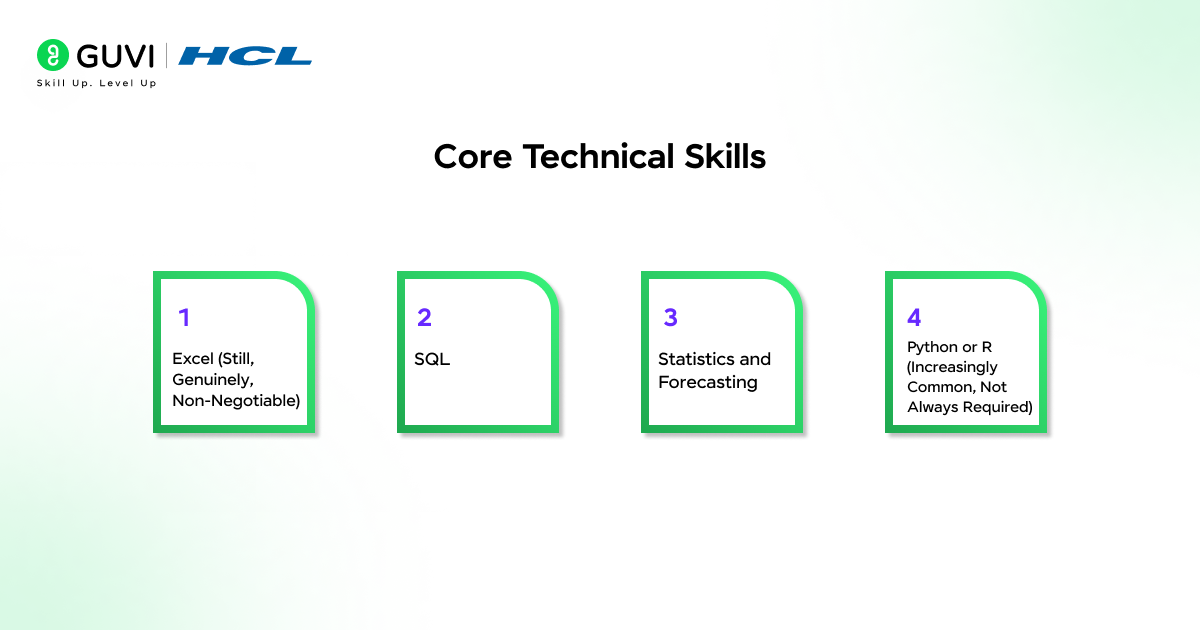
1. Excel (Still, Genuinely, Non-Negotiable)
Despite the rise of Python and BI tools, Excel remains the backbone of financial modeling. Pivot tables, VLOOKUP/XLOOKUP, and building three-statement models are baseline expectations in most finance-adjacent roles.
2. SQL
Financial data usually lives in transaction systems or data warehouses. Being able to pull and join data yourself rather than waiting on someone else is a major efficiency advantage.
3. Statistics and Forecasting
Understanding trend analysis, regression basics, and variance analysis lets you build forecasts that hold up to scrutiny, rather than just extending last year’s numbers by a flat percentage.
4. Python or R (Increasingly Common, Not Always Required)
For more advanced modeling like Monte Carlo simulations for risk analysis Python’s pandas and numpy libraries are increasingly common, particularly in larger organizations or roles closer to quantitative finance.
Despite the rapid adoption of Python and AI-powered analytics tools, Microsoft Excel remains the most widely used tool for financial modeling, budgeting, forecasting, and FP&A. Most finance roles still expect strong Excel skills alongside SQL and modern data visualization tools like Power BI or Tableau.
Financial Domain Knowledge You Can’t Skip
This is where financial data analysis differs from general data analytics and it’s often underestimated by people coming from a pure tech background.
Reading Financial Statements
You need to comfortably read an income statement, balance sheet, and cash flow statement, and understand how they connect to each other.
Core Financial Ratios
Metrics like gross margin, current ratio, and return on equity show up constantly in analysis work. Knowing what they mean and what a “good” number looks like in context matters more than memorizing formulas.
Valuation Basics
Even analysts who don’t do formal valuation work benefit from understanding concepts like discounted cash flow and how a company’s numbers translate into perceived value.
Regulatory and Reporting Awareness
Depending on the industry, you may need familiarity with GAAP or IFRS reporting standards, and general awareness of compliance requirements around financial data handling.
⚠️ Warning: Don’t assume strong Excel or SQL skills alone qualify you for financial analysis roles. A technically clean model built on a misunderstood financial concept can produce a confidently wrong answer which is worse than an obviously incomplete one.
Soft Skills That Matter More Than People Expect
- Translating numbers into a narrative a model means nothing if a decision-maker can’t act on it.
- Attention to detail, since small errors in financial models compound quickly.
- Comfort with ambiguity, since financial forecasting always involves incomplete information.
- Stakeholder communication, particularly explaining assumptions behind a forecast, not just the output.
Best Practice: In interviews, be ready to walk through a time you had to defend an assumption in a model. This comes up often because financial analysis is as much about justified judgment calls as it is about calculation.

Tools of the Trade
| Category | Common Tools | Priority for Beginners |
|---|---|---|
| Spreadsheets/Modeling | Excel, Google Sheets | High |
| Database Querying | SQL (PostgreSQL, SQL Server) | High |
| Visualization | Power BI, Tableau | Medium |
| Programming | Python, R | Medium |
| ERP/Financial Systems | SAP, NetSuite, QuickBooks | Medium (often role-dependent) |
| Statistical Software | SPSS, SAS | Lower (role-dependent) |
A Step-by-Step Path to Build These Skills
- Master Excel modeling fundamentals. Learn pivot tables, lookup functions, and how to build a basic three-statement model.
- Learn SQL. Even basic querying ability sets you apart from candidates who rely entirely on pre-built reports.
- Study core financial concepts. Financial statements, key ratios, and basic valuation this is the domain knowledge layer.
- Practice with real (public) financial data. SEC EDGAR filings and public company financial statements are free and realistic practice material.
- Build a portfolio project. For example, a three-statement model or valuation analysis of a public company, with your assumptions clearly documented.
- Consider a certification based on your target role FMVA for corporate finance/FP&A, CFA for investment-focused paths.
Financial Analyst vs. General Data Analyst
| Factor | Financial Data Analyst | General Data Analyst |
|---|---|---|
| Domain Knowledge Required | High (financial statements, ratios, valuation) | Varies by industry |
| Core Tool | Excel-centric | Varies (often BI tools) |
| Typical Deliverable | Models, forecasts, variance analysis | Dashboards, reports |
| Entry Barrier | Moderate (finance literacy required) | Lower |
| Career Path | Often ties to FP&A, investment, or corporate finance tracks | Broader across industries |
Common Mistakes Beginners Make
- Over-relying on Excel while neglecting SQL, which limits your ability to work independently with larger datasets.
- Building technically impressive models without clearly documenting assumptions this undermines trust with stakeholders.
- Treating financial concepts as secondary to technical skills, when in practice they’re equally weighted by employers.
What to Do Next
If you’re starting out, focus first on Excel modeling and core financial statement literacy these show up in nearly every posting. Layer in SQL next, then build one portfolio project using real public financial data, like an SEC filing, so you have something concrete to discuss in interviews.
If you want to learn more about data science related domains like this and its functionalities in the real world, then consider enrolling in HCL GUVI’s Certified Data Science Course which not only gives you theoretical knowledge but also practical knowledge with the help of real-world projects.
Conclusion
Financial data analysis is much more than building spreadsheets or running calculations—it’s about turning financial information into insights that drive better business decisions. While tools like Excel, SQL, Power BI, and Python are valuable, they deliver the most impact when combined with a solid understanding of financial statements, forecasting, valuation, and business context. By mastering both technical and financial skills, building real-world portfolio projects, and continuously improving your communication abilities, you can position yourself for a successful career as a financial data analyst in 2026 and beyond
FAQs
Q: Do I need a finance degree to become a financial data analyst?
A: No, but you’ll need to build financial statement literacy and core concept knowledge alongside your technical skills if you’re coming from a different background.
Q: Is Python necessary for financial data analysis?
A: Not always at entry level. Excel and SQL are more consistently required, with Python becoming more relevant in senior or quantitative-leaning roles.
Q: What certification is most useful for corporate finance roles?
A: FMVA is popular for corporate finance and FP&A paths, while CFA is more relevant if you’re aiming toward investment-focused roles.
Q: How is this different from a general data analyst role?
A: The technical skills overlap significantly, but financial analysts also need to understand financial statements, ratios, and valuation concepts that general roles don’t require.
Q: What’s a good first project to build a portfolio?
A: Build a three-statement model or basic valuation analysis using a public company’s SEC filings, documenting your assumptions clearly.
Success Stories

About the Author
Vishalini Devarajan
An Aerospace Engineer turned content writer, I focus on making complex concepts easy to understand through well-structured, reader-friendly blogs. Whether it’s a technical topic or a non-technical one, I love creating content that is clear, engaging, and impactful.
View all posts by Vishalini Devarajan
Connect with me @













Did you enjoy this article?