


Data Analysis Articles
BPO Experience for Data Analyst Jobs Does It Count When Applying? - Best Guide
Can a BPO Team Leader Become a Data Analyst?
BPO vs Data Analyst Salary in India: What Changes After the Switch?
How to Switch From BPO to Data Analytics in 2026: Best Skills, Roadmap & Jobs


Get In Touch For Details! Request More Information
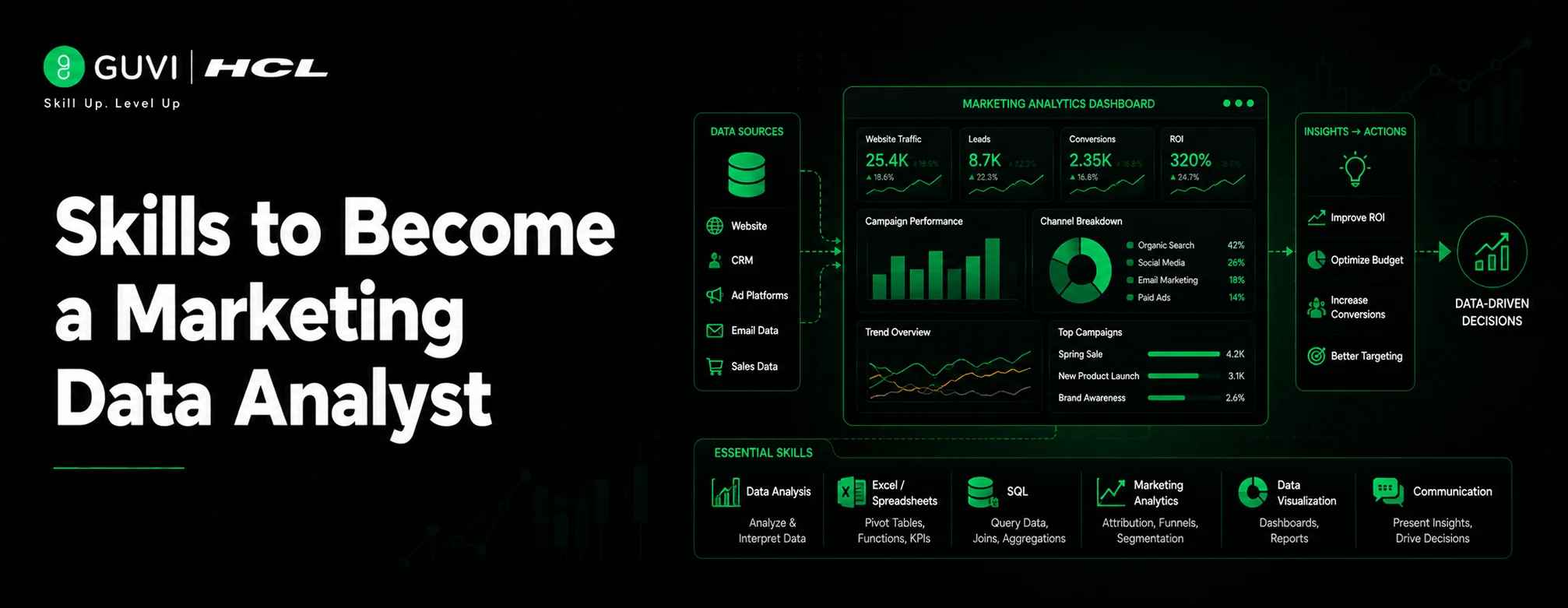
Skills to Become a Marketing Data Analyst in 2026
Jul 22, 2026 4 Min Read 880 Views
(Last Updated)
Table of contents
- TL;DR Summary
- What Does a Marketing Data Analyst Do?
- Core Technical Skills You Need
- SQL for Data Querying
- Python or R for Data Analysis
- Data Visualisation Tools
- Google Analytics and Marketing Platforms
- Statistical and Analytical Skills
- Understanding Statistics Is Not Optional
- Marketing Domain Knowledge
- Soft Skills That Actually Matter
- Communication and Storytelling
- Critical Thinking and Problem Framing
- Common Mistakes Beginners Make
- Conclusion
- FAQs
- What is a marketing data analyst?
- What skills are required to become a marketing data analyst?
- Is coding necessary to become a marketing data analyst?
- Can I become a marketing data analyst without a marketing degree?
- What tools does a marketing data analyst use daily?
- How long does it take to learn the skills for this role?
- What is the difference between a data analyst and a marketing data analyst?
- Is AI knowledge required for this role in 2026?
TL;DR Summary
A marketing data analyst collects, interprets, and translates campaign and customer data into actionable business decisions. To succeed in this role, you need a combination of technical skills like SQL, Python, and data visualisation, along with marketing knowledge, statistical thinking, and strong communication.
The role has seen a 127% increase in job postings since 2020, making it one of the fastest-growing positions in the marketing space. If you are looking to build a career at the intersection of data and marketing, this guide covers every skill you need to get started.
What Does a Marketing Data Analyst Do?
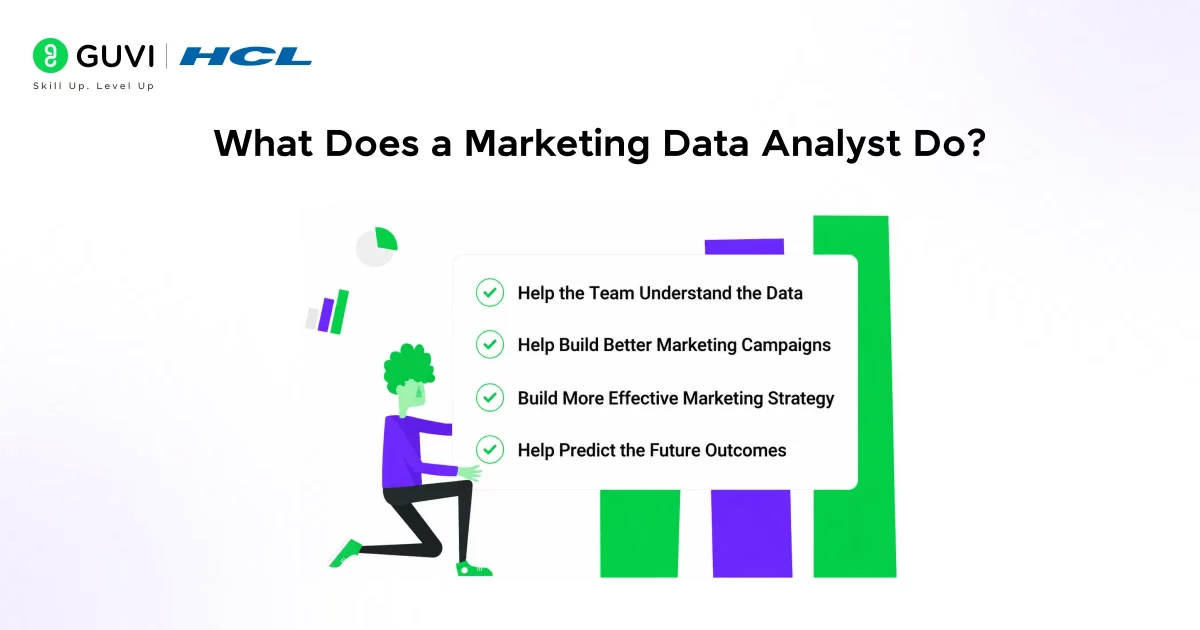
A marketing analyst is responsible for collecting, analysing, and interpreting data to help businesses make informed marketing decisions. They track consumer behaviour, market trends, and campaign performance to determine what strategies are working and where improvements can be made.
Think of it this way: every ad campaign, email blast, or social media push generates a flood of data. Your job as a marketing data analyst is to make sense of that flood and tell the business what to do next.
The daily focus typically involves analysing campaign metrics, creating dashboards, identifying trends, and recommending optimisations. It is equal parts technical work and strategic communication.
Core Technical Skills You Need
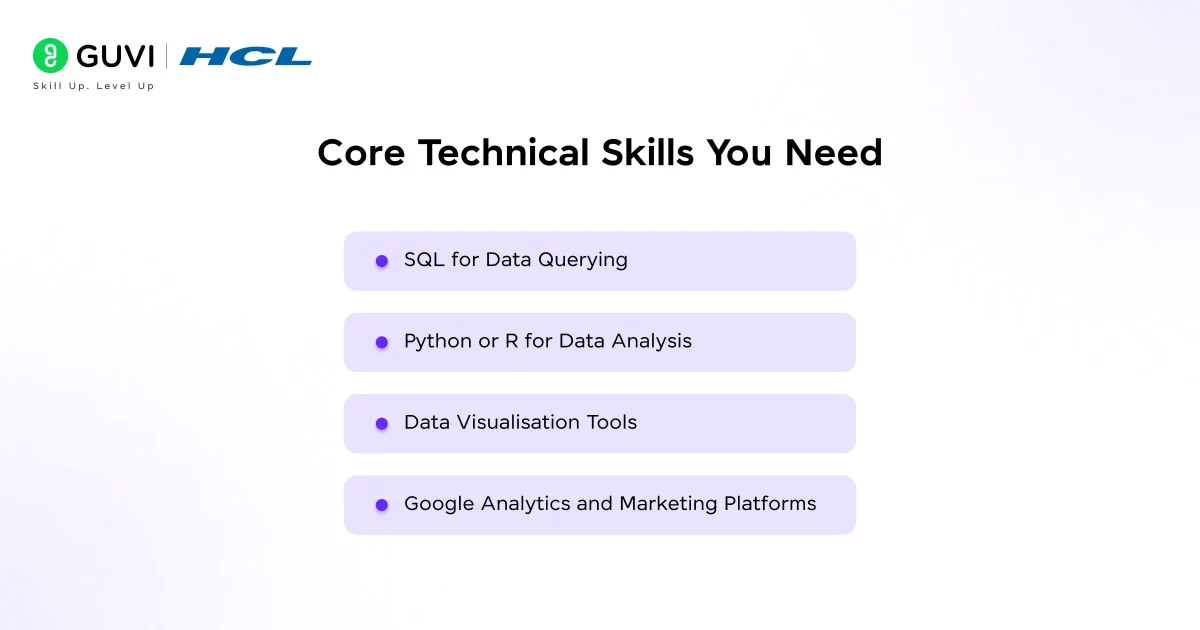
1. SQL for Data Querying
SQL is non-negotiable for this role. SQL is the language of databases and is arguably the most important technical skill for analysts. It allows you to efficiently query and manage large datasets across multiple systems, something Excel cannot do at scale.
As a marketing data analyst, you will use SQL to pull campaign performance data, customer segment records, and conversion metrics directly from databases. Start with basic queries, then move to joins, aggregations, and subqueries.
2. Python or R for Data Analysis
Once you are comfortable with SQL, picking up Python becomes your next priority. Python is versatile for automation and integration, while R excels in statistical analysis. Python is more in demand for job postings in 2026.
For marketing analytics specifically, Python libraries like Pandas and NumPy help you clean and manipulate data efficiently. You do not need to be a software developer level programmer; working knowledge is enough to give you a strong edge.
3. Data Visualisation Tools
Raw numbers rarely convince stakeholders. You need to present your findings visually. Skills in platforms like Tableau and Power BI help you translate data into clear, actionable visual reports.
The most effective marketing analysts build dashboards that non-technical teams can use independently. A dashboard is not just a fancy chart. Beyond visualisations, analysts need to build dashboards and reports that allow stakeholders to interact with data.
Key tools to learn:
- Tableau
- Power BI
- Google Looker Studio
- Excel (still widely used for quick reporting)
4. Google Analytics and Marketing Platforms
This is where marketing data analytics separates itself from general data analytics. Marketing analysts use tools like Google Analytics, CRM software, and statistical models to provide insights that guide marketing teams in optimising advertising, pricing, and product positioning.
Hands-on familiarity with platforms like Google Analytics 4, Meta Ads Manager, HubSpot, and Salesforce is expected in most job roles. These tools generate the raw campaign data you will be working with daily.
Statistical and Analytical Skills
Understanding Statistics Is Not Optional
You do not need a master’s degree in statistics, but you do need a working understanding of core concepts. Knowledge of statistics including descriptive statistics, experiment design, and regression analysis is among the core skills a marketing data analyst needs to have.
In practice, this means understanding:
- A/B testing and experiment design
- Correlation vs. causation
- Regression analysis for forecasting
- Hypothesis testing for campaign validation
Strong statistical analysis knowledge separates analysts who report numbers from those who generate insights. Skills like regression, correlation, hypothesis testing, and A/B testing help you interpret trends accurately.
Marketing Domain Knowledge
Here is something a lot of beginners overlook. Understanding data tools is only half the job. You also need to understand what the data is measuring. A solid grasp of marketing fundamentals including campaign strategy, segmentation, and performance metrics is essential for a marketing data analyst.
Key marketing concepts you should be familiar with include:
- Customer Lifetime Value (CLV)
- Return on Ad Spend (ROAS)
- Conversion rate optimisation
- Funnel analysis
- Customer segmentation
Soft Skills That Actually Matter
Communication and Storytelling
The capacity to explain complex data insights to non-technical stakeholders and contribute to collaborative decision-making is one of the most important skill areas for this role.
You might build the most accurate dashboard in the company, but if you cannot explain what it means to a marketing manager, your work loses its value. Practice translating technical findings into plain business language.
Critical Thinking and Problem Framing
Before you analyse anything, you need to ask the right question. Good marketing data analysts do not just answer what happened. They investigate why it happened and what the business should do about it.

Project management is also increasingly important. Marketing analysts often lead complex efforts to work with data, sometimes across different teams.
Common Mistakes Beginners Make
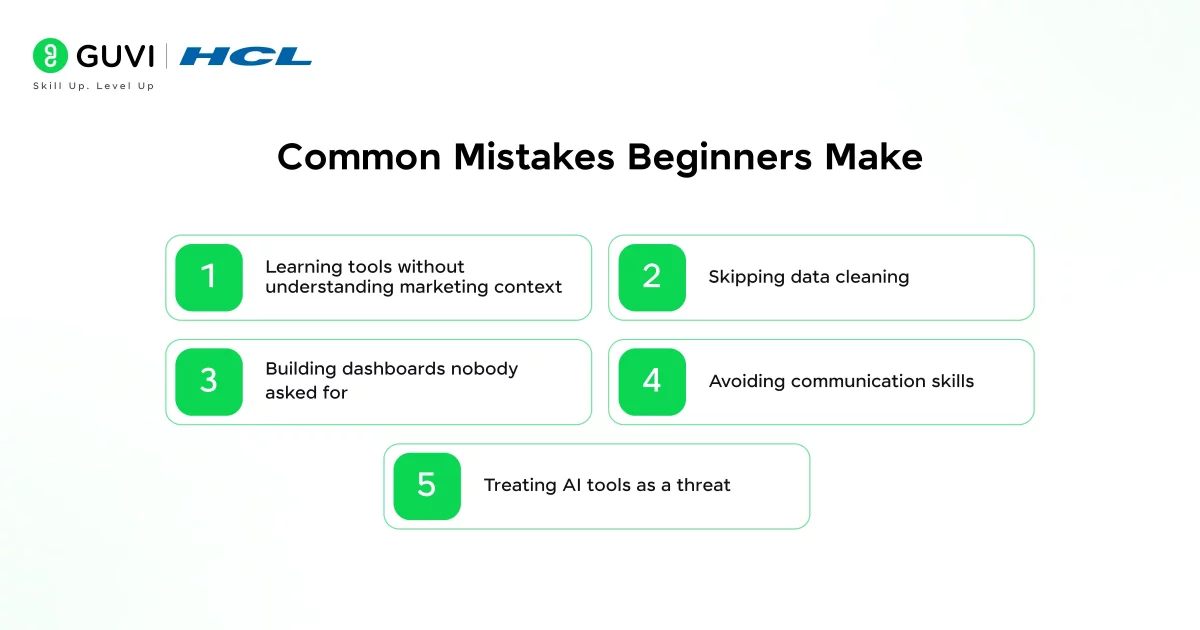
1. Learning tools without understanding marketing context: Many beginners focus entirely on SQL and Python but do not understand what metrics like CTR, ROAS, or CAC actually mean. Without that context, your analysis lacks direction.
2. Skipping data cleaning: Data rarely comes perfect. Cleaning and transforming datasets, removing duplicates, handling missing values, and standardising formats are often the most time-consuming but essential parts of the job. Do not underestimate this step.
3. Building dashboards nobody asked for: A beautiful dashboard that does not answer a business question is wasted effort. Always start with the question, then build the visual.
4. Avoiding communication skills: Technical analysts who cannot present findings clearly often get overlooked for senior roles. Practice writing clear summaries of your analysis.
5. Treating AI tools as a threat: AI is changing the role, not replacing it. The rise of AI and machine learning has elevated rather than replaced the marketing data analyst role, with analysts now spending less time on data preparation and more time on strategic analysis and storytelling with data.
If you want to learn more about data science related domains like this and its functionalities in the real world, then consider enrolling in HCL GUVI’s Certified Data Science Course which not only gives you theoretical knowledge but also practical knowledge with the help of real-world projects.
Conclusion
The marketing data analyst role sits at a high-value intersection of two fast-growing fields: marketing and data. Success in this role requires a blend of technical skills like SQL, BI tools, and statistical software alongside soft skills including analytical thinking, communication, and business acumen. Start by building your SQL foundation, then layer in Python basics, a visualisation tool of your choice, and Google Analytics.
Pair that with genuine marketing curiosity and the ability to communicate clearly, and you will be well ahead of most candidates entering this field in 2026.
FAQs
What is a marketing data analyst?
A marketing data analyst collects, processes, and interprets campaign and customer data to help businesses make better marketing decisions. They work with tools like SQL, Python, Google Analytics, and Tableau to turn raw data into actionable insights.
What skills are required to become a marketing data analyst?
The core skills include SQL for data querying, Python or R for analysis, data visualisation tools like Tableau or Power BI, statistical knowledge, Google Analytics, and strong communication skills. Marketing domain knowledge is equally important.
Is coding necessary to become a marketing data analyst?
Yes, to a working degree. SQL is essential and Python is highly recommended. You do not need to be a software engineer, but comfort with data querying and scripting will significantly expand what you can do in the role.
Can I become a marketing data analyst without a marketing degree?
What tools does a marketing data analyst use daily?
Common tools include SQL databases, Python, Google Analytics 4, Tableau, Power BI, Excel, Meta Ads Manager, HubSpot, and Salesforce. The exact stack varies by company and industry.
How long does it take to learn the skills for this role?
With structured learning and consistent practice, most beginners can become job-ready in 6 to 12 months. Starting with SQL and Google Analytics, then moving to Python and visualisation tools, is the most practical sequence.
What is the difference between a data analyst and a marketing data analyst?
A general data analyst works across business functions like operations, finance, or product. A marketing data analyst specialises in campaign performance, customer behaviour, and marketing metrics. The technical skills overlap, but the domain knowledge differs significantly.
Is AI knowledge required for this role in 2026?
Increasingly, yes. Familiarity with generative AI tools for automating reporting tasks, writing test variants, or analysing large datasets is now seen as a competitive advantage in most hiring processes.
Success Stories

About the Author
Lukesh S
A professional content writer who has experience in freelancing and now working as a Technical Content Writer at HCL GUVI having sound knowledge in Blog Writing and Creative Writing!
View all posts by Lukesh S
Connect with me @













Did you enjoy this article?