


Data Analysis Articles
Accountant vs Data Analyst Salary in India After Switching Careers - Best Guide
Insurance Claims Executive to Data Analyst: Is It a Good Switch?
Banking Executive (Loans, KYC) to Data Analyst: Skills and Career Path
BPO Fresher: Switch to Data Analytics Now or Gain More Experience First?


Get In Touch For Details! Request More Information
Data Analyst Roles and Responsibilities in 2026: Skills, Tools & Career Insights
Jul 08, 2026 7 Min Read 7222 Views
(Last Updated)
TL;DR
- A Data Analyst collects, cleans, analyses, and interprets data to help businesses make smarter decisions.
- They use tools like SQL, Python, Excel, Power BI, and Tableau to find trends, create dashboards, and deliver insights.
- Key responsibilities include data collection, data cleaning, analysis, visualisation, reporting, and stakeholder collaboration.
- Essential skills in 2026 include SQL, Python, Excel, statistics, data visualisation, AI tools, and communication skills.
- Common tools used by analysts include SQL databases, Pandas, NumPy, Power BI, Tableau, Jupyter, ChatGPT, and cloud data platforms.
- Data analyst roles exist across industries like Finance, Healthcare, E-commerce, SaaS, Banking, and Manufacturing.
- In India, data analyst salaries range from around ₹4–7 LPA for freshers to ₹25+ LPA for experienced professionals.
- Career growth path: Junior Analyst → Data Analyst → Senior Analyst → Analytics Lead/Manager → Director of Analytics.
- AI is transforming analytics by helping with SQL generation, report automation, data cleaning, and faster insights.
- Data analytics remains a high-demand career in 2026 due to increasing data needs and the growing importance of AI-driven decision-making.
In today’s data-driven world, businesses generate massive amounts of information every second, but data alone has no value unless someone can turn it into meaningful insights. This is where Data Analysts play a crucial role.
A Data Analyst transforms raw data into actionable business decisions by collecting, cleaning, analysing, and visualising information. From identifying customer trends and improving products to helping companies reduce costs and increase revenue, their work directly influences business strategies.
In 2026, the role of a Data Analyst has evolved beyond traditional reporting. With the rise of AI tools, automation, and advanced analytics platforms, analysts are becoming faster, smarter, and more involved in strategic decision-making.
This guide covers everything you need to know about a Data Analyst career, including roles and responsibilities, essential skills, tools, salary expectations in India, career growth, and how AI is reshaping the future of analytics.
Table of contents
- What is a Data Analyst?
- What Are the Core Roles and Responsibilities of a Data Analyst?
- What Skills Does a Data Analyst Need in 2026?
- Soft Skills
- What Tools Do Data Analysts Use in 2026?
- What Are the Different Types of Data Analysts?
- Types of Data Analysts
- What is the Salary of a Data Analyst in India in 2026?
- Salary by Experience Level
- Salary by City
- Companies Paying Above Average
- What is the Career Path for a Data Analyst?
- Career Path Timeline
- How is AI Changing the Data Analyst Role in 2026?
- Data Analyst vs Data Scientist: What's the Difference?
- Data Analyst Job Description Template
- Is Data Analytics a Good Career in India in 2026?
- Common Mistakes Aspiring Data Analysts Make
- Ready to Start Your Data Analytics Journey?
- Conclusion
- Frequently Asked Questions
- What does a Data Analyst do?
- What is the salary of a Data Analyst in India in 2026?
- What skills are needed to become a Data Analyst?
- Is Data Analyst a good career in 2026?
- What tools do Data Analysts use?
- Can a fresher become a Data Analyst?
- How long does it take to learn Data Analytics?
- What is the difference between a Data Analyst and Data Scientist?
- What does a Data Analyst do daily?
- Which industries hire Data Analysts?
- How is AI changing the Data Analyst role?
- What is the role of SQL in Data Analytics?
- Do Data Analysts need to know coding?
- Can I become a Data Analyst without Python?
What is a Data Analyst?
A data analyst is a professional who collects, processes, and interprets large datasets to help businesses make informed decisions.
They use tools like SQL, Python, Power BI, and Excel to identify trends, build dashboards, and present insights to stakeholders. The role sits between raw data and business strategy, translating numbers into action.
What Are the Core Roles and Responsibilities of a Data Analyst?
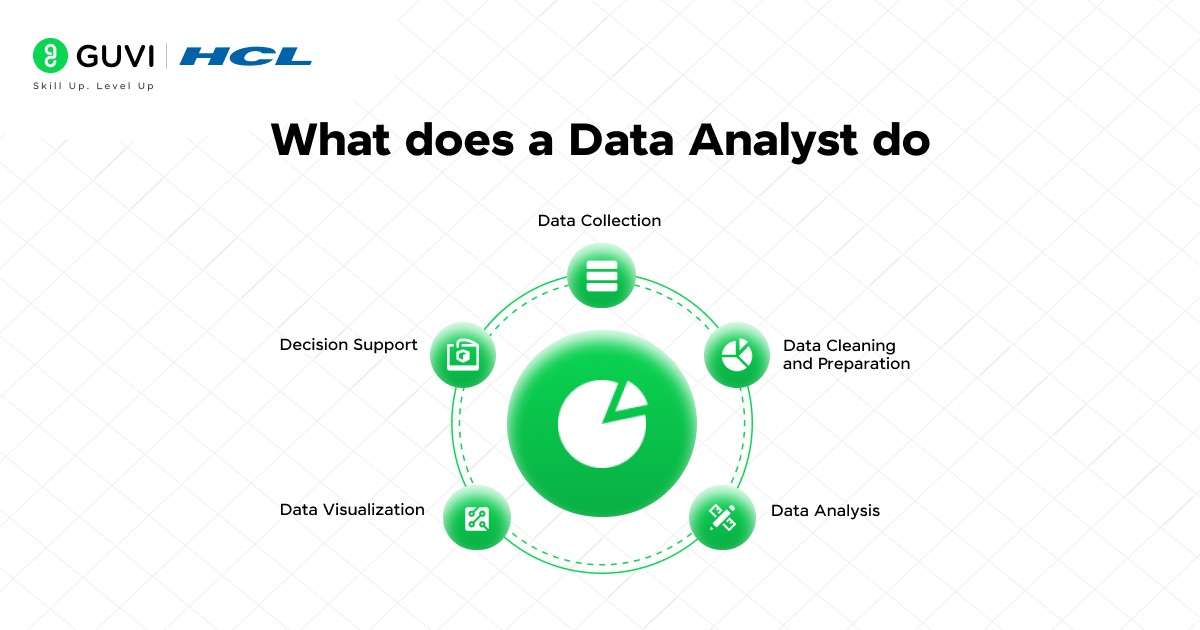
Data analysts wear many hats. Here are the six core responsibilities you’ll encounter in nearly every analyst job description:
1. Data Collection Analysts gather data from multiple sources, databases, APIs, spreadsheets, and third-party tools. They ensure the data is relevant, complete, and accessible before any analysis begins.
2. Data Cleaning Raw data is messy. Analysts remove duplicates, fix errors, handle missing values, and standardise formats. This step consumes roughly 60–80% of a typical analyst’s time.
3. Data Analysis Using statistical techniques and tools like Python or SQL, analysts identify patterns, correlations, and trends hidden inside the data.
4. Data Visualisation Analysts translate numbers into charts, dashboards, and reports using tools like Power BI and Tableau. The goal is to make insights accessible to non-technical stakeholders.
5. Reporting and Presentation Analysts present their findings to managers, product teams, or executives. Clear communication of insights and what to do about them is as important as the analysis itself.
6. Collaboration with Business Teams Analysts work closely with marketing, finance, product, and operations teams to understand the business problem before diving into data. Every analysis starts with a question.
What Skills Does a Data Analyst Need in 2026?
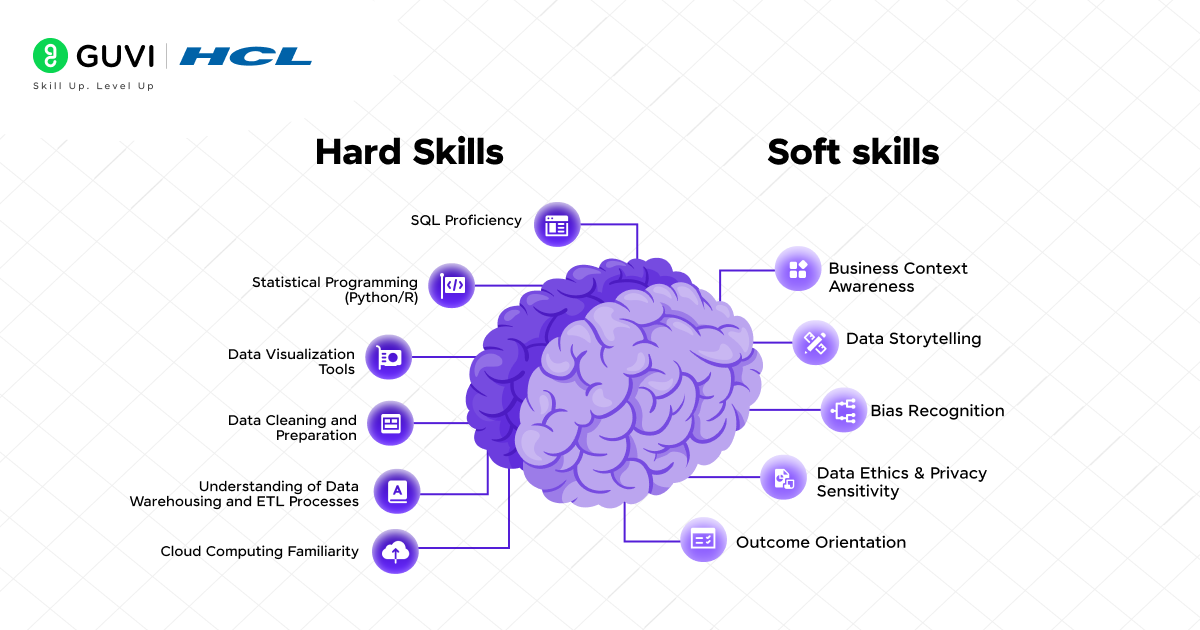
Data analyst skills fall into two categories: technical skills and soft skills. You need both to succeed.
Technical skills
| Skill | Why It Matters | Priority |
| SQL | Query databases; appears in 70%+ of job postings | Must-Have |
| Python | Data cleaning, analysis, automation | Must-Have |
| Excel / Google Sheets | Quick analysis, reporting, and pivots | Must-Have |
| Power BI / Tableau | Dashboard creation, data visualisation | Must-Have |
| Statistics | Hypothesis testing, regression, probability | Important |
| Data Cleaning | Handling null values, duplicates, and outliers | Must-Have |
| Machine Learning Basics | Predictive models, trend forecasting | Good to Have |
Soft Skills
| Skill | Why It Matters |
| Business Communication | Translating data into decisions for non-technical teams |
| Critical Thinking | Questioning assumptions, spotting flaws in data |
| Problem-Solving | Framing the right question before analysing |
| Attention to Detail | Catching errors in data before they cascade |
| Storytelling with Data | Making insights clear and compelling |
What Tools Do Data Analysts Use in 2026?
Here’s a quick reference of the tools most commonly used by data analysts today:
| Tool | Category | What Analysts Use It For | Skill Level |
| SQL | Database Querying | Extracting and filtering data from databases | Beginner–Intermediate |
| Python (Pandas, NumPy) | Programming | Data manipulation, automation, analysis | Intermediate |
| Excel / Google Sheets | Spreadsheet | Quick calculations, pivot tables, basic charts | Beginner |
| Power BI | Visualisation | Interactive dashboards for business reporting | Beginner–Intermediate |
| Tableau | Visualisation | Advanced data storytelling and visual analytics | Intermediate |
| Google Looker Studio | Visualisation | Web-based dashboards, often used with Google data | Beginner |
| Jupyter Notebook | Development | Writing and sharing Python analysis code | Intermediate |
| ChatGPT / Copilot | AI Assistant | Generating SQL queries, summarising data, and automating | Beginner |
| Julius AI | AI Analysis | Conversational data analysis without coding | Beginner |
| Google BigQuery / Snowflake | Cloud Data Warehouse | Querying large-scale enterprise datasets | Intermediate–Advanced |
What Are the Different Types of Data Analysts?
Not all data analyst roles are the same. The title varies across industries and company sizes.
| Type | Focus | Common Industries | Key Tools |
| Business Analyst | Business process improvement, KPI tracking | FMCG, Consulting, Finance | Excel, SQL, Power BI |
| Financial Analyst | Revenue, cost, and financial forecasting | Banking, FinTech, PE/VC | Excel, Python, Bloomberg |
| Marketing Analyst | Campaign performance, customer segmentation | E-commerce, SaaS, AdTech | GA4, SQL, Tableau |
| Operations Analyst | Supply chain, logistics, efficiency metrics | Manufacturing, Retail, Logistics | SQL, Power BI, ERP tools |
| Healthcare Analyst | Patient data, clinical outcomes, policy | Hospitals, Pharma, Health-tech | |
| Product Analyst | Feature performance, user behaviour, A/B testing | Tech, SaaS, Gaming | SQL, Amplitude, Mixpanel |
| Risk Analyst | Credit risk, fraud detection, compliance | Banking, Insurance | Python, SQL, SAS |
Each type shares the same core skill set: SQL, Python, and visualisation, but applies them to a different domain.
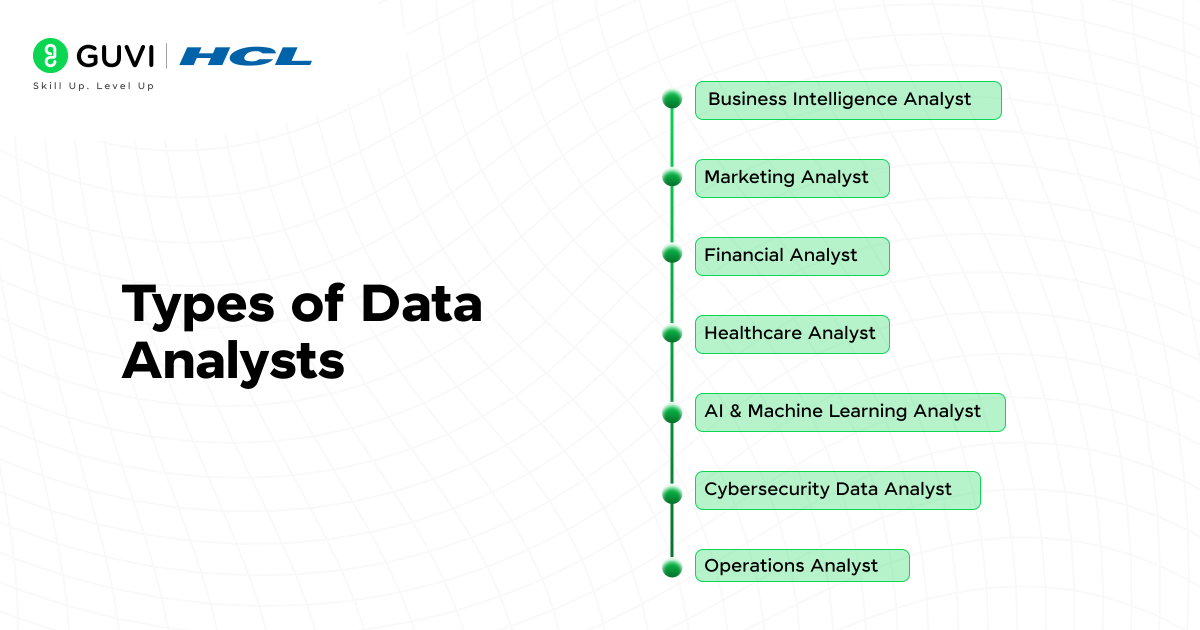
Types of Data Analysts
| Role | Focus | Industries | Role in Organization |
| Business Intelligence (BI) Analyst | Transforming data into actionable business insights. | Corporate strategy, e-commerce, and manufacturing | Analyzes data to drive business strategy and decisions. |
| Marketing Analyst | Analyzing consumer behavior and marketing campaign performance. | Tech, finance, autonomous systems, and AI marketing | Optimizes marketing efforts through data-driven insights. |
| Financial Analyst | Analyzing financial data to guide business decisions. | Banking, fintech, investment firms, insurance | Manages financial data to guide investment decisions. |
| Healthcare Analyst | Analyzing patient data and healthcare trends to improve outcomes. | Hospitals, insurance, biotech, pharmaceuticals | Provides insights to improve healthcare services and costs. |
| AI & Machine Learning Analyst | Analyzing AI models and datasets for machine learning accuracy. | Tech, finance, autonomous systems, AI marketing | Optimizes AI and machine learning systems. |
| Cybersecurity Data Analyst | Using data analysis to detect and prevent cyber threats. | Government, banking, IT security, cloud | Analyzes data to secure systems from cyber threats. |
| Operations Analyst | Analyzing processes to enhance operational efficiency. | Manufacturing, logistics, retail, supply chain | Identifies inefficiencies and optimizes operations. |
| Product Analyst | Evaluating product performance and user behavior. | Tech, consumer goods, SaaS | Guides product strategy with data-backed insights. |
What is the Salary of a Data Analyst in India in 2026?
Salary is one of the most searched topics in this space, and for good reason. Here’s a clear breakdown of what data analysts earn in India based on experience level.
Salary by Experience Level
| Experience Level | Salary Range (LPA) | Common Job Titles |
| Fresher (0–1 years) | ₹4 – ₹7 LPA | Junior Data Analyst, Data Analyst Trainee |
| Mid-Level (2–4 years) | ₹8 – ₹14 LPA | Data Analyst, Business Analyst |
| Senior (5–8 years) | ₹15 – ₹25 LPA | Senior Data Analyst, Lead Analyst |
| Analytics Manager (8+ years) | ₹25 – ₹45 LPA | Analytics Manager, Head of Data |
Salary by City
| City | Average Fresher Salary | Average Senior Salary |
| Bengaluru | ₹6 – ₹8 LPA | ₹18 – ₹28 LPA |
| Mumbai | ₹5.5 – ₹7.5 LPA | ₹16 – ₹26 LPA |
| Hyderabad | ₹5 – ₹7 LPA | ₹15 – ₹24 LPA |
| Delhi / NCR | ₹5 – ₹7 LPA | ₹15 – ₹23 LPA |
| Chennai | ₹4.5 – ₹6.5 LPA | ₹13 – ₹20 LPA |
| Pune | ₹4.5 – ₹6.5 LPA | ₹13 – ₹20 LPA |
Companies Paying Above Average
Top-paying companies hiring Data Analysts in India include:
- Amazon
- Flipkart
- Razorpay
- PhonePe
- Meesho
- Zomato
- Swiggy
- JPMorgan Chase
- Deutsche Bank
These companies offer competitive salaries due to high demand for professionals skilled in SQL, Python, analytics, business intelligence, and AI-driven data solutions.
What is the Career Path for a Data Analyst?
Career progression in data analytics is structured and well-defined. Here’s how most analysts grow over time:
Fresher → Junior Analyst (0–2 years) Focus on learning SQL, Excel, and basic Python. Work on data cleaning, report building, and dashboards. Build a portfolio with real datasets.
Junior → Mid-Level Analyst (2–4 years) Take ownership of recurring reports and business dashboards. Start working directly with business stakeholders. Begin exploring Python for automation.
Mid-Level → Senior Analyst (4–7 years) Lead analysis projects independently. Mentor juniors. Build complex models and deliver strategic recommendations to leadership.
Senior → Analytics Manager / Lead (7+ years): Manage a team of analysts. Define the data strategy for a department or product area. Collaborate with data engineers and data scientists on larger data initiatives.
Career Path Timeline
0–2 yrs → Junior / Associate Data Analyst
2–4 yrs → Data Analyst
4–7 yrs → Senior Data Analyst
7–10 yrs → Analytics Lead / Manager
10+ yrs → Director of Analytics / Chief Data Officer
Alternatively, many mid-level analysts pivot into Data Science, Data Engineering, or Product Management, all of which value the analytical foundation.
How is AI Changing the Data Analyst Role in 2026?
AI is not replacing data analysts; it is making them dramatically more productive.
Here are three concrete ways AI is reshaping the role right now:
1. Faster SQL and Python Code Generation Tools like ChatGPT and GitHub Copilot can now write basic SQL queries and Python scripts from plain English prompts. Analysts spend less time writing boilerplate code and more time interpreting results.
2. Automated Report Generation AI tools like Copilot in Excel and Power BI’s AI features can generate draft reports, summarise trends, and suggest visualisations automatically. What used to take two hours now takes twenty minutes.
3. Conversational Data Analysis Platforms like Julius AI and Google Gemini Advanced let analysts query their own datasets using plain English, no SQL required.
This is opening analytics work to non-technical team members, which actually increases demand for skilled analysts who can validate and contextualise those AI-generated insights.

Data Analyst vs Data Scientist: What’s the Difference?
This is one of the most common questions from students and career switchers. Here’s a clear side-by-side comparison:
| Parameter | Data Analyst | Data Scientist |
| Primary Goal | Explain what happened and why | Predict what will happen next |
| Key Tools | SQL, Excel, Power BI, Tableau, Python | Python, R, TensorFlow, Spark, ML frameworks |
| Skills Focus | Data cleaning, visualisation, reporting | Machine learning, statistical modelling, AI |
| Typical Deliverable | Dashboard, report, business insight | Predictive model, ML pipeline, experiment |
| Entry Salary (India) | ₹4–7 LPA | ₹6–10 LPA |
| Education | Bachelor’s in any field + skills | Master’s or PhD preferred, but not mandatory |
| Career Transition | Can pivot to Data Science with ML skills | Often starts as Data Analyst |
| Difficulty in Entering | Moderate | Higher |
Which should you choose? Start with data analytics if you’re new to the field. The barrier to entry is lower, the job market is larger, and the skills you build as an analyst (SQL, Python, statistics) form the exact foundation for data science.
Data Analyst Job Description Template
Use this template if you’re preparing your resume, applying for jobs, or if you’re an HR professional hiring for an analyst role.
Job Title: Data Analyst Location: [City / Remote / Hybrid] Experience: [X–Y years]
About the Role We are looking for a detail-oriented Data Analyst to join our [team/department]. You will be responsible for collecting, analysing, and interpreting data to help the business make better decisions.
Key Responsibilities
- Collect and clean data from multiple internal and external sources
- Write SQL queries to extract and transform data from databases
- Build and maintain dashboards and reports using Power BI / Tableau
- Identify trends, patterns, and anomalies in business data
- Collaborate with product, marketing, and operations teams to define KPIs
- Present data-driven insights and recommendations to stakeholders
- Document data definitions, processes, and findings
Required Skills
- Proficiency in SQL (mandatory)
- Experience with Python or R for data analysis
- Hands-on with Excel or Google Sheets
- Familiarity with Power BI, Tableau, or Looker
- Strong communication and presentation skills
- Attention to detail and ability to work with large datasets
Good to Have
- Knowledge of cloud platforms (GCP, AWS, Azure)
- Experience with A/B testing and experimentation
- Understanding of machine learning concepts
What We Offer
- Competitive salary: ₹[X – Y] LPA
- [Hybrid / Remote] work options
- Learning and development budget
- Fast-paced, data-driven culture
Is Data Analytics a Good Career in India in 2026?
Yes, and the data backs it up.
NASSCOM reports a shortage of 11 lakh data professionals in India. LinkedIn’s 2026 Jobs Report lists data analyst as one of the top 10 fastest-growing roles in the country. Salaries for skilled analysts continue to rise, with mid-level professionals commanding ₹10–14 LPA even in Tier-2 cities.
The role is also becoming more strategic. Analysts who can combine SQL and Python skills with business context are increasingly involved in product decisions, growth strategy, and company planning, not just reporting.
If you’re a fresher, the path is well-defined: learn SQL and Python basics, build a portfolio project, get a certification, and apply to entry-level roles. Most analysts land their first job within 6–12 months of structured learning.
Common Mistakes Aspiring Data Analysts Make
1. Skipping data cleaning and jumping straight to analysis: Raw data is almost always messy. Analysts who skip cleaning produce inaccurate results, which destroys stakeholder trust fast. Always validate and clean before you analyse.
2. Learning tools without understanding the business context: Knowing Power BI or Python is valuable, but knowing why you’re analysing something is more important. Practice framing business questions before diving into data.
3. Building a portfolio with only toy datasets: Using the Titanic or Iris dataset is fine for learning, but recruiters want to see real-world problem-solving. Use public datasets from Kaggle, data.gov.in, or government open data portals to build projects that solve actual business problems.
4. Ignoring soft skills: Many new analysts are strong technically but struggle to communicate findings. If a stakeholder can’t understand your insight, it has no value. Practice presenting your analysis in plain English.
5. Waiting to be “ready” before applying for jobs: Most analysts feel underprepared when they start applying. Apply anyway. The job itself is where 80% of learning happens.
Ready to Start Your Data Analytics Journey?
If you’re eager to step into this exciting field, consider enrolling in HCL GUVI’s Data Science Course. With in-depth modules covering everything from data wrangling to machine learning, this course is designed to equip you with the skills needed to thrive in a data-driven world. If you’re a beginner or looking to deepen your knowledge, this comprehensive program will provide hands-on experience and prepare you for a successful career as a data analyst. Explore HCL GUVI’s Data Science Course
Conclusion
Data analytics remains one of the most in-demand and well-paying career paths in India in 2026. The role has evolved, AI tools have made analysts faster and more strategic, and the demand for people who can turn data into business decisions is only growing.
To get started, focus on SQL, Python basics, and one visualisation tool. Build two or three portfolio projects on real datasets. And remember: the biggest barrier isn’t skill, it’s getting started.
Frequently Asked Questions
What does a Data Analyst do?
A Data Analyst collects, cleans, analyses, and interprets data to help businesses make better decisions. They use tools like SQL, Python, Excel, and Power BI to find trends, create dashboards, and present insights.
What is the salary of a Data Analyst in India in 2026?
A Data Analyst in India earns around ₹4–7 LPA at entry level, ₹8–14 LPA with 2–4 years of experience, and ₹15–25+ LPA at senior levels. Salaries vary based on skills, experience, location, and company.
What skills are needed to become a Data Analyst?
A Data Analyst needs skills in SQL, Python, Excel, data visualisation, statistics, and business communication. Knowledge of AI tools and cloud platforms is becoming increasingly valuable in 2026.
Is Data Analyst a good career in 2026?
Yes. Data Analytics is a high-demand career because companies across industries rely on data-driven decisions. AI adoption is also increasing the need for analysts who can interpret and validate insights.
What tools do Data Analysts use?
Common Data Analyst tools include SQL, Python libraries like Pandas and NumPy, Excel, Power BI, Tableau, Jupyter Notebook, and AI assistants like ChatGPT and Copilot.
Can a fresher become a Data Analyst?
Yes. Freshers can become Data Analysts by learning SQL, Python, Excel, and data visualisation, building real-world projects, and developing a strong portfolio. A formal degree is helpful but practical skills matter most.
How long does it take to learn Data Analytics?
Most beginners can build a foundation in Data Analytics within 4–6 months with consistent practice. Becoming job-ready usually takes 6–12 months with projects and hands-on experience.
What is the difference between a Data Analyst and Data Scientist?
A Data Analyst studies existing data to find insights and trends, while a Data Scientist builds predictive models using machine learning to forecast future outcomes.
What does a Data Analyst do daily?
A Data Analyst’s daily work includes writing SQL queries, cleaning datasets, creating dashboards, analysing trends, answering business questions, and presenting insights to teams.
Which industries hire Data Analysts?
Data Analysts are hired across industries such as technology, finance, healthcare, e-commerce, banking, telecom, SaaS, and manufacturing.
How is AI changing the Data Analyst role?
AI helps Data Analysts automate repetitive tasks like data cleaning, SQL generation, and report creation. It allows analysts to focus more on strategy, problem-solving, and business insights.
What is the role of SQL in Data Analytics?
SQL helps Data Analysts extract, filter, organise, and analyse data stored in databases. It is one of the most important skills required for most Data Analyst jobs.
Do Data Analysts need to know coding?
Yes, basic coding knowledge is helpful. Most Data Analysts use Python for data cleaning, automation, analysis, and working with large datasets.
Can I become a Data Analyst without Python?
Yes, you can start with SQL, Excel, and data visualisation tools. However, learning Python improves your ability to automate tasks and handle advanced analysis.
Success Stories

About the Author
Salini Balasubramaniam
A curious, information-savvy writer loves to turn deep insights into authentic and engaging content that connects. With experience in writing for brands and driving audience engagement, I believe that words can make a powerful difference.
View all posts by Salini Balasubramaniam
Connect with me @









Did you enjoy this article?