


Interview Articles
InfyTQ Interview Experience 2026: Process, Questions, Preparation & Tips
Deloitte NLA Interview Experience 2026: Rounds, Questions and Preparation - Best Guide
Capgemini Exceller Interview Questions 2026: Coding, Technical, HR, and AI Prep - Best Guide
Wipro Elite NTH Interview Experience 2026: What Candidates Say

Get In Touch For Details! Request More Information
Top 100 Amazon Data Scientist Interview Questions!
Oct 31, 2026 6 Min Read 33800 Views
(Last Updated)
Preparing for Amazon Data Scientist interview questions requires more than revising Machine Learning concepts. For experienced IT professionals, the process can test SQL, statistics, modelling, coding, project experience, business thinking, and behavioural skills. This guide combines the original Amazon Data Scientist question bank with a round-by-round process, a practical four-week preparation plan, and mock-interview practice.
Table of contents
- TL;DR
- Quick Answer
- What Interview Rounds Can You Expect for an Amazon Data Scientist Role?
- Round 1: Recruiter Interview
- Round 2: Technical Round
- Round 3: Onsite Interviews
- How to Prepare for an Amazon Data Scientist Interview?
- Follow a Four-Week Preparation Roadmap
- 1] Amazon Data Scientist Interview Questions:
- 2] Amazon data scientist interview questions on Coding SQL
- 3] Amazon Data Scientist interview questions concerning Data structure and algorithms
- 4] Amazon Data Scientist interview questions regarding Modelling
- 5] Amazon Data Scientist interview questions: Machine Learning
- 6] Amazon Data Scientist Interview Questions on Deep Learning:
- 7] Amazon data scientist interview questions on Statistics:
- 8] Additional Amazon data scientist interview questions:
- Let's Wrap It Up!
- FAQs
- How many rounds are there in an Amazon Data Scientist interview?
- What technical skills are required for an Amazon Data Scientist interview?
- Is SQL important for Amazon Data Scientist interviews?
- What Machine Learning questions are asked in Amazon interviews?
- How should I prepare for Amazon Data Scientist behavioural interviews?
- How long does it take to prepare for an Amazon Data Scientist interview?
- How can experienced professionals prepare for an Amazon Data Scientist interview?
TL;DR
- Amazon Data Scientist interviews can include recruiter, technical, behavioural, and onsite rounds.
- Prepare SQL, Python, statistics, Machine Learning, modelling, and project-based questions.
- Experienced candidates should connect technical answers to real projects and business outcomes.
- Use mock interviews to practise explaining solutions clearly under interview conditions.
Quick Answer
| Amazon Data Scientist interview preparation should cover technical skills, practical experience, and behavioural preparation. The question bank includes SQL, Data Structures and Algorithms, modelling, Machine Learning, Deep Learning, statistics, and behavioural questions, along with recruiter, technical, and onsite stages Source: Amazon — How We Hire |
What Interview Rounds Can You Expect for an Amazon Data Scientist Role?
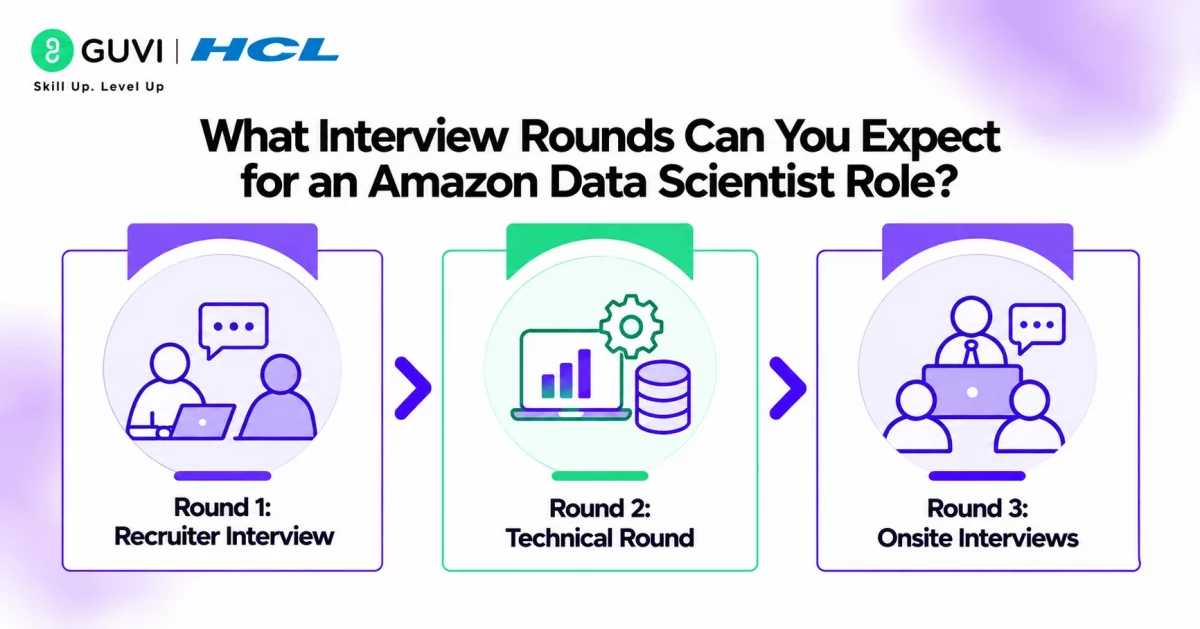
The Amazon Data Scientist interview process can take around four to eight weeks and includes a recruiter interview, technical round, and onsite interviews.
Round 1: Recruiter Interview
The recruiter interview is generally the initial conversation about your experience, background, and fit for the role. The source describes this as a roughly 30-minute video call.
Round 2: Technical Round
The technical stage includes 1–2 video calls of around 60 minutes each. Prepare for areas such as SQL, coding, data analysis, Machine Learning, statistics, modelling, and problem-solving.
Round 3: Onsite Interviews
The source describes 5–6 onsite interviews lasting around 45–60 minutes each. These can cover technical and behavioral areas, while Amazon’s Leadership Principles should also be part of your preparation.
How to Prepare for an Amazon Data Scientist Interview?
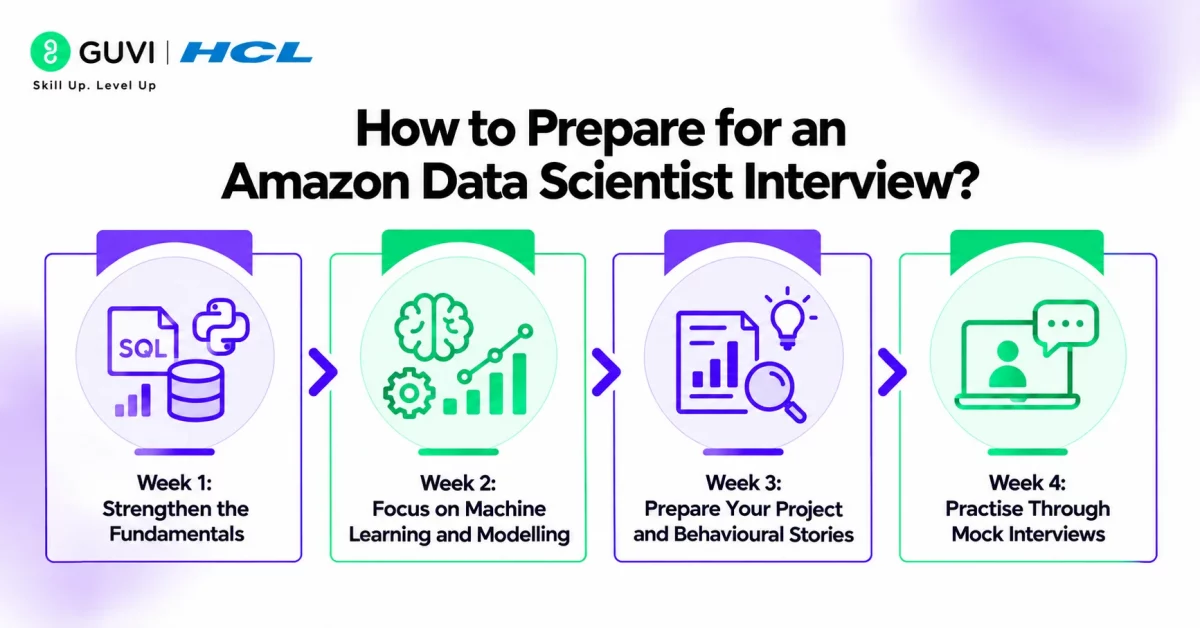
Follow a Four-Week Preparation Roadmap
Week 1: Strengthen the Fundamentals
Revise SQL, Python, statistics, probability, and data manipulation. Practise writing queries and solving data-related problems while explaining your approach clearly.
Week 2: Focus on Machine Learning and Modelling
Revise Machine Learning algorithms, model evaluation, feature engineering, missing data, outliers, time-series concepts, and model selection. Focus on understanding when and why you would use each approach.
Week 3: Prepare Your Project and Behavioural Stories
Review your most important Data Science projects. Be ready to explain the business problem, data, methodology, challenges, decisions, results, and impact. Also prepare examples covering teamwork, ambiguity, disagreements, failures, and problem-solving.
Week 4: Practise Through Mock Interviews
Simulate the interview experience with SQL, technical problem-solving, Machine Learning, statistics, modelling, and behavioural questions. Use each mock interview to identify weak areas and revise them before the actual interview.
Amazon Data Scientist interviews can assess how you apply data science to real business problems, not just how well you know algorithms. Be prepared to explain your approach, the reasoning behind your decisions, and how your analysis or models could influence business outcomes.
1] Amazon Data Scientist Interview Questions:
1. What is Data Science?
2. Tell us something about AWS.
3. Was there any time when you had to deal with ambiguity?
4. What is a confusion matrix?
5. Differentiate between supervised and unsupervised learning.
6. What are the types of selection bias?
7. Describe Markov Chains.
8. How do you find the RMSE and MSE linear regression models?
9. Why do we use a summary function?
10. Why is R used in data visualization?
11. Have you ever worked in a team?
12. Explain any of your Data Science projects in detail.
13. What are your time management strategies?
14. Name three disadvantages of using a linear model
15. Why do you need to perform resampling?
Here are some Amazon data scientist interview questions for the next level of interviews.
2] Amazon data scientist interview questions on Coding SQL
1. What is the most advanced query written by you?
2. Difference between CHAR and VARCHAR in MySQL
3. How do you differentiate between Oracle and MySQL?
4. How to test for NULL values in a database?
5. Write a SQL code to explain month to month user retention rate.
6. What is a foreign key? How to implement the same in MySQL?
7. What are Database White Box Testing & Black Box Testing?
8. Describe different JOINs in SQL.
9. Given a table with three columns (id, category, value) and each id has three or fewer categories (price, size, colour). How can you find those IDs for which the value of two or more categories match one another?
10. Given a CSV file with ID and Quantity columns, 50 million records, and the size of the data is 2gig, write a program to aggregate the QUANTITY column.
11. Which drivers are necessary for MySQL?
12. What is a trigger in MySQL? How can we use it?
13. How can we run MySQL in batch mode?
14. What are the various types of tables present in Mysql?
15. How can you convert timestamps to date time in MySQL?
16. How to import and export MySQL databases?
Learn more about SQL: Top SQL Interview Questions One Needs On Their Fingertips!!!
3] Amazon Data Scientist interview questions concerning Data structure and algorithms
1. What is the computational complexity of a Python code that will help you recognize whether the entries to a list have the same characters or not
2. Suppose you have an array of integers of which you want to find a particular element; what effective algorithm would you use, and what is its efficiency?
3. For a long sorted list and a short (4 element) sorted list, what algorithm would you use to search the long list for the 4 elements?
4. Given an unfair coin with the probability of heads not equal to .5, what algorithm could you use to create a list of random 1s and 0s?
5. Given a bar plot, imagine you are pouring water from the top. How do you qualify how much water can be kept in the bar chart? (solution)
6. Write a Python function that displays the first n Fibonacci numbers. (solution)
7. Suppose you have a list of strings, each of which is an English sentence. # Output a dictionary out_dict that maps a key n to the list of words that occur in n different sentences. # E.g. # Input: str_list = [ “The cat ate the fish”, “The cat saw the roses”, “The roses are red” ]
8. If given an integer n and an array of numbers, state the histogram divided into n bins.
Master Data Structure & Algorithm: Why Do You Need To Focus On Data Structure & Algorithms?
4] Amazon Data Scientist interview questions regarding Modelling
1.How would you improve a classification model that suffers from low precision?
2. We have two models, one with 85% accuracy, and one with 82%. Which one do you pick? (solution)
3. When you have time series data by month, and it has large data records, how will you find significant differences between this month and the previous month?
4. How do you inspect missing data, and when are they important?
5. Assume you have a file containing data in the form of data = [{“one”:a1, “two”:b1,…},{“one”:a2, “two”:b2,…},{“one”:a3, “two”:b3,…},…] How could you split this data into 30% test and 70% train data?
5] Amazon Data Scientist interview questions: Machine Learning
1.What is Machine Learning?
2. What is Pruning?
3. What is linear regression?
4. How do you interpret logistic regression?
5. How does dropout work?
6. What is L1 vs L2 regularization?
7. Explain the drawbacks of a linear model
8. What is the difference between bagging and boosting?
9. Explain in detail how a 1D CNN works.
10. Describe a case where you have solved an ambiguous business problem using machine learning.
11. Having a categorical variable with thousands of distinct values, how would you encode it?
12. Briefly describe the Decision Tree Algorithm.
13. What are Entropy and information gained in the Decision Tree Algorithm?
14. How do you manage an unbalanced data set?
15. What is lstm? How & Why was lstm used in your experience?
16. What are Recommender Systems?
17. What did you use to remove multicollinearity? Explain what values of VIF you used.
18. Explain different time series and analysis models. What are some time series models other than Arima?
19. How does a neural network with one layer and one input and output compare to logistic regression?
20. Describe Ensemble learning.
21. During analysis, how do you treat missing values?
22. How can outlier values be treated?
Is Machine Learning on your mind: Getting Started with Machine Learning Algorithms

Also mastering Data Science is easy now. How?
You can refer to these books to learn Machine Learning: Top 25 Essential Machine Learning Books For Beginners & Experienced Professionals
6] Amazon Data Scientist Interview Questions on Deep Learning:
1.What is Deep Learning?
2. What is the difference between Machine Learning and Deep Learning?
3. Why do you think Deep Learning is gaining more popularity?
4. Explain Neural Network fundamentals.
5. Describe Neural Networks.
6. Define reinforcement learning.
7. What are Hyperparameters?
8. Differentiate between Epoch, Batch, and Iteration in Deep Learning.
9. What is the structure of an Artificial Neural Network?
10. What are the different layers on CNN?
11. How does Pooling work on CNN?
12. Explain how the LSTM network works.
13. Define the Gradient Descent.
14. What are exploding gradients?
15. Explain Cost Function.
Master Deep Learning: How to become proficient in deep learning and neural networks in just 30 days!!
7] Amazon data scientist interview questions on Statistics:
1.What is the p-value?
2. What is the maximum likelihood of getting k heads when you tossed a coin n times?
3. There are 4 white balls and 2 green balls. What’s the probability of them not being the same in the 2 picks?
4. How would you explain hypothesis testing for a newbie?
5. What is cross-validation?
6. How do you interpret OLS regression results?
7. Explain confidence intervals
8. Name the five assumptions of linear regression.
10. Estimate the disease probability in one city given the probability is very low nationwide. Randomly asked 1000 people in this city, with all negative responses (NO disease). What is the probability of disease in this city?
11. What is the difference between linear regression and a t-test?
Further here are some interview questions generally asked in Amazon Data Scientist interviews for checking your Leadership and Interpersonal skills.
Also find this: What Skills Are Needed To Be A Data Scientist?
8] Additional Amazon data scientist interview questions:
1.Tell me about yourself.
2. Where do you see yourself within the next 5 years?
3. Tell me a time when a goal was hard to achieve. What did you learn from that?
4. Why Data Science?
5. If you have to simplify some of your projects for customer experience enhancement, how would you proceed with it? Explain.
6. Tell me a time you used the data to come up with data-driven statistics, and how did you present your findings?
7. Describe the situation when you disagreed with your manager, and how did you handle that?
8. Share about any of your failed projects that might have been successful, with a few changes made to them.
9. Explain the most innovative idea you have ever had?
10. Tell me about a time you applied judgment to a decision when data was not available.
11. Tell me about your most important accomplishment. Why do you think it is important
12. What is the composition of your current team, and how are you encouraging their growth?
13. Describe the last time you figured out a way to keep an approach simple or to save on expenses
14. What is the one feedback/complaint you always get from your colleagues? How are you working on such feedback?
Let’s Wrap It Up!
Preparing for an Amazon Data Scientist interview requires more than memorising interview questions. You need to strengthen your SQL, statistics, Machine Learning, modelling, and problem-solving skills while being ready to explain your projects, decisions, and business impact clearly. Understanding the interview process and practising both technical and behavioural questions can help you approach each stage with greater confidence.
If you want to put your preparation to the test, practise with a mock interview and identify the areas you need to improve before the actual interview.
FAQs
1. How many rounds are there in an Amazon Data Scientist interview?
The process generally includes recruiter screening, technical interviews, and onsite rounds. Onsite interviews may involve 5–6 rounds covering technical and behavioural skills.
2. What technical skills are required for an Amazon Data Scientist interview?
Candidates should prepare SQL, Python, statistics, probability, Machine Learning, Deep Learning, data structures, algorithms, and statistical modelling.
3. Is SQL important for Amazon Data Scientist interviews?
Yes. SQL is essential for technical preparation. Focus on joins, subqueries, NULL values, data aggregation, database concepts, and complex queries.
4. What Machine Learning questions are asked in Amazon interviews?
Common topics include linear and logistic regression, decision trees, regularization, bagging, boosting, ensemble learning, missing values, and outlier treatment.
5. How should I prepare for Amazon Data Scientist behavioural interviews?
Prepare real examples involving teamwork, problem-solving, handling ambiguity, and failures. Use the STAR method and relate your answers to Amazon’s Leadership Principles.
6. How long does it take to prepare for an Amazon Data Scientist interview?
A four-week plan can help structure preparation, covering technical fundamentals, Machine Learning, project discussions, behavioural questions, and mock interviews.
7. How can experienced professionals prepare for an Amazon Data Scientist interview?
Focus on technical revision and real project experience. Be ready to explain business problems, analytical approaches, challenges, results, and measurable business impact.
Success Stories

About the Author
Archana
A traveler, and explorer, Archana is an active writer at GUVI. You can usually find her with a book/kindle binge-reading (with an affinity to the mystery/humor).
View all posts by Archana
Connect with me @














Did you enjoy this article?