


Data Science Articles
Accountant vs Data Analyst Salary in India After Switching Careers - Best Guide
Finance Managers: Could Data Science Be Your Next Career Move?
Insurance Claims Executive to Data Analyst: Is It a Good Switch?
Banking Executive (Loans, KYC) to Data Analyst: Skills and Career Path


Get In Touch For Details! Request More Information
Data Scientist Salary for Senior and Mid-Career Professionals in India: Career Switch Guide for IT & Non-IT Professionals
Oct 23, 2026 5 Min Read 42817 Views
(Last Updated)
If you already have a few years of work experience and are considering a move into Data Science, salary is naturally part of the decision. But the data scientist salary you can expect depends on more than the number of years you’ve worked.
Your existing background matters too. An IT professional moving into Data Science may be able to build on programming, databases, cloud, or other technical experience. A non-IT professional may bring valuable domain expertise from areas such as finance, marketing, operations, or consulting, while needing to build a stronger technical foundation.
So, what can experienced professionals realistically expect to earn after making the switch? In this guide, we’ll look at data scientist salary by experience, skills, city, and role, along with how salary expectations can differ for IT and non-IT career switchers.
Table of contents
- TL;DR
- How Does Data Scientist Salary Vary by Experience?
- IT vs Non-IT: How Does Your Background Affect a Data Science Career Switch?
- Which Skills Can Influence Your Data Scientist Salary?
- Which Industries Pay Data Scientists the Most in India?
- What Are Experienced Data Scientists Earning Across Companies?
- Which Indian Cities Offer Higher Data Scientist Salaries?
- What Can Help You Increase Your Data Scientist Salary?
- Continuous Skill Development
- Build a Portfolio
- Gain Experience
- Pursue Certified Courses
- Thinking About Your Next Career Move?
- Wrapping Up
- FAQs
- What is the data scientist salary for experienced professionals in India?
- Does a higher degree lead to a higher Data Scientist salary?
- Can certifications help increase a Data Scientist salary?
- How important is data scientist salary by experience when evaluating a job offer?
- When should a Data Scientist negotiate a salary increase?
- Should I accept a lower salary when switching to Data Science?
TL;DR
- Data scientist salary varies significantly with experience, skills, location, role, and company.
- Mid-career and senior professionals may be able to leverage existing technical or domain expertise while switching.
- IT and non-IT professionals can have different starting points depending on how relevant their previous experience is.
- Skills in ML, AI/GenAI, cloud, and MLOps can influence earning potential as you specialize.
- A career switch doesn’t guarantee a salary hike; your current pay, target role, and demonstrated skills also matter.
How Does Data Scientist Salary Vary by Experience?
According to AmbitionBox salary insights, data scientists with 3–6 years of experience earn an average of around ₹16 LPA, while those with 6–9 years earn nearly ₹22 LPA.
For career switchers, however, total work experience and Data Science experience are not always equivalent. An experienced IT professional may carry relevant technical experience into the new role, while a non-IT professional may bring valuable domain expertise but need to build stronger technical skills. As a result, two professionals with the same total years of experience may enter Data Science at different salary levels.
IT vs Non-IT: How Does Your Background Affect a Data Science Career Switch?
If you’re a mid-career or senior professional , moving into Data Science doesn’t necessarily mean starting over. What matters is how much of your existing experience is relevant to the role you’re targeting.
| Parameter | IT Professional Switching to Data Science | Non-IT Professional Switching to Data Science |
| What you already bring | Programming, databases, cloud or other technical experience | Domain expertise, business knowledge and industry experience |
| Main skill gap | Data Science, ML, AI and advanced analytics | Python, SQL, statistics, ML and other technical foundations |
| How previous experience helps | Existing technical skills may transfer directly to Data Science work | Domain knowledge can help solve industry-specific data problems |
| Salary positioning | Relevant technical experience may strengthen positioning for experienced roles | Depends heavily on technical readiness and how relevant domain expertise is |
| What can improve earning potential | Deeper AI/ML expertise, specialization and higher-responsibility roles | Strong technical skills combined with existing domain expertise |
Verdict : Neither IT nor non-IT professionals have a fixed salary advantage when switching to Data Science. IT professionals may benefit from transferable technical experience, while non-IT professionals can bring valuable domain expertise. Ultimately, your salary positioning depends on how well your previous experience complements your new Data Science skills and the role you’re targeting.
Which Skills Can Influence Your Data Scientist Salary?
For experienced professionals, the data scientist salary you can command also depends on how well your skills align with the roles you’re targeting. Here’s what IT and non-IT professionals can prioritize.
| IT Professionals | Non-IT Professionals |
| Machine Learning Build advanced predictive models and improve model performance. | Python Build the programming foundation required for Data Science. |
| AI & GenAI Develop expertise in LLMs and Generative AI applications. | SQL Learn to query, extract, and work with data. |
| Deep Learning Work with neural networks, NLP, and computer vision. | Statistics Understand probability, regression, and statistical analysis techniques. |
| Cloud Deploy and scale Data Science workloads on cloud platforms. | Machine Learning Learn to build, evaluate, and improve predictive models. |
| MLOps Deploy, monitor, and manage models in production environments. | Data Visualization Communicate insights clearly through dashboards and visual storytelling. |
Key takeaway: As you specialize, understanding the difference between Machine Learning and Deep Learning can also help you identify which technical areas are most relevant to the roles you want to pursue.
IT professionals can focus on deeper specialization, while non-IT professionals can prioritize building the technical foundation that complements their existing domain expertise.
Which Industries Pay Data Scientists the Most in India?
The industry you work in can make a noticeable difference to your data scientist salary. Companies where data directly influences products, revenue, risk, or customer decisions often offer stronger compensation for Data Science talent.
According to Recrew’s Data Scientist Salary Guide, salary ranges vary considerably across industries and company types:
| Industry / Company Type | Data Scientist Salary Range |
| SaaS / Product Companies | ₹14–80 LPA |
| Fintech | ₹12–70 LPA |
| E-commerce | ₹10–60 LPA |
| Startups (Seed to Series B) | ₹8–45 LPA |
| IT Services / Consulting | ₹5–28 LPA |
What does this mean for your career? Salary shouldn’t be the only reason to choose an industry. For mid-career and senior professionals, existing domain knowledge can also matter. Experience in areas such as finance, e-commerce, consulting, or technology may become useful when you combine it with strong Data Science skills.
What Are Experienced Data Scientists Earning Across Companies?
Here are some recently reported salaries on AmbitionBox from Data Scientists with 4–6 years of experience, offering a snapshot of compensation at this career stage, giving us a snapshot of earnings at the mid-level to senior stage.
| Company | Experience | Latest Reported Salary |
| Wipro | 6 years | ₹18 LPA |
| NeoSOFT | 4 years | ₹16 LPA |
| PepsiCo | 4 years | ₹15.7 LPA |
| LTM Limited | 4 years | ₹15 LPA |
| Swiggy | 4 years | ₹13 LPA |
| Orbex Technologies | 5 years | ₹10 LPA |
Note: These are individual salaries recently reported on AmbitionBox, not company-wide averages. Actual compensation can vary based on role, skills, location, and experience.
Which Indian Cities Offer Higher Data Scientist Salaries?
Location can also influence how much a Data Scientist earns, with salary ranges varying across India’s major technology and business hubs.

| City | Salary Range |
| Gurugram | ₹13.4–15 LPA |
| Bengaluru | ₹13.2–14.5 LPA |
| Mumbai | ₹13.1–14.5 LPA |
| Pune | ₹12.6–13.9 LPA |
| New Delhi | ₹12.5–14.2 LPA |
| Hyderabad | ₹12.3–13.5 LPA |
Gurugram, Bengaluru, and Mumbai show some of the higher salary ranges among these major hubs. Bengaluru also has a strong concentration of Data Science companies, although actual compensation can vary by experience, company, skills, and role.
Netflix once offered a $1 million prize to anyone who could improve the accuracy of its movie recommendation system by 10%. The challenge took nearly three years to crack.
What Can Help You Increase Your Data Scientist Salary?
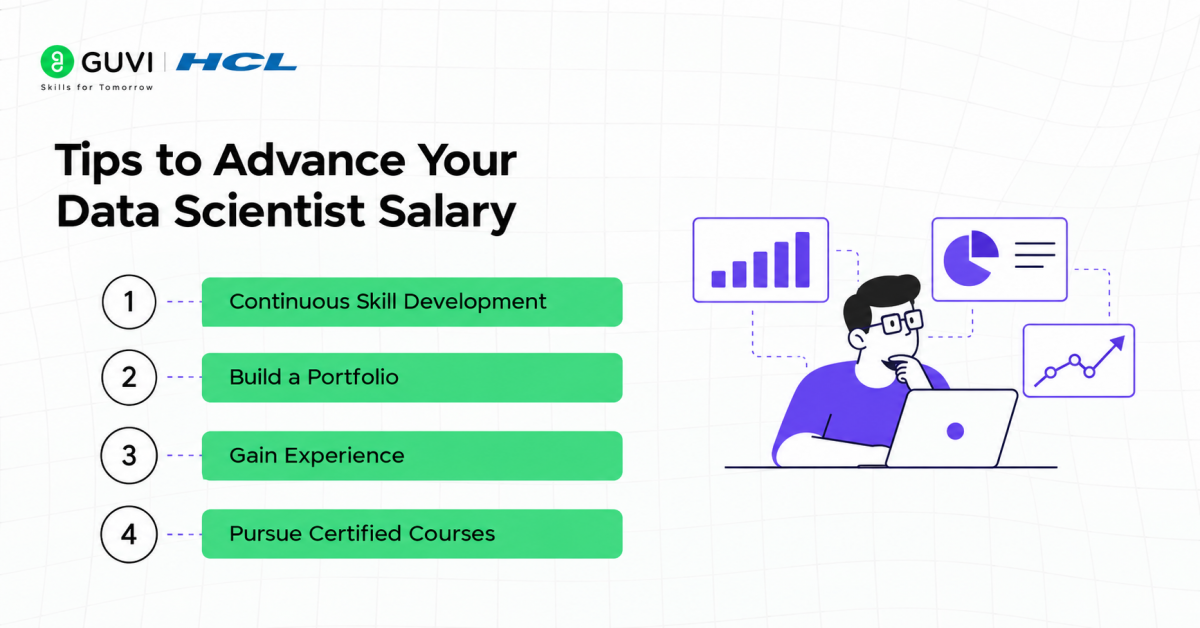
Salary growth in Data Science depends on more than years of experience. The skills you develop, the projects you work on, and the responsibility you take on can all strengthen your earning potential.
1. Continuous Skill Development
Keep strengthening skills that match the roles you want to pursue. This could include advanced Machine Learning and Deep Learning, AI/GenAI, Data Visualization, cloud, or MLOps. Strong communication and stakeholder management also become more important as you move into higher-responsibility roles. Understanding Machine Learning vs Deep Learning can help you choose the right areas to specialize in.
2. Build a Portfolio
A strong portfolio shows how well you can apply Data Science skills to practical problems. Include projects that demonstrate technical execution, Data Visualization, problem-solving, and business impact, especially if you’re transitioning from a non-IT background.
3. Gain Experience
Take on challenging projects, solve real business problems, and gradually assume greater ownership. Understanding the distinction between Data Science and Data Analytics careers can also help you target roles that better match your existing experience and strengths.
4. Pursue Certified Courses
Certifications can help you build and validate new skills, but they carry more weight when supported by practical application. Prioritize courses that include real datasets, projects, and opportunities to demonstrate what you’ve learned.
Thinking About Your Next Career Move?
Spent a few years building your career but feel ready for something different? You may already be in IT and looking to move into Data Science and AI, or you may be planning a non-IT to tech career switch and wondering where to even begin.
HCL GUVI’s Data Science Career Program gives you a structured path to build job-relevant Data Science skills through expert-led learning, hands-on projects, and practical exposure. Instead of figuring out the transition alone, you can build on the experience you already have while developing the technical skills needed for your next role.
If you want to start with something shorter and self-paced, HCL GUVI’s Data Science and Project course lets you work through a practical Data Science project and apply your learning hands-on.
Wrapping Up
A career in Data Science can offer strong earning potential, but there is no single salary figure that applies to everyone. Your experience, skills, industry, company, and location all play a part in determining what you can earn.
For mid-career and senior professionals, the bigger question is how effectively you can build on what you already know. Technical experience can support deeper specialization, while years of non-IT domain experience can still be valuable when paired with the right Data Science skills. Focus on building the right capabilities for the roles you want, rather than chasing a salary number alone.
FAQs
1. What is the data scientist salary for experienced professionals in India?
According to AmbitionBox, Data Scientists with 3–6 years of experience earn around ₹16 LPA on average, while those with 6–9 years earn nearly ₹22 LPA. Actual salaries can vary considerably based on skills, company, industry, location, and how relevant your previous experience is to the Data Science role.
2. Does a higher degree lead to a higher Data Scientist salary?
Not necessarily. Advanced qualifications can strengthen your profile, but employers also consider practical skills, project experience, problem-solving ability, and your ability to work with real-world data.
3. Can certifications help increase a Data Scientist salary?
Certifications alone may not lead to a salary increase. They are more valuable when they help you develop demonstrable skills that can be applied to real projects and workplace problems.
4. How important is data scientist salary by experience when evaluating a job offer?
Experience is an important benchmark, but it should not be considered in isolation. Your specialization, responsibilities, company, industry, and overall compensation package can make two offers for similarly experienced professionals quite different.
5. When should a Data Scientist negotiate a salary increase?
A good time is when your responsibilities have expanded, you have delivered measurable results, developed valuable expertise, or taken ownership of more complex projects.
6. Should I accept a lower salary when switching to Data Science?
Not automatically. A career switch may sometimes involve a compensation adjustment, but this depends on how transferable your previous experience is and the role you’re entering. Consider the role, learning opportunity, long-term growth, and compensation together.
Success Stories












Did you enjoy this article?