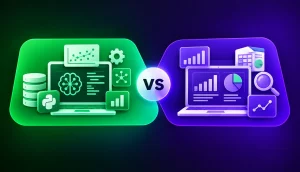
TL;DR — Quick Answer
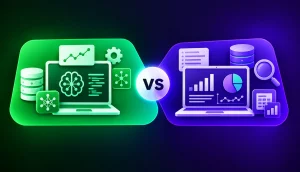
Choose Full-Stack Developer if you want faster entry into your first job, a more linear learning path, and strong freelancing options. Choose Data Scientist if you’re drawn to statistics, machine learning, and building AI-driven insights, and you’re willing to invest more time before you’re job-ready.
- Choose Data Scientist if: You enjoy math, statistics, and pattern-finding, and want to work on ML models, analytics, or AI products.
- Choose Full-Stack Developer if: You enjoy building complete web applications end-to-end and want broad, fast-moving job opportunities.
- Best for beginners: Full-Stack Developer — the frontend-to-backend learning path is more visual and beginner-friendly.
- Best for freshers: Full-Stack Developer has more entry-level job postings across service and product companies in India.
- Best for AI-era career growth: Data Scientist, especially with GenAI and MLOps specialization.
- Best for long-term growth: Both are strong; Full-Stack Developers scale into architect/tech-lead roles, while Data Scientists scale into ML/AI leadership roles.
Who this comparison is for: College students picking a specialization, freshers deciding what to learn first, working professionals planning a switch into tech, and anyone comparing Data Scientist vs Full-Stack Developer for salary, jobs, or freelancing in India in 2026.
What are Data Scientist and Full-Stack Developer?
A Data Scientist collects, cleans, analyzes, and models data to extract insights and build predictive systems for business decisions. Data scientists use Python, statistics, and machine learning to solve problems like demand forecasting, fraud detection, and personalization, and they’re employed across banking, e-commerce, healthcare, and enterprise analytics teams. In 2026, many data scientists also work with GenAI tools, building RAG pipelines and AI-powered analytics features.
Data Scientist vs Full-Stack Developer — Side-by-Side Comparison
| Criteria | Data Scientist | Full-Stack Developer | Winner |
|---|---|---|---|
| Learning Difficulty | Moderate to High (stats + ML) | Moderate | Full-Stack wins for beginners |
| Programming Requirement | Medium to High (Python, SQL) | High (JS/Java, multiple frameworks) | Depends on interest |
| Core Knowledge Needed | Statistics, ML, data handling | Frontend + backend frameworks, databases, APIs | Different skill bases |
| Job Market in India | Growing fast, more specialized | Very large, consistently high demand | Full-Stack wins on volume |
| Starting Salary | Slightly higher on average | Solid, wide-ranging | Data Scientist slightly higher |
| Career Opportunities | Analytics, ML, AI, research | Web, product, enterprise, startups | Full-Stack wins on breadth |
| Time to Learn Basics | 4–6 months | 3–5 months | Full-Stack slightly faster |
| Remote Work | Good, especially analytics roles | Excellent, widely remote-friendly | Full-Stack wins |
| Freelancing | Moderate (dashboards, ML consulting) | Strong (websites, apps, MVPs) | Full-Stack wins |
| Future Growth | Excellent, especially with GenAI skills | Excellent, especially with AI-assisted dev tools | Tie |
| Best For | Analytical, math-driven thinkers | Builders who like shipping complete products | Depends on interest |
| HCL GUVI Course Available | Yes | Yes | Both available |
Find Your Career Path
Answer 3 quick questions to discover whether Data Science or Full-Stack Development is the better career fit for you.
What type of work interests you most?
Choose what you'd enjoy doing regularly.
Which skills would you rather learn?
Pick the technologies that excite you most.
Which problem would you rather solve?
Think about your ideal day of coding.
The Key Difference Between Data Scientist and Full-Stack Developer
“The biggest difference is simple: a Data Scientist focuses on extracting insight and predictions from data, while a Full-Stack Developer focuses on building the complete application that delivers a product to users.”
A few concrete differences:
- Core purpose: Data scientists answer questions using data; full-stack developers build the systems users directly interact with.
- Skills required: Data Science leans on statistics, probability, and machine learning; Full-Stack leans on frontend frameworks, backend architecture, and databases.
- Tools/technologies: Data scientists use Python, Pandas, and ML frameworks like scikit-learn or TensorFlow; full-stack developers use React, Node.js, Express, and SQL/NoSQL databases.
- Type of work: Data Science work is exploratory and model-driven; Full-Stack work is structured around building, testing, and deploying complete features.
- Career environment: Data scientists often collaborate closely with business and analytics teams; full-stack developers typically work within product and engineering teams on sprint-based delivery.
In Practical Terms
A full-stack developer building a food delivery app makes sure the app loads fast, the cart works, and orders reach the restaurant reliably. A data scientist working on the same app predicts which restaurants a specific user is likely to order from next, based on their past orders. One builds the product; the other makes it smarter.
Data Scientist vs Full-Stack Developer for Getting a Job as a Fresher in India
Freshers generally find more entry-level openings as Full-Stack Developers because IT services companies, startups, and product firms hire developers at scale every hiring season. Roles like Junior Full-Stack Developer, Associate Software Engineer, and Frontend/Backend Developer are widely posted across company sizes and cities.
Data Scientist hiring for freshers is growing but remains more selective — many companies expect a portfolio of real projects, internships, or a Kaggle-style track record even at entry level, since the role assumes some analytical maturity from day one.
If your priority is landing your first job quickly, Full-Stack Development currently offers the wider funnel. Freshers targeting Data Scientist roles should be prepared to invest extra time in building a strong project portfolio before applying.
Data Scientist vs Full-Stack Developer for AI and Machine Learning Careers
If your goal is to build machine learning models, recommendation systems, or generative AI features, Data Science is the more direct path — it builds the statistical and ML foundation needed for roles like ML Engineer, Data Scientist, and AI Engineer.
Full-stack developers can move into AI-adjacent work, such as integrating AI APIs or building GenAI-powered features into applications, but they typically layer data science fundamentals on top rather than starting from them.
Advanced Data Science & Generative AI Program
Data Scientist vs Full-Stack Developer for Web and Product Development
If your goal is to build and ship complete products — websites, dashboards, SaaS tools, or mobile-responsive apps — Full-Stack Development is the direct path. It covers everything from UI design implementation (React, Tailwind CSS) to backend logic and database design (Node.js, Express, MongoDB or PostgreSQL).
Data scientists occasionally build simple dashboards or internal tools, but they generally aren’t expected to own full application architecture the way full-stack developers do.
Data Scientist vs Full-Stack Developer for Working Professionals Switching Careers
Career switchers usually find Full-Stack Development faster to break into because:
- Learning resources and structured bootcamps are abundant and well-standardized.
- Portfolio expectations (a few solid projects, a GitHub profile, a deployed app) are clearly understood by hiring managers.
- Entry-level and junior roles are widely available across company types.
- The skill path — HTML/CSS/JS, then a framework, then a backend — is linear and predictable.
Data Science is achievable for career switchers too, but it typically requires more time invested in statistics and machine learning fundamentals before a candidate is genuinely job-ready, making the switch a longer runway for most non-technical professionals.
Data Scientist vs Full-Stack Developer for Freelancing
Full-Stack Development has a much larger and more mature freelance ecosystem. Freelancers commonly work on:
- Business websites and landing pages
- E-commerce store builds and customizations
- MVP development for startups
- API integrations and backend features
- Ongoing maintenance and bug fixes for existing products
Data Science freelancing exists — dashboards, data analysis, and small ML models are common gigs — but the client base is smaller, and projects often require more upfront trust-building since non-technical clients find data work harder to evaluate directly.
Software and AI Engineer Programme
Data Scientist vs Full-Stack Developer Salary in India (2026)
| Experience | Data Scientist | Full-Stack Developer |
|---|---|---|
| Fresher (0–1 year) | ₹4–10 LPA | ₹3.5–7 LPA |
| Junior (1–3 years) | ₹8–15 LPA | ₹6–12 LPA |
| Mid-Level (3–5 years) | ₹12–22 LPA | ₹10–22 LPA |
| Senior (5+ years) | ₹25–40+ LPA | ₹20–45+ LPA |
Salary varies significantly by company, city, tech stack, and specialization. Product companies and top-tier employers pay well above these ranges for both roles; figures above reflect broader market benchmarks synthesised from AmbitionBox and Glassdoor India data.
Which Has Better Long-Term Earning Potential?
Both roles offer strong long-term earning potential, but their growth paths differ.
Data Scientists can specialize into Machine Learning Engineer, AI Engineer, Data Science Lead, or Analytics Manager roles. As companies deepen their investment in AI and GenAI, professionals who combine data science fundamentals with LLM and MLOps skills are seeing some of the fastest salary growth in Indian tech.
Full-Stack Developers can grow into Senior Developer, Tech Lead, Solutions Architect, or Engineering Manager roles. The path to senior technical leadership is well established, and product-based companies pay significantly more than IT services firms at the same experience level — especially for developers fluent in cloud deployment and AI-assisted development tools.
In both careers, specialization is what drives the biggest jumps in pay — generalists plateau faster than professionals who build deep expertise in a specific, high-demand niche.
Recommendation — Here Is the Honest Answer
Choose Data Scientist if:
- You enjoy statistics, probability, and working with numbers.
- You’re excited about machine learning, AI, and predictive modeling.
- You want to work at the intersection of business and technology.
- You’re comfortable with a longer runway before landing your first role.
- You want to build toward specialized, high-ceiling AI careers.
Choose Full-Stack Developer if:
- You enjoy building and shipping complete, visible products.
- You want broader, faster access to entry-level jobs.
- You prefer a structured, linear learning path.
- You want strong freelancing and remote work options early on.
- You’re switching careers and want a well-tested route into tech.
Should You Learn Both?
Yes—but not at the same time. Start with one, build strong fundamentals, gain practical experience, and then add the second skill if your career requires it. Many experienced professionals eventually pick up both — for example, a full-stack developer learning data science to build ML-powered features, or a data scientist strengthening full-stack skills to deploy and serve models in production.
Explore: Data Scientist Salary in India
Conclusion
Data Scientist is the better choice if you’re drawn to statistics, machine learning, and long-term specialization in AI-driven roles, and you’re willing to invest more time before your first job. Full-Stack Developer is the better choice if you want a faster, more predictable path into your first tech job, broader job availability, and strong freelancing options along the way.
Both careers are thriving in 2026, and both will keep evolving as AI reshapes how software gets built and how data gets used. The smartest approach isn’t chasing whichever role sounds more “future-proof” — it’s choosing the one that matches your interests, learning style, and the kind of problems you actually want to solve every day. That decision will carry you further than any trend.
Frequently Asked Questions
Which is better, Data Scientist or Full-Stack Developer?
Neither is universally better. Full-Stack Development offers faster entry and broader job availability, while Data Science offers deeper specialization and strong long-term growth in AI-driven roles. The right choice depends on your interests and career goals.
Which is easier for beginners?
Full-Stack Development is generally easier to start with because its learning path — HTML/CSS/JS, then a framework, then a backend — is visual and linear. Data Science requires an added layer of statistics and machine learning concepts alongside programming.
Which has more job opportunities in India?
Full-Stack Development has a larger volume of job openings because nearly every company building a digital product needs developers. Data Scientist roles are growing quickly but remain more specialized, with fewer but often higher-paying positions.
Which is better for freshers?
Full-Stack Development is generally better for freshers seeking a first job quickly, thanks to widespread entry-level hiring across service and product companies. Freshers targeting Data Scientist roles should build a strong project portfolio to compete effectively.
Which has a higher salary?
Data Scientist roles often have a slightly higher average starting salary, especially for candidates with strong ML skills. However, Full-Stack Development offers a wide senior-level range too, with product-company roles matching or exceeding Data Science pay.
Can I learn both Data Science and Full-Stack Development?
Yes, but not simultaneously. Master one field’s fundamentals first, gain practical project or job experience, then add the second skill set if your career path calls for it — many professionals eventually combine both.
Which is better for freelancing?
Full-Stack Development has a larger, more established freelance market for websites, apps, and MVPs. Data Science freelancing exists but is a smaller market, often centered on dashboards, analysis, and small ML projects.
Which has better long-term career growth?
Both offer strong long-term growth. Full-Stack Development has a well-defined path to architect and engineering leadership roles, while Data Science offers growth into specialized AI and ML leadership roles, currently among the fastest-growing in Indian tech.