


Data Engineering Articles
Apache Iceberg Tutorial: A Practical Guide for Data Engineers
12 Important Data Architect Roles and Responsibilities


Get In Touch For Details! Request More Information
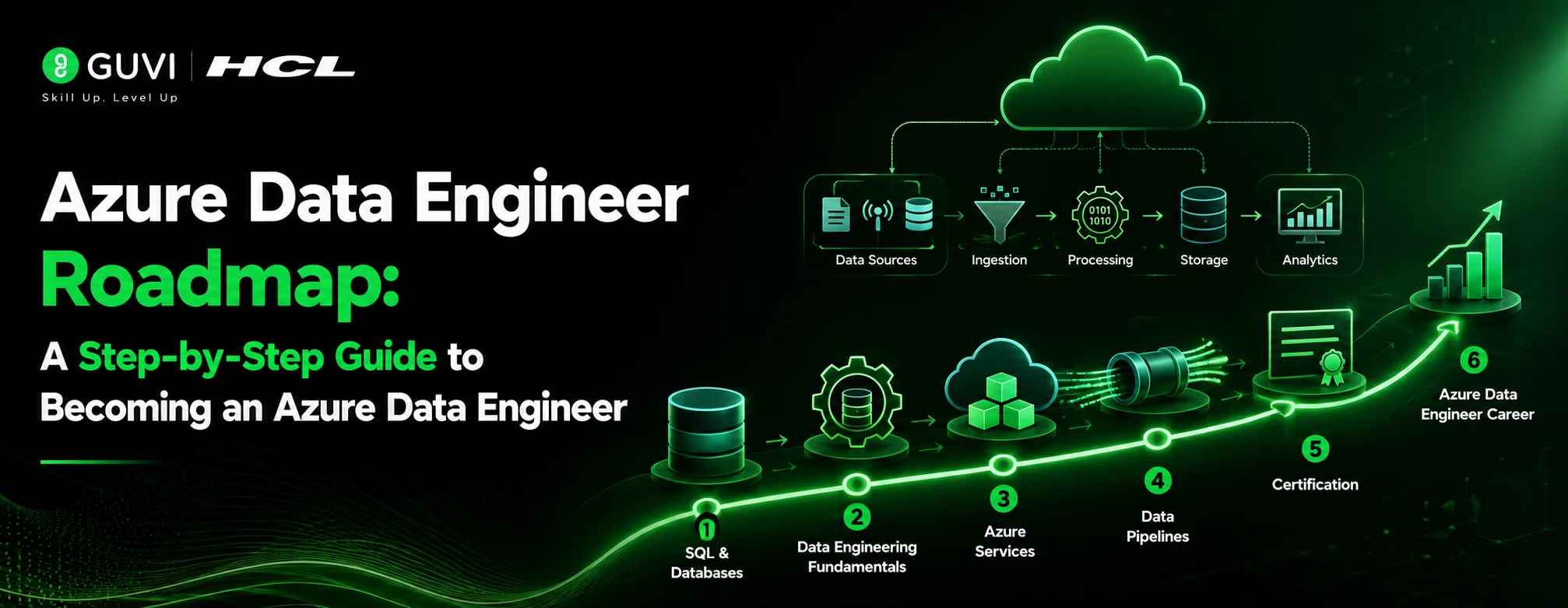
Azure Data Engineer Roadmap: A Step-by-Step Guide to Becoming an Azure Data Engineer
Oct 14, 2026 6 Min Read 2466 Views
(Last Updated)
Data has become the backbone of modern businesses, driving everything from real-time dashboards and recommendation engines to AI applications. This growing reliance on data has made Data Engineering an important career path in the cloud computing era.
An Azure Data Engineer designs, builds, and optimizes data pipelines, storage systems, and processing frameworks using Microsoft Azure. They ensure data flows efficiently so analysts, data scientists, and businesses can make informed decisions.
If you want to start a career in this field or transition into a cloud-based tech role, this Azure Data Engineer roadmap will guide you through the essential skills, tools, certifications, and hands-on projects to focus on in 2026. You will also learn about career opportunities, salary prospects, and common mistakes to avoid while building your expertise.
Table of contents
- TL;DR;
- What Does an Azure Data Engineer Do?
- Why Choose Azure for Data Engineering?
- The Azure Data Engineer Roadmap
- Step 1: Learn the Fundamentals
- Step 2: Understand Azure Fundamentals
- Step 3: Master the Core Azure Data Engineering Tools
- Step 4: Learn Programming for Data Engineering
- Step 5: Work with Big Data and Streaming
- Step 6: Understand Data Security and Governance
- Step 7: Learn CI/CD and DevOps for Data Engineering
- Step 8: Build Real-World Projects
- Step 9: Prepare for the Azure Data Engineer Certification
- Azure Data Engineer Salary in India
- Career Opportunities After Learning Azure Data Engineering
- Common Mistakes Beginners Should Avoid
- Final Thoughts
- Frequently Asked Questions
- What skills are required to become an Azure Data Engineer?
- Can a non-IT student become an Azure Data Engineer?
- What is the salary of an Azure Data Engineer in India?
- Is Azure Data Engineering a good career in 2026?
- Which certification is best for Azure Data Engineers?
- Do Azure Data Engineers use AI and Machine Learning?
- Is Azure Data Engineering difficult to learn?
- What projects should beginners build for Azure Data Engineering?
- Can I learn Azure Data Engineering without experience?
- Which programming language is best for Azure Data Engineering?
- What is the difference between a Data Engineer and a Data Analyst?
- Does Azure Data Engineering require mathematics?
- Can Azure Data Engineers work remotely?
- What are the best tools for Azure Data Engineering?
- How do I practice Azure Data Engineering for free?
TL;DR;
- Azure Data Engineering is one of the fastest-growing cloud careers in 2026.
- Azure Data Engineers build and manage data pipelines, storage systems, and analytics infrastructure.
- Start with fundamentals like SQL, databases, ETL/ELT concepts, and cloud computing basics.
- Learn core Azure services: Azure Data Factory, Databricks, Synapse Analytics, and Data Lake Storage.
- Build programming skills in Python, SQL, and PySpark for data transformation and automation.
- Understand big data, streaming, data security, governance, and DevOps practices.
- Gain hands-on experience through real-world projects and GitHub portfolios.
- Certifications like AZ-900 and DP-203 help validate your Azure expertise.
- Avoid common mistakes like skipping fundamentals or learning without practical projects.
- Azure Data Engineering offers high salaries, strong job demand, and long-term career growth across industries.
What Does an Azure Data Engineer Do?
Before diving into the roadmap, it’s worth understanding the day-to-day responsibilities of the role:
- Designing and managing data pipelines that move data from source systems to storage and analytics layers
- Handling structured and unstructured data: from relational databases to JSON files and streaming feeds
- Working with cloud-native platforms like Azure Synapse, Databricks, and Data Lake Storage
- Supporting analytics and AI teams by ensuring clean, well-organized, and accessible data
- Ensuring data security, compliance, and scalability as data volumes grow
Ready to fast-track your data career? If you’re serious about breaking into the data field, HCL GUVI Zen Class Data Science Course gives you the Python, SQL, Machine Learning, and AI foundations that every Azure Data Engineer needs, with IIT-M Pravartak certification, live expert-led sessions.
Why Choose Azure for Data Engineering?
Microsoft Azure is the second-largest cloud platform globally and the preferred choice in enterprise environments. Here’s why Azure makes sense for data engineers:
- Deep Microsoft ecosystem integration with tools like Power BI, SQL Server, and Active Directory
- Rich suite of native data services, including Azure Data Factory, Synapse Analytics, and Databricks
- Strong enterprise adoption means higher job demand and better salaries for certified professionals
- Cloud-native scalability that allows pipelines to handle petabytes of data with minimal overhead
The Azure Data Engineer Roadmap
Step 1: Learn the Fundamentals
Every great engineer starts with a solid foundation. Before touching any Azure service, get comfortable with:
- SQL: the universal language of data. Learn to write queries, joins, aggregations, and window functions
- Database concepts: relational vs. non-relational, normalization, indexing
- Data warehousing: star schemas, fact and dimension tables, OLAP vs. OLTP
- ETL vs. ELT: understanding the difference between transforming data before and after loading it
- Cloud computing basics: what IaaS, PaaS, and SaaS mean, and how cloud billing works
Skipping this step is the most common mistake beginners make. Tools change; fundamentals don’t.
Step 2: Understand Azure Fundamentals
Once you’re comfortable with data concepts, get familiar with the Azure platform itself:
- The Azure Portal and how to navigate services
- Resource groups, subscriptions, and cost management
- Storage accounts, virtual machines, and networking basics
Recommended Certification: AZ-900 (Azure Fundamentals). This entry-level certification is ideal for building confidence with the platform. It validates your understanding of cloud concepts and core Azure services. Most learners can prepare in 2–3 weeks using Microsoft Learn’s free paths.
Step 3: Master the Core Azure Data Engineering Tools
This is where the real work begins. Four services form the backbone of Azure data engineering:
Azure Data Factory (ADF) is the ETL workhorse of Azure. It lets you build pipelines that move and transform data across hundreds of sources, from on-premises SQL Server to cloud-based REST APIs. Learn to work with datasets, linked services, triggers, and integration runtimes.
Azure Databricks is the big data processing engine, built on Apache Spark. It enables large-scale data transformation, machine learning workflows, and collaborative notebook environments. Understanding Spark’s distributed computing model is essential here.
Azure Synapse Analytics combines data warehousing and big data analytics in a single platform. It supports both SQL-based queries and Spark workloads, making it a one-stop analytics environment. Learn dedicated SQL pools, serverless queries, and pipeline integration.
Azure Data Lake Storage (ADLS Gen2) is where your raw and processed data lives. Learn the difference between the Bronze, Silver, and Gold layers (the Medallion architecture) and how to manage security with access control lists and managed identities.
Step 4: Learn Programming for Data Engineering
You don’t need to be a software engineer, but you do need to write code. Focus on:
- Python: for automation, data manipulation with Pandas, and API interactions
- SQL: deepen your knowledge with window functions, CTEs, and performance tuning
- PySpark: for distributed data transformations in Databricks
Practice by building scripts that clean messy datasets, automate file movements, or run Spark transformations on large CSVs.
Struggling to get started with Python or SQL? HCL GUVI Zen Class Data Science Course covers Python, Pandas, SQL, and even Spark, all taught by industry experts in a structured, project-based format. Over 10,000+ learners have already transitioned into data careers through this program.
Step 5: Work with Big Data and Streaming
Modern data engineering isn’t just about batch processing. Real-time data is everywhere, from IoT sensors to financial transactions. Learn:
- Apache Spark fundamentals: RDDs, DataFrames, and the Spark execution model
- Azure Event Hubs: a managed service for ingesting millions of events per second
- Azure Stream Analytics: for writing SQL-like queries on streaming data in real time
Understanding event-driven architectures will make you far more versatile as an engineer.
Step 6: Understand Data Security and Governance
Data engineers handle sensitive information. Knowing how to protect it is non-negotiable:
- Role-Based Access Control (RBAC): controlling who can access what in Azure
- Data encryption: at rest and in transit
- Microsoft Purview: for data cataloging, lineage tracking, and governance
- Compliance frameworks: GDPR, HIPAA awareness as it relates to data storage and movement
Step 7: Learn CI/CD and DevOps for Data Engineering
Professional data engineers don’t just build pipelines; they deploy and maintain them reliably:
- Git and GitHub: version control for your ADF pipelines, notebooks, and scripts
- Azure DevOps: for creating automated deployment pipelines
- Infrastructure as Code: basics of ARM templates or Terraform for provisioning Azure resources
This step elevates you from a “tool user” to a mature engineering professional.
Step 8: Build Real-World Projects
Nothing on a resume speaks louder than actual projects. Try building:
- A sales analytics pipeline using ADF → ADLS → Synapse → Power BI
- A real-time streaming dashboard with Event Hubs and Stream Analytics
- A customer data lake with raw, cleaned, and aggregated data layers
- A full ETL pipeline from a public API to a SQL-based reporting layer
Host your code on GitHub with clear documentation. These projects demonstrate initiative and technical ability better than any certification alone.
Step 9: Prepare for the Azure Data Engineer Certification
DP-203: Data Engineering on Microsoft Azure is the industry-standard certification for this role. It validates your ability to work across ADF, Databricks, Synapse, and Data Lake Storage.
What happened to DP-203?
DP-203: Data Engineering on Microsoft Azure was the certification associated with the Azure Data Engineer Associate role. Microsoft retired the DP-203 exam and the Azure Data Engineer Associate certification on March 31, 2025. So, beginners starting their certification journey in 2026 should not plan to take DP-203.

The current Microsoft certification to consider is DP-700: Fabric Data Engineer Associate. It focuses on implementing data engineering solutions using Microsoft Fabric and covers data ingestion, transformation, analytics management, monitoring, and optimization.
Recommended Certification Path in 2026
A practical certification path can look like this:
Azure Fundamentals → Azure Data Services → Microsoft Fabric → DP-700
Before preparing for DP-700, focus on:
- SQL and T-SQL
- Python and PySpark
- Data ingestion and transformation
- Data pipelines and orchestration
- Lakehouses and data warehouses
- Microsoft Fabric and OneLake
- Real-time data processing
- Data security and governance
- Monitoring and performance optimization
The current DP-700 exam measures three major areas: implementing and managing an analytics solution, ingesting and transforming data, and monitoring and optimizing an analytics solution.
If you are specifically targeting Azure Data Factory, Azure Synapse, Azure Data Lake Storage, and Azure Databricks, continue learning these technologies because they remain useful Azure data engineering skills. However, do not present DP-203 as an active certification in a 2026 roadmap.
Preparation tips:
- Work through Microsoft Learn modules aligned to the exam
- Use practice tests from platforms like MeasureUp or Whizlabs
- Complete hands-on labs in a real Azure environment (free trial available)
- Review the official exam skills outline and ensure you’ve covered each domain
Ready to build a career in Azure Data Engineering? The HCL GUVI Zen Class Data Science Course helps you learn through live expert-led classes, hands-on projects, and dedicated placement support.
Enroll today and start your journey toward becoming an industry-ready data professional.
Azure Data Engineer Salary in India
Azure Data Engineer salaries vary depending on experience, location, technical skills, and the organization. According to Glassdoor’s 2026 salary data, Azure Data Engineers in India have a median total pay of around ₹8.1 lakh per year, while reported total compensation ranges from approximately ₹5.45 lakh to ₹13 lakh per year.
A rough experience-based range is:
| Experience Level | Approximate Salary in India |
|---|---|
| Fresher / Entry Level | ₹4–7 LPA |
| 1–3 Years | ₹6–10 LPA |
| 3–5 Years | ₹9–15 LPA |
| 5+ Years | ₹14–25+ LPA |
These figures are indicative rather than fixed. Strong skills in Azure Data Factory, Databricks, Synapse, SQL, Python, PySpark, Microsoft Fabric, and cloud architecture can improve your earning potential.
Certifications can strengthen your profile, but hands-on projects and the ability to design, build, and troubleshoot production-style data pipelines are equally important.
Career Opportunities After Learning Azure Data Engineering
Once certified and skilled, doors open across industries. Common roles include Azure Data Engineer, Cloud Data Engineer, Big Data Engineer, Analytics Engineer, and BI Engineer. Industries hiring aggressively include FinTech, Healthcare, E-commerce, EdTech, and enterprise SaaS companies.
The demand is strong and growing, and experienced Azure Data Engineers command salaries well above the industry average for software roles.
Also Explore: Azure Certification Roadmap 2026: 7 Best Certifications Beginners Must Know
Common Mistakes Beginners Should Avoid
- Skipping SQL and data fundamentals: tools are built on concepts. Without the concepts, you’ll hit walls quickly
- Watching tutorials without building: passive learning creates false confidence. Always code along and then build independently
- Ignoring cloud basics: jumping straight to advanced services without understanding Azure’s foundation leads to confusion
- Chasing certifications over skills: A cert without hands-on experience rarely impresses hiring managers
Final Thoughts
The journey may seem overwhelming at first, but the path is more structured than ever. Start by building a strong foundation in SQL, databases, and cloud computing. From there, gradually master Azure services like Data Factory, Databricks, Synapse Analytics, and Data Lake Storage while strengthening your programming and big data skills through hands-on projects.
Consistency matters more than speed. Certifications like AZ-900 and DP-203 can validate your expertise, but real-world projects and practical experience are what truly make you job-ready. Whether you’re a fresher, a working professional, or someone transitioning into tech, Azure Data Engineering offers strong career growth, high demand, and long-term opportunities across industries.
Frequently Asked Questions
What skills are required to become an Azure Data Engineer?
Core skills include SQL, Python, cloud computing fundamentals, ETL/ELT concepts, data warehousing, and hands-on experience with Azure tools like Data Factory, Synapse, Databricks, and Data Lake Storage.
Can a non-IT student become an Azure Data Engineer?
Yes. Many professionals transition from non-IT backgrounds by learning SQL, cloud basics, and data engineering tools step by step through projects and certifications.
What is the salary of an Azure Data Engineer in India?
Freshers typically earn between ₹5 LPA and ₹8 LPA, while experienced Azure Data Engineers can earn ₹15 LPA to ₹30+ LPA depending on skills, certifications, and company size.
Is Azure Data Engineering a good career in 2026?
Yes. With cloud adoption and AI-driven analytics growing rapidly, Azure Data Engineering remains one of the highest-demand and future-proof careers in tech.
Which certification is best for Azure Data Engineers?
DP-203: Data Engineering on Microsoft Azure is the most recognized certification for Azure Data Engineers. AZ-900 is recommended as a beginner starting point.
Do Azure Data Engineers use AI and Machine Learning?
They mainly build and manage the data infrastructure that supports AI and ML systems. Some engineers also work closely with machine learning pipelines and feature engineering.
Is Azure Data Engineering difficult to learn?
It can feel overwhelming initially because it combines cloud, databases, and programming. However, with structured learning and hands-on projects, it becomes manageable even for beginners.
What projects should beginners build for Azure Data Engineering?
Good beginner projects include ETL pipelines, sales dashboards, API-to-database workflows, streaming analytics systems, and cloud-based data lakes.
Can I learn Azure Data Engineering without experience?
Yes. Many beginners start with SQL and Azure Fundamentals, then build practical projects before applying for internships or entry-level roles.
Which programming language is best for Azure Data Engineering?
Python is the most important programming language, followed by SQL and PySpark for big data processing.
What is the difference between a Data Engineer and a Data Analyst?
Data Engineers build and maintain data systems and pipelines, while Data Analysts focus on interpreting data, creating reports, and generating business insights.
Does Azure Data Engineering require mathematics?
No advanced mathematics is required. Basic logic, problem-solving, and understanding of data concepts are usually enough.
Can Azure Data Engineers work remotely?
Yes. Many cloud and data engineering roles offer remote or hybrid work 14. opportunities because most workflows are cloud-based.
What are the best tools for Azure Data Engineering?
Popular tools include Azure Data Factory, Azure Databricks, Azure Synapse Analytics, Azure Data Lake Storage, Power BI, SQL Server, and Azure DevOps.
How do I practice Azure Data Engineering for free?
You can use Microsoft Learn, GitHub datasets, Azure free-tier services, and open-source tools like Apache Spark to build hands-on projects without major costs.
Success Stories

About the Author
Salini Balasubramaniam
A curious, information-savvy writer loves to turn deep insights into authentic and engaging content that connects. With experience in writing for brands and driving audience engagement, I believe that words can make a powerful difference.
View all posts by Salini Balasubramaniam
Connect with me @









Did you enjoy this article?