


Data Engineering Articles
Apache Iceberg Tutorial: A Practical Guide for Data Engineers
Mage AI Tutorial: A Practical Guide for Data Engineers
Delta Lake Tutorial: A Practical Guide for Data Engineers
Azure Data Engineer Roadmap: A Step-by-Step Guide to Becoming an Azure Data Engineer


Get In Touch For Details! Request More Information
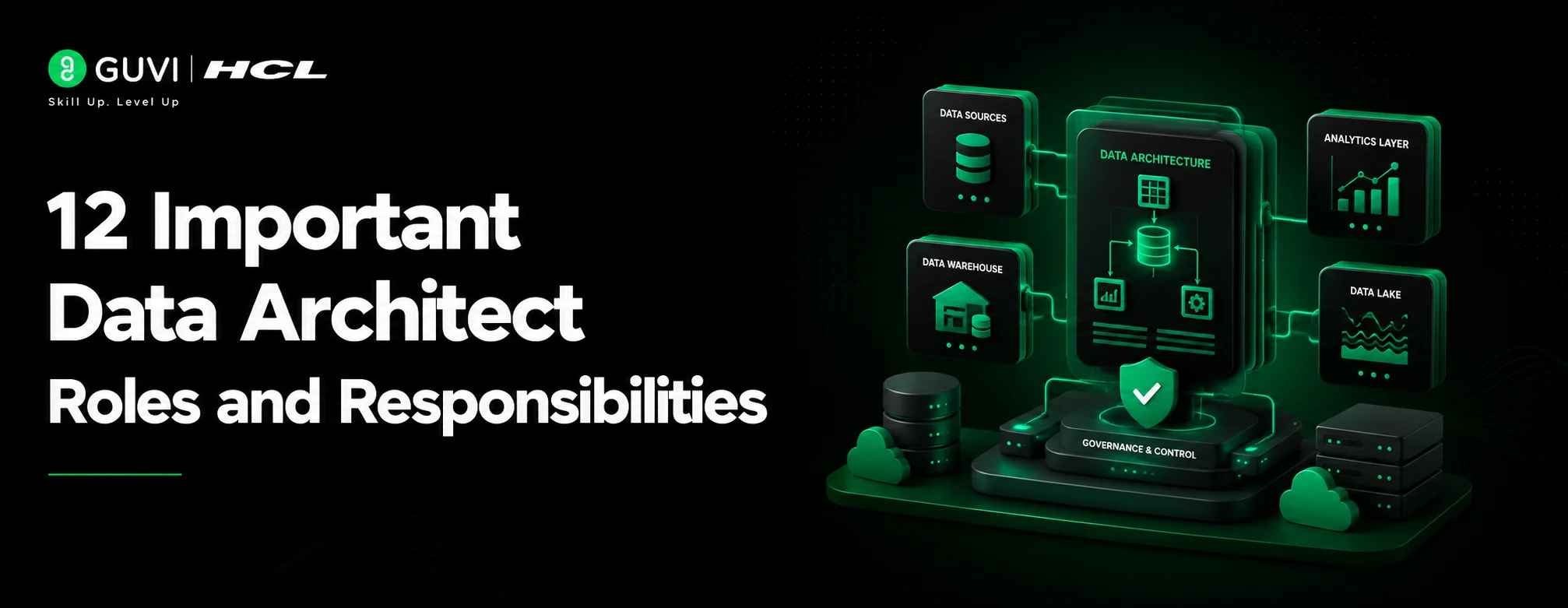
12 Important Data Architect Roles and Responsibilities
Jul 08, 2026 10 Min Read 572 Views
(Last Updated)
Table of contents
- TL;DR Summary
- What is a Data Architect?
- Why Do Companies Need Data Architects?
- What are Data Architect Roles and Responsibilities ?
- Key Data Architecture Terms Beginners Should Know
- 12 Data Architect Roles and Responsibilities
- Understanding Business and Data Requirements
- Designing Data Architecture Blueprints
- Creating Data Models
- Planning Databases, Data Warehouses, and Data Lakes
- Defining Data Standards and Governance Rules
- Ensuring Data Security, Privacy, and Compliance
- Designing Data Integration and ETL/ELT Flows
- Choosing the Right Data Tools and Platforms
- Supporting Cloud and Big Data Architecture
- Improving Data Quality and Consistency
- Collaborating with Data Engineers, Analysts, and Business Teams
- Planning Data Migration, Scalability, and Performance
- How Data ArchitectRoles and Responsibilities Change by Experience Level
- Different Data Architect Career Paths You Can Explore
- Real-World Example: Data Architect in an E-commerce Company
- Data Architect vs Data Engineer vs Data Scientist
- How Data Architect Roles and Responsibilities are Changing in 2026
- Cloud Data Architecture is Becoming More Important
- AI and GenAI Need Better Data Foundations
- Data Governance is Becoming a Core Responsibility
- Real-Time Data is Becoming More Common
- Data Architects are Becoming Business Partners
- Skills Required for Data Architect Roles and responsibilities
- How to Become a Data Architect: Quick Glance
- A Day in the Life of a Data Architect
- Common Mistakes Beginners Make About Data Architect Roles and responsibilities
- Thinking Data Architecture is Only Database Design
- Ignoring Business Requirements
- Skipping Data Governance
- Not Understanding Data Pipelines
- Learning Tools Without Understanding Design
- Build Job-Ready Data Science Skills With HCL GUVI
- Final Thoughts
- FAQs
- What are Data Architect roles and responsibilities?
- What does a Data Architect do daily?
- What skills are required for Data Architect roles?
- Is Data Architect a good career?
- Can freshers become Data Architects?
- What is the difference between Data Architect and Data Engineer?
- What is the difference between Data Architect and Data Scientist?
- Does a Data Architect need coding?
- Which tools do Data Architects use?
- How are Data Architect roles changing in 2026?
TL;DR Summary
Data Architect roles and responsibilities include designing how data is collected, stored, organized, secured, integrated, and used across an organization. A Data Architect creates data models, defines database structures, plans data warehouses or data lakes, sets governance rules, supports cloud data systems, and works with data engineers, analysts, and business teams. Their main goal is to make data reliable, accessible, secure, and useful for decision-making.
Data Architect roles and responsibilities focus on building the structure that helps companies manage and use data properly.
Every company collects data from websites, apps, customers, sales, payments, operations, and internal tools. But collecting data is not enough. If that data is messy, duplicated, insecure, or difficult to access, teams cannot use it properly.
This is where a Data Architect becomes important.
A Data Architect designs how data should flow, where it should be stored, how it should be protected, and how different teams can use it for analytics, reporting, AI, and business decisions.
In this guide, you will learn what a Data Architect does, their key responsibilities, required skills, career paths, 2026 role changes, common mistakes, and FAQs.
What is a Data Architect?
A Data Architect is a data professional who designs the blueprint for how an organisation collects, stores, manages, connects, and protects its data.
In simple words, a Data Architect decides how data systems should be structured so that data engineers, analysts, data scientists, and business teams can use data correctly.
For example, imagine an e-commerce company collecting customer details, product clicks, orders, payments, delivery updates, reviews, and support tickets. A Data Architect decides how all this data should be organised and connected.
A good data architecture helps companies avoid duplicate data, poor reporting, security risks, and confusion between teams.
A strong understanding of database management helps beginners understand how Data Architects organise, store, and maintain business data.
Why Do Companies Need Data Architects?
Companies need Data Architects because modern businesses depend on clean, secure, and well-organised data.
Without proper data architecture, different teams may store the same data in different formats. One team may define a customer in one way, while another team may use a different definition. This can lead to wrong reports, slow analysis, poor customer insights, and security issues.
A Data Architect helps companies build a strong data foundation. They make sure data is stored in the right systems, follows common standards, and can be used safely for analytics, dashboards, AI models, and business decisions.
For example, a banking company needs accurate customer, transaction, loan, and risk data. A Data Architect helps design systems where this data remains secure, consistent, and useful across departments.
What are Data Architect Roles and Responsibilities ?
The main roles and responsibilities of a Data Architect are to design, organize, secure, and improve the data systems used by an organization.
A Data Architect works on data models, databases, data warehouses, data lakes, cloud platforms, governance rules, data integration, and scalability planning. Their work helps companies use data confidently and avoid messy or unreliable systems.
Common Data Architect roles and responsibilities include:
- Understanding business and data requirements
- Designing data architecture blueprints
- Creating data models
- Planning databases, data warehouses, and data lakes
- Defining data standards and governance rules
- Ensuring data security and privacy
- Designing data integration flows
- Choosing the right data tools and platforms
- Supporting cloud and big data architecture
- Improving data quality and consistency
- Working with data engineers, analysts, and business teams
- Planning data migration, scalability, and performance improvements
In simple words, a Data Architect creates the structure that allows data to move, grow, and support business decisions without becoming confusing or unreliable.
Key Data Architecture Terms Beginners Should Know
Before understanding Data Architect roles and responsibilities in detail, it helps to know a few common data architecture terms.
| Term | Simple Meaning |
| Data Model | A structure that shows how data is organised and connected |
| Database | A system used to store and manage data |
| Data Warehouse | A central system used for reporting and analytics |
| Data Lake | A storage system that keeps large volumes of raw or semi-structured data |
| ETL | A process that extracts, transforms, and loads data |
| ELT | A process where data is extracted, loaded, and then transformed |
| Data Governance | Rules for managing data quality, access, security, and usage |
| Metadata | Information that describes data, such as source, format, and meaning |
| Master Data | Core business data like customers, products, employees, or vendors |
These terms will help you understand how Data Architects design systems that make data easier to store, access, secure, and analyse.
For a broader industry view, beginners can also explore DAMA-DMBOK, a recognised data management framework that covers areas like data governance, data architecture, metadata, data quality, and data security.
12 Data Architect Roles and Responsibilities
Data Architect roles and responsibilities are not limited to designing databases.
A Data Architect works on the complete data structure of an organisation, from data collection and storage to security, governance, analytics, and scalability.
Here are the main responsibilities you will commonly see in Data Architect job roles.
1. Understanding Business and Data Requirements
One of the most important Data Architect roles and responsibilities is to first understand what the business wants to achieve with data.
They speak with business teams, data analysts, engineers, product teams, and leadership to understand reporting, analytics, compliance, and operational needs.
For example, if a retail company wants to analyse customer buying patterns, the Data Architect identifies what customer, product, order, and payment data must be captured and connected.
This step is important because good architecture starts with real business needs, not just tools.
2. Designing Data Architecture Blueprints
A Data Architect creates the overall blueprint for how data will move across systems.
This includes deciding where data will come from, where it will be stored, how it will be processed, and who can access it.
For example, in an e-commerce company, the blueprint may show how website data, payment data, inventory data, and delivery data flow into a central analytics platform.
This blueprint helps technical teams understand how the entire data system should work.
3. Creating Data Models
Data Architects design data models that show how different data entities are related.
These entities may include customers, products, orders, payments, employees, vendors, or transactions.
For example, a customer table may connect with order details, payment history, support tickets, and delivery status to give a complete view of the customer journey.
Data modelling helps companies avoid confusion and makes data easier to query, analyse, and maintain.
Beginners can first learn data models in DBMS to understand how tables, entities, relationships, and business rules are represented in a structured way.
4. Planning Databases, Data Warehouses, and Data Lakes
A Data Architect decides which storage systems are needed for different types of data.
Some data may go into operational databases, some into data warehouses, and some into data lakes.
For example, daily app transactions may be stored in a database, while historical sales data may be moved into a data warehouse for reporting and analysis.
The goal is to choose the right storage system based on speed, cost, structure, reporting needs, and business usage.
A Data Architect should also understand relational vs non-relational databases because different use cases may need different storage models.
5. Defining Data Standards and Governance Rules
Data Architects define rules for how data should be named, stored, accessed, cleaned, and managed.
These standards help different teams use data consistently.
For example, one team should not store “customer ID” as cust_id while another stores it as client_number without a clear mapping. Data standards reduce confusion and reporting errors.
Data governance also helps companies manage privacy, compliance, ownership, and accountability.
6. Ensuring Data Security, Privacy, and Compliance
A Data Architect helps design secure data systems.
They decide how sensitive data should be protected, who can access it, and how data privacy rules should be followed.
For example, in a healthcare platform, patient data must be stored securely and accessed only by authorised users. The Data Architect helps design this access and security structure.
This responsibility has become more important because companies now handle large volumes of personal, financial, customer, and business-sensitive data.
7. Designing Data Integration and ETL/ELT Flows
Data often comes from many sources, such as apps, websites, CRMs, payment systems, marketing tools, and third-party platforms.
A Data Architect plans how this data should be integrated into one usable system.
For example, a company may need to combine sales data from Shopify, marketing data from ads, and customer data from a CRM to create one business dashboard.
A good integration design makes sure data is accurate, updated, and usable across teams.
To practise this concept, beginners can try data integration project ideas that involve combining data from multiple sources into one useful system.
8. Choosing the Right Data Tools and Platforms
A Data Architect helps choose the right tools for storage, processing, analytics, governance, and cloud data management.
For example, based on the company’s size and needs, they may recommend PostgreSQL, Snowflake, BigQuery, Databricks, AWS Redshift, Azure Synapse, or other data platforms.
The best tool is not always the most popular one. A Data Architect chooses tools based on business needs, scalability, security, cost, team skills, and future growth.
For example, Google describes BigQuery as a serverless cloud data warehouse that can run fast analytics queries at very large scale.
Tools like Databricks for data analysis are also useful to understand because many modern data teams use platforms that support analytics, big data, and AI-ready workflows.
9. Supporting Cloud and Big Data Architecture
Many companies now store and process data on cloud platforms.
A Data Architect helps design cloud-based data systems that are scalable, secure, and cost-efficient.
For example, if a company moves from on-premise databases to AWS or Google Cloud, the Data Architect plans how data should be migrated and managed in the cloud.
They may also work with big data systems when the company handles large volumes of structured and unstructured data.
For example, AWS shows how a modern data analytics architecture can collect data from multiple enterprise sources and move it into analytics systems for business insights.
Since modern data systems often run on cloud platforms, comparing AWS vs Azure vs Google Cloud can help learners understand how cloud choices affect data architecture.
10. Improving Data Quality and Consistency
Data Architects help reduce duplicate, incomplete, outdated, or inconsistent data.
They define systems and rules that improve data quality over time.
For example, if the same customer appears with different phone numbers in multiple systems, the Data Architect helps design a method to identify and manage the correct customer record.
Good data quality is important because poor data leads to poor decisions.
11. Collaborating with Data Engineers, Analysts, and Business Teams
A Data Architect does not work alone.
They collaborate with data engineers who build pipelines, analysts who create reports, data scientists who build models, and business teams who use insights.
For example, if analysts need faster access to sales data, the Data Architect works with data engineers to design a better data pipeline and warehouse structure.
This collaboration helps technical and business teams work with the same data understanding.
12. Planning Data Migration, Scalability, and Performance
As companies grow, their data systems must handle more users, more records, and more complex analytics.
A Data Architect plans for this growth.
For example, if a food delivery app expands to more cities, the Data Architect ensures the data system can handle more orders, restaurants, delivery partners, and real-time tracking data without slowing down.
These data architect roles and responsibilities helps organizations avoid future performance issues and expensive redesigns.
According to the U.S. Bureau of Labor Statistics, employment for database administrators and architects is projected to grow 4% from 2024 to 2034, with about 7,800 openings projected each year on average.
This shows that data architecture remains a steady career path as organisations continue to depend on structured, secure, and scalable data systems.
How Data Architect Roles and Responsibilities Change by Experience Level
Data Architect roles and responsibilities change as you gain experience.
A beginner may start by understanding databases, SQL, data models, and data pipelines. As the role grows, the work becomes more focused on architecture decisions, governance, cloud systems, business strategy, and leadership.
| Level | Main Focus | Common Responsibilities |
| Junior Data Professional | Data basics and support | Works with SQL, databases, reports, and simple data models |
| Data Engineer / Data Analyst | Data pipelines or analysis | Builds pipelines, prepares data, creates reports, or supports analytics |
| Data Architect | Data system design | Designs data models, storage systems, governance rules, and data flows |
| Senior Data Architect | Enterprise architecture | Handles complex systems, cloud architecture, security, and scalability |
| Lead / Principal Data Architect | Strategy and leadership | Defines data architecture standards and guides organisation-wide data decisions |
In simple words, early-career professionals work more with data tasks, while Data Architects focus on designing the systems and rules that make data reliable across the organisation.
Different Data Architect Career Paths You Can Explore
Data architect roles and responsibilities are not limited to one job title.
Once you understand databases, data modelling, governance, cloud platforms, and data pipelines, you can move into different architecture roles based on your interest.
| Career Path | What They Mainly Do |
| Data Architect | Designs the overall structure for data storage, movement, and usage |
| Cloud Data Architect | Designs cloud-based data systems on AWS, Azure, or Google Cloud |
| Enterprise Data Architect | Creates organisation-wide data standards and architecture strategy |
| Data Warehouse Architect | Designs data warehouse systems for reporting and analytics |
| Big Data Architect | Designs systems for large-scale data processing and storage |
| Data Governance Architect | Focuses on data quality, privacy, access, compliance, and standards |
| Solution Architect | Designs broader technology solutions that may include data systems |
| AI Data Architect | Designs data foundations used for AI, ML, and GenAI systems |
If you are a beginner, you do not need to choose an advanced path immediately.

Start with SQL, databases, data modelling, and data engineering basics. Once your foundation is strong, you can move toward cloud data architecture, governance, big data, or AI-focused data architecture.
Real-World Example: Data Architect in an E-commerce Company
Imagine an e-commerce company that sells products through a website and mobile app.
The company collects data from product searches, customer accounts, shopping carts, payments, delivery updates, returns, reviews, and customer support.
If this data is not organised properly, teams may struggle to understand sales trends, customer behaviour, inventory issues, and delivery delays.
A Data Architect designs how all this data should be stored and connected.
They may create data models for customers, products, orders, payments, and delivery partners. They also decide how this data moves into a data warehouse for analytics.
This helps business teams track best-selling products, marketing teams understand customer behaviour, and operations teams improve delivery performance.
Data Architect vs Data Engineer vs Data Scientist
Many beginners confuse Data Architect, Data Engineer, and Data Scientist because all three work with data.
The simple difference is this:
A Data Architect designs the data system, a Data Engineer builds the data pipelines, and a Data Scientist uses data to create insights, predictions, or machine learning models.
| Role | Main Focus | Simple Meaning |
| Data Architect | Data system design and strategy | Designs how data should be stored, connected, secured, and used |
| Data Engineer | Data pipelines and infrastructure | Builds systems that move, clean, and process data |
| Data Scientist | Insights and predictive models | Uses data to find patterns, build models, and support decisions |
So, if the question is about how data should be structured and governed, it usually comes under the Data Architect role.
If the question is about building pipelines, it usually comes under the Data Engineer role.
If the question is about predictions, models, or advanced analysis, it usually comes under the Data Scientist role.
How Data Architect Roles and Responsibilities are Changing in 2026
Data Architect roles and responsibilities are changing in 2026 because companies are using more cloud platforms, AI tools, real-time analytics, and data-driven decision-making.
Earlier, data architecture was mostly about databases and data warehouses. Now, Data Architects also work with cloud ecosystems, governance frameworks, AI-ready data, privacy rules, and scalable data platforms.
1. Cloud Data Architecture is Becoming More Important
Companies are moving data systems to AWS, Azure, Google Cloud, Snowflake, Databricks, and similar platforms.
This means Data Architects need to understand cloud storage, data warehouses, data lakes, security, cost optimisation, and scalable architecture.
2. AI and GenAI Need Better Data Foundations
AI systems need clean, secure, and well-structured data.
A Data Architect helps design the data foundation that supports AI models, analytics platforms, recommendation systems, and GenAI applications.
This is why modern Data Architects are not only thinking about storage. They are also thinking about whether the data is useful, trusted, governed, and ready for AI use cases.
3. Data Governance is Becoming a Core Responsibility
As companies collect more data, they need stronger rules for privacy, access, quality, compliance, and responsible data use.
This makes data governance one of the most important responsibilities for modern Data Architects.
Without governance, data becomes difficult to trust, especially when companies use it for analytics, automation, and AI.
4. Real-Time Data is Becoming More Common
Many businesses now need real-time or near real-time data for fraud detection, customer tracking, recommendations, logistics, and monitoring.
Architects help design systems that can handle fast-moving data without affecting quality or performance.
5. Data Architects are Becoming Business Partners
Modern Data Architects are not only technical designers.
They also understand business goals, translate them into data solutions, and help companies use data for better decisions.
This means communication, documentation, and stakeholder management are becoming just as important as technical knowledge.
Gartner’s 2026 data and analytics updates highlight that organisations with successful AI initiatives invest much more strongly in data and analytics foundations.
This matters because AI success does not depend only on models. Companies also need clean, governed, secure, and well-structured data, which is where Data Architects play an important role.
Skills Required for Data Architect Roles and responsibilities
To work as a Data Architect, you need a mix of data knowledge, technical skills, system design thinking, and business understanding.
Freshers can start with SQL, databases, data modelling, DBMS concepts, and basic data engineering. These skills help you understand how data is stored, queried, cleaned, and connected.
As you grow, you can build skills in data warehousing, data lakes, ETL/ELT, cloud platforms, big data tools, data governance, security, and architecture design.
Important technical skills include:
- SQL
- Database design
- Data modelling
- DBMS concepts
- Data warehousing
- Data lakes
- ETL and ELT concepts
- Cloud platforms
- Big data basics
- Data pipelines
- Metadata management
- Data governance
- Data quality
- Data security
- Analytics systems
- Basic Python or scripting
Learners interested in analytics can also explore SQL for data science to understand how SQL supports querying, filtering, and preparing data.
Apart from tools, Data Architects also need communication, documentation, problem-solving, stakeholder management, and business thinking.
A good Data Architect does not just design systems. They design systems that solve real business problems.
How to Become a Data Architect: Quick Glance
To become a Data Architect, start with strong data fundamentals and then build experience in databases, data modelling, data engineering, cloud platforms, and governance.
Here is a simple path beginners can follow:
- Learn SQL and database fundamentals
- Understand DBMS, data models, and relationships
- Learn data warehousing and data lake basics
- Practise data modelling with real business examples
- Learn ETL/ELT and data pipeline concepts
- Build basic knowledge of cloud platforms like AWS, Azure, or Google Cloud
- Understand data governance, privacy, and security basics
- Work on real data projects and architecture case studies
- Move into data engineering, analytics, or database roles
- Grow toward data architecture through hands-on experience
You do not need to become a Data Architect on day one.
Most professionals move into this role after gaining experience in data engineering, database administration, analytics, BI development, or cloud data roles.
If you are planning this career path, reviewing a data engineering syllabus can help you understand the core skills needed before moving into data architecture.
A Day in the Life of a Data Architect
A day in the life of a Data Architect usually includes reviewing data requirements, designing data models, discussing architecture decisions, checking data quality issues, and working with data teams.
They may start the day by reviewing a new business requirement, such as adding customer segmentation to a dashboard.
Then they may check whether the required data already exists, where it is stored, and whether it needs a new data model or pipeline.
They also spend time in meetings with data engineers, analysts, product teams, security teams, and business stakeholders.
The main goal of data architect roles and responsibilities stays the same: making sure the company’s data systems are reliable, scalable, secure, and useful.
Common Mistakes Beginners Make About Data Architect Roles and responsibilities
Beginners often think Data Architects only design databases, but the role is much broader.
Here are some common mistakes to avoid.
1. Thinking Data Architecture is Only Database Design
Database design is part of the role, but Data Architects also work on governance, integration, cloud systems, security, data quality, and scalability.
2. Ignoring Business Requirements
A data system is useful only when it solves business problems.
Always understand what teams need from the data before designing the architecture.
3. Skipping Data Governance
Without governance, data can become duplicated, inconsistent, or insecure.
Learn the basics of data quality, access control, privacy, metadata, and ownership early.
4. Not Understanding Data Pipelines
Data Architects do not always build every pipeline, but they must understand how data moves between systems.
This helps them design better architecture.
5. Learning Tools Without Understanding Design
Tools keep changing, but architectural thinking stays valuable.
Focus on data modelling, system design, scalability, and governance before chasing every new tool.
Build Job-Ready Data Science Skills With HCL GUVI
Data Architect roles and responsibilities are closely connected to data science, analytics, databases, data modelling, and AI-ready data systems.
If you want to build a strong foundation in data-driven careers, explore HCL GUVI’s Data Science Course. It can help you learn core concepts like Python, SQL, data analysis, machine learning, and real-world data handling through practical learning.
Start building your data science foundation with GUVI and move closer to high-growth roles in data, analytics, and AI.
Final Thoughts
Data Architect roles and responsibilities are important because every data-driven company needs clean, secure, scalable, and well-organised data systems.
A Data Architect designs the blueprint for how data is stored, connected, governed, and used across teams. They work with data engineers, analysts, business teams, and security teams to make data reliable and useful.
For beginners, the best starting point is SQL, databases, data modelling, and data engineering basics.
As you gain experience, you can move toward cloud data architecture, governance, big data systems, and AI-ready data platforms.
FAQs
1. What are Data Architect roles and responsibilities?
Data Architect roles and responsibilities include designing data systems, creating data models, planning databases and data warehouses, defining governance rules, ensuring data security, and helping teams use data effectively.
2. What does a Data Architect do daily?
A Data Architect reviews business requirements, designs data models, plans data flows, checks architecture decisions, works with data engineers and analysts, and ensures data systems are reliable, secure, and scalable.
3. What skills are required for Data Architect roles?
Data Architect roles require SQL, database design, data modelling, data warehousing, data lakes, ETL/ELT concepts, cloud platforms, data governance, security basics, and business communication skills.
4. Is Data Architect a good career?
Yes, Data Architect is a good career for professionals interested in data systems, cloud platforms, analytics, and enterprise data strategy. It is usually a mid to senior-level role that requires strong data experience.
5. Can freshers become Data Architects?
Freshers usually do not start directly as Data Architects. They can begin with roles like data analyst, database developer, data engineer, BI developer, or database administrator and move into data architecture after gaining experience.
6. What is the difference between Data Architect and Data Engineer?
A Data Architect designs how data systems should be structured, while a Data Engineer builds and maintains the pipelines that move and process data. The architect creates the blueprint, and the engineer builds the system.
7. What is the difference between Data Architect and Data Scientist?
A Data Architect designs the data foundation, while a Data Scientist uses data to build insights, predictions, and machine learning models. Data Scientists depend on well-structured data systems designed by architects.
8. Does a Data Architect need coding?
A Data Architect does not always write production code daily, but they should understand SQL, databases, data pipelines, cloud systems, and sometimes Python or scripting. Coding knowledge helps them design practical and scalable systems.
9. Which tools do Data Architects use?
Data Architects may use SQL databases, Snowflake, BigQuery, Redshift, Databricks, ER modelling tools, cloud platforms, metadata tools, data catalogues, and governance platforms.
10. How are Data Architect roles changing in 2026?
Data Architect roles are changing with cloud platforms, AI-ready data systems, real-time analytics, stronger data governance, and privacy requirements. Modern Data Architects need both technical architecture skills and business understanding.
Success Stories

About the Author
Reemsha Khan
Always been a storyteller at heart. Now, I turn complex topics into simple, easy-to-understand stories through content. Hope you find it helpful.
View all posts by Reemsha Khan
Connect with me @










Did you enjoy this article?