


Artificial Intelligence and Machine Learning Articles
How to Evaluate LLM Outputs in Production Deployments
AI/ML Skills Gap 2026: Why Companies Can't Find Job-Ready Talent
20 AI/ML Interview Questions Recruiters Can Use Without a Tech Background - Best Guide
How Industry-Backed AI/ML Bootcamps Are Changing the AI/ML Hiring Pipeline - Best Guide 2026


Get In Touch For Details! Request More Information
Data Models in DBMS: A Complete Beginner’s Guide
Jun 24, 2026 6 Min Read 1007 Views
(Last Updated)
Every app, from food delivery to banking and social media, needs structured data storage for speed, consistency, and concurrent access. That’s where DBMSes shine, helping organizations navigate organizational chaos with smart blueprints. At their core? The data model decision that defines structure, relationships, and queries.
Wrong model = future pain: complex rework for evolving needs, scalability walls, ballooning costs. The right model from day one builds systems that scale effortlessly vs. maintenance nightmares. Choose wisely; it’s your app’s lifelong foundation.
In this article, we will walk through every major type of Data Models in DBMS: hierarchical, network, relational, entity-relationship, object-oriented, and object-relational, explaining what each one is, how it works, where it is used in the real world, and what its advantages and limitations are.
Table of contents
- TL;DR:
- The Three Levels of Data Models
- The Hierarchical Data Model
- Origins and Structure
- How It Works: Family Tree Analogy
- Strengths and Limitations
- The Network Data Model
- Response to Hierarchical Limitations
- Core Structure and Flexibility
- Real-World Examples
- Trade-offs and Legacy
- The Relational Data Model
- Introduction and Dominance
- Fundamental Structure
- Power Through Simplicity and SQL
- Key Innovation: Data Independence
- The Entity-Relationship Model
- Conceptual Role in Design
- High-Level Purpose
- ER Diagram Elements
- From Design to Implementation
- The Object-Oriented Data Model
- Evolution from OOP Needs
- Core Object Structure
- Key Features and Inheritance
- Use Cases and Limitations
- The Object-Relational Data Model
- PostgreSQL as Prime Example
- Ideal Use Cases
- Choosing the Right Data Model
- Final Thoughts
- FAQs
- Should I ever use hierarchical or network models in 2026?
- Is the ER model a "real" database model?
- Why didn't object-oriented databases win?
- What's the difference between logical and physical models?
- Which model should I learn first as a beginner?
TL;DR:
- Hierarchical: Tree structure (1 parent → many children). Fast but rigid. Legacy mainframes.
- Network: Graph-like (many-to-many). Complex to maintain. Inspired modern graph DBs.
- Relational: Tables + SQL. Dominant everywhere. Flexible + mature tooling.
- ER Model: Design blueprint (entities → relationships). Converts to relational tables.
- Object-Oriented: Stores programming objects directly. Niche; ORM won instead.
- Object-Relational: Relational + OO features (PostgreSQL). Best of both worlds.
What Is a Data Model in DBMS?
A data model in DBMS is a blueprint that defines how data is organized, stored, and related. It serves as the structural foundation on which all database design decisions are built.
The Three Levels of Data Models
Before getting into the specific model types, it is worth understanding that data models exist at three different levels of abstraction. Each level serves a different audience and a different purpose in the database design process.
- Key types include conceptual, logical, and physical models, each suited to different clarity, complexity, and performance needs.
- The conceptual level is the highest; it describes what data exists and how it relates to other data, without worrying about how it will be stored technically.
- This is the level where you communicate with business stakeholders and non-technical team members. The ER model lives here.
- The logical level sits below conceptual. It describes the structure of data in enough detail that a developer can implement it with tables, columns, keys, and relationships, but without tying it to any specific database system or storage technology.
- The relational, hierarchical, network, and object-oriented models all operate at this level. The physical level is the lowest, describing exactly how data is stored on disk file formats, indexes, partitions, and storage structures.
- This is where performance tuning lives, and it is typically managed by the database system itself rather than by developers directly.
The Hierarchical Data Model
Origins and Structure
The hierarchical model was one of the earliest data models, developed in the 1960s for IBM’s Information Management System, known as IMS.
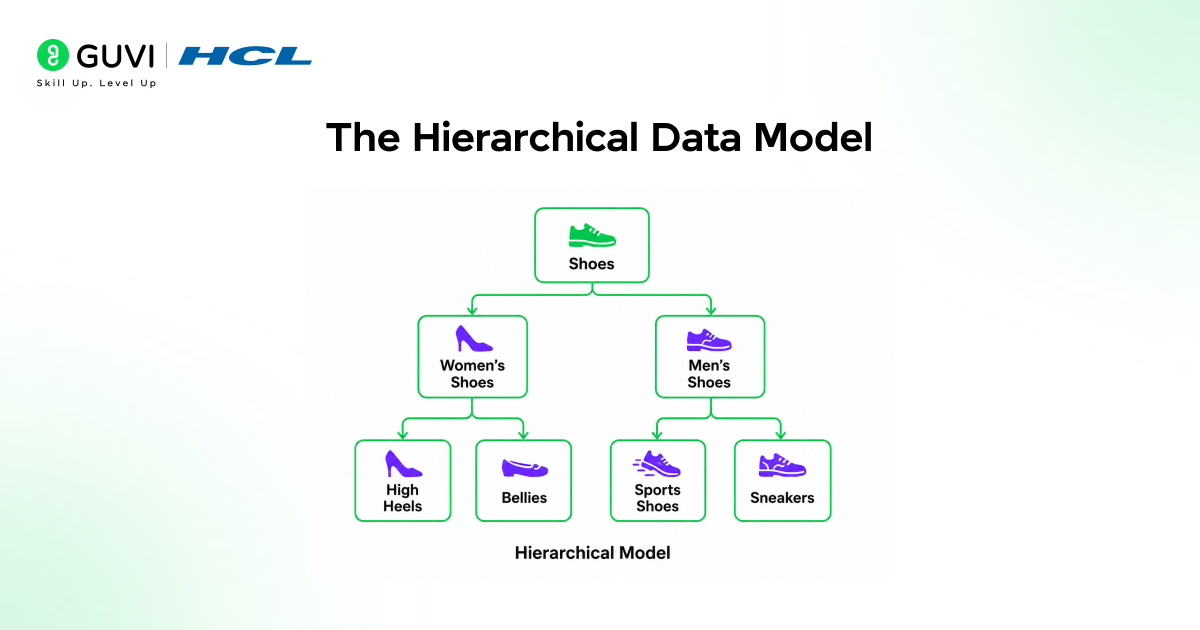
It organizes data in a tree-like structure where every record has exactly one parent, and a parent can have multiple children. In a hierarchical model, data is organized into a tree-like structure where each record consists of one parent record and many children.
Even if the segments are connected as a chain-like structure by logical associations, the structure can be a fan structure with multiple branches.
How It Works: Family Tree Analogy
Think of it like a family tree: one grandparent at the top, multiple parents below, and multiple children below each parent.
Navigation through a hierarchical database always starts at the root and moves downward through the branches.
Strengths and Limitations
The practical strength of this model is speed. Because the relationships are pre-defined and fixed, traversing from parent to child is extremely fast.
This made it ideal for mainframe-era applications where data relationships were simple and predictable, such as payroll systems, airline reservation systems, and organizational charts. The limitation is rigidity.
If your data has a many-to-many relationship where one child record needs to belong to multiple parents, the hierarchical model cannot represent that naturally.
It also makes restructuring expensive because changing the tree structure requires reorganizing large amounts of stored data.
The Network Data Model
Response to Hierarchical Limitations
The network model was developed as a direct response to the hierarchical model’s biggest weakness, its inability to represent many-to-many relationships. In 1971, the Conference on Data Systems Languages (CODASYL) formally defined the network model.
The basic data modeling construct in the network model is the set construct. A set consists of an owner record type, a set name, and a member record type. A member record type can have that role in more than one set; hence, the multiparent concept is supported.
Core Structure and Flexibility
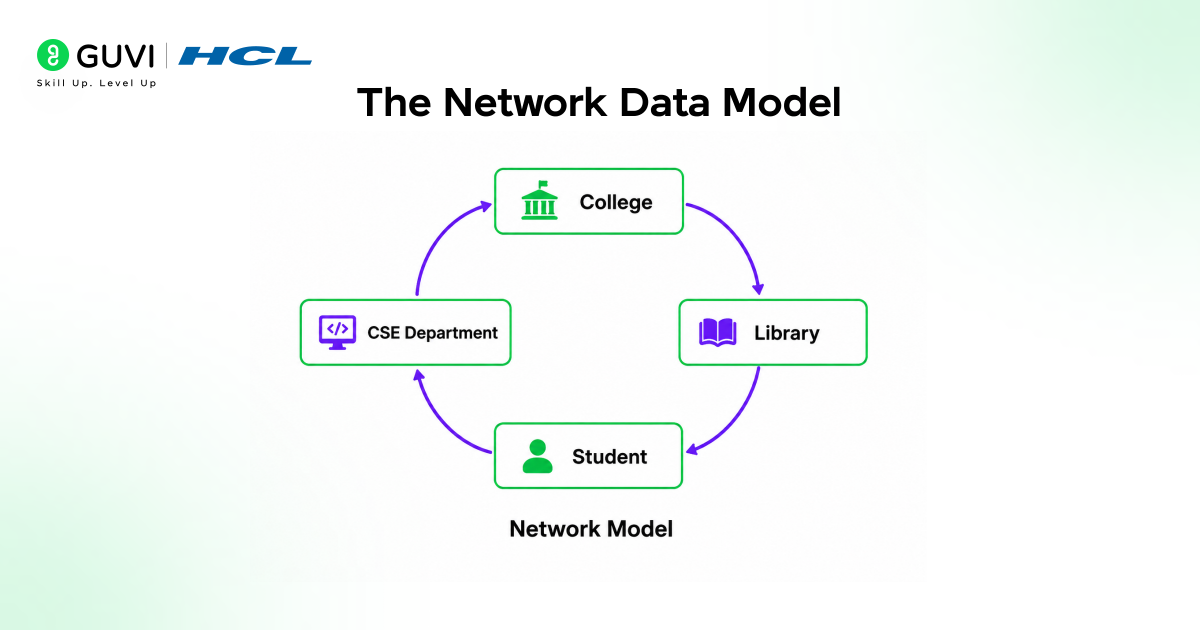
The network model extends the hierarchical model by allowing more complex relationships, including many-to-many relationships. Data is represented using node entities and edge relationships. The network model builds upon the hierarchical model by enabling a child record to have more than one parent, leading to a graph-like structure.
Real-World Examples
A student can belong to multiple courses, and a course can have multiple students. A product can be supplied by multiple suppliers, and a supplier can provide multiple products. These relationships that break the hierarchical model are natural in the network model.
Real-world use cases include telecommunications systems, transportation networks, and manufacturing systems where components are shared across multiple products.
Trade-offs and Legacy
While the network model is efficient for certain use cases, it is difficult to maintain due to its complexity. As relationships multiply, the web of connections becomes hard to visualize, hard to query, and hard to modify without introducing errors.
For this reason, the network model was largely displaced by the relational model in the 1980s and 1990s, though its concepts influenced modern graph databases like Neo4j.
The Relational Data Model
Introduction and Dominance
The relational model is the dominant data model in use today, and it is almost certainly what you encounter first when you study databases. The relational model, proposed by E.F. Codd in 1970, is the most widely used database model.
Fundamental Structure
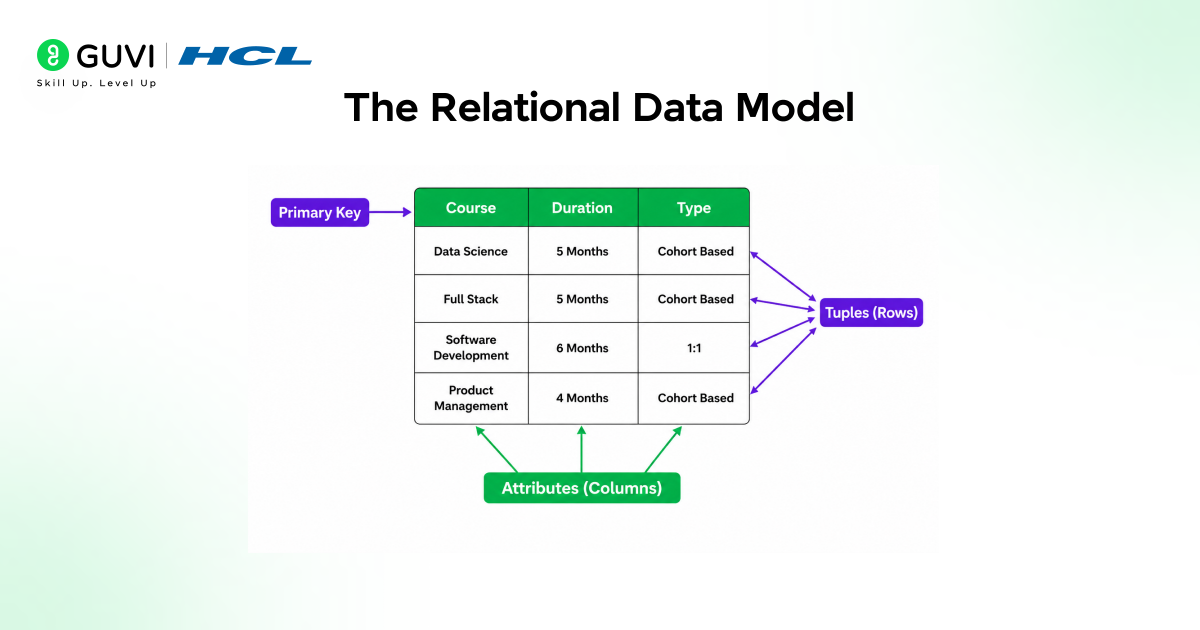
It organizes data into tables called relations, consisting of rows called tuples and columns called attributes. Each table represents a real-world entity, and relationships between tables are established through foreign keys.
Power Through Simplicity and SQL
The power of the relational model comes from its simplicity and its mathematical foundation in set theory. Data lives in tables. Tables connect through shared key values. You query the data using SQL (Structured Query Language), which allows you to ask complex questions across multiple tables with a single statement.
Adding new data, modifying existing data, and creating new relationships between tables are all straightforward operations.
This flexibility made the relational model the foundation of MySQL, PostgreSQL, SQLite, Microsoft SQL Server, and Oracle, the databases that power the majority of the world’s web applications, business software, and enterprise systems.
Key Innovation: Data Independence
The relational model also introduced the concept of data independence, the idea that the physical storage of data can change without affecting how applications interact with it.
This separation between the logical structure and the physical implementation is one of the reasons relational databases have remained dominant for over five decades.
The Entity-Relationship Model
Conceptual Role in Design
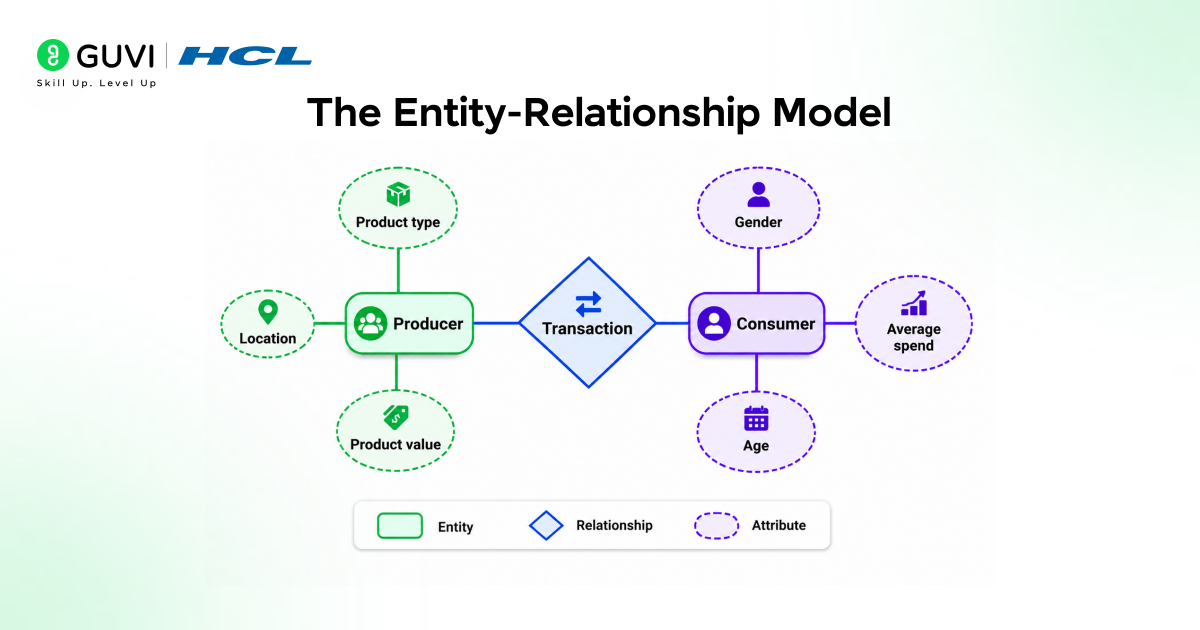
The entity-relationship model, commonly called the ER model, is a conceptual tool used in the design phase of database development. Unlike the other models we have discussed, it is not a model you actually implement in a database system; it is a modeling language for designing the structure of a database before you build it.
High-Level Purpose
The ER model is a high-level data model that is used to define the data and the relationships between them. It is basically a conceptual design of any database, which makes it easy to design the view of data. The entity-relationship model describes object entities and the relationships among those entities for conceptual database design.

ER Diagram Elements
An ER diagram uses rectangles to represent entities, things like Customer, Product, or Order; ovals to represent attributes of those entities; and diamonds to represent relationships between them.
The cardinality of each relationship, whether it is one-to-one, one-to-many, or many-to-many, is marked on the connecting lines. The model is expressed using ER diagrams, which define entities, attributes, and relationships.
From Design to Implementation
The ER model is most commonly used in the early stages of database design. After the ER diagram is complete and approved by stakeholders, it is converted into a relational schema, a set of tables and foreign keys, before actual database implementation begins.
Understanding ER modeling is one of the most valuable skills for anyone starting in database design because it forces you to think clearly about what data you need and how different pieces of data connect before writing a single line of SQL.
The Object-Oriented Data Model
Evolution from OOP Needs
As object-oriented programming became the dominant programming paradigm in the 1980s and 1990s, a new question emerged: why should developers have to convert their objects into tables every time they write to a database and back into objects every time they read? The object-oriented data model was the answer.
Core Object Structure
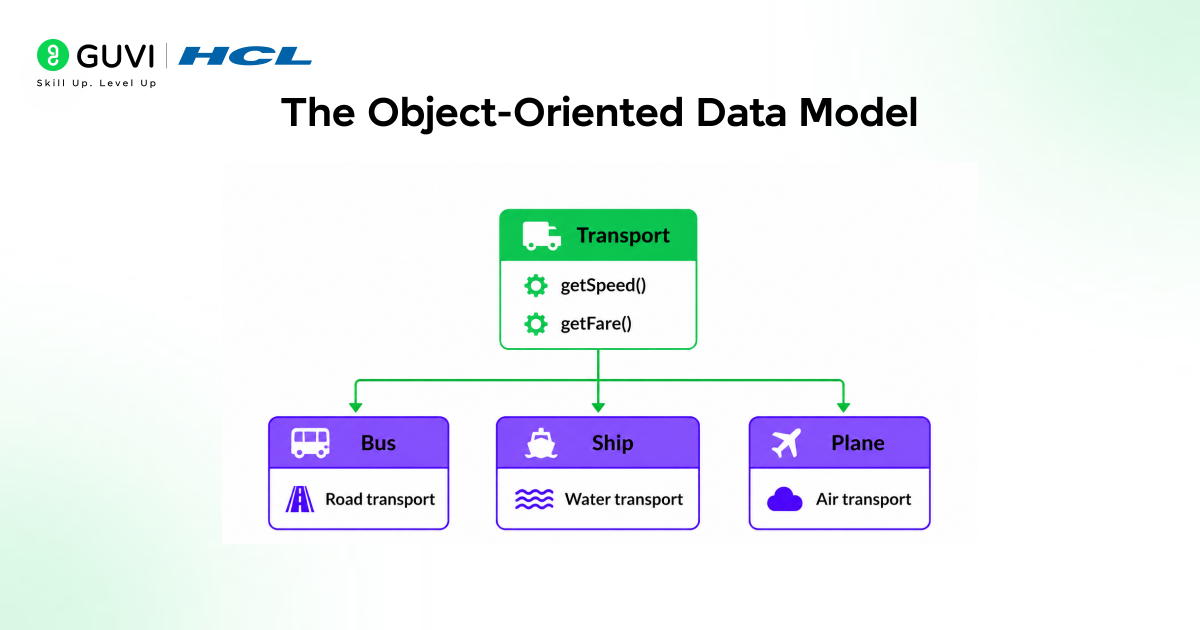
In the object-oriented data model, data and their relationships are contained in a single structure, which is referred to as an object. Real-world problems are represented as objects with different attributes. All objects have multiple relationships with each other.
An object in this model is the same as an object in programming; it has attributes (the data it contains) and methods (the operations it can perform).
Key Features and Inheritance
The database stores actual objects rather than rows and columns. Inheritance is supported, so a Dog object can inherit properties from an Animal object the same way it would in Java or Python.
The object-oriented data model integrates concepts from object-oriented programming into database management. It supports encapsulation, combining data and behavior, and inheritance hierarchies.
Use Cases and Limitations
Use cases include applications requiring complex data representations, such as CAD or CAM systems, multimedia applications, and programs using graphics or intricate structures.
The main limitation is that object-oriented databases have never achieved the widespread adoption of relational databases.
Partly because SQL was already deeply entrenched in enterprise systems and partly because mapping between the two worlds, the object world of application code and the relational world of databases, while imperfect, proved manageable enough through tools called ORM frameworks.
The Object-Relational Data Model
- The object-relational model bridges relational and object-oriented databases, extending SQL systems with OO features instead of fully replacing them.
- At its core, it’s a relational database enhanced to natively handle complex data types, inheritance, and encapsulation. This hybrid avoids the rigidity of pure relational schemas while retaining SQL’s power and familiarity.
1. PostgreSQL as Prime Example
PostgreSQL exemplifies object-relational design, fundamentally relational yet packed with OO capabilities like custom data types, table inheritance, array columns, and even methods on types.
You write standard SQL for 90% of queries but model nested structures (JSON-like hierarchies and geometric shapes) without awkward normalization. Result: cleaner schemas, faster development for semi-structured data.
2. Ideal Use Cases
Perfect for apps that are 80% relational but need richer types in key domains. Scientific apps store flat experiment data in tables but use custom spatial types for coordinates.
E-commerce platforms keep products in rows, tagging colors/sizes as arrays; no join tables are needed. This targeted enhancement delivers relational reliability with OO expressiveness where it counts most.
The hierarchical database model from the 1960s still powers critical systems in industries like banking and airlines today.
The relational model, introduced by E.F. Codd, was initially overlooked but went on to dominate modern databases through SQL systems.
Meanwhile, graph databases like Neo4j revive concepts from the network model, and ideas from object-oriented databases continue to live on in ORMs and systems like PostgreSQL.
Choosing the Right Data Model
The choice of data model has long-term consequences that shape how easily your system can grow, adapt, and be maintained.
- For the vast majority of web and business applications, the relational model is the right starting point; it is mature, well-understood, supported by excellent tooling, and flexible enough to handle most requirements.
- Each data model has its limitations. The hierarchical model struggles with complex relationships, while the key-value model lacks support for advanced queries. The choice of model can lead to inefficiencies or expensive redesigns.
- Hierarchical models make sense when your data genuinely has a rigid tree structure like an organizational chart or a file system, and you need fast parent-to-child navigation.
- Network models are worth considering when many-to-many relationships are the core of your domain. Modern graph databases have revived this concept elegantly.
- Object-oriented and object-relational models are best when your data is genuinely complex and strongly tied to an object-oriented codebase.
Unlock pro tips on mastering relational, hierarchical, and network data models, plus real-world schema design and normalization techniques, by enrolling in HCL GUVI’s Intel & IITM Pravartak Certified Data Science course.
Final Thoughts
Data models in DBMS are the foundational concepts that everything else in database design builds on. Understanding these models helps in understanding how data is organized, connected, and accessed.
These models serve as blueprints that determine how data is stored, relationships are established, and people engage with the data.
Start by getting comfortable with the relational model and SQL; that knowledge will serve you in the majority of real-world projects you will encounter in your career.
Once you understand why the relational model works the way it does and what its trade-offs are, the other models will make much more sense because you can see exactly which problems they were designed to solve.
Every data model is an answer to a specific question about how to represent the real world inside a computer, and understanding the questions is just as important as understanding the answers.
FAQs
1. Should I ever use hierarchical or network models in 2026?
Rarely. Use them only for legacy mainframe migration or when data perfectly fits tree/graph structures. Modern alternatives (PostgreSQL JSON, Neo4j) are easier.
2. Is the ER model a “real” database model?
No, it’s conceptual only. Think whiteboard planning before building the actual relational tables.
3. Why didn’t object-oriented databases win?
ORM frameworks (Hibernate, SQLAlchemy) made relational + objects “good enough.” SQL’s enterprise dominance sealed the deal.
4. What’s the difference between logical and physical models?
Logical = “tables with keys” (what data). Physical = “B-tree indexes on SSD” (how it’s stored). Apps see logical; DB engine handles physical.
5. Which model should I learn first as a beginner?
Relational + SQL. Powers 90% of jobs. Master tables/keys/queries first, then explore NoSQL/graph when needed.
Success Stories

About the Author
Vishalini Devarajan
An Aerospace Engineer turned content writer, I focus on making complex concepts easy to understand through well-structured, reader-friendly blogs. Whether it’s a technical topic or a non-technical one, I love creating content that is clear, engaging, and impactful.
View all posts by Vishalini Devarajan
Connect with me @












Did you enjoy this article?