


Artificial Intelligence and Machine Learning Articles
Finance Manager to Data Analytics: Career Growth, Salary and Seniority
How to Evaluate LLM Outputs in Production Deployments
AI/ML Skills Gap 2026: Why Companies Can't Find Job-Ready Talent
20 AI/ML Interview Questions Recruiters Can Use Without a Tech Background - Best Guide


Get In Touch For Details! Request More Information

Everything You Need to Know About Model Context Protocol (MCP)
Jun 24, 2026 4 Min Read 698 Views
(Last Updated)
AI is incredibly powerful at creating text, code, and insights. But one issue is holding it back: AI can’t interact with the real world.
This implies no real-time data, no tool usage, and no ability to take real action without huge custom integrations.
The MCP (Model Context Protocol) transforms AI from a static model into a connected system.
In this article, we’ll break down how MCP works, why it matters, and how it is shaping the next generation of intelligent, connected AI systems.
Table of contents
- TL;DR
- How Existing AI Systems Fail
- What MCP Actually Does
- What MCP Enables in Modern AI Systems
- MCP Architecture
- MCP Versus Traditional AI Systems
- MCP vs RAG: Knowing the Difference
- Real-World Example of an MCP Flow
- Example (Conceptual workflow)
- Key Benefits of MCP
- Security Considerations You Cannot Ignore
- The Rise of AI Agents with MCP
- How to Get Started with MCP (Beginner Flow)
- Common Mistakes to Avoid
- The Bigger Shift: From Prompts to Systems
- Future of MCP
- Conclusion
- FAQs
- What is MCP in simple terms?
- How is MCP different from APIs?
- Is MCP only for developers?
- Can MCP reduce AI hallucinations?
- Is MCP required for AI agents?
- Is MCP difficult to implement?
TL;DR
- The MCP (Model Context Protocol) is an open standard that connects AI models with real-world tools, APIs, and data sources.
- It solves AI’s central limitation, being tied to its training data, and allows real-time interaction and action.
- The MCP simplifies integration of AI models by standardizing the way that models and external systems communicate, doing away with complex custom-built solutions.
- It is powering the next generation of intelligent agents that can retrieve data, run workflows, and automate tasks.
- The MCP protocol moves the practice of building AI systems away from solely prompt engineering and toward building intelligently connected systems.
What is the MCP Model Context Protocol guide?
The MCP Model Context Protocol guide explains how the MCP standard streamlines communication between AI systems and external tools, enabling real-time access to data and task execution. It outlines the practices needed to build intelligent, connected AI systems.
How Existing AI Systems Fail
Most AI systems operate as isolated systems where an AI receives only information from its own pre-trained data.
These systems have fundamental issues when used in real-world applications, where real-time information, execution, and accuracy are required.
The most technical problem that developers have faced is the N × M integration issue.
- N: AI models
- M: tools
- Number of integrations required: N M
Adding more and more new models to an AI system increases complexity. Scaling such systems becomes cumbersome.
The MCP solves this issue by introducing a standard abstraction layer that works across different systems.
What MCP Actually Does
MCP is a bridging layer between an AI model and a downstream system. It enables a model to request, get, and operate on data it wasn’t originally trained on.
Instead of building a new integration every single time, developers use a single, standard protocol.
This transforms AI from a mere chatbot to an action engine.
What MCP Enables in Modern AI Systems
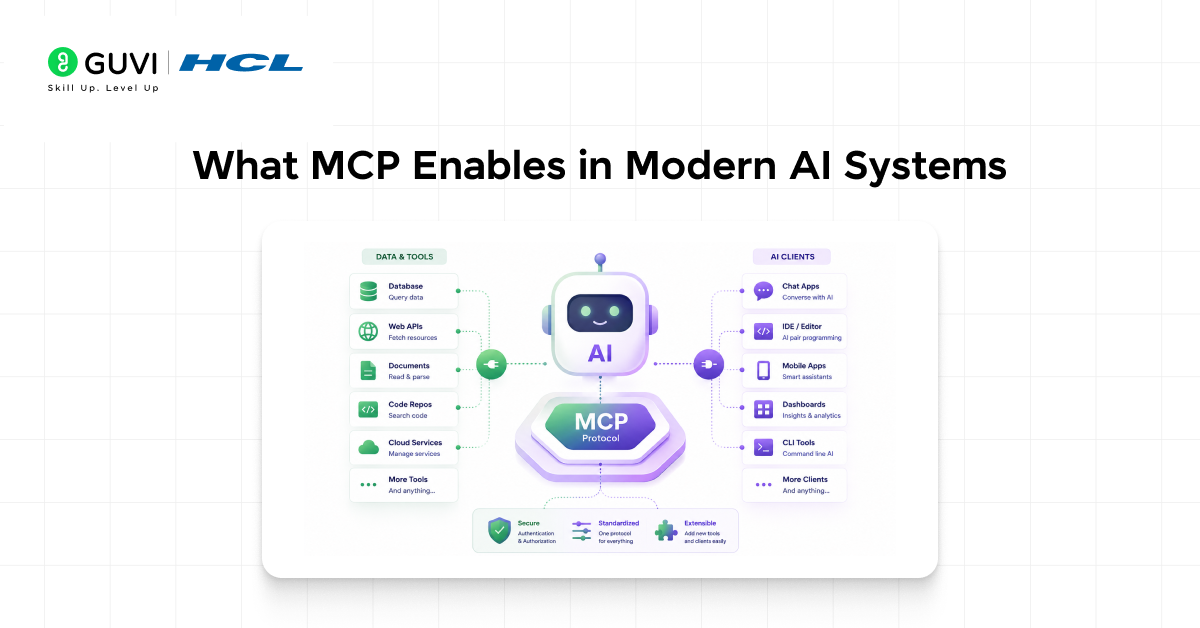
MCP revolutionises what modern AI systems can do.
Using MCP, AI can:
- Get real-time data from APIs and databases.
- Take actions such as writing files or triggering workflow executions.
- Chain tools to complete tasks.
- Maintain context over time between communications.
This functionality is what the AI agents are built on. AI is no longer about finding information; it’s about completing a task.
MCP Architecture
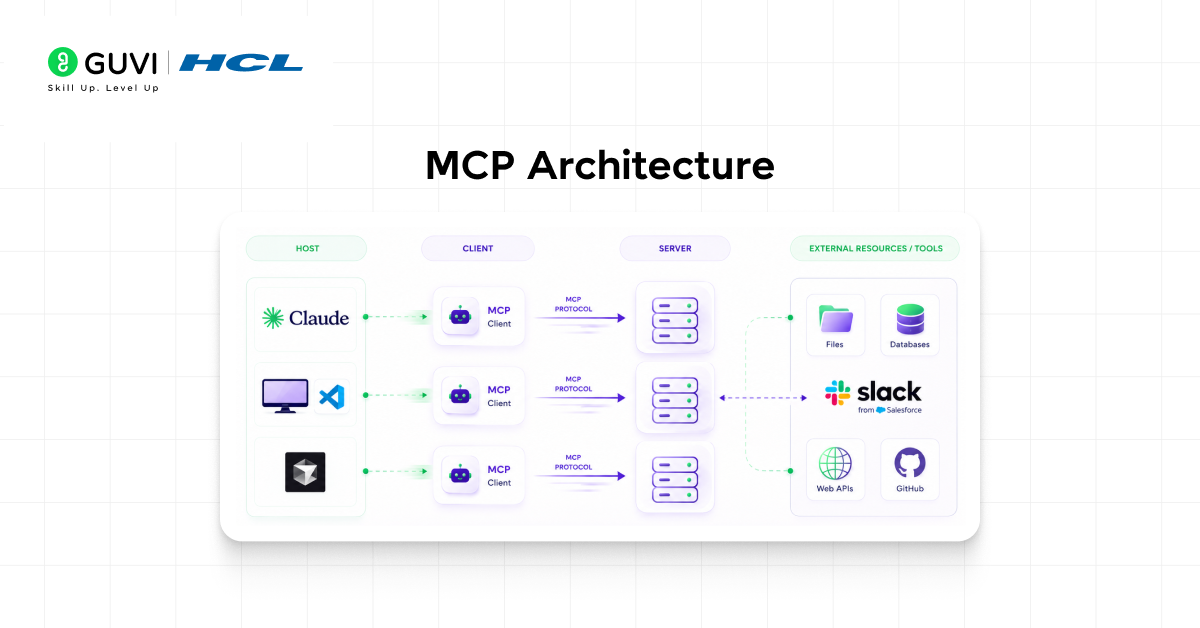
MCP uses a simple client-server structure for communication:
- Host (This is where your AI application runs.)
- Client (This component translates AI requests into the MCP protocol.)
- Server (This component handles tools, APIs, and database access.)
The flow is simple: a user makes a request, the AI processes it, the client identifies required tools, and the server executes them.
This removes ad-hoc integrations and replaces them with a structured system.
MCP Versus Traditional AI Systems
Traditional AI systems will primarily use the data that they have been trained on, without being able to without being able to make changes or query fresh data from external systems. MCP breaks down those barriers to allow AI to interact with the live systems that surround it and complete tasks.
The new paradigm is:
- Static AI answers
- MCP-powered AI performs actions
This is where AI moves from an answer provider to a utility.
MCP vs RAG: Knowing the Difference
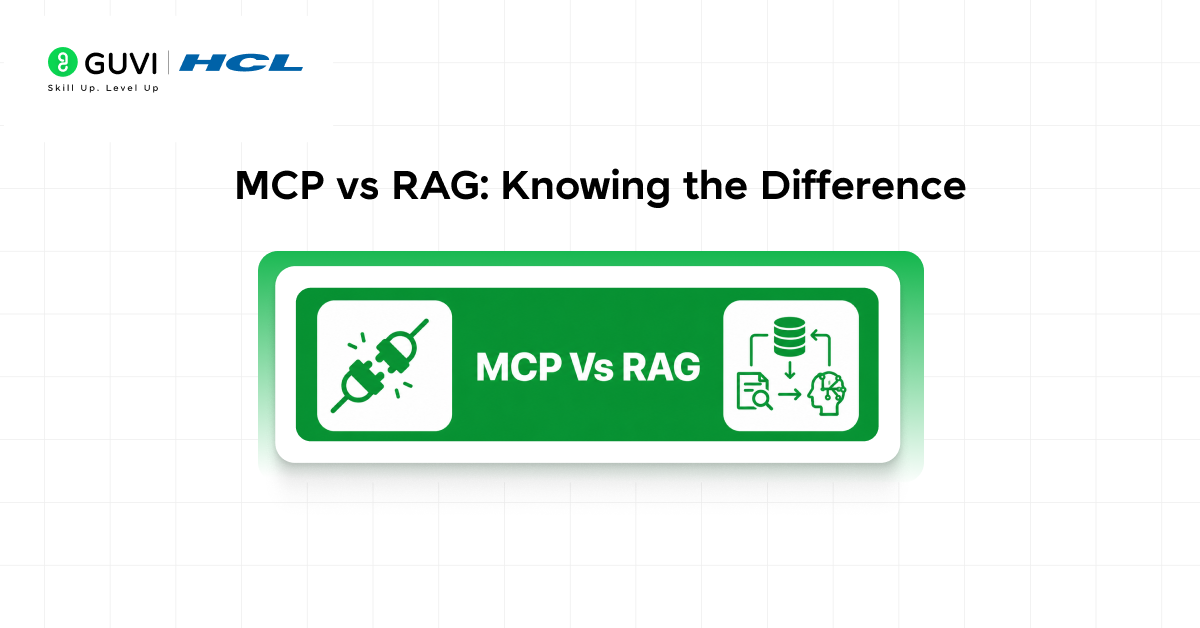
The difference between MCP and retrieval-augmented generation (RAG) is a source of confusion among developers, especially because both work together in modern AI systems but serve different roles in handling context and knowledge, as explained in this guide on MCP RAG AI Agents
RAG allows AI to improve a generated response with information retrieved from a knowledge base. While RAG increases the relevance and accuracy of a response, it does not give AI any capabilities to take action.
MCP enables AI to take action beyond data retrieval, allowing it to perform tasks such as sending emails, updating records, or initiating workflows. You can see how MCP connects AI with real-world tools and systems in this guide on using Model Context Protocol with Claude.
Real-World Example of an MCP Flow
Let’s demonstrate with a simple example: a user asks an AI to create a report from database data and write it to a file.
The AI determines that it has to:
- Query the data source
- Process the data
- Write data to a file
MCP handles this process using tool calls, so you do not need to build custom integrations.
Example (Conceptual workflow)
Step 1:
Request data from the database tool
data = mcp_client.call_tool(“database_query”, {
“query”: “SELECT * FROM sales WHERE month=’March'”
})
Step 2:
Process data
summary = analyze_sales(data)
Step 3:
Save the result using another tool
mcp_client.call_tool(“file_writer”, {
“filename”: “report.txt”,
“content”: summary

})
This is a multi-step workflow handled seamlessly using MCP.
If you want to see how AI systems actually move beyond prompts into real-world execution, check this out:
Generative AI: The Next Intelligence Revolution (Ebook)
MCP (Model Context Protocol) reduces AI integration complexity from exponential growth (N × M connections) to a linear, standardized system.
This makes it possible to scale AI systems efficiently without rewriting integrations every time a new tool or data source is added.
Key Benefits of MCP
MCP offers advantages from a technical standpoint and strategically.
- Improves accuracy by using real data
- Allows automation by tool calls
- Simplifies system design and integration
- Allows independence of AI models
More significantly, this brings AI models into a production state instead of an experimental state.
Security Considerations You Cannot Ignore
MCP introduces significant benefits that also introduce risks.
The ability for AI models to communicate with external tools. Security should be paramount.
Concerns of the system include:
- Unauthorized access to private data or sensitive tools.
- Prompt injection attacks targeting tool usage.
- Data leaks via insecure output mechanisms.
- Risks of dependencies on an external server.
Having proper validations, permissions, and monitoring will be of great importance in using the system. Ignoring this could be disastrous.
The Rise of AI Agents with MCP
MCP is the foundation of AI agents.
Agents must see, decide, and act, and MCP enables the action layer.
This approach is used in multi-agent system architectures.
This is the reason that MCP must go hand in hand with:
- Autonomous workflows
- Intelligent assistants
- End-to-end automated systems
Without MCP, AI agents have limitations. With MCP, they are operational.
How to Get Started with MCP (Beginner Flow)
You do not need a large setup to get started.
Start by connecting:
- LLM platform
- MCP client system
- At least one MCP server (API or database), as explained in this guide on Claude Code MCP servers
Then make a simple tool call.
Expand gradually into multi-step workflows. Focus on small working systems before scaling
Common Mistakes to Avoid
Many developers misunderstand or use MCP in a suboptimal way.
Avoid the following:
- Thinking that MCP is an AI concept, not a system layer
- Building a complex system instead of first implementing simple workflows
- Skipping security and permissions
- Not connecting MCP with real use-cases
These issues are highlighted in modern MCP server implementations.
Simplicity rather than complexity should be the key principle of the system.
The Bigger Shift: From Prompts to Systems
MCP represents a larger shift in the development process for AI. While before it was about better prompts, the focus is now shifting towards system design, allowing AI to leverage tools and data more effectively.
This change from prompt engineering to system architecture defines the future of AI development.
Future of MCP
MCP is quickly becoming the foundation of modern AI infrastructures. As AI systems grow in complexity and capability, the need for them to interact with real-world systems is no longer optional; it is becoming essential.
We are entering a phase where:
- Fully automated agents
- Real-time decision-making systems
- Integrated AI systems
They are no longer distant possibilities but practical realities.
To build real-world systems proficiency in AI, consider exploring HCL GUVI’s AI & Machine Learning Course, which includes information on real-world AI workflows, automation, and system design principles relevant to MCP.
Conclusion
Model Context Protocol isn’t merely another technology; it represents a shift in development methodology. The ability of AI systems to instantly pull data from the real world and then enact solutions is making them evolve from an inanimate tool into a dynamic system.
Those who are prepared to grasp MCP early on are sure to have a leg up on developing future applications of artificial intelligence. They are intelligent, scalable, and ready for the real world.
FAQs
1. What is MCP in simple terms?
MCP is a standard that allows AI systems to connect with external tools and data sources to perform real-world tasks.
2. How is MCP different from APIs?
APIs provide access to services, while MCP standardizes how AI interacts with multiple APIs and tools efficiently.
3. Is MCP only for developers?
Primarily yes, but its impact extends to anyone building AI-powered applications or systems.
4. Can MCP reduce AI hallucinations?
Yes. By accessing real-time data, MCP helps AI generate more accurate and reliable responses.
5. Is MCP required for AI agents?
While not mandatory, MCP is a key enabler for building functional and scalable AI agents.
6. Is MCP difficult to implement?
Not necessarily. Starting with basic tool integrations makes it approachable even for beginners.
Success Stories

About the Author
Vishalini Devarajan
An Aerospace Engineer turned content writer, I focus on making complex concepts easy to understand through well-structured, reader-friendly blogs. Whether it’s a technical topic or a non-technical one, I love creating content that is clear, engaging, and impactful.
View all posts by Vishalini Devarajan
Connect with me @











Did you enjoy this article?