


Artificial Intelligence and Machine Learning Articles
Finance Manager to Data Analytics: Career Growth, Salary and Seniority
How to Evaluate LLM Outputs in Production Deployments
AI/ML Skills Gap 2026: Why Companies Can't Find Job-Ready Talent
20 AI/ML Interview Questions Recruiters Can Use Without a Tech Background - Best Guide

Get In Touch For Details! Request More Information
MCP RAG AI Agents: What It Is & How It Works
Sep 03, 2026 4 Min Read 1161 Views
(Last Updated)
Quick Answer: MCP RAG AI Agents combine the power of Model Context Protocol (MCP) and Retrieval-Augmented Generation (RAG) to build intelligent systems that can fetch real-time data, maintain structured context, and generate accurate responses. MCP standardizes how context flows between tools, models, and agents, while RAG enhances responses using external knowledge sources like databases or documents.
What if your AI agent could not only generate answers but also understand context deeply, fetch real-time knowledge, and act intelligently across systems? That is exactly where MCP RAG AI Agents come in.
Traditional AI relies on static data, but real-world use cases demand dynamic context and fresh information. MCP structures and manages context, while RAG retrieves up-to-date knowledge, together enabling adaptive, context-aware AI systems. In this blog, we break down how MCP RAG AI Agents work, why they matter, and how you can build them effectively.
Table of contents
- What is MCP RAG AI?
- How MCP RAG AI Agents Work
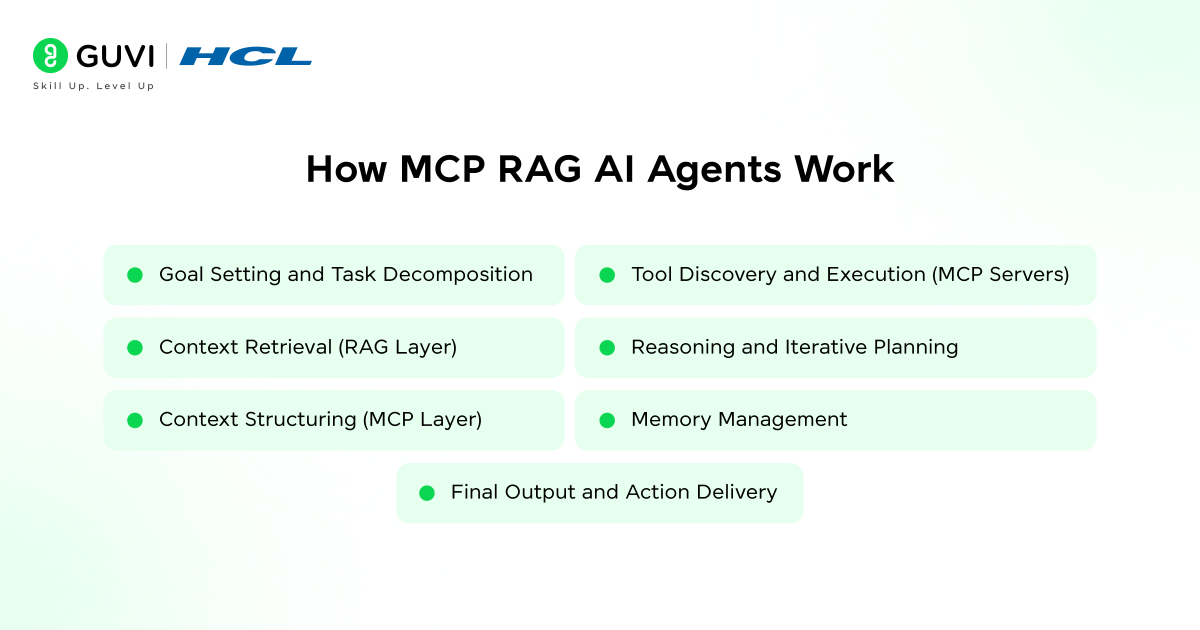
- Goal Setting and Task Decomposition
- Context Retrieval (RAG Layer)
- Context Structuring (MCP Layer)
- Tool Discovery and Execution (MCP Servers)
- Reasoning and Iterative Planning
- Memory Management
- Final Output and Action Delivery
- Benefits of MCP RAG AI Agents
- Real-World Use Cases of MCP RAG AI Agents
- Enterprise Knowledge Assistant for Internal Support
- E-commerce Checkout Optimization Agent
- Healthcare Clinical Decision Support Agent
- Challenges and Limitations of MCP RAG AI Agents
- Conclusion
- FAQs
- What tools and technologies are required to build MCP RAG AI Agents?
- How do MCP RAG AI Agents handle multi-step workflows across systems?
- Can MCP RAG AI Agents be integrated with existing enterprise systems?
What is MCP RAG AI?
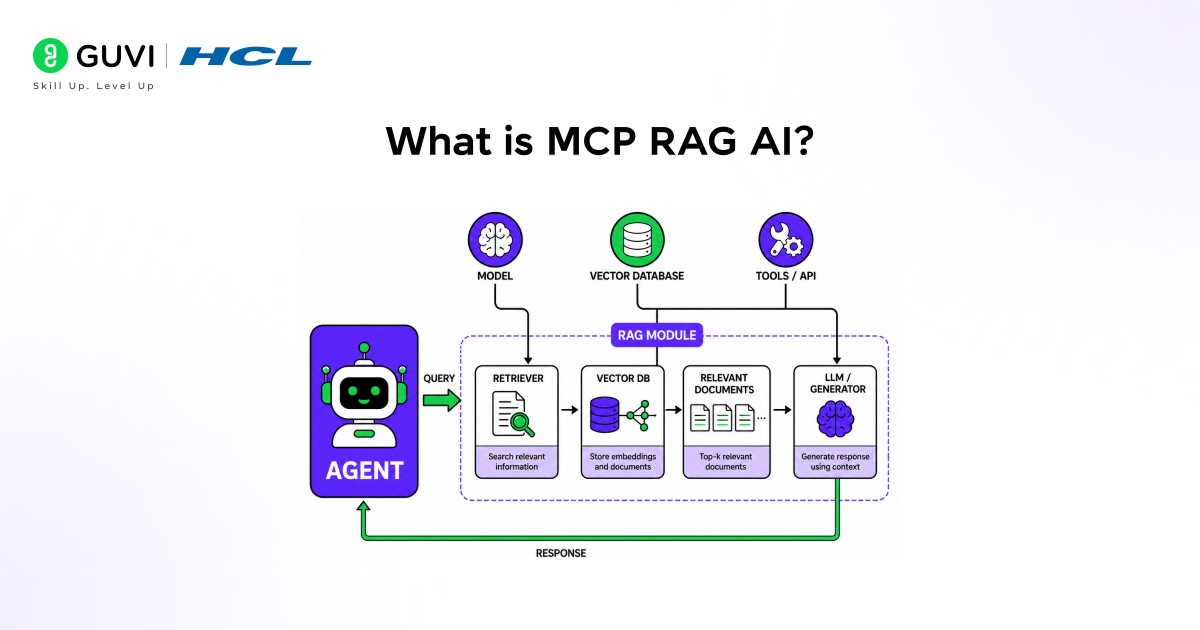
MCP RAG AI refers to a modern AI architecture that combines Model Context Protocol (MCP) and Retrieval-Augmented Generation (RAG) to build intelligent, context-aware, and action-capable AI systems.
- MCP (Model Context Protocol): A standardized framework that manages how context is structured, shared, and passed between AI models, tools, APIs, and memory systems
- RAG (Retrieval-Augmented Generation): A technique where AI retrieves relevant external data from sources like databases or documents and uses it to generate accurate, up-to-date responses
Together, MCP + RAG enable AI agents to:
- Understand and maintain structured context
- Access real-time knowledge beyond training data
- Perform multi-step reasoning and actions
- Deliver more accurate and reliable outputs
Build practical Generative AI skills and move from experimentation to real-world execution. Download HCL GUVI’s GenAI eBook to learn prompt engineering strategies, explore real use cases, and follow a structured roadmap for building scalable AI applications.
How MCP RAG AI Agents Work
1. Goal Setting and Task Decomposition
- The user provides a high-level objective
Example: analyze a Jira ticket and update technical documentation - The agent:
- Parses intent using an LLM
- Breaks the task into sub-steps such as retrieval, validation, and execution
- Defines success criteria and constraints
2. Context Retrieval (RAG Layer)
- The agent converts the query into embeddings using models like OpenAI Embeddings or Sentence Transformers
- Performs similarity search on vector databases such as Pinecone or FAISS
- Retrieves:
- Relevant documents
- Knowledge base entries
- Logs, tickets, or internal files
- Applies:
- Top-k retrieval
- Re-ranking
- Metadata filtering
- Output is a context bundle with high-signal information for the task
3. Context Structuring (MCP Layer)
- MCP defines a structured schema for passing context:
- System instructions
- Retrieved documents
- Conversation state
- Tool specifications
- Ensures:
- Consistent formatting across tools
- Interoperability between agents and services
- Context is serialized into a format the LLM can process efficiently
4. Tool Discovery and Execution (MCP Servers)
- The agent queries MCP servers to discover available tools:
- APIs
- File systems
- Databases
- SaaS integrations
- Tools are exposed via standardized interfaces similar to REST API or GraphQL
- The agent:
- Selects the appropriate tool based on task requirements
- Generates structured function calls
- Executes actions such as:
- Fetching additional data
- Updating documents
- Triggering workflows
5. Reasoning and Iterative Planning
- The LLM performs:
- Chain-of-thought style reasoning internally
- Decision evaluation based on retrieved data
- The agent follows a loop:
- Retrieve → Act → Evaluate
- Uses:
- Confidence scoring
- Validation checks
- Rule-based constraints
- If the objective is not met:
- Refines queries
- Calls additional tools
- Repeats retrieval and execution steps
6. Memory Management
- MCP integrates memory at multiple levels:
- Short-term memory for session context
- Long-term memory using vector storage
- Enables:
- Context persistence across interactions
- Personalization
- Stateful workflows
7. Final Output and Action Delivery
- The agent compiles:
- Generated response
- Retrieved evidence
- Results from executed tools
- Produces:
- Structured output such as JSON or reports
- Direct system actions such as updates or triggers
- Ensures:
- Traceability
- Explainability
- Output validation before delivery
Build advanced AI systems like MCP and RAG-based agents with structured, real-world learning. Join HCL GUVI’s Artificial Intelligence and Machine Learning Course to learn from industry experts and Intel engineers through live online classes, master in-demand skills like Python, ML, MLOps, Generative AI, and Agentic AI, and gain hands-on experience with 20+ industry-grade projects, 1:1 doubt sessions, and placement support with 1000+ hiring partners.
Benefits of MCP RAG AI Agents
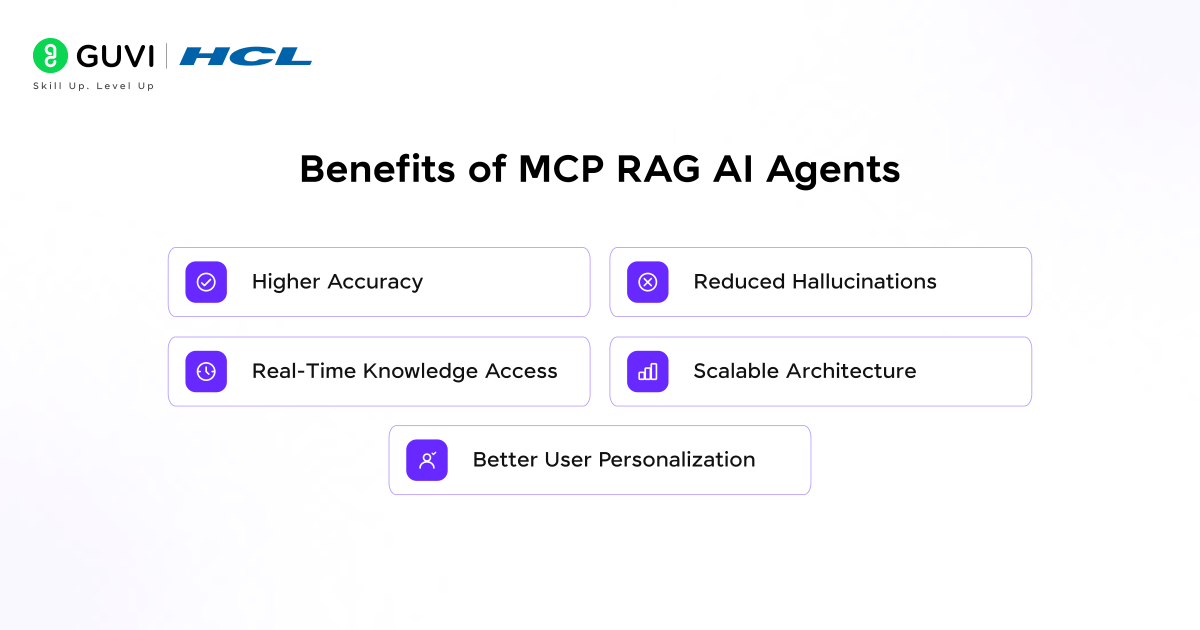
- Higher Accuracy: Combines retrieval with generation to ground responses in real data, improving factual correctness and reducing guesswork
- Reduced Hallucinations: Uses external knowledge sources instead of relying solely on model memory, leading to more reliable outputs
- Real-Time Knowledge Access: Retrieves up-to-date information from databases, APIs, and documents at runtime
- Scalable Architecture: Modular design with MCP enables easy integration of new tools, data sources, and workflows
- Better User Personalization: Maintains structured context and memory to deliver tailored responses based on user history and preferences

Real-World Use Cases of MCP RAG AI Agents
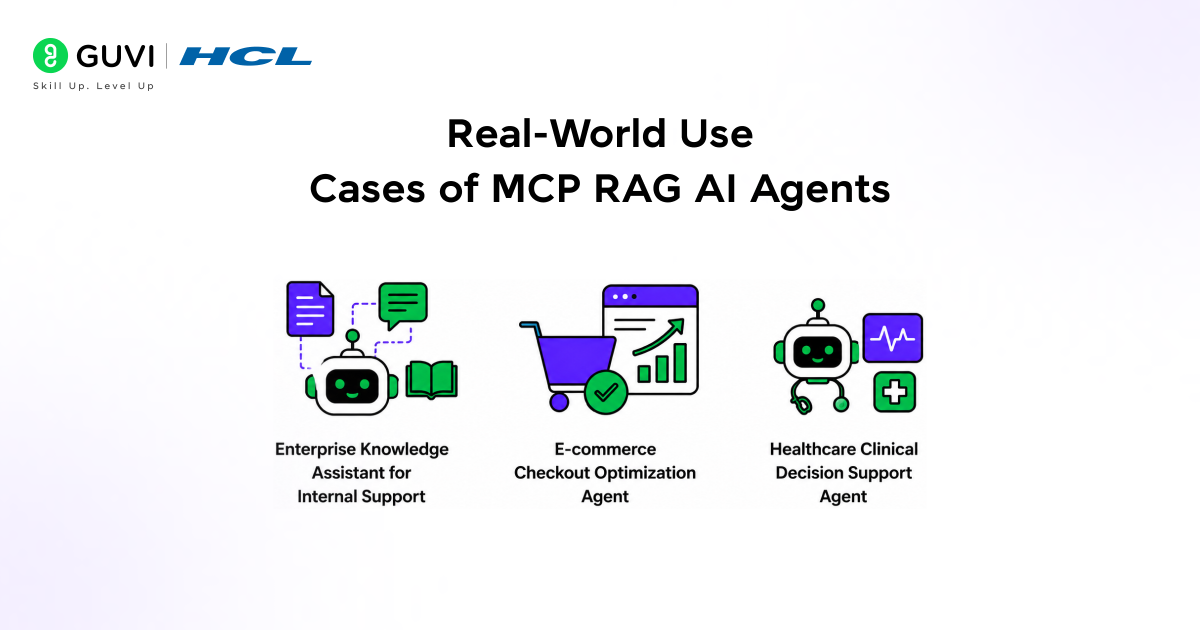
1. Enterprise Knowledge Assistant for Internal Support
An MCP RAG AI agent can act as a centralized knowledge assistant across tools like Jira, Confluence, and internal documentation systems. When an employee raises a query such as debugging a recurring production issue, the agent retrieves relevant tickets, past resolutions, and technical docs using RAG. MCP structures this context and enables the agent to fetch logs, summarize root causes, and even suggest fixes. It can also update documentation automatically after resolution, ensuring knowledge continuity across teams.
2. E-commerce Checkout Optimization Agent
In an e-commerce platform, an MCP RAG agent can dynamically reduce cart abandonment by analyzing user behavior in real time. It retrieves user session data, past purchase patterns, and pricing rules from backend systems. Using MCP-integrated APIs, it can trigger actions such as applying personalized discounts, surfacing relevant FAQs, or resolving payment errors.
For example, if a user drops off at checkout, the agent can identify friction points and instantly respond with targeted interventions, improving conversion rates without manual intervention.
3. Healthcare Clinical Decision Support Agent
In clinical environments, an MCP RAG agent can assist doctors by retrieving patient records from electronic health systems like Epic Systems and combining them with medical literature databases. When a doctor inputs symptoms or diagnostic queries, the agent uses RAG to fetch relevant case histories, research papers, and treatment guidelines.
MCP ensures structured context handling across sensitive data sources and enables actions like updating patient notes or flagging anomalies. This helps clinicians make faster, evidence-backed decisions while maintaining compliance and traceability.
Challenges and Limitations of MCP RAG AI Agents
- Complex Architecture Design: Requires coordination between retrieval systems, MCP layers, LLMs, and tool orchestration
- Latency from Retrieval Steps: Multiple retrieval and tool calls can increase response time, especially in real-time applications
- Data Privacy Concerns: Handling sensitive enterprise data requires strict governance, access control, and compliance measures
- Cost of Embeddings and Storage: Vectorization, storage, and retrieval infrastructure can increase operational costs at scale
Conclusion
MCP RAG AI Agents represent the next evolution of intelligent systems. They go beyond simple text generation to become knowledge-driven and action-capable agents.
By combining structured context management with real-time retrieval, they solve the biggest limitations of traditional AI systems: lack of memory and outdated knowledge. If you are building AI for real-world applications, MCP RAG is not just an option. It is fast becoming the standard.
FAQs
What tools and technologies are required to build MCP RAG AI Agents?
To build MCP RAG AI Agents, you need LLMs, embedding models, vector databases like Pinecone or FAISS, MCP-compatible tool servers, and APIs for data access. Integration frameworks and orchestration layers are also essential for managing workflows and tool execution.
How do MCP RAG AI Agents handle multi-step workflows across systems?
MCP RAG AI Agents use structured context, tool orchestration, and iterative reasoning loops to execute multi-step workflows. They retrieve relevant data, interact with APIs, validate outputs, and continuously refine actions until the task objective is achieved.
Can MCP RAG AI Agents be integrated with existing enterprise systems?
Yes, MCP RAG AI Agents are designed for seamless integration with enterprise systems like CRMs, databases, and SaaS tools. MCP standardizes context exchange, making it easier to connect AI agents with existing infrastructure without major architectural changes.
Success Stories

About the Author
Vaishali
I'm a seasoned writer with four years of experience across technical, non-technical, and just about every genre or niche you can imagine. Adaptable and curious, I enjoy exploring new topics and making information engaging and easy to understand. Fueled by a steady stream of tea, I approach each project with creativity, reliability, and genuine enthusiasm for storytelling.
View all posts by Vaishali
Connect with me @









Did you enjoy this article?