


Artificial Intelligence and Machine Learning Articles
How to Evaluate LLM Outputs in Production Deployments
AI/ML Skills Gap 2026: Why Companies Can't Find Job-Ready Talent
20 AI/ML Interview Questions Recruiters Can Use Without a Tech Background - Best Guide
How Industry-Backed AI/ML Bootcamps Are Changing the AI/ML Hiring Pipeline - Best Guide 2026


Get In Touch For Details! Request More Information
15 Practical AI Agent Examples to Scale Your Business in 2026
Sep 24, 2026 4 Min Read 769 Views
(Last Updated)
AI agents are already an integral part of how modern businesses operate. They are utilised to automate processes, support decision-making, and complete tasks that would otherwise be very time-consuming. In layman‘s terms, they are intelligent virtual assistants with the ability to operate automatically.
In this blog, we will explore 15 examples of how AI agents are being used in real businesses today. These examples will provide you with a clear picture of how they can save time, enhance work, and scale operational efficiency in 2026.
Quick TL;DR Summary
- This blog explains what AI agents are in simple terms.
- It shares 15 practical examples of AI agents focused on business growth in 2026.
- It helps you understand how AI agents can be used in real business situations.
Table of contents
- What Are AI Agents?
- 15 AI Agent Examples for Business Growth in 2026
- Customer Support Automation Agent
- Sales Outreach Automation Agent
- Lead Qualification System
- Email Marketing Automation System
- Campaign Optimisation System
- Social Media Management System
- Content Creation Assistant
- SEO Optimisation System
- Market Research Assistant
- Business Analytics System
- Finance Tracking Assistant
- Recruitment Automation System
- Employee Onboarding Assistant
- Inventory Management System
- Workflow Automation System
- Conclusion
- FAQs
- How do you choose the right agent for your business?
- Which business areas benefit the most from these systems?
- Do these systems replace human employees?
- How long does it take to see results?
- Can small businesses also use these systems?
- What is the first step to getting started?
- What is the difference between an AI course and an AI & ML course?
- Why is SQL important for AI & ML professionals?
- What job roles can I apply for after completing an AI & ML course?
- How do I choose the best AI course for my career goals?
- What should I look for before enrolling in an AI & ML course?
- How should I evaluate AI & ML certifications before enrolling?
- What is the difference between an AI course and an AI & ML course?
- Why is SQL important for AI & ML professionals?
- What job roles can I apply for after completing an AI & ML course?
- How do I choose the best AI course for my career goals?
- What should I look for before enrolling in an AI & ML course?
- How should I evaluate AI & ML certifications before enrolling?
What Are AI Agents?
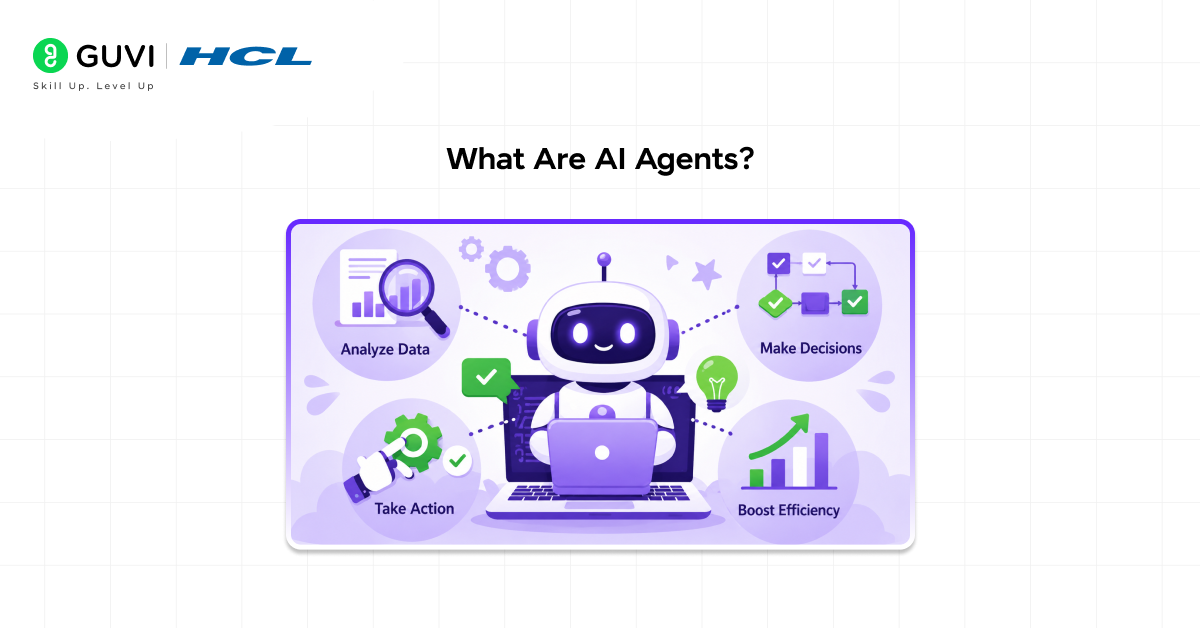
An AI agent is a system that utilises an LLM to accept and process the inputs, make decisions, and perform actions to accomplish a task with minimal human effort.
This tool can run in a loop that accepts data, reasons with the LLM, stores context in memory, and executes actions with tools and APIs.
Also Read: Types of AI Agents: A Practical Guide with Examples
Learn from our free 5-day AI/ML course and explore its applications across different industries: AI/ML Email Course
15 AI Agent Examples for Business Growth in 2026
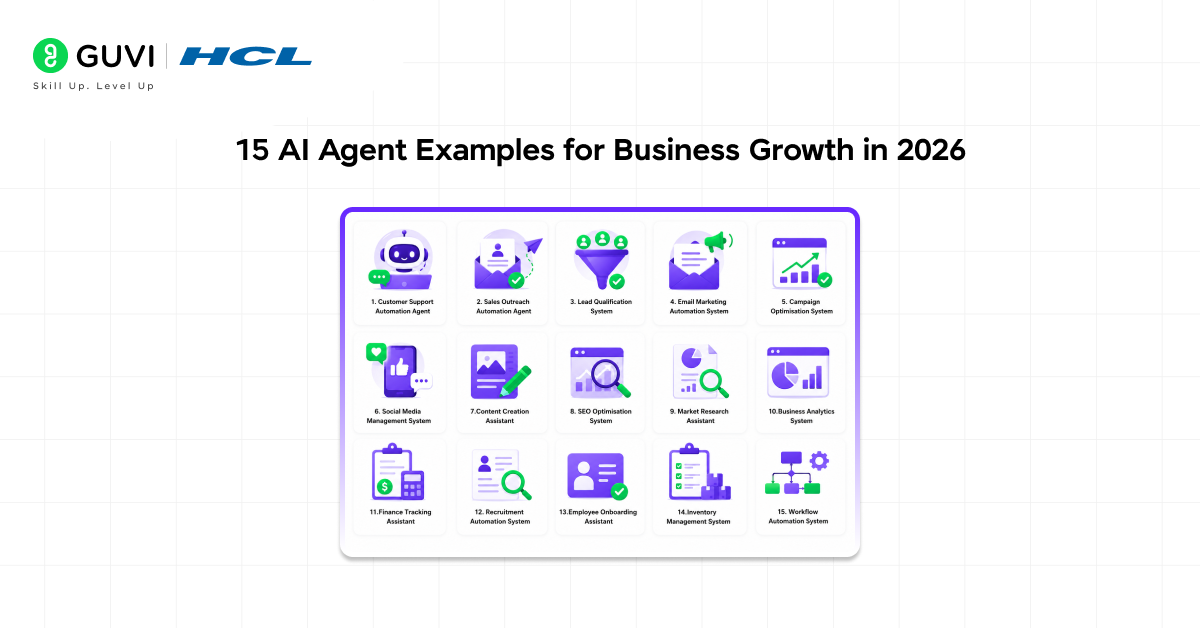
Here are the following examples of AI agents used for business growth in 2026:
1. Customer Support Automation Agent
Responds to customer questions across chat, email and support tickets, understanding frequent problems and providing immediate solutions. Simpler cases are quickly forwarded to human agents.
Business Benefits:
- Faster responses
- Less manual work
- 24/7 availability
2. Sales Outreach Automation Agent
Sends targeted emails automatically to potential customers according to their behaviour and information stored in the databases. In addition, automates follow-up email management and measures responses.
Business Benefits:
- Saves outreach time
- Improves follow-ups
- Increases lead reach
3. Lead Qualification System
Analyses incoming leads using datapoints on topics such as user activity, interest level, and basic information. It filters and ranks leads to identify the most promising prospects, so businesses can direct their efforts to those most likely to convert.
Business Benefits:
- Filters quality leads
- Saves sales effort
- Improves conversions
4. Email Marketing Automation System
Automates email marketing by scheduling messages, sending triggered emails, monitoring performance and other functions. Allows segmentation of recipients, customises messages, and analyses results.
Business Benefits:
- Automates email sending
- Improves targeting
- Tracks performance
5. Campaign Optimisation System
Enhances marketing efforts by analysing performance data and testing alternative strategies. The tool adjusts the advertising budget and leverages the most successful alternatives to improve efficiency without frequent interventions.
Business Benefits:
- Improves campaign results
- Optimises budget use
- Reduces manual tracking
6. Social Media Management System
Handles posting, scheduling, responding, and tracking engagement on social media. It keeps content consistent and eliminates the need to manage each account individually.
Business Benefits:
- Saves posting time
- Keeps content consistent
- Tracks engagement
7. Content Creation Assistant
Supports Content Production, Ideas Generation, writing text, and improving existing content. Helps you to create blogs, ads, and product descriptions more quickly and keeps production consistent.
Business Benefits:
- Speeds up writing
- Helps with ideas
- Reduces effort
8. SEO Optimisation System
Analyses and recommends changes to content to improve search engine rankings. The focus is on the structure and placement of keywords, as well as readability, to enhance visibility and unpaid traffic.
Business Benefits:
- Improves rankings
- Suggests keywords
- Optimizes content
9. Market Research Assistant
Collects and analyses data about market trends, competitors and customers. It provides companies with market information and helps them make profitable decisions.
Business Benefits:
- Tracks trends
- Analyzes competitors
- Supports decisions
10. Business Analytics System
Works with business data and provides meaningful insights through reports and dashboards. Provides performance and trend information to enable data-driven decisions across operations.
Business Benefits:
- Gives clear insights
- Tracks performance
- Supports decisions
11. Finance Tracking Assistant
Keeps track of money flow to and from the business, monitoring income, expenses and cash flow. Maintains business records accurately and up to date, helping the business avoid manual errors.
Business Benefits:
- Tracks finances
- Reduces errors
- Saves time
12. Recruitment Automation System
Supports hiring by screening resumes, creating candidate shortlists, and coordinating interviews. It helps reduce the effort required for the manual sorting of job applications.
Business Benefits:
- Speeds up hiring
- Filters candidates
- Reduces manual work
13. Employee Onboarding Assistant
Guides new employees by providing necessary information, documents, and step-by-step instructions. It facilitates the training of new staff in a comfortable way without an extra burden on HR teams.
Business Benefits:
- Simplifies onboarding
- Saves HR time
- Improves experience
14. Inventory Management System
Tracks stock levels and updates inventory data automatically in real time. It helps to control supply by avoiding stockouts and reducing errors.
Business Benefits:
- Tracks stock
- Reduces errors
- Improves control
15. Workflow Automation System
Links processes across various business functions and automatically executes triggered tasks. It reduces manual interactions among teams and departments in order to be more consistent.
Business Benefits:
- Automates tasks
- Saves time
- Improves efficiency
Looking to land a role at top global tech companies? HCL GUVI’s Intel & IITM Pravartak Certified Artificial Intelligence (AI) and Machine Learning (ML) Course gives you the skills and credibility you need. Master AI & ML from industry experts and become a certified professional ready for high-impact tech careers. Don’t wait—level up your career today!

Conclusion
Nowadays, AI agents are increasingly critical to how modern businesses expand and operate. In 2026, organisations that leverage them effectively will scale faster by automating a range of business functions, increasing accuracy, and enabling faster decision-making.
FAQs
How do you choose the right agent for your business?
Start by identifying repetitive tasks and time-consuming areas, then match them with the right automation system.
Which business areas benefit the most from these systems?
Customer support, sales, marketing, and operations usually see the fastest impact.
Do these systems replace human employees?
They handle routine work, allowing teams to focus on more important and creative tasks.
How long does it take to see results?
Most businesses notice improvements in efficiency and time-saving within a few weeks.
Can small businesses also use these systems?
They can be used by businesses of all sizes, depending on the tools and setup.
What is the first step to getting started?
Begin with one simple use case and expand gradually based on results.
What is the difference between an AI course and an AI & ML course?
An AI course focuses on artificial intelligence concepts, while an AI & ML course includes machine learning, deep learning, NLP, computer vision, and practical model-building skills. If you’re looking for hands-on AI and ML training, explore the HCL GUVI AI & ML Programme.
Why is SQL important for AI & ML professionals?
SQL helps AI & ML professionals extract, clean, and analyze data from databases, making it essential for building accurate machine learning models. Most industry-focused AI & ML programmes include SQL as a core data skill.
What job roles can I apply for after completing an AI & ML course?
You can apply for roles such as AI Engineer, Machine Learning Engineer, Data Scientist, NLP Engineer, Computer Vision Engineer, and AI Developer. To prepare for these roles, consider a project-based AI & ML Programme with career support.
How do I choose the best AI course for my career goals?
Choose an AI course based on your career goals, curriculum, hands-on projects, mentor support, industry tools, and placement assistance. A structured AI & ML Programme can help you build practical skills and a strong portfolio.
What should I look for before enrolling in an AI & ML course?
Look for a structured curriculum, practical projects, experienced mentors, updated AI tools, certification value, and career support. Compare programmes carefully before enrolling in an AI & ML Programme.
How should I evaluate AI & ML certifications before enrolling?
Evaluate AI & ML certifications based on industry recognition, curriculum relevance, hands-on learning, project experience, and career outcomes. You can also compare what’s included in the HCL GUVI AI & ML Programme before making a decision.
What is the difference between an AI course and an AI & ML course?
An AI course focuses on artificial intelligence concepts, while an AI & ML course includes machine learning, deep learning, NLP, computer vision, and practical model-building skills. If you’re looking for hands-on AI and ML training, explore the HCL GUVI AI & ML Programme.
Why is SQL important for AI & ML professionals?
SQL helps AI & ML professionals extract, clean, and analyze data from databases, making it essential for building accurate machine learning models. Most industry-focused AI & ML programmes include SQL as a core data skill.
What job roles can I apply for after completing an AI & ML course?
You can apply for roles such as AI Engineer, Machine Learning Engineer, Data Scientist, NLP Engineer, Computer Vision Engineer, and AI Developer. To prepare for these roles, consider a project-based AI & ML Programme with career support.
How do I choose the best AI course for my career goals?
Choose an AI course based on your career goals, curriculum, hands-on projects, mentor support, industry tools, and placement assistance. A structured AI & ML Programme can help you build practical skills and a strong portfolio.
What should I look for before enrolling in an AI & ML course?
Look for a structured curriculum, practical projects, experienced mentors, updated AI tools, certification value, and career support. Compare programmes carefully before enrolling in an AI & ML Programme.
How should I evaluate AI & ML certifications before enrolling?
Evaluate AI & ML certifications based on industry recognition, curriculum relevance, hands-on learning, project experience, and career outcomes. You can also compare what’s included in the HCL GUVI AI & ML Programme before making a decision.
Success Stories







Did you enjoy this article?