


Artificial Intelligence and Machine Learning Articles
Data Analyst vs Machine Learning Engineer: Which Career Grows Faster?
Finance Manager to Data Analytics: Career Growth, Salary and Seniority
How to Evaluate LLM Outputs in Production Deployments
AI/ML Skills Gap 2026: Why Companies Can't Find Job-Ready Talent


Get In Touch For Details! Request More Information

What is Narrow AI: Examples, and Why It Matters
Nov 05, 2026 5 Min Read 1292 Views
(Last Updated)
Table of contents
- TL;DR
- Defining Narrow AI: The Core Idea
- Is ChatGPT a narrow AI?
- Types of Narrow AI
- Real-World Examples of Narrow AI
- Narrow AI vs. Artificial General Intelligence
- AGI
- Narrow AI
- Limitations of Narrow AI
- Wrapping Up
- FAQs
TL;DR
What Is Narrow AI?
Narrow AI, also known as Weak AI or Artificial Narrow Intelligence (ANI), is a type of artificial intelligence designed to perform a specific task or a limited set of tasks with high efficiency. It operates within predefined boundaries and cannot transfer its knowledge or skills to unrelated tasks outside its training. Examples of narrow AI include virtual assistants, recommendation systems, image recognition tools, language models, and self-driving vehicle systems. Despite their impressive capabilities, these systems lack the broad reasoning and adaptability associated with human intelligence.
Defining Narrow AI: The Core Idea
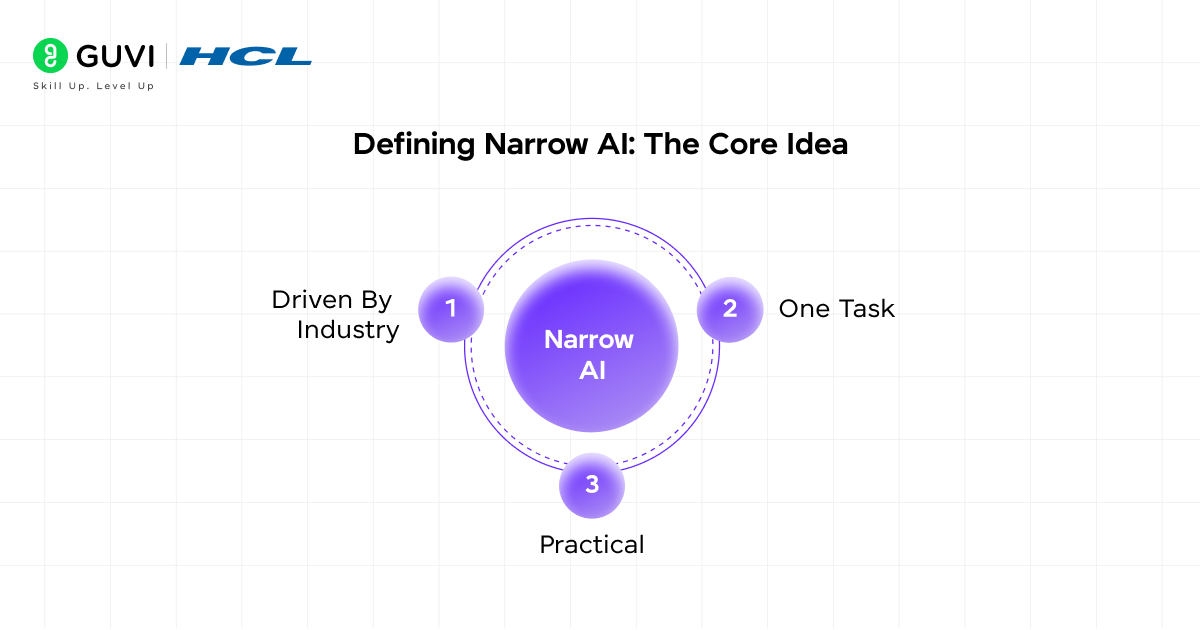
Narrow AI, also known as weak AI or artificial narrow intelligence (ANI), is designed to perform a single specific task exceptionally well. It operates within a predefined set of parameters and cannot generalize its knowledge to other areas.
- The word narrow does not mean weak or limited in the sense of being unhelpful. It means focused. A narrow AI system is deeply specialized, often performing its designated task better than any human being could. The narrowness refers to the scope of what it can do, not the depth at which it does it.
- Narrow AI performs specific tasks, such as voice recognition or image analysis. It does not possess understanding or consciousness. Rather, it follows pre-programmed rules or learns patterns from data.
- When a spam filter decides whether an email belongs in your inbox or your junk folder, it is not thinking. It is matching the content of that email against patterns it learned from millions of labeled examples during training.
- The moment you ask that same system to do something unrelated, like recommend a restaurant or drive a car, it can’t respond. That task simply does not exist within its parameters.
- People and businesses use artificial narrow intelligence to complete specific tasks with machines instead of people.
- Machines access data from a particular source and use it to perform a singular task or a series of related tasks. Because these machines lack human-like intelligence, they operate only within the confines of their programming.
- Many machines get better at tasks over time through programmed training techniques called machine learning and deep learning.
Why Is It Called Weak AI?
- The term weak AI was coined not to imply the technology is poor at what it does, but to distinguish it philosophically from strong AI, which would possess genuine understanding and consciousness. Narrow AI is called weak AI because it lacks human-like intelligence and reasoning.
- Narrow AI, unlike general AI, cannot achieve self-awareness, consciousness, emotions, or true intelligence that can compete with human intelligence. Despite their seeming sophistication and intelligence, ANI systems function within a fixed and predefined set of parameters, restrictions, and settings.
- The naming can be misleading, which is why the term narrow AI has become more common in recent years.
- Calling a system that beats world chess champions or reads medical scans better than doctors weak feels inaccurate. The system is not weak at its job. It is narrow in scope.
Is ChatGPT a narrow AI?

One of the most common questions people ask when they first learn about narrow AI is whether systems like ChatGPT or Claude count as narrow AI. Given how versatile these tools feel in conversation, it’s a fair question.
- Even OpenAI’s ChatGPT is considered a form of narrow AI because it is limited to the single task of text-based chat. Artificial general intelligence (AGI), also known as “strong AI,” is still a theoretical concept.
- ChatGPT is narrow AI. It was trained on a fixed dataset, retains no memory between sessions, and cannot set or pursue its own goals. Its versatility comes from the breadth of human language in its training data, not from general intelligence.
- While ChatGPT is a clear example of narrow AI, it plays an important role in the broader AI landscape.
- Advances in language models like ChatGPT provide valuable insights into how AI can handle specific cognitive tasks, which could eventually contribute to the development of general AI.
- The same logic applies to every large language model available today, including Gemini, Claude, and others.
- They are all narrow AI because they were trained for a specific domain, text generation and conversation, and they cannot step outside that domain into genuinely new types of tasks on their own.
Types of Narrow AI
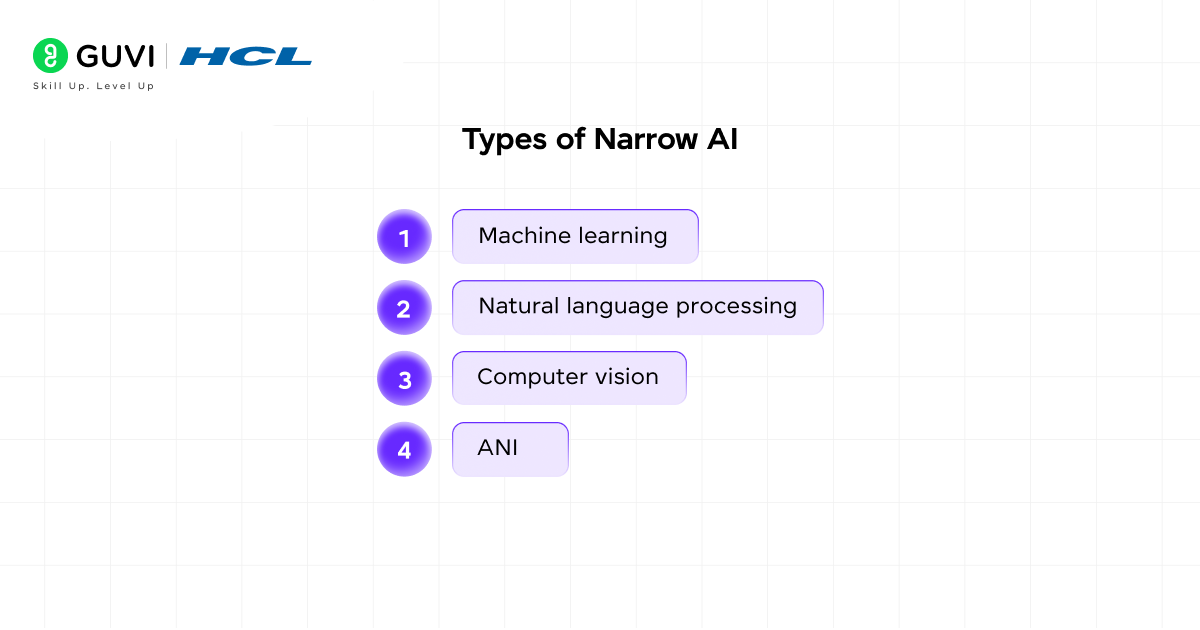
Narrow AI is not a single technology. It is an umbrella term covering several distinct types of AI systems, each built for a different kind of task.
- Machine learning powers recommendation systems like those used by Netflix, Amazon, and Spotify. These systems analyze historical user behavior, identify patterns, and use them to predict what a person is likely to enjoy next. The model is trained on data and improves over time as more data flows in, but it exists only to solve the recommendation problem. It has no awareness of anything else.
- Natural language processing enables machines to understand and respond to human language. This is the technology behind virtual assistants like Siri and Alexa, chatbots, translation tools, and sentiment analysis systems.
Several of the narrow AI systems use NLP to connect with humans in a natural and personalized way. Chatbots, virtual assistants such as Siri and Alexa, and customer service AI technologies use NLP to understand and respond to speech and text inputs, improving user engagement and satisfaction.
- Computer vision allows AI to interpret and make decisions based on visual input. It powers facial recognition on your phone, quality-control cameras in manufacturing, and object-detection systems in autonomous vehicles. Each of these applications uses a model trained specifically for its particular type of visual classification.
- ANI is also used in manufacturing, where robots are programmed to perform specific tasks such as welding, painting, and assembling products. These robotic systems are another form of narrow AI: extraordinarily precise within their programmed range of motion, but completely unable to adapt to anything outside it.
Real-World Examples of Narrow AI
The clearest way to understand narrow AI is through the systems you already use every day.
- Virtual assistants are the most visible face of narrow AI in consumer technology. Siri, Alexa, and Google Assistant are prime examples. These are designed for tasks like answering questions, setting reminders, or controlling smart home devices.
They cannot think or act outside of those specific functions. Each system is trained to understand voice or text commands and produce useful responses within its trained domain. Ask Siri to set a reminder, and it works flawlessly. Ask it to genuinely understand why you are stressed today, and it has no mechanism to help.
- Recommendation engines run quietly in the background of most of the content platforms you use. These systems, which predict content a user might like or search for next, are forms of weak AI.
Netflix’s recommendation algorithm analyzes your viewing history, the time you watch, what you finish versus abandon, and what similar users enjoy, then produces personalized suggestions. It is extraordinarily good at this specific task. It doesn’t understand why you enjoyed a particular film or what mood you are in.

- Self-driving vehicles represent one of the most technically complex applications of narrow AI. Self-driving cars are considered narrow AI because they are specifically designed to perform the task of driving.
They use sensors, cameras, machine learning algorithms, and data processing to navigate roads, avoid obstacles, and make real-time driving decisions. However, their intelligence is limited to this particular domain.
A self-driving car cannot use that knowledge to play chess, write a poem, or have a conversation.
- Medical AI is one of the most impactful narrow AI applications in terms of real-world consequences. A narrow AI system designed to identify cancer from X-ray or ultrasound images might spot a cancerous mass faster and more accurately than a trained radiologist.
This kind of narrow AI does not replace doctors. It gives them a powerful tool that handles one specific diagnostic task better than human perception alone.
- Fraud detection in banking and finance is another major use case. AI systems at companies like Mastercard and PayPal monitor transactions in real time and flag unusual patterns that might indicate fraudulent activity.
AI-driven threat detection tools identify novel attack patterns without requiring prior exposure to specific cases. This capability allows organizations to respond to emerging threats faster than traditional rule-based security systems ever could.
Narrow AI vs. Artificial General Intelligence
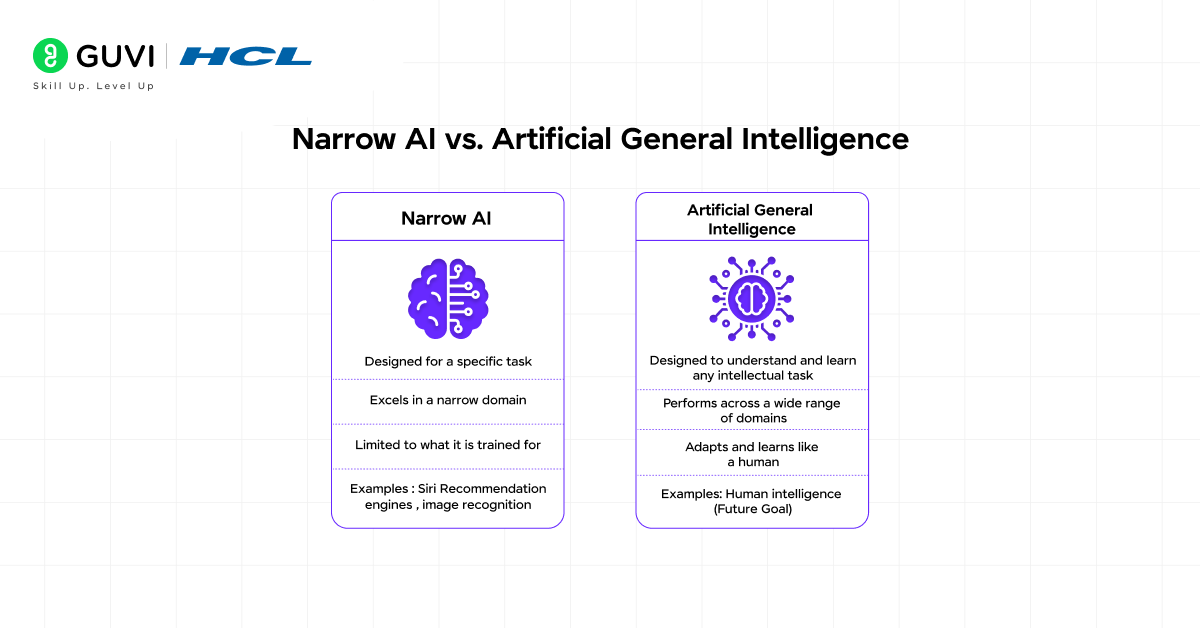
Understanding narrow AI becomes clearer when you contrast it with what it is not: AGI, or artificial general intelligence.
1. AGI
It can use previous learning and skills to accomplish new tasks in different contexts without humans having to retrain the underlying models. This ability allows AGI to learn and perform any intellectual task that a human being can.
A true AGI system would be able to move from analyzing medical scans to writing software to composing music to solving a physics problem, all using the same underlying intelligence and without needing to be retrained for each new domain.
AGI remains entirely theoretical as of today. Every AI product in use, no matter how sophisticated it appears, is a form of narrow AI.
2. Narrow AI
It is highly specialized and limited to specific tasks. For instance, an AI trained for image recognition cannot perform natural language processing tasks without retraining. This constraint defines narrow AI.
Each capability lives in its own silo. A voice assistant cannot use its language skills to help navigate a car, and a self-driving car cannot use its object detection skills to hold a conversation.
Many experts think we are decades away from achieving true artificial general intelligence. Today’s narrow AI models lack human-like reasoning, adaptability, and self-awareness. Major hurdles include computing power, the ability to learn on its own, and replicating consciousness.
Advantages of Narrow AI
The focused nature of narrow AI is not just a limitation. It is also a source of genuine strength.
- Narrow AI systems are significantly more adept than humans at solving specific problems. Compared with a skilled radiologist, a narrow AI system can identify cancer in medical images much faster and more accurately.
- Because narrow AI focuses its computational resources entirely on one domain, it can achieve a depth of expertise that no generalist system could match.
- A model trained on tens of millions of chest X-rays develops pattern-recognition capability for detecting lung abnormalities that exceeds what any human radiologist could build in a lifetime of experience.
- Because narrow AI systems like ChatGPT focus on specific tasks, they use less computational power and can deploy at scale without requiring the massive infrastructure needed for AGI.
- This makes them more affordable and accessible for businesses. The focused scope also makes narrow AI easier to test, validate, and deploy responsibly because its behavior within its defined domain is predictable and measurable.
- In a 2025 survey, 88 per cent of respondents reported using AI in at least one business function, with 7 per cent fully implementing AI, 31 per cent scaling their deployment, 30 per cent piloting it, and 32 per cent experimenting.
- The scale of business adoption reflects just how much practical value narrow AI delivers in real operational settings today.
Limitations of Narrow AI
Despite its impressive capabilities within specific domains, narrow AI carries clear and important limitations that anyone working with it should understand.
- The most fundamental limitation is the inability to generalize. Narrow AI systems cannot transfer knowledge or apply it to completely new or unrelated problems.
- While a language model can help draft a report or assist with programming tasks, it cannot independently develop reasoning across domains it was not trained for.
- Data dependency is another critical constraint. The lack of transparency in AI decision processes, often called the black box issue, limits trust and understanding.
- Critical decisions made by AI systems in high-risk circumstances remain unexplained, creating accountability and understandability challenges. A narrow AI model is only as good as the data it was trained on. If that training data contains biases, the model’s outputs will reflect those biases in ways that can be harmful.
- When narrow AI focuses on a particular task, its performance may suffer from adjustments because it is designed solely to accomplish that objective.
- If you ask it to apply skills from one domain to an entirely different one, it cannot adapt. Each new capability requires its own training pipeline, dataset, and deployment infrastructure. This means scaling across multiple domains is expensive and time-consuming.
Wrapping Up
FAQs
Success Stories
















Did you enjoy this article?