


Artificial Intelligence and Machine Learning Articles
AI/ML Skills Gap 2026: Why Companies Can't Find Job-Ready Talent
20 AI/ML Interview Questions Recruiters Can Use Without a Tech Background - Best Guide
How Industry-Backed AI/ML Bootcamps Are Changing the AI/ML Hiring Pipeline - Best Guide 2026
From IT Support to AI Engineer: A Realistic Career Switch Guide 2026


Get In Touch For Details! Request More Information
How to Evaluate LLM Outputs in Production Deployments
Sep 24, 2026 4 Min Read 14 Views
(Last Updated)
Evaluating an LLM in production requires more than checking whether individual responses sound correct. Real deployments involve changing user inputs, different data sources, latency requirements, costs, and failure patterns. For a Forward Deployed Engineer (FDE), evaluation must connect model behavior with the customer’s actual workflow. The goal is to measure whether the system remains accurate, reliable, safe, and useful after deployment.
Table of contents
- TL;DR Summary
- Why Is Production LLM Evaluation Different?
- Why Isn't Pre-Deployment Testing Enough?
- What Should You Measure?
- How Do You Define Good LLM Output?
- Create Clear Evaluation Criteria
- Establish a Baseline
- Which Metrics Should You Track?
- Accuracy and Task Success
- Groundedness and Hallucinations
- Latency
- Cost
- Safety and Policy Compliance
- How Do Automated Evaluations Help?
- What Can Automated Checks Measure?
- What Are Their Limitations?
- Why Is Human Evaluation Still Important?
- When Should Humans Review Outputs?
- How Should Feedback Be Collected?
- How Do FDEs Investigate Production Failures?
- Start With the Output
- Identify the Failure Layer
- How Does Evaluation Work for RAG Systems?
- Check Retrieval Quality
- Check Grounded Generation
- How Should You Monitor Evaluation After Launch?
- Track Trends, Not Just Averages
- Watch for Drift
- Real-World Example
- How Can You Build a Production Evaluation System?
- Create a Feedback Loop
- Conclusion
- FAQs
- What is LLM evaluation in production?
- Which metrics should I use for LLM evaluation?
- Should LLM outputs always be evaluated by humans?
- How do I evaluate an RAG application?
- How can I detect LLM failures?
- Why should production failures become test cases?
- Is LLM evaluation a one-time process?
TL;DR Summary
- Production LLM evaluation should measure real workflow outcomes, not just model quality.
- Use task-specific metrics, human feedback, automated checks, and representative test cases.
- Monitor accuracy, hallucinations, latency, cost, safety, and failure patterns continuously.
- Production feedback should drive prompt, model, retrieval, and system improvements.
Quick Answer
| Evaluate LLM outputs in production by defining success criteria first, creating representative evaluation datasets, combining automated and human assessment, and continuously monitoring live behavior. Track metrics such as task success, factual accuracy, groundedness, latency, cost, safety, and escalation rates. Compare results against a baseline and investigate failures by category so you can determine whether the problem comes from the model, prompt, retrieval layer, tools, data, or surrounding application. |
Why Is Production LLM Evaluation Different?
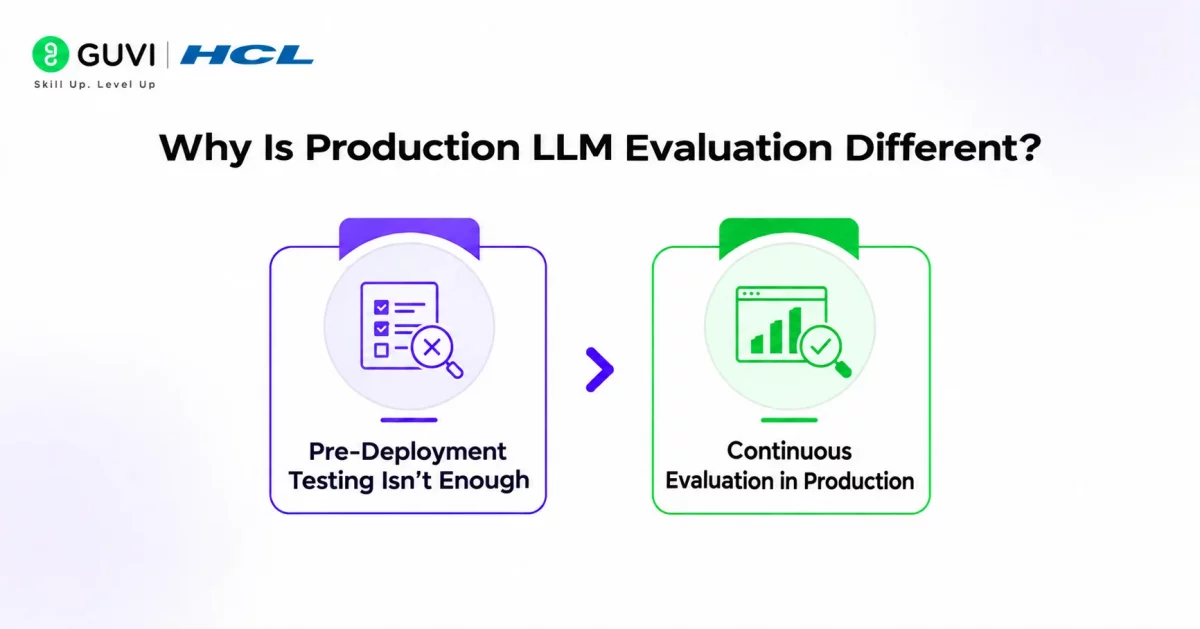
1. Why Isn’t Pre-Deployment Testing Enough?
A model can perform well on a controlled test set and still behave poorly with real users. Production traffic introduces unexpected questions, incomplete information, unusual edge cases, changing data, and new usage patterns.
FDEs therefore need evaluation systems that reflect the customer’s actual environment. The evaluation process should continue after launch rather than ending when the application passes its initial tests.
2. What Should You Measure?
Start with the outcome the customer cares about. A support assistant might need to resolve requests accurately, while a document-processing system might need to extract information correctly.
The metric should reflect the workflow rather than an abstract measure of model performance.
How Do You Define Good LLM Output?
1. Create Clear Evaluation Criteria
Before measuring responses, define what a successful output looks like. Criteria can include factual correctness, relevance, completeness, tone, format, policy compliance, or successful task completion.
For an AI agent, evaluation may also include whether the correct tool was selected and whether the requested action was completed successfully.
2. Establish a Baseline
Measure the existing process before judging the AI system. A customer may currently rely on manual review, a rules-based application, or another model.
A baseline helps determine whether the LLM actually improves the workflow rather than simply producing impressive-looking responses.
Which Metrics Should You Track?
1. Accuracy and Task Success
Accuracy measures whether the output is correct according to the requirements. Task success goes one step further by asking whether the system actually accomplished the user’s goal.
These measures should be customized to the application.
2. Groundedness and Hallucinations
For systems using customer data, outputs should remain supported by approved sources. Track unsupported claims, incorrect citations, and information that cannot be traced to the provided context.
This is particularly important for retrieval-augmented generation applications.
3. Latency
A response that is accurate but takes too long may still create a poor user experience. Track response time and identify which components contribute to delays.
For agentic systems, measure both total execution time and individual tool or model calls.
4. Cost
LLM applications can make many model calls, especially when agents use multiple tools or reasoning steps.
Track token consumption, model usage, and cost per task. Rising costs may indicate inefficient prompts, unnecessary context, excessive tool calls, or poor model selection.
5. Safety and Policy Compliance
Production systems should monitor harmful outputs, unauthorized actions, sensitive-data exposure, and violations of customer policies.
The exact safety criteria depend on the application and industry.
How Do Automated Evaluations Help?
1. What Can Automated Checks Measure?
Automated evaluators can assess large volumes of outputs quickly. They can check structured formats, required fields, source attribution, response length, keyword conditions, or other application-specific requirements.
An evaluator model can also score characteristics such as relevance or quality when designed carefully.
2. What Are Their Limitations?
Automated evaluation is not automatically reliable. An evaluator can misunderstand context or reproduce its own biases.
Use automated checks as one layer rather than treating them as the final authority.
Why Is Human Evaluation Still Important?
1. When Should Humans Review Outputs?
Human reviewers are particularly useful when quality depends on judgment or domain expertise. They can identify subtle factual errors, inappropriate recommendations, confusing responses, or workflow problems that automated metrics miss.
For high-impact applications, human review can also provide an important safety mechanism.
2. How Should Feedback Be Collected?
Give reviewers clear criteria and examples. Instead of simply asking whether an answer is “good,” ask them to identify the specific failure.
For example, classify an output as incorrect, incomplete, irrelevant, unsupported, unsafe, or incorrectly formatted.
How Do FDEs Investigate Production Failures?

1. Start With the Output
When an output fails, preserve the relevant input, model response, retrieved context, tool calls, and system configuration where appropriate.
This gives the engineer enough information to reproduce the problem.
2. Identify the Failure Layer
An incorrect response does not necessarily mean the model is the problem.
The issue could originate from poor retrieval, stale data, an incorrect tool result, an ambiguous prompt, an integration failure, or an application bug.
Separating these causes prevents engineers from repeatedly changing the model when another component is responsible.
How Does Evaluation Work for RAG Systems?
1. Check Retrieval Quality
A retrieval system can fail before the model generates anything. If the correct documents are not retrieved, the model may not have enough information to answer correctly.
Measure whether relevant sources are being retrieved and whether irrelevant information is creating confusion.
2. Check Grounded Generation
After retrieval, evaluate whether the final response accurately represents the available evidence.
This creates two distinct evaluation questions: Did we retrieve the right information? and Did the model use that information correctly?
How Should You Monitor Evaluation After Launch?
1. Track Trends, Not Just Averages
An overall quality score can hide important failures. Break metrics down by customer segment, workflow, model, language, request type, or other meaningful categories.
A system might perform well overall while failing consistently for one important group of users.
2. Watch for Drift
Customer data, user behavior, prompts, models, and workflows can change over time.
Regular evaluation helps identify when performance begins to decline. A previously reliable system may need new test cases as production usage evolves.
LLM evaluation is increasingly becoming part of the production engineering lifecycle rather than a one-time model-testing exercise. Modern AI systems require evaluation alongside observability because model behavior can change when prompts, retrieval sources, models, tools, or customer workflows change.
Real-World Example
Imagine an FDE deploys an AI assistant that helps employees answer questions using internal company documents. After launch, users report that some answers contain outdated information.
The FDE examines the failed requests and discovers that the retrieval system is prioritizing older documents. Instead of immediately changing the model, the engineer updates document-ranking logic, adds freshness checks, creates new evaluation cases, and monitors whether groundedness improves.
How Can You Build a Production Evaluation System?
Create a Feedback Loop
A practical evaluation workflow can follow this cycle:
Collect → Evaluate → Classify failures → Fix → Retest → Monitor.
Keep representative examples of successful and unsuccessful requests. Every important production failure can become a new evaluation case.
For broader AI preparation, HCL GUVI’s Artificial Intelligence & Machine Learning Certification Bundle can strengthen your AI and engineering foundation. The HCL GUVI Artificial Intelligence eBook can also help you revise core AI concepts while preparing for technical interviews.
Conclusion
Evaluating LLM outputs in production is an ongoing engineering responsibility. A strong evaluation system measures the outcomes that matter to the customer while combining automated checks, human judgment, observability, and real production feedback.
The most important principle is to investigate failures systematically. Determine whether the issue comes from the model, prompt, retrieval system, data, tools, or application before changing anything. By turning real failures into repeatable evaluation cases, FDEs can steadily improve reliability and keep AI systems aligned with production requirements.
FAQs
1. What is LLM evaluation in production?
It is the continuous measurement of an LLM application’s quality, reliability, safety, cost, and performance after deployment.
2. Which metrics should I use for LLM evaluation?
Common metrics include task success, accuracy, groundedness, hallucination rate, latency, cost, safety, and escalation rate.
3. Should LLM outputs always be evaluated by humans?
No. Automated checks can handle many cases, while human review is especially valuable for complex, subjective, or high-impact outputs.
4. How do I evaluate an RAG application?
Evaluate both retrieval and generation. Check whether the correct information is retrieved and whether the final response accurately uses that information.
5. How can I detect LLM failures?
Monitor production outputs, user feedback, evaluation scores, tool calls, retrieval results, latency, and other application-specific signals.
6. Why should production failures become test cases?
They represent realistic problems that your original test set may not contain. Adding them to evaluation helps prevent the same issue from returning.
7. Is LLM evaluation a one-time process?
No. Production evaluation should continue because models, prompts, data, users, integrations, and workflows can change over time.
Success Stories

About the Author
HCL GUVI
This article was selected and published as part of the HCL GUVI AI Blogathon 2026, an initiative designed to encourage students, AI enthusiasts, and aspiring tech writers to simplify complex AI concepts through impactful technical content. The contest recognized high-quality, original, and insightful AI-focused blogs, with selected authors receiving publication opportunities on the HCL GUVI blog platform along with official author credits and recognition.
View all posts by HCL GUVI
Connect with me @









Did you enjoy this article?