


Forward Deployed Engineer Articles
Excalidraw and Whiteboarding: How FDEs Communicate Technical Solutions
How to Fine-Tune Open-Source Models as a Forward Deployed Engineer
Rate Limiting, Retries, and Caching: Production AI Patterns for FDEs
How to Run a Great Client Demo as a Forward Deployed Engineer


Get In Touch For Details! Request More Information
What Is a Forward Deployed Engineer? A Complete Beginner’s Guide
Sep 04, 2026 4 Min Read 598 Views
(Last Updated)
A forward deployed engineer is a technical professional who works closely with customers to solve real-world problems using software, data, AI, and automation. Instead of building products entirely from behind a desk, they work directly with users or client teams to understand their challenges, build solutions, deploy them, and improve them based on feedback.
The role has become increasingly relevant as companies build AI and data products that need to be adapted to specific business environments. It sits somewhere between software engineering, consulting, product development, and customer-facing technical work.
Table of contents
- TL;DR Summary
- What Does a Forward Deployed Engineer Do
- Why Is This Role Different?
- What Does a Typical Project Look Like?
- Understand
- Prototype
- Integrate
- Deploy
- Iterate
- Skills Required
- Communication Skills Matter
- Where Do Forward Deployed Engineers Work?
- How to Become a Forward Deployed Engineer
- Build a Portfolio Around Real Problems
- Key Takeaways
- Conclusion
- FAQs
- What is a forward deployed engineer?
- Is a forward deployed engineer a software engineer?
- What skills does a forward deployed engineer need?
- Is AI knowledge necessary for the role?
- Is forward deployed engineering a good career?
TL;DR Summary
- A forward-deployed engineer builds technical solutions directly for customer problems.
- They typically work across coding, deployment, debugging, and customer collaboration.
- The role is especially relevant in AI, data, cybersecurity, and enterprise software.
- Strong programming, cloud, APIs, databases, and communication skills are valuable.
- It can be a good career option for engineers who enjoy both technology and problem-solving with customers.
What Does a Forward Deployed Engineer Do
The easiest way to understand the role is to imagine a customer has a problem that cannot be solved by simply clicking a button in an existing product.
For example, a company might want to use an AI platform to analyze thousands of internal documents.
A forward deployed engineer may:
- Talk to the customer to understand the workflow.
- Identify technical requirements.
- Connect the platform to the customer’s systems.
- Build custom integrations or automation.
- Test the solution with real data.
- Deploy it into the customer’s environment.
- Monitor the solution and fix problems.
- Work with product teams to communicate recurring customer needs.
So, instead of only asking “How do I build this feature?”, the engineer often asks:
“What is the customer’s actual problem, and what is the best technical solution?”
Read More: How to Start App Development in 2026: A Complete Beginner’s Guide
Build the skills needed for modern AI engineering with HCL GUVI’s Artificial Intelligence & Machine Learning Course. Learn AI, machine learning, and practical development through hands-on projects.
Why Is This Role Different?
Traditional software engineers often work primarily on a company’s product or internal systems.
A forward deployed engineer operates much closer to the customer.
| Traditional Software Engineer | Forward Deployed Engineer |
| Builds product features | Builds customer-specific solutions |
| Works mainly with engineering teams | Works with customers and engineering teams |
| Product roadmap drives priorities | Customer problems often drive priorities |
| Usually focuses on one product | May work across multiple environments |
| Less customer-facing | Highly customer-facing |
The role can therefore involve more ambiguity than a conventional engineering position.
What Does a Typical Project Look Like?
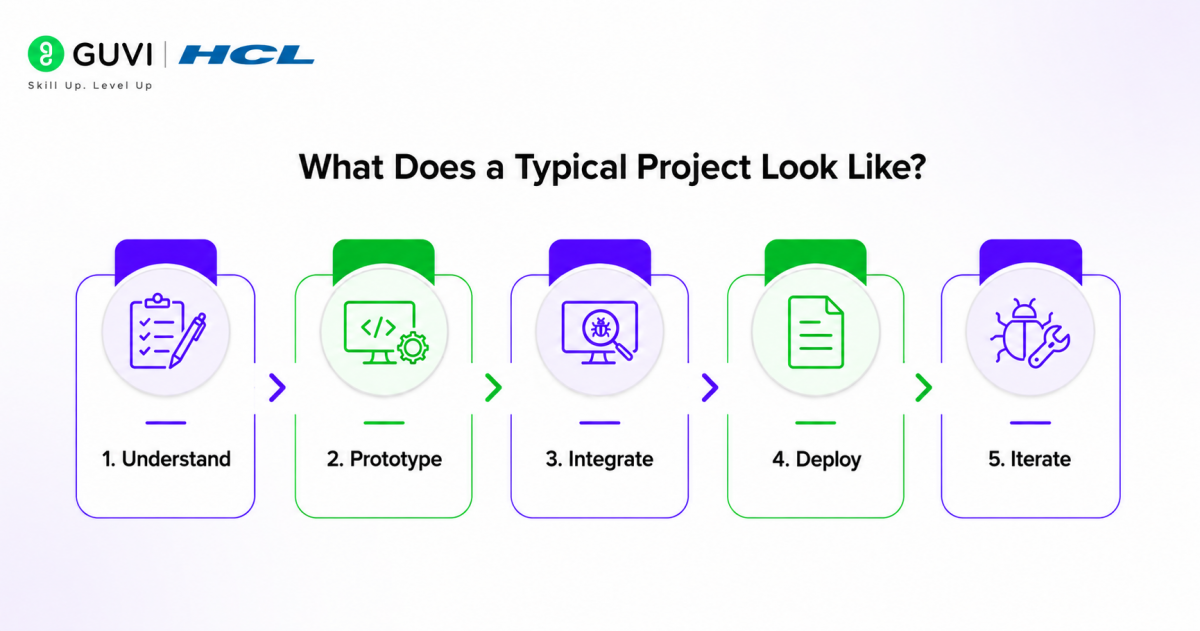
Consider a healthcare company that wants to automate the processing of documents.
A forward deployed engineer might:
Understand → Prototype → Integrate → Deploy → Iterate1. Understand
Meet stakeholders and understand the existing workflow.
2. Prototype
Build a small proof of concept to demonstrate whether the proposed solution works.
3. Integrate
Connect the solution to APIs, databases, cloud infrastructure, or internal applications.
4. Deploy
Move the solution into the customer’s actual environment.
5. Iterate
Collect feedback, fix issues, and improve the workflow.
This means the engineer may write code one day and spend the next day debugging a customer’s deployment or explaining the solution to stakeholders.
The term “forward deployed” comes from the idea of placing technical expertise close to where the problem is being solved, rather than keeping engineers entirely within the company’s internal development environment.
Skills Required
A forward deployed engineer needs a combination of technical depth and communication skills.
- Programming
Strong fundamentals in languages such as:
- Python
- JavaScript/TypeScript
- Java
- Go
Python is particularly useful for AI, automation, data processing, and API integrations.
- APIs and Integrations
You should understand:
- REST APIs
- JSON
- Authentication
- Webhooks
- API testing
- Third-party integrations
A large part of customer engineering involves connecting systems that were never designed to work together.
- Cloud and DevOps
Knowledge of cloud platforms such as AWS, Azure, or Google Cloud can be valuable.
Useful concepts include:
- Docker
- Kubernetes
- CI/CD
- Linux
- Networking
- Infrastructure as Code
- Monitoring
- Databases
You should be comfortable working with:
- SQL
- Relational databases
- NoSQL databases
- Data pipelines
- AI and Machine Learning
For AI-focused companies, understanding concepts such as:
- LLMs
- RAG
- Embeddings
- Vector databases
- Prompt engineering
- Model evaluation
can be particularly useful.
Pro Tip: You do not need to be an expert in every technology. Being able to quickly learn an unfamiliar tool and use it to solve a customer problem is one of the most valuable skills in this role.

Communication Skills Matter
Technical ability alone is not enough.
A forward deployed engineer needs to translate between technical and non-technical teams.
For example, a customer may say:
“Our employees waste hours searching through documents.”
The engineer needs to convert that statement into technical requirements such as:
Document ingestion → Search → Retrieval → AI response → Access control → MonitoringThis ability to turn ambiguous business problems into technical solutions is a major part of the role.
Where Do Forward Deployed Engineers Work?
The role is especially common in companies building complex technology for enterprise customers.
Potential industries include:
- Artificial intelligence
- Cybersecurity
- Cloud computing
- Fintech
- Enterprise SaaS
- Data platforms
- Robotics
- Defense technology
- Automation
AI companies are particularly suited to this model because deploying AI into an organization often requires significant customization.
How to Become a Forward Deployed Engineer
You do not necessarily need a specific degree or job title.
A practical path is:
Software Fundamentals → Cloud & APIs → Real Projects → Customer Problem-Solving → Production DeploymentBuild projects that demonstrate more than coding.
For example, instead of creating only a chatbot, build:
RAG chatbot → API → Authentication → Database → Docker → Cloud Deployment → MonitoringThis demonstrates that you can take a solution from an idea to a working system.
Build a Portfolio Around Real Problems
Good projects could include:
- Automating business workflows.
- Building an AI document assistant.
- Creating an analytics dashboard.
- Integrating multiple APIs.
- Deploying an ML application to the cloud.
- Building an internal automation platform.
Explain the problem, your solution, architecture, technologies, and measurable result.
Key Takeaways
- A forward deployed engineer combines engineering with customer-facing problem solving.
- The role involves building, integrating, deploying, and improving technical solutions.
- Programming, APIs, cloud, databases, and DevOps are valuable skills.
- AI and LLM knowledge can be particularly useful for modern roles.
- Communication and requirement discovery are as important as coding.
- The role offers variety but can involve ambiguity and frequent context switching.
- Real-world projects are one of the best ways to demonstrate readiness.
Build the skills needed for modern AI engineering with HCL GUVI’s Artificial Intelligence & Machine Learning Course. Learn AI, machine learning, and practical development through hands-on projects.
Conclusion
A forward deployed engineer is essentially an engineer who takes technology closer to the real-world problem. Instead of simply building features according to a predefined specification, they work with customers to understand unclear problems and turn them into working technical solutions.
The role is particularly interesting for engineers who enjoy coding, cloud technologies, AI, troubleshooting, and interacting with people. As enterprise technology becomes more customized and AI adoption grows, engineers who can bridge the gap between powerful technology and practical business use cases can become increasingly valuable.
FAQs
What is a forward deployed engineer?
A forward deployed engineer works directly with customers to design, build, integrate, deploy, and improve technical solutions for real-world business problems.
Is a forward deployed engineer a software engineer?
Yes, the role typically requires strong software engineering skills, but it also involves significant customer interaction, solution design, deployment, and problem-solving.
What skills does a forward deployed engineer need?
Important skills include programming, APIs, cloud platforms, databases, DevOps, system integration, debugging, communication, and problem-solving.
Is AI knowledge necessary for the role?
Not always. However, AI, LLMs, RAG, embeddings, and model deployment can be valuable skills for forward deployed roles at modern AI and technology companies.
Is forward deployed engineering a good career?
It can be an excellent career for engineers who enjoy variety, customer interaction, hands-on development, and solving ambiguous real-world problems.
Success Stories

About the Author
HCL GUVI
This article was selected and published as part of the HCL GUVI AI Blogathon 2026, an initiative designed to encourage students, AI enthusiasts, and aspiring tech writers to simplify complex AI concepts through impactful technical content. The contest recognized high-quality, original, and insightful AI-focused blogs, with selected authors receiving publication opportunities on the HCL GUVI blog platform along with official author credits and recognition.
View all posts by HCL GUVI
Connect with me @










Did you enjoy this article?