


Forward Deployed Engineer Articles
Excalidraw and Whiteboarding: How FDEs Communicate Technical Solutions
How to Fine-Tune Open-Source Models as a Forward Deployed Engineer
Rate Limiting, Retries, and Caching: Production AI Patterns for FDEs
How to Run a Great Client Demo as a Forward Deployed Engineer


Get In Touch For Details! Request More Information
TypeScript for Forward Deployed Engineers: When and Why to Use It
Sep 28, 2026 4 Min Read 32 Views
(Last Updated)
TypeScript for forward deployed engineers can be useful when customer projects involve web applications, APIs, integrations, or JavaScript-based systems. Forward Deployed Engineers often work across different technologies and need to adapt quickly to the customer’s existing technical environment.
TypeScript extends JavaScript with static typing and other development features that can make larger applications easier to maintain. For FDEs, this can be particularly valuable when building customer-facing interfaces, backend services, integration layers, or internal tools that need to evolve beyond a quick prototype.
However, FDEs do not need to use TypeScript for every project. The right choice depends on the customer’s technology stack, project requirements, deployment environment, and long-term maintenance needs.
Table of contents
- TL;DR Summary
- What Is TypeScript and Why Does It Matter for FDEs?
- Where Can FDEs Use TypeScript?
- Frontend Applications
- Backend Services
- API Integrations
- Internal Tools
- When Should a Forward Deployed Engineer Use TypeScript?
- Use TypeScript When:
- Consider JavaScript When:
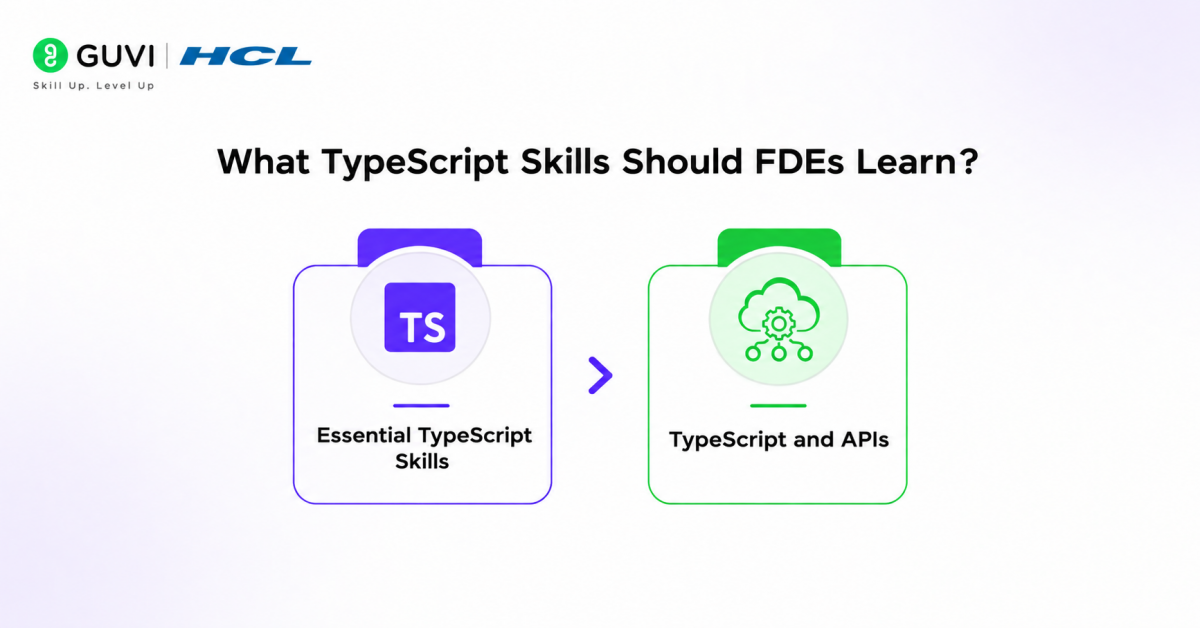
- What TypeScript Skills Should FDEs Learn?
- Essential TypeScript Skills
- TypeScript and APIs
- How Does TypeScript Help With Customer Integrations?
- TypeScript vs JavaScript for FDE Projects
- Common Mistakes to Avoid
- Learning Advanced TypeScript Too Early
- Ignoring JavaScript Fundamentals
- Assuming Types Guarantee Runtime Safety
- Ignoring the Customer's Stack
- Start Your Learning Journey with HCL GUVI
- Conclusion
- FAQs
- Do Forward Deployed Engineers need to know TypeScript?
- How much TypeScript should an FDE learn?
- Is TypeScript better than JavaScript for FDE projects?
- Can FDEs use TypeScript for API integrations?
- Should FDEs learn JavaScript before TypeScript?
- Is TypeScript useful for customer-facing applications?
TL;DR Summary
- TypeScript for forward deployed engineers is useful for web applications, APIs, integrations, and customer solutions built with JavaScript technologies.
- TypeScript adds static typing that can make complex codebases easier to understand and maintain.
- FDEs can use TypeScript for frontend applications, Node.js services, API integrations, and internal tools.
- It is especially useful when a project has multiple developers or needs long-term maintenance.
- FDEs should understand JavaScript fundamentals before learning TypeScript.
- Choose TypeScript based on the customer’s stack and project requirements rather than using it automatically.
What Is TypeScript and Why Does It Matter for FDEs?
TypeScript is a programming language developed by Microsoft that builds on JavaScript by adding static typing and additional language features. TypeScript code is generally compiled or transformed into JavaScript that can run in JavaScript environments.
For FDEs, TypeScript is useful because customer projects often involve existing JavaScript applications, modern web frameworks, APIs, and Node.js services.
Static types can help identify certain mistakes during development before they become runtime problems.
For example, defining the expected structure of an API response can make it easier to identify incorrect property names or unexpected data types while developing an integration.
Build practical AI and software engineering skills with HCL GUVI’s Artificial Intelligence & Machine Learning Course. Learn AI, machine learning, and real-world application development through hands-on projects.
Where Can FDEs Use TypeScript?
TypeScript can support several areas of Forward Deployed Engineering.
1. Frontend Applications
FDEs may build dashboards, customer portals, configuration interfaces, and other web applications.
TypeScript works well with popular JavaScript-based frontend ecosystems and can make large interfaces easier to maintain.
2. Backend Services
With Node.js and frameworks such as Express or NestJS, FDEs can use TypeScript to build:
- API services
- Integration layers
- Webhooks
- Authentication services
- Data processing services
3. API Integrations
Customer environments often require connecting multiple systems.
TypeScript can help structure API clients, request objects, response types, authentication logic, and error handling.
4. Internal Tools
FDEs frequently build small applications that help customers manage workflows or interact with technical systems.
TypeScript can provide structure as these tools become more complex.
TypeScript can be adopted incrementally in many JavaScript projects. This allows teams to introduce types gradually instead of rewriting an entire application at once.
When Should a Forward Deployed Engineer Use TypeScript?
The decision should depend on the project rather than personal preference.
1. Use TypeScript When:
- The customer already uses TypeScript.
- The project involves a large JavaScript codebase.
- Multiple engineers will maintain the solution.
- The application has complex data structures.
- You are building a long-lived service.
- The solution contains multiple API integrations.
2. Consider JavaScript When:
- You are creating a very small prototype.
- The customer environment is entirely JavaScript without TypeScript requirements.
- Speed of experimentation is more important than long-term structure.
- The project will be short-lived and simple.
Best Practice: Match the customer’s existing technology stack whenever practical. FDE work often involves maintaining or integrating with systems you did not design, so compatibility can be more important than using your personal favorite technology.
What TypeScript Skills Should FDEs Learn?
FDEs do not necessarily need to master every advanced TypeScript feature.
Focus first on skills that help with real customer projects.
1. Essential TypeScript Skills
Learn:
- Basic types
- Interfaces
- Type aliases
- Functions and typed parameters
- Objects and arrays
- Union and intersection types
- Generics
- Optional properties
- Type narrowing
- Enums and utility types
- Async/await
- Error handling
You should also understand how TypeScript works with JavaScript and how a TypeScript project is built and deployed.
2. TypeScript and APIs
API work is particularly relevant to FDEs.
You should be comfortable defining types for:
- Request bodies
- Query parameters
- API responses
- Authentication data
- Error responses
- Configuration objects
This can make integration code easier to understand and maintain.

How Does TypeScript Help With Customer Integrations?
Imagine an FDE needs to connect a customer’s CRM with an internal application.
The integration may need to:
- Receive customer data.
- Validate the data.
- Transform the fields.
- Send the information to another API.
- Handle errors.
- Log the result.
Without clear data structures, integration code can become difficult to maintain.
TypeScript allows engineers to define expected data shapes and catch some inconsistencies during development.
For example, if a customer API changes a field from a number to a string, properly typed integration code can make the mismatch easier to identify during development.
TypeScript does not replace runtime validation, however. Data received from external systems should still be validated before the application relies on it.
TypeScript vs JavaScript for FDE Projects
Both technologies can be useful in Forward Deployed Engineering.
| Factor | TypeScript | JavaScript |
| Static typing | Yes | No |
| Learning curve | Higher | Lower |
| Large codebases | Useful | Can become harder to manage |
| Quick prototypes | Suitable | Often simpler |
| API integrations | Strong | Strong |
| Long-term maintenance | Strong | Depends on project structure |
| JavaScript ecosystem | Yes | Yes |
The choice should be based on the project’s requirements and customer environment.
An FDE’s goal is not to demonstrate that TypeScript is superior to JavaScript. The goal is to select a technology that helps deliver and maintain the required solution.
Common Mistakes to Avoid
1. Learning Advanced TypeScript Too Early
Do not start with complex type-level programming. Build a strong understanding of JavaScript and basic TypeScript first.
2. Ignoring JavaScript Fundamentals
TypeScript does not replace JavaScript knowledge. Understanding asynchronous programming, objects, functions, modules, and the runtime remains important.
3. Assuming Types Guarantee Runtime Safety
Types are primarily a development-time tool. External API data can still be incorrect or unexpected.
4. Ignoring the Customer’s Stack
Introducing TypeScript into a project without considering the customer’s existing environment can create unnecessary complexity.
Pro Tip: For FDE interviews and projects, focus on demonstrating how you use TypeScript to solve practical problems rather than simply listing TypeScript among your skills.
Start Your Learning Journey with HCL GUVI
Build practical AI and software engineering skills with HCL GUVI’s Artificial Intelligence & Machine Learning Course. Learn AI, machine learning, and real-world application development through hands-on projects.
Conclusion
TypeScript for forward deployed engineers is a valuable skill when customer projects involve modern JavaScript applications, APIs, integrations, and backend services. Its static typing can help FDEs build clearer and more maintainable solutions, particularly when projects become larger or involve multiple developers.
However, TypeScript is not automatically the right choice for every deployment. Forward Deployed Engineers should understand both JavaScript and TypeScript and choose the approach that fits the customer’s environment and project requirements. Building practical skills around APIs, integrations, error handling, and application development will make TypeScript more useful in real FDE work.
FAQs
Do Forward Deployed Engineers need to know TypeScript?
TypeScript is not mandatory for every FDE role, but it can be valuable when working with web applications, APIs, integrations, and JavaScript-based customer environments.
How much TypeScript should an FDE learn?
Start with types, interfaces, functions, generics, asynchronous programming, error handling, and API integration. Advanced type-level programming is usually not necessary at the beginning.
Is TypeScript better than JavaScript for FDE projects?
Neither is universally better. The appropriate choice depends on the customer’s technology stack, project complexity, development speed, and long-term maintenance requirements.
Can FDEs use TypeScript for API integrations?
Yes. TypeScript can help define API requests, responses, configuration objects, and error structures, making integration code easier to understand and maintain.
Should FDEs learn JavaScript before TypeScript?
Yes. A strong JavaScript foundation makes TypeScript easier to understand because TypeScript builds on JavaScript rather than replacing it.
Is TypeScript useful for customer-facing applications?
Yes. FDEs can use TypeScript to build customer portals, dashboards, internal tools, API services, and other applications that require JavaScript-based technologies.
Success Stories

About the Author
HCL GUVI
This article was selected and published as part of the HCL GUVI AI Blogathon 2026, an initiative designed to encourage students, AI enthusiasts, and aspiring tech writers to simplify complex AI concepts through impactful technical content. The contest recognized high-quality, original, and insightful AI-focused blogs, with selected authors receiving publication opportunities on the HCL GUVI blog platform along with official author credits and recognition.
View all posts by HCL GUVI
Connect with me @








Did you enjoy this article?