


Forward Deployed Engineer Articles
Excalidraw and Whiteboarding: How FDEs Communicate Technical Solutions
How to Fine-Tune Open-Source Models as a Forward Deployed Engineer
Rate Limiting, Retries, and Caching: Production AI Patterns for FDEs
How to Run a Great Client Demo as a Forward Deployed Engineer


Get In Touch For Details! Request More Information
How Sierra and Decagon Use FDEs to Deploy AI Agents
Sep 28, 2026 4 Min Read 45 Views
(Last Updated)
Sierra Decagon forward deployed engineers represent a growing approach to deploying AI agents in real customer environments. While AI companies can build powerful models and agent platforms, turning those capabilities into reliable business solutions often requires engineers who understand both the technology and the customer’s workflow.
Companies such as Sierra and Decagon focus on AI agents designed to handle customer service and business workflows. Their implementations can involve connecting agents to company data, business systems, APIs, knowledge bases, and operational processes.
Forward Deployed Engineers, or FDEs, help bridge this gap. They work closely with customers to understand requirements, configure and integrate AI agents, solve technical problems, and move deployments from initial experimentation toward production use. This article explains how FDEs fit into AI agent deployment, what they do, the skills they need, and why this model is becoming increasingly important.
Table of contents
- TL;DR Summary
- What Are Sierra and Decagon Forward Deployed Engineers?
- Why Do AI Agents Need FDEs?
- What Do FDEs Do When Deploying AI Agents?
- Understand the Customer's Workflow
- Connect Enterprise Systems
- Configure Agent Behavior
- Test and Evaluate the Agent
- Troubleshoot Production Issues
- How Does an AI Agent Deployment Work?
- What Skills Do AI Agent FDEs Need?
- Software Engineering
- AI and LLM Knowledge
- APIs and Integrations
- Cloud and Deployment
- Communication
- How Is This Different From Traditional AI Engineering?
- How Can Engineers Prepare for AI Agent FDE Roles?
- Start Your Learning Journey with HCL GUVI
- Conclusion
- FAQs
- What are Sierra Decagon forward deployed engineers?
- Why are FDEs important for AI agent deployment?
- What skills do AI agent FDEs need?
- Do FDEs work directly with customers?
- Are Sierra and Decagon FDE roles the same?
- How can I prepare for an AI agent FDE role?
TL;DR Summary
- Sierra Decagon forward deployed engineers help turn AI agent capabilities into customer-specific solutions.
- FDEs work closely with customers to understand workflows, requirements, integrations, and technical constraints.
- Their work can involve APIs, enterprise data, knowledge bases, testing, debugging, deployment, and agent evaluation.
- Strong software engineering, AI, API, cloud, and communication skills are useful for the role.
- FDEs help bridge the gap between an AI agent prototype and a reliable production deployment.
What Are Sierra and Decagon Forward Deployed Engineers?
Sierra Decagon forward deployed engineers can be understood as customer-facing technical professionals who help organizations implement AI agents for practical business use cases.
Sierra and Decagon operate in the enterprise AI agent space, where agents can be used to automate customer interactions and business processes. Deploying these systems successfully requires more than connecting a model to a chatbot interface.
An enterprise AI agent may need access to customer-approved information, internal knowledge, APIs, business rules, and existing software systems. FDEs help bring these pieces together while adapting the implementation to each customer’s environment.
Their work sits at the intersection of:
- AI engineering
- Software development
- API integration
- Data and knowledge systems
- Cloud deployment
- Customer engineering
- Technical problem-solving
Prepare for emerging AI engineering opportunities with HCL GUVI’s Artificial Intelligence & Machine Learning Course. Learn AI, machine learning, and practical application development through hands-on, real-world projects.
Why Do AI Agents Need FDEs?
An AI agent can work well in a controlled demonstration but encounter very different challenges in production.
A customer service agent, for example, may need to retrieve information from a knowledge base, access customer records, interact with business applications, follow authorization rules, and escalate complex cases to human employees.
Each organization may have different systems and workflows.
FDEs help solve these customer-specific challenges by understanding the environment and adapting the agent implementation accordingly.
Deploying an AI agent can involve several systems beyond the underlying model, including retrieval, APIs, authentication, business logic, monitoring, evaluation, and human escalation workflows.
What Do FDEs Do When Deploying AI Agents?
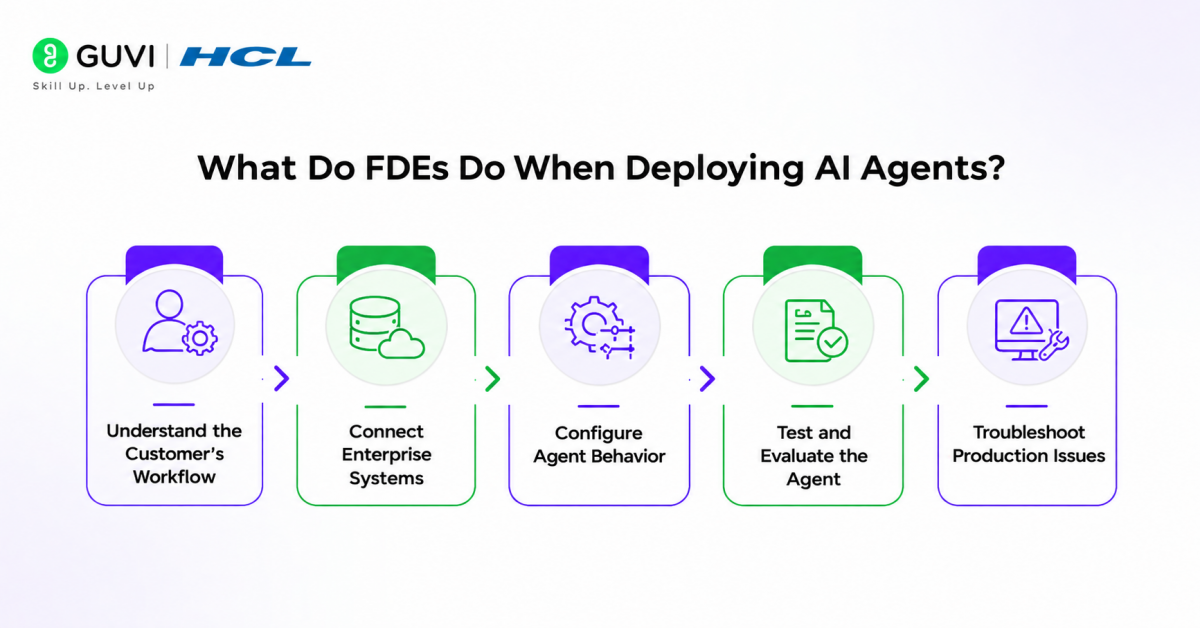
1. Understand the Customer’s Workflow
The first step is identifying how the customer currently handles a process.
For a customer support use case, an FDE may investigate how requests are received, where information is stored, which systems employees use, and when human intervention is required.
This helps determine where an AI agent can provide value.
2. Connect Enterprise Systems
AI agents often need to interact with existing applications.
FDEs may work with APIs, webhooks, databases, authentication systems, knowledge bases, and other integrations to connect the agent to the customer’s environment.
3. Configure Agent Behavior
Agents need appropriate instructions, tools, knowledge sources, and boundaries.
FDEs can help configure these components so that the agent behaves appropriately for a particular business workflow.
4. Test and Evaluate the Agent
An agent should be evaluated against realistic scenarios before being widely deployed.
FDEs may create test cases, examine failures, identify inaccurate responses, and improve the system based on observed behavior.
5. Troubleshoot Production Issues
Real-world deployments can expose unexpected problems.
Engineers may investigate incorrect tool calls, missing information, API failures, latency, authentication issues, or unexpected agent behavior.
Pro Tip: Test AI agents using realistic customer scenarios rather than only ideal examples. Edge cases often reveal problems that are invisible during simple demonstrations.
How Does an AI Agent Deployment Work?
A typical deployment can follow this process:
Discovery → Workflow analysis → Integration → Agent configuration → Testing → Evaluation → Deployment → MonitoringThe process is iterative.
During testing, an FDE may discover that the agent lacks access to important information. An API may return unexpected data, or a business rule may require additional logic.
Instead of treating deployment as a one-time handoff, FDEs continue refining the system based on real-world results.
This approach helps organizations move from an initial AI demonstration toward a system that can operate reliably within an existing workflow.

What Skills Do AI Agent FDEs Need?
1. Software Engineering
Programming fundamentals are important for building integrations, automating workflows, debugging problems, and adapting applications.
Python, JavaScript, or TypeScript can be useful depending on the environment.
2. AI and LLM Knowledge
Engineers should understand language models, prompts, retrieval-augmented generation, agent workflows, evaluation, and common AI limitations.
3. APIs and Integrations
REST APIs, JSON, authentication, webhooks, databases, and application architecture are particularly useful when connecting agents to enterprise systems.
4. Cloud and Deployment
Knowledge of cloud platforms, containers, logging, monitoring, CI/CD, and security can help engineers support production deployments.
5. Communication
FDEs need to communicate directly with customers. They must be able to ask the right questions, explain technical trade-offs, manage expectations, and translate business requirements into technical solutions.
Best Practice: Develop a T-shaped skill set. Build deep expertise in software or AI while developing practical knowledge of APIs, cloud infrastructure, data, security, and customer problem-solving.
How Is This Different From Traditional AI Engineering?
| Area | Traditional AI Engineering | AI Agent FDE |
| Main focus | AI systems and products | Customer-specific AI solutions |
| Requirements | Product-defined | Customer-driven |
| Integrations | Often reusable | Customer-specific |
| Testing | Standardized evaluations | Real customer scenarios |
| Communication | Mainly internal | Customers and internal teams |
| Problem scope | Often specialized | Broad and adaptable |
Traditional AI engineers may focus on building models, platforms, or reusable AI capabilities. FDEs focus more heavily on applying those capabilities to individual customer environments.
The roles complement each other. Product and AI teams build the underlying capabilities, while FDEs help turn those capabilities into working customer solutions.
How Can Engineers Prepare for AI Agent FDE Roles?
Start with strong programming fundamentals and learn how modern AI applications are built.
Focus on:
- Python or another programming language
- REST APIs and authentication
- Databases and data processing
- Cloud fundamentals
- LLM and RAG concepts
- Agent architectures
- Evaluation and testing
- Debugging and monitoring
Then build an end-to-end AI agent project. For example, create a support agent that retrieves information from a knowledge base, calls an API, handles errors, evaluates responses, and includes human escalation.
You should also practice explaining your technical decisions to non-technical stakeholders.
Warning: Do not focus only on prompt engineering. Production AI agents require software engineering, integration, evaluation, security, debugging, and deployment skills.
Start Your Learning Journey with HCL GUVI
Prepare for emerging AI engineering opportunities with HCL GUVI’s Artificial Intelligence & Machine Learning Course. Learn AI, machine learning, and practical application development through hands-on, real-world projects.
Conclusion
Sierra Decagon forward deployed engineers highlight how the role of an AI engineer is expanding beyond model development. As businesses adopt AI agents for customer service and operational workflows, organizations need engineers who can connect those systems to real data, applications, and business processes.
FDEs provide that bridge by combining software engineering, AI knowledge, integration skills, and customer collaboration. For engineers interested in applied AI, learning how to build reliable agents, integrate APIs, evaluate outputs, troubleshoot deployments, and communicate with customers can provide a strong foundation for similar forward deployed roles.
FAQs
What are Sierra Decagon forward deployed engineers?
They are customer-focused technical professionals who help organizations implement and deploy AI agent solutions. Their work can involve integrations, configuration, testing, evaluation, and troubleshooting.
Why are FDEs important for AI agent deployment?
AI agents need to work with real customer data, systems, APIs, and business workflows. FDEs help adapt the technology to these customer-specific requirements.
What skills do AI agent FDEs need?
Important skills include software engineering, Python, APIs, cloud platforms, LLMs, RAG, agent workflows, debugging, evaluation, and customer communication.
Do FDEs work directly with customers?
Yes. Customer interaction is a major part of forward deployed engineering. FDEs may gather requirements, explain solutions, troubleshoot issues, and coordinate deployment activities.
Are Sierra and Decagon FDE roles the same?
Not necessarily. Each company can structure its forward deployed teams and responsibilities differently. However, both approaches can involve applying AI agent technology to specific customer environments.
How can I prepare for an AI agent FDE role?
Build strong programming, API, cloud, and AI fundamentals. Create end-to-end agent projects and practice solving ambiguous customer problems, evaluating AI outputs, and explaining technical decisions.
Success Stories

About the Author
HCL GUVI
This article was selected and published as part of the HCL GUVI AI Blogathon 2026, an initiative designed to encourage students, AI enthusiasts, and aspiring tech writers to simplify complex AI concepts through impactful technical content. The contest recognized high-quality, original, and insightful AI-focused blogs, with selected authors receiving publication opportunities on the HCL GUVI blog platform along with official author credits and recognition.
View all posts by HCL GUVI
Connect with me @








Did you enjoy this article?