


Forward Deployed Engineer Articles
Excalidraw and Whiteboarding: How FDEs Communicate Technical Solutions
How to Fine-Tune Open-Source Models as a Forward Deployed Engineer
Rate Limiting, Retries, and Caching: Production AI Patterns for FDEs
How to Run a Great Client Demo as a Forward Deployed Engineer


Get In Touch For Details! Request More Information
Why Legacy Enterprise Software Vendors Are Building FDE Teams
Sep 27, 2026 4 Min Read 69 Views
(Last Updated)
Forward Deployed Engineering (FDE) is no longer limited to AI-native companies. Established enterprise software vendors are adopting the model because customers increasingly want help turning AI capabilities into working production systems. Instead of relying entirely on traditional consulting, solution architecture, or customer success, vendors are placing engineers closer to customer workflows to build, integrate, test, and improve AI solutions.
Table of contents
- TL;DR Summary
- Why Are Legacy Vendors Adopting FDE?
- What Has Changed in Enterprise Software?
- Why Is AI Accelerating the Shift?
- How Is FDE Different From Traditional Professional Services?
- Is FDE Just Consulting With a New Name?
- Why Does That Distinction Matter?
- What Do Legacy Software FDE Teams Actually Do?
- Understand Customer Workflows
- Build Customer Solutions
- Move From Pilot to Production
- Why Do FDEs Matter for Legacy Product Roadmaps?
- Customer Deployments Reveal Product Gaps
- FDEs Create a Feedback Loop
- Which Enterprise Vendors Are Embracing the Model?
- What Are the Business Benefits?
- Faster Enterprise Adoption
- Stronger Customer Relationships
- Better Product-Market Feedback
- More Expansion Opportunities
- What Are the Risks?
- Customization Can Become Too Expensive
- Measuring FDE ROI Is Difficult
- Real-World Example
- How Can You Prepare for Enterprise FDE Roles?
- Build More Than AI Demos
- Conclusion
- FAQs
- Why are enterprise software vendors hiring FDEs?
- Is FDE the same as professional services?
- How do FDEs help product teams?
- Which legacy vendors are adopting FDE?
- Can FDE teams become expensive?
- What skills does an enterprise FDE need?
- Will FDE become a permanent enterprise role?
TL;DR Summary
- Legacy software vendors are adopting FDE to accelerate enterprise AI adoption.
- FDEs close the gap between product capabilities and customer-specific implementation.
- The model combines engineering, customer discovery, integration, and measurable outcomes.
- Vendors can use customer deployments to improve products and create reusable solutions.
Quick Answer
| Legacy enterprise software vendors are building FDE teams because selling AI capabilities alone is no longer enough. Enterprise customers often need help connecting new AI systems to existing applications, data, workflows, and governance requirements. FDEs provide that hands-on engineering layer, helping customers reach production faster while giving vendors direct feedback about what needs to improve in the product. ICONIQ’s 2026 research found that the FDE model has spread across AI-native companies, legacy enterprise vendors, and hyperscalers. |
Why Are Legacy Vendors Adopting FDE?
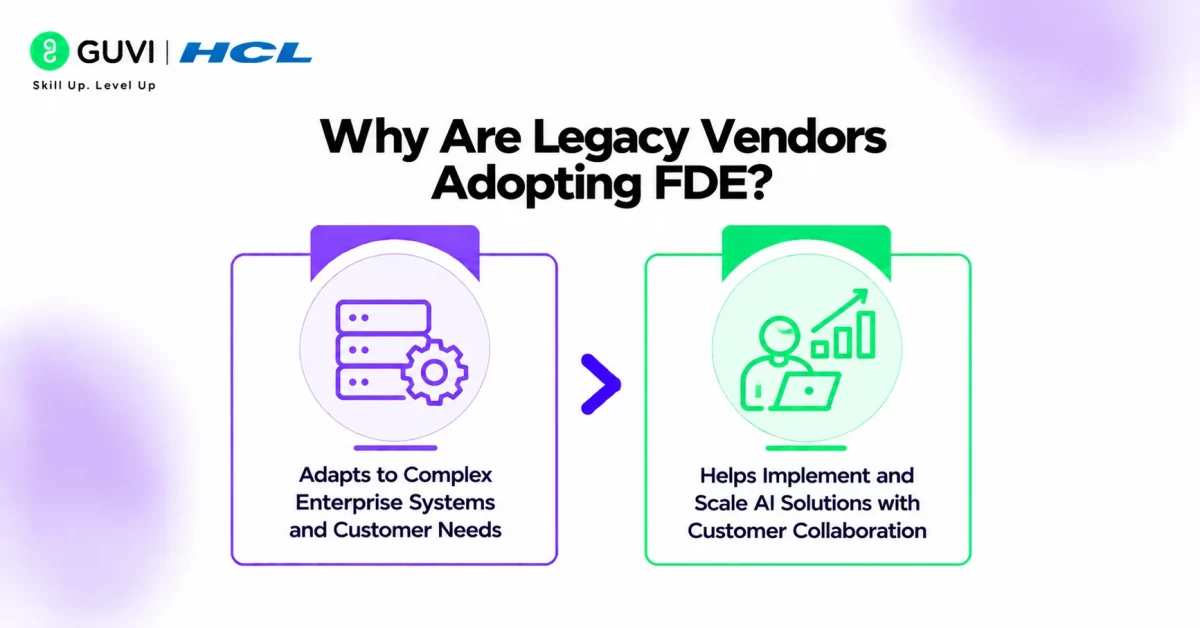
1. What Has Changed in Enterprise Software?
Traditional enterprise software was often sold as a product that customers configured and implemented through established IT processes. Generative AI has made that approach harder.
AI systems frequently need customer-specific data, integrations, workflows, evaluation, and ongoing refinement. Customers may understand the potential but lack the engineering capacity to turn an AI feature into a production workflow.
FDEs address this implementation gap by working directly with the customer instead of leaving the final engineering work entirely to the buyer or a separate services organization.
2. Why Is AI Accelerating the Shift?
Enterprise AI adoption is moving faster than many organizations can absorb it. Technology vendors can provide increasingly capable models and platforms, but customers still have to determine where those capabilities fit into their operations.
TBR describes FDEs as embedded technical builders who identify high-value AI use cases, build or configure systems around enterprise data, and help move projects from pilots into production.
How Is FDE Different From Traditional Professional Services?
1. Is FDE Just Consulting With a New Name?
There is significant overlap. FDEs can perform work traditionally associated with solution architects, consultants, implementation specialists, and field engineers.
The difference is the emphasis on hands-on engineering and production ownership. Instead of primarily recommending an approach, FDEs can write code, build integrations, test systems, debug problems, and iterate with users.
TBR notes that hyperscalers and ISVs are adding FDEs alongside existing professional services, solution architecture, field engineering, customer success, and partner programs rather than necessarily replacing those functions.
2. Why Does That Distinction Matter?
AI deployments often involve problems that cannot be solved through documentation or configuration alone. The FDE gives the vendor a technical resource capable of staying involved when the implementation becomes complex.
That makes the customer relationship more engineering-intensive.
What Do Legacy Software FDE Teams Actually Do?
1. Understand Customer Workflows
FDEs first investigate how the customer operates. They identify users, existing applications, data sources, bottlenecks, and business objectives.
This prevents the vendor from forcing an AI capability into a workflow where it does not actually create value.
2. Build Customer Solutions
Once the problem is understood, FDEs can create integrations, applications, automations, agents, and other technical components required for deployment.
The implementation may involve modifying the product or building additional components around it.
3. Move From Pilot to Production
A successful demonstration is not the same as a production system. FDEs help address authentication, security, reliability, evaluation, monitoring, deployment, and operational requirements.
The objective is to make the solution useful under real customer conditions.
Why Do FDEs Matter for Legacy Product Roadmaps?
1. Customer Deployments Reveal Product Gaps
An FDE working inside a customer environment sees problems that may not appear in traditional product feedback channels.
If multiple customers repeatedly need the same integration or capability, the vendor can turn that pattern into a product feature.
2. FDEs Create a Feedback Loop
The process can become:
Customer problem → FDE implementation → deployment feedback → product improvement → reusable capability.
This allows enterprise deployments to influence the core product instead of remaining isolated custom projects.
ICONIQ identifies downstream product impact, including features originating from customer deployments, as one way FDE organizations measure their value.
Which Enterprise Vendors Are Embracing the Model?
- Infor
Infor describes FDE as an emerging standard for enterprise AI delivery and says it has invested in the approach for years. Its current strategy is evolving FDE through an AI Adoption Hub designed to help engineers prototype, refine, deploy, and manage AI solutions.
- ServiceNow
ServiceNow launched a Forward Deployed Engineering program with Accenture in 2026. Its AI-native FDE team works with Accenture FDEs inside customer environments to build agentic AI workflows and move them from enterprise pilots into production.
- IBM
IBM is also positioning FDE as part of enterprise AI transformation. Its model describes forward-deployed units as multidisciplinary groups combining FDEs, architects, and domain specialists to implement AI solutions for customers.

These examples show that FDE is becoming part of a broader enterprise delivery strategy rather than remaining a niche operating model.
What Are the Business Benefits?
1. Faster Enterprise Adoption
Customers receive hands-on technical assistance instead of being expected to figure out complex AI implementation alone.
2. Stronger Customer Relationships
An engineer working directly with a customer develops a deeper understanding of the organization’s technical environment and business priorities.
3. Better Product-Market Feedback
FDE teams provide product organizations with direct evidence about recurring customer problems.
4. More Expansion Opportunities
When a vendor successfully deploys one workflow, the same customer may expand into additional departments or use cases.
ICONIQ reports that FDE organizations commonly track revenue retention, FDE-supported deal wins, and product impact, although companies differ in how they measure the function.
What Are the Risks?
Customization Can Become Too Expensive
The biggest challenge is scalability. If every customer requires completely different engineering work, the vendor can end up operating a large services organization instead of a scalable software business.
FDE teams therefore need to distinguish between necessary customer configuration and capabilities that should become part of the core product.
Measuring FDE ROI Is Difficult
It can be difficult to determine exactly how much revenue or adoption resulted from FDE involvement.
ICONIQ reports that companies are still experimenting with how to attribute and monetize FDE work.
ICONIQ’s 2026 State of AI research found that 37% of AI builder respondents already employed FDEs, 22% were hiring them, and 50% planned to make the function a permanent part of their go-to-market motion.
Real-World Example
Imagine an enterprise software vendor launches an AI agent for automating finance workflows. A large customer wants to use it, but its data is spread across several systems, and its approval process is highly customized.
An FDE can map the workflow, build the required integrations, establish evaluation criteria, deploy the agent, and work with the customer’s team. If several customers encounter the same integration problem, the vendor can eventually turn that FDE-built solution into a reusable product capability.
For additional preparation, HCL GUVI’s Artificial Intelligence & Machine Learning Certification Bundle can strengthen your AI and engineering foundation. The HCL GUVI Artificial Intelligence eBook can support revision of core concepts before technical interviews.
How Can You Prepare for Enterprise FDE Roles?
Build More Than AI Demos
FDE candidates should demonstrate the ability to take an idea through implementation. Build projects involving APIs, databases, AI models, authentication, evaluation, deployment, and monitoring.
Also practice explaining technical decisions from a customer’s perspective: What problem are you solving? Why does the architecture fit? How will success be measured?
Conclusion
Legacy enterprise software vendors are building FDE teams because enterprise AI adoption requires more than adding an AI feature to an existing product. Customers need engineers who can understand their environment, build integrations, solve deployment problems, and demonstrate meaningful outcomes.
The model also benefits vendors by creating a direct feedback loop between customer problems and product development. The long-term challenge is scalability: successful companies must transform repeated FDE work into reusable products rather than creating a separate custom solution for every customer.
FAQs
1. Why are enterprise software vendors hiring FDEs?
They need engineers who can help customers integrate AI into existing systems and move projects from experimentation into production.
2. Is FDE the same as professional services?
Not exactly. FDE typically places greater emphasis on hands-on engineering, implementation, and production ownership.
3. How do FDEs help product teams?
They expose recurring customer problems and can help identify capabilities that should become reusable product features.
4. Which legacy vendors are adopting FDE?
Companies including Infor, ServiceNow, IBM, and other established enterprise technology providers are adopting or expanding FDE approaches.
5. Can FDE teams become expensive?
Yes. Excessive customization can increase engineering costs and reduce the scalability advantage of software.
6. What skills does an enterprise FDE need?
Software engineering, AI, APIs, systems integration, cloud infrastructure, problem-solving, customer discovery, and communication are valuable.
7. Will FDE become a permanent enterprise role?
Current industry research suggests the function is increasingly becoming a permanent part of enterprise AI go-to-market and delivery strategies.
Success Stories

About the Author
HCL GUVI
This article was selected and published as part of the HCL GUVI AI Blogathon 2026, an initiative designed to encourage students, AI enthusiasts, and aspiring tech writers to simplify complex AI concepts through impactful technical content. The contest recognized high-quality, original, and insightful AI-focused blogs, with selected authors receiving publication opportunities on the HCL GUVI blog platform along with official author credits and recognition.
View all posts by HCL GUVI
Connect with me @






Did you enjoy this article?