


Forward Deployed Engineer Articles
Excalidraw and Whiteboarding: How FDEs Communicate Technical Solutions
How to Fine-Tune Open-Source Models as a Forward Deployed Engineer
Rate Limiting, Retries, and Caching: Production AI Patterns for FDEs
How to Run a Great Client Demo as a Forward Deployed Engineer


Get In Touch For Details! Request More Information
SQL Skills Every Forward Deployed Engineer Needs
Sep 27, 2026 4 Min Read 77 Views
(Last Updated)
SQL is one of the most practical technical skills for a Forward Deployed Engineer (FDE). Customer environments are full of databases, operational records, inconsistent data, and systems that rarely look like clean development datasets. FDEs often need to investigate that data quickly, understand how systems connect, identify problems, and turn findings into working solutions. Current FDE roles continue to list SQL alongside programming and data-engineering skills.
Table of contents
- TL;DR Summary
- Why Does an FDE Need SQL?
- What Makes SQL So Useful?
- Is SQL Only for Data Engineers?
- Which SQL Fundamentals Should FDEs Master?
- SELECT, WHERE, and ORDER BY
- GROUP BY and Aggregations
- JOINs
- Why Are CTEs Important?
- What Do CTEs Help With?
- Why Does Readability Matter?
- What Are Window Functions?
- Why Should FDEs Learn Them?
- How Does SQL Help With Data Quality?
- Can SQL Find Bad Data?
- Why Is This Important Before Deployment?
- How Does SQL Help With Customer Discovery?
- Can SQL Answer Business Questions?
- How Does SQL Support AI and FDE Work?
- Preparing Data for AI Systems
- Investigating AI Failures
- Does an FDE Need SQL Optimization Skills?
- When Does Performance Matter?
- What SQL Mistakes Should FDEs Avoid?
- Ignoring Duplicate Rows
- Filtering Too Late
- Assuming Data Is Correct
- Real-World Example
- How Can You Improve Your SQL for FDE Roles?
- Practice With Unfamiliar Data
- Combine SQL With Engineering
- Conclusion
- FAQs
- Do Forward Deployed Engineers need SQL?
- What SQL topics should an FDE learn first?
- Are window functions important for FDEs?
- Can SQL help with AI projects?
- Do FDEs need advanced SQL optimization?
- How should I practice SQL for an FDE interview?
- Is SQL enough to become an FDE?
TL;DR Summary
- FDEs use SQL to investigate customer data and understand unfamiliar systems.
- Joins, CTEs, window functions, filtering, and aggregation are essential skills.
- SQL also helps with debugging, data validation, transformation, and AI pipelines.
- Strong FDEs use SQL to answer customer questions, not just solve coding exercises.
Quick Answer
| Every FDE should be comfortable reading unfamiliar schemas, writing multi-table queries, investigating data-quality problems, aggregating business information, and transforming data for downstream applications. Advanced roles may also require query optimization, analytical functions, and experience working with large datasets. SQL matters because FDEs frequently work with customer data before they can design or deploy a reliable technical solution. |
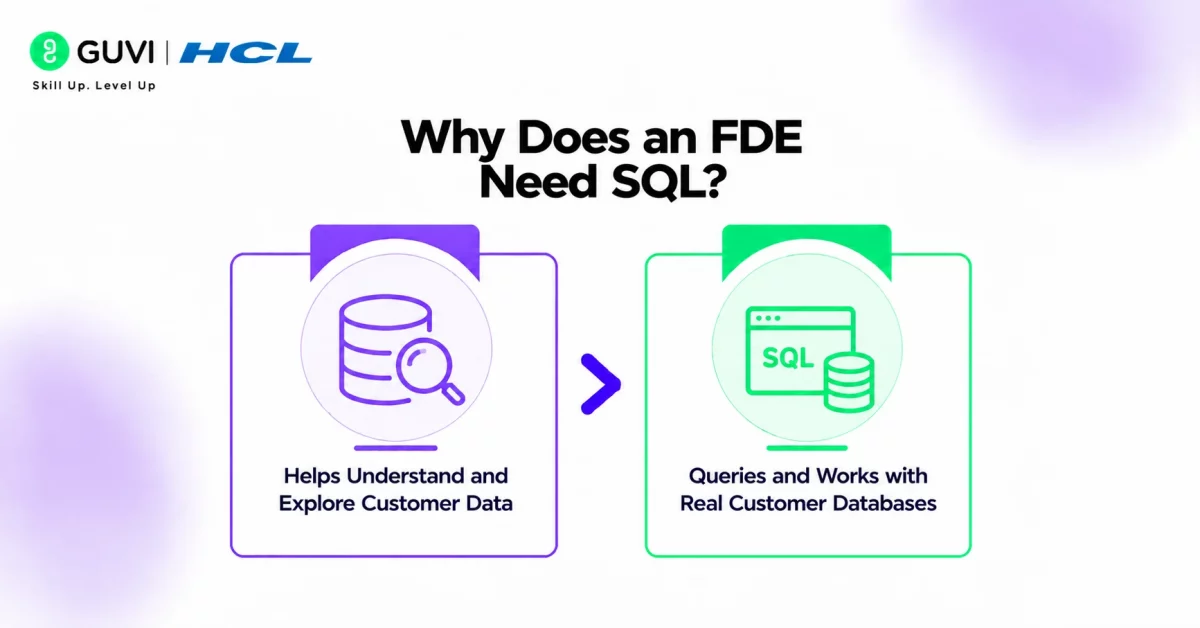
Why Does an FDE Need SQL?
1. What Makes SQL So Useful?
Forward Deployed Engineers work directly with customer environments, where understanding the data is often the first technical challenge. Before building an application or AI workflow, an FDE may need to determine what information exists, where it lives, how records relate, and whether the data is trustworthy.
Palantir’s current Forward Deployed roles explicitly include SQL among relevant technical skills, while its engineers are expected to work directly with business-critical customer data.
2. Is SQL Only for Data Engineers?
No. An FDE may not spend the entire day writing queries, but SQL can become essential whenever a deployment depends on customer data.
It helps engineers investigate unfamiliar databases without waiting for another team to extract every answer.
Which SQL Fundamentals Should FDEs Master?
1. SELECT, WHERE, and ORDER BY
These are basic commands, but FDEs should be able to use them quickly. You should know how to select specific columns, filter records, sort results, and combine conditions.
The goal is speed. When a customer asks a question about their data, you should be able to investigate immediately.
2. GROUP BY and Aggregations
Functions such as COUNT, SUM, AVG, MIN, and MAX help turn raw records into useful information.
For example, an FDE might calculate the number of support tickets created each week or determine the average processing time for a workflow.
3. JOINs
JOINs are especially important because enterprise data is rarely stored in one table.
You should understand INNER JOIN, LEFT JOIN, and the situations where different join types produce different results. Incorrect joins can create duplicate records or silently remove important information.
Why Are CTEs Important?
1. What Do CTEs Help With?
Common Table Expressions, or CTEs, allow complex queries to be broken into logical stages. This makes investigation and transformation easier to understand.
An FDE might first isolate eligible customers, then calculate their activity, and finally compare those results with another dataset.
2. Why Does Readability Matter?
FDE work is collaborative. Another engineer, analyst, or customer may need to understand your query later.
Readable SQL makes debugging easier and reduces the chance of introducing mistakes during fast-moving deployments.
What Are Window Functions?
Why Should FDEs Learn Them?
Window functions allow calculations across related rows without collapsing the result into a single grouped record.
Functions such as ROW_NUMBER(), RANK(), LAG(), and LEAD() can help identify the latest event, compare records over time, or rank results within categories.
These techniques become useful when customer questions involve sequences, rankings, trends, or historical changes.
How Does SQL Help With Data Quality?
1. Can SQL Find Bad Data?
Yes. FDEs often need to determine whether unexpected application behavior is actually caused by the underlying data.
Queries can reveal missing values, duplicate records, invalid relationships, unexpected categories, and unusual distributions.
For example, if an AI workflow produces poor results for a particular group of customers, SQL can help determine whether the source data contains missing or inconsistent information.
2. Why Is This Important Before Deployment?
A sophisticated application cannot compensate for fundamentally unreliable input data. SQL gives engineers a fast way to inspect the source before spending time changing the application itself.
How Does SQL Help With Customer Discovery?
Can SQL Answer Business Questions?
Often, yes. Customers may describe a problem in business language rather than technical terms.
An FDE can translate that question into a query and use actual customer data to establish what is happening.
Suppose a customer says, “Our approval process is getting slower.” An engineer could examine processing times by department, month, workflow stage, or user group to determine where the slowdown occurs.
That analysis can shape the technical solution.
How Does SQL Support AI and FDE Work?
1. Preparing Data for AI Systems
AI applications often depend on structured information alongside documents, APIs, or other sources. SQL can help extract and transform the structured portion of that data.

FDEs may use queries to create datasets, identify records for evaluation, or prepare information for downstream processing.
2. Investigating AI Failures
SQL can also help diagnose production behavior. An engineer might compare successful and unsuccessful requests, examine customer segments, or identify patterns in records associated with failed outputs.
This makes SQL useful beyond traditional analytics.
Does an FDE Need SQL Optimization Skills?
When Does Performance Matter?
Basic SQL is enough for many investigations, but large customer databases can make inefficient queries expensive or slow.
FDEs working with substantial datasets should understand indexes, execution plans, filtering strategies, joins, and unnecessary data scans.
The objective is not to become a database administrator. It is to recognize when a query is inefficient and know how to improve it.
What SQL Mistakes Should FDEs Avoid?
1. Ignoring Duplicate Rows
A join can unexpectedly multiply records when relationships are not one-to-one. Always check whether the resulting row count makes sense.
2. Filtering Too Late
Pulling a huge dataset and filtering it afterward can waste resources. Apply sensible filters as early as possible when the database design and query planner allow it.
3. Assuming Data Is Correct
Customer data should be investigated rather than trusted automatically. Check nulls, duplicates, relationships, timestamps, and unexpected values before using the results.
A current FDE skills guide recommends practicing SQL against schemas you did not design. That is particularly relevant because FDEs frequently enter unfamiliar customer environments where they must understand existing data structures quickly rather than relying on databases they already know.
Real-World Example
Imagine a retailer wants an AI system that predicts which orders require manual review. An FDE could use SQL to examine historical orders, join customer and transaction records, identify incomplete fields, calculate review rates, and create a reliable dataset for evaluation.
The engineer can then use those findings to design a better production workflow.
For additional AI preparation, HCL GUVI’s Artificial Intelligence & Machine Learning Certification Bundle can strengthen your broader technical foundation. The HCL GUVI Artificial Intelligence eBook can also support revision of core AI concepts.
How Can You Improve Your SQL for FDE Roles?
1. Practice With Unfamiliar Data
Do not practice only textbook queries. Work with messy schemas containing multiple tables, missing values, duplicates, and unclear relationships.
Try answering practical questions under time limits. This develops the investigation speed FDE work requires.
2. Combine SQL With Engineering
SQL is most valuable when combined with programming, APIs, cloud systems, and data engineering. OpenAI’s current FDE roles emphasize end-to-end delivery, customer discovery, system design, production rollout, and direct coding, showing why SQL should be treated as one part of a broader engineering toolkit.
Conclusion
SQL is not merely another item on an FDE interview checklist. It is a practical investigation tool that helps engineers understand customer data, validate assumptions, diagnose failures, and prepare information for production systems.
Start with filtering, aggregation, joins, and CTEs. Then develop confidence with window functions, data-quality checks, and query optimization. Most importantly, practice using SQL to answer real business questions. That is the difference between knowing SQL syntax and using SQL effectively as a Forward Deployed Engineer.
FAQs
1. Do Forward Deployed Engineers need SQL?
Yes. SQL is particularly useful for investigating customer data, troubleshooting applications, and supporting data-driven implementations.
2. What SQL topics should an FDE learn first?
Start with SELECT, filtering, aggregation, GROUP BY, JOINs, subqueries, and CTEs.
3. Are window functions important for FDEs?
They are useful for ranking, sequencing, comparisons, and analyzing changes across related records.
4. Can SQL help with AI projects?
Yes. SQL can support data preparation, evaluation datasets, debugging, analysis, and investigation of AI-system behavior.
5. Do FDEs need advanced SQL optimization?
Not always, but understanding indexes, execution plans, joins, and inefficient queries becomes valuable when working with large customer datasets.
6. How should I practice SQL for an FDE interview?
Use unfamiliar schemas and solve practical business problems instead of practicing only isolated syntax questions.
7. Is SQL enough to become an FDE?
No. FDE roles also require software engineering, system design, integration, deployment, problem-solving, and strong customer communication skills.
Success Stories

About the Author
HCL GUVI
This article was selected and published as part of the HCL GUVI AI Blogathon 2026, an initiative designed to encourage students, AI enthusiasts, and aspiring tech writers to simplify complex AI concepts through impactful technical content. The contest recognized high-quality, original, and insightful AI-focused blogs, with selected authors receiving publication opportunities on the HCL GUVI blog platform along with official author credits and recognition.
View all posts by HCL GUVI
Connect with me @











Did you enjoy this article?