


Artificial Intelligence and Machine Learning Articles
Finance Manager to Data Analytics: Career Growth, Salary and Seniority
How to Evaluate LLM Outputs in Production Deployments
AI/ML Skills Gap 2026: Why Companies Can't Find Job-Ready Talent
20 AI/ML Interview Questions Recruiters Can Use Without a Tech Background - Best Guide


Get In Touch For Details! Request More Information
Types of AI Agents Explained: A Guide to AI Agent Architectures (2026)
Sep 22, 2026 6 Min Read 1461 Views
(Last Updated)
There are several types of AI agents, and each one thinks and acts a little differently. An AI agent is software that doesn’t just wait for instructions. It watches, decides, and acts on its own to get something done.
Think of it as the difference between a calculator and an assistant: one only responds when you press a button, the other figures out what needs pressing.
From simple rule-followers to agents that learn from their own mistakes, these types range wildly in how smart and independent they are. Knowing which type you’re dealing with changes how you build, use, or trust them.
Table of contents
- TL;DR Summary
- What Is an AI Agent?
- The Agent Environment: Where AI Agents Operate
- Type 1: Simple Reflex Agents
- How It Works
- Strengths and Limitations
- Real-World Examples
- Type 2: Model-Based Reflex Agents
- How It Works
- Strengths and Limitations
- Real-World Examples
- Type 3: Goal-Based Agents
- How It Works
- Strengths and Limitations
- Real-World Examples
- Type 4: Utility-Based Agents
- How It Works
- Strengths and Limitations
- Real-World Examples
- Type 5: Learning Agents
- How It Works
- Strengths and Limitations
- Real-World Examples
- Multi-Agent Systems: When Agents Work Together
- Why Multi-Agent Systems Matter
- Cooperation vs. Competition
- Comparing the Five Types of AI Agents
- Conclusion
- FAQs
- What are the different types of AI agents?
- Which type of AI agent is the simplest?
- Can AI agents learn from experience?
- Do AI agents work together?
- Which type of agent handles uncertainty best?
TL;DR Summary
- AI agents range from dead simple reflex systems to ones that learn and improve on their own.
- The five types are simple reflex, model-based reflex, goal-based, utility-based, and learning agents.
- The environment type (predictable vs messy, visible vs partial) determines which agent architecture works.
- Simple reflex agents react instantly but have zero memory, while goal-based and utility-based agents actually plan ahead.
- Multiple agents can team up in multi-agent systems to solve problems no single agent could handle alone.
What Is an AI Agent?
An AI agent is a system that perceives its environment through physical or digital sensors and takes actions through actuators to achieve a specific goal.
What makes AI agents different from simple programs is their autonomy. Instead of following only fixed instructions, an agent decides what actions to take based on what it observes and the situation it encounters.
Ready to actually build these AI agents, not just read about them? The HCL GUVI Artificial Intelligence and Machine Learning Course takes you from Python basics all the way to building real AI agents and multi-agent systems, with live mentor-led sessions and hands-on projects. Enroll now and turn this concept into a skill you can put on your resume!
The Agent Environment: Where AI Agents Operate
Before examining the types of AI agents, it is important to understand the environment in which they operate. Every agent exists within an environment that shapes what it can perceive and what actions are available.
Environments in AI are classified along several dimensions:
- Observable vs. partially observable: A fully observable environment gives the agent complete information about its current state. A partially observable environment does not allow the agent to infer what it cannot directly sense.
- Deterministic vs. stochastic: In a deterministic environment, the outcome of an action is completely predictable. In a stochastic environment, outcomes involve uncertainty.
- Static vs. dynamic: A static environment does not change while the agent is deciding. A dynamic environment changes in real time, requiring faster and more adaptive decision-making.
- Discrete vs. continuous: A discrete environment has a finite number of possible states and actions. A continuous environment has infinite gradations, like the physical world.
The type of environment determines which agent architecture is appropriate. A simple, fully observable, static environment can be handled by a simple reflex agent. A complex, partially observable, dynamic environment demands something far more sophisticated.
Type 1: Simple Reflex Agents
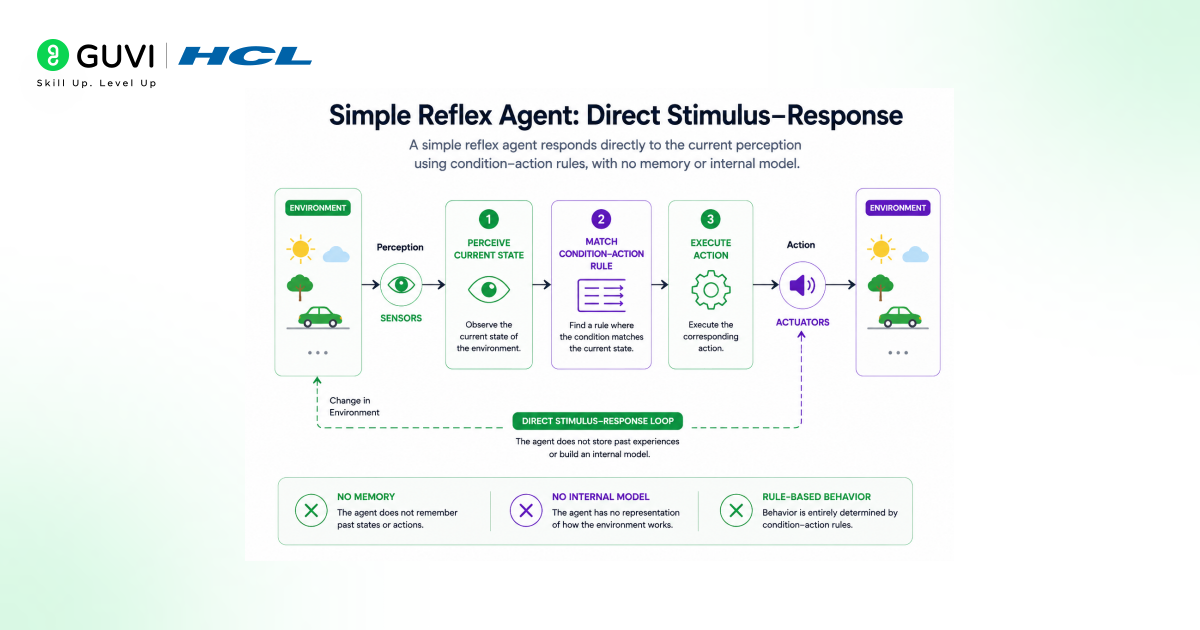
The simple reflex agent is the most basic type in the AI agent classification. It selects actions based solely on its current perception, ignoring all history and context.
How It Works
A simple reflex agent operates through condition-action rules, also called if-then rules or productions. Each rule maps a perceived condition to a specific action:
• If the floor sensor detects dirt, activate the vacuum.
• If the traffic light is red, stop the vehicle.
• If the temperature exceeds the threshold, activate the cooling system.
There is no reasoning, no memory, no planning. The agent perceives the current state and fires the matching rule. That is its entire decision-making process.
Strengths and Limitations
- Strengths: Fast, computationally cheap, easy to implement and understand. Reliable in environments where the correct action depends only on the current state.
- Limitations: Completely blind to history. Cannot handle partial observability. Fails when the right action depends on context that is not present in the current percept.
Real-World Examples
• Thermostat controllers that activate heating or cooling based on current temperature.
• Basic spam filters that block emails based on specific keywords.
• Traffic light controllers that change signals on a fixed-time schedule.
• The classic vacuum-world agent from AI textbooks is the first agent most students encounter.
Type 2: Model-Based Reflex Agents
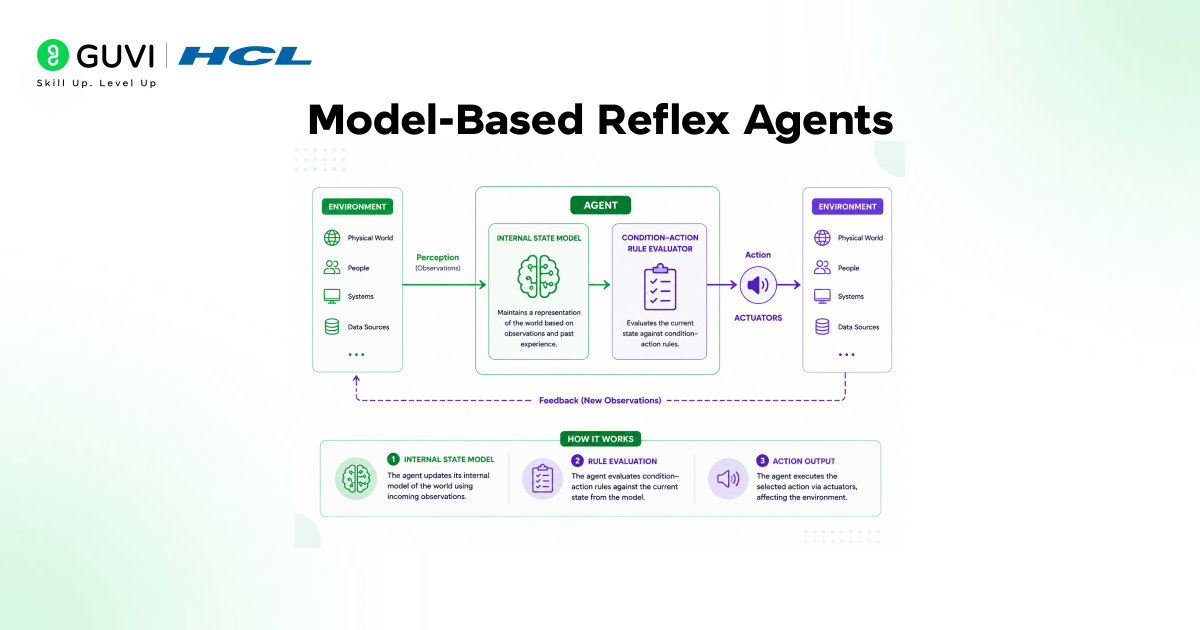
The model-based reflex agent solves the primary weakness of its simpler counterpart: it maintains an internal model of the world that persists across time. This model lets the agent handle partial observability by tracking aspects of the environment it cannot currently see.
How It Works
At each step, the agent updates its internal state model based on two inputs:
- How the world evolves: What the agent knows about how the environment changes over time, independent of its actions.
- What its actions do: How the agent’s previous actions have affected the world’s state.
The agent then applies condition-action rules to this updated internal model rather than to the raw percept alone. This gives it a richer, more accurate picture of the situation.
Strengths and Limitations
- Strengths: Handles partial observability. Can reason about aspects of the environment not currently visible. More contextually aware than a simple
- Limitations: The internal model may become inaccurate if the environment changes in ways the agent does not anticipate. Still relies on pre-defined rules rather than goal-directed planning.
Real-World Examples
• A self-driving car that tracks the position of vehicles that move out of sensor range.
• A robot arm that maintains a model of object positions as it moves items around.
• A network monitoring agent that tracks connection states across time.
The widely used classification of simple reflex agents, model-based agents, goal-based agents, utility-based agents, and learning agents was formalized by Stuart Russell and Peter Norvig in their landmark textbook Artificial Intelligence: A Modern Approach, first published in 1995.
The framework remains one of the most influential and widely adopted ways to describe AI agent architectures in both academic research and real-world AI system design.
Type 3: Goal-Based Agents
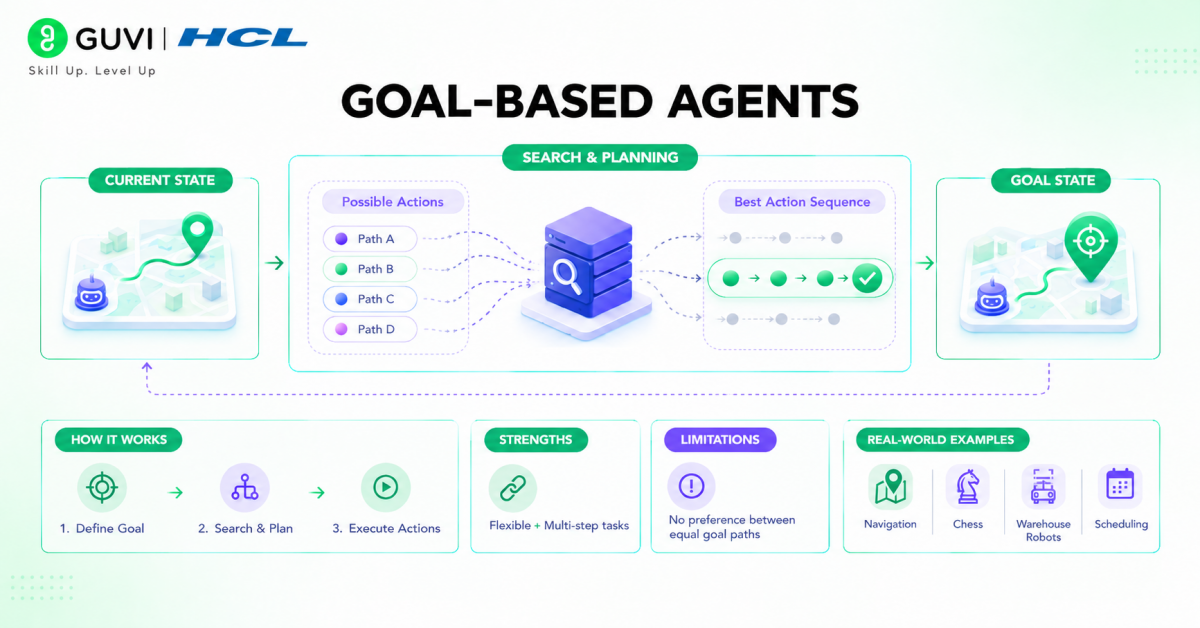
Goal-based agents introduce a qualitative leap in intelligence. Instead of selecting actions based on fixed rules applied to the current state, they select actions based on what will lead toward a defined goal. This requires the agent to reason about the future to consider sequences of actions and their outcomes.
How It Works
A goal-based agent maintains an internal model of the world and additionally holds a representation of a desirable goal state. It uses search and planning algorithms to identify a sequence of actions that will transform the current state into the goal state.
This is a fundamentally different mode of operation from reflex agents. Rather than asking, “What should I do right now given what I see?”, the goal-based agent asks, “What sequence of actions will get me from here to where I want to be?”
Strengths and Limitations
- Strengths: Flexible and adaptable. The same goal-based architecture can find different action sequences in different situations. Can handle complex, multi-step tasks.
- Limitations: Does not distinguish between paths that all lead to the goal. Cannot handle situations with multiple goals of different importance, or where goals conflict.

Real-World Examples
• Navigation systems that find a route from the current location to a destination.
• Chess-playing programs that plan sequences of moves to achieve checkmate.
• Warehouse robots that plan optimal pick-and-place sequences to fulfil orders.
• Automated scheduling systems that arrange tasks to meet a set of deadlines.
Type 4: Utility-Based Agents
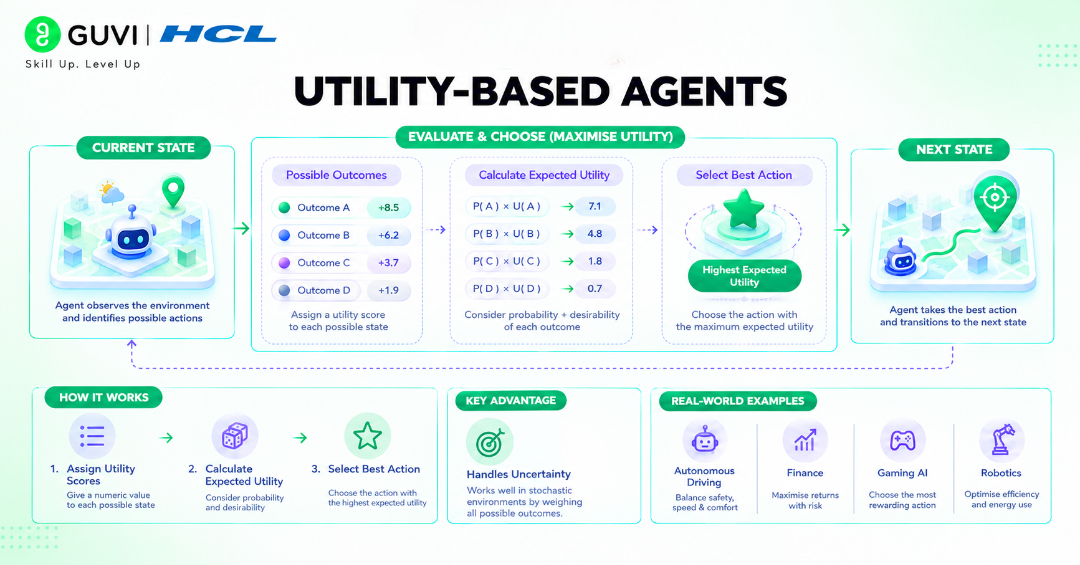
Goal-based agents treat success as binary: the goal is either achieved or not. Utility-based agents go further by evaluating how desirable different outcomes are, not just whether they meet a goal. They select the action that maximises expected utility, given the best possible outcome and environmental uncertainty.
How It Works
A utility-based agent assigns a numeric value, or a utility score, to each possible state or outcome. When choosing between actions, it evaluates the expected utility of each action’s possible outcomes and selects the action with the highest expected utility.
This is particularly powerful in stochastic environments where an action’s outcome is uncertain. The agent does not just plan for success; it weighs the probability and desirability of all possible outcomes.
Strengths and Limitations
- Strengths: Handles trade-offs between competing objectives. Can make rational decisions under uncertainty. Distinguishes between better and worse ways to achieve goals.
- Limitations: Defining a utility function that accurately captures human preferences and values is extremely difficult. Poorly designed utility functions lead to unintended and sometimes harmful behaviour.
Real-World Examples
- Medical diagnosis systems that weigh the probabilities and outcomes of different treatment options.
- Autonomous vehicle systems that balance speed, safety, and passenger comfort simultaneously.
- Financial trading algorithms that optimize returns while managing risk exposure.
- Recommendation engines that balance engagement, relevance, and user satisfaction.
Type 5: Learning Agents
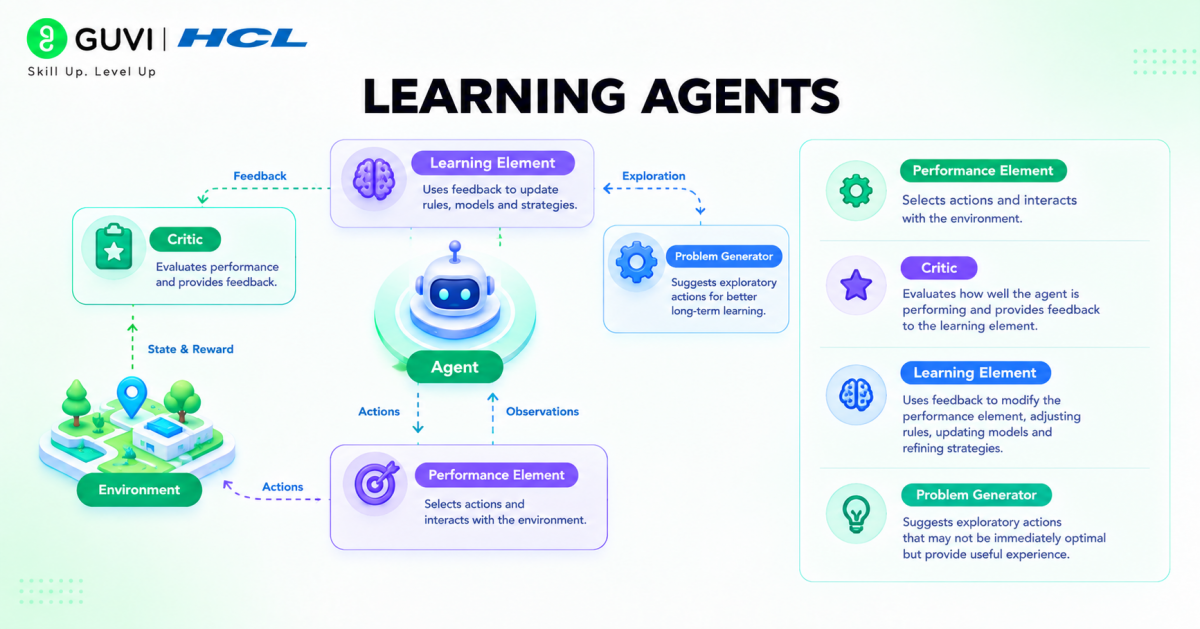
Learning agents are AI systems that improve over time by learning from experience, feedback, and past actions. They adapt their behaviour to make better decisions in changing environments.
How It Works
A learning agent has four core components working together in a continuous feedback loop:
- Performance element: The component that selects actions and interacts with the environment. This corresponds to the entire decision-making mechanism of the other agent types.
- Critic: Evaluates how well the agent is performing relative to a performance standard. It provides feedback to the learning element about what needs to improve.
- Learning element: Uses feedback from the critic to modify the performance element, adjusting rules, updating models, and refining strategies. This is where improvement happens.
- Problem generator: Suggests exploratory actions that may not be immediately optimal but will generate experience useful for long-term improvement.
This architecture allows the agent to start with limited knowledge and progressively build competence through interaction with its environment.
Strengths and Limitations
- Strengths: Can handle unknown environments. Improves performance over time. Can discover strategies not anticipated by designers. Adapts to changing conditions.
- Limitations: Requires significant data and experience. Can develop unexpected behaviours if the performance standard is poorly defined. Training can be slow, expensive, and unstable.
Real-World Examples
- Reinforcement learning agents that master complex games like Go, Chess, and StarCraft through self-play.
- Personalization systems that learn individual user preferences over time.
- Fraud detection systems that continuously adapt to new fraud patterns.
- Modern large language models are fine-tuned using human feedback to improve response quality.
Multi-Agent Systems: When Agents Work Together
The five types described above are individual agent architectures. Multi-agent systems (MAS) extend this framework by placing multiple agents, potentially of different types,s within a shared environment where they interact with one another.
Why Multi-Agent Systems Matter
Some problems are simply too large, too distributed, or too complex for a single agent to solve. Multi-agent systems address this by:
- Parallelization: Multiple agents work on different parts of a problem simultaneously, reducing the time to solution.
- Specialization: Different agents are optimized for different sub-tasks. A planning agent coordinates while execution agents carry out actions.
- Robustness: If one agent fails, others can compensate. Distributed systems are inherently more fault-tolerant than centralized ones.
- Emergent behaviour: Agents interacting locally according to simple rules can produce complex, intelligent collective behaviour as seen in ant colonies and swarm robotics.
Cooperation vs. Competition
Multi-agent systems can be designed around cooperation, where agents share goals and coordinate actions or competition, where agents pursue individual goals that may conflict. Many real-world systems involve both dynamics simultaneously.
- Cooperative examples: Distributed sensor networks, multi-robot warehouse systems, collaborative AI research agents.
- Competitive examples: Algorithmic trading systems, adversarial game-playing agents, and auction-based resource allocation.
Comparing the Five Types of AI Agents
| Agent Type | How It Decides | Handles Uncertainty? | Improves Over Time? | Best Suited For |
|---|---|---|---|---|
| Simple Reflex Agent | Reacts to the current input using fixed if-then rules | No | No | Simple, fully observable, static environments |
| Model-Based Reflex Agent | Keeps an internal model to track what it can’t currently see, then applies rules | Partially, through memory | No | Partially observable environments with known dynamics |
| Goal-Based Agent | Searches for a sequence of actions that leads to a specific goal | No, treats outcomes as pass/fail | No | Complex, multi-step tasks with a clear objective |
| Utility-Based Agent | Scores possible outcomes and picks the action with the highest expected value | Yes, weighs probability and desirability | No | Environments with competing objectives and unpredictable outcomes |
| Learning Agent | Uses a critic and learning element to adjust its own behavior from feedback | Yes | Yes | Unknown, changing, or complex environments where rules can’t be predefined |
Conclusion
Choosing among AI agent types isn’t really a technical decision; it’s a practical one. Ask yourself how much your environment changes and how much you trust automation to handle it, and the answer usually picks itself. Start simple, upgrade only when the problem actually demands it.
FAQs
1. What are the different types of AI agents?
There are five main types of AI agents: simple reflex, model-based reflex, goal-based, utility-based, and learning agents.
2. Which type of AI agent is the simplest?
Simple reflex agents are the simplest because they react only to what’s happening right now, with no memory involved.
3. Can AI agents learn from experience?
Yes, learning agents improve over time using feedback, unlike other agent types that follow fixed logic.
4. Do AI agents work together?
Yes, multi-agent systems let multiple AI agents cooperate or compete to solve bigger problems.
5. Which type of agent handles uncertainty best?
Utility-based agents handle uncertainty best since they weigh outcomes instead of just chasing a fixed goal.
Success Stories










Did you enjoy this article?