


Artificial Intelligence and Machine Learning Articles
Finance Manager to Data Analytics: Career Growth, Salary and Seniority
How to Evaluate LLM Outputs in Production Deployments
AI/ML Skills Gap 2026: Why Companies Can't Find Job-Ready Talent
20 AI/ML Interview Questions Recruiters Can Use Without a Tech Background - Best Guide

Get In Touch For Details! Request More Information
Top 10 AI Agent Frameworks in 2026: A Developer’s Guide to Building Production-Ready AI Agents
Sep 22, 2026 8 Min Read 4325 Views
(Last Updated)
AI Agent Frameworks are toolkits (libraries, SDKs, and orchestration layers) that let developers build, connect, and manage AI agents without assembling everything from scratch. They handle the repetitive plumbing (memory, tool calls, multi-step planning) so you can focus on what your agent actually needs to do.
Table of contents
- TL;DR Summary
- What Are AI Agents and AI Agents Frameworks
- AI Agent
- AI Agent Framework
- The AI Agent Framework Market in 2026
- Top 10 AI Agent Frameworks in 2026
- LangChain
- Microsoft Semantic Kernel
- AutoGPT
- CrewAI
- LangGraph
- LlamaIndex
- Haystack
- OpenAI Agents SDK
- DSPy
- Pydantic AI
- AI Agent Frameworks Comparison Table
- AI Agent Frameworks Learning Path for Developers in India (2026)
- AI Agent Framework Use Cases by Industry (2026)
- Emerging AI Agent Frameworks to Watch in 2026
- Which AI Agent Framework Should You Choose by Model Provider?
- Real Adoption Numbers Behind the Top AI Agent Frameworks
- Conclusion
- FAQs
- Are AI Agent Frameworks difficult for beginners?
- Do I need to know advanced AI to use these AI Agent frameworks?
- Can these frameworks be used in real production systems?
- How do these frameworks connect with real data?
- Are these frameworks only useful for developers?
- How do I choose the right framework for my project?
- What is the difference between an AI course and an AI & ML course?
- Why is SQL important for AI & ML professionals?
- What job roles can I apply for after completing an AI & ML course?
- How do I choose the best AI course for my career goals?
- What should I look for before enrolling in an AI & ML course?
- How should I evaluate AI & ML certifications before enrolling?
- Why is SQL important for AI & ML professionals?
TL;DR Summary
- AI Agent Frameworks are pre-built libraries and SDKs that handle memory, tool calls, and multi-step planning for you, so you’re not building that plumbing from scratch for every project.
- LangGraph currently leads enterprise production adoption (roughly 34.5 million monthly downloads); CrewAI is fastest for prototyping, and the OpenAI Agents SDK is the natural pick if you’re building on OpenAI models.
- Microsoft merged AutoGen and Semantic Kernel into a single Microsoft Agent Framework in April 2026, and OpenAI’s Agents SDK has fully replaced its earlier experimental Swarm library.
- Gartner expects 40% of enterprise applications to include task-specific AI agents by the end of 2026, up from under 5% in 2025.
- Most major AI Agent Frameworks, including LangChain, LangGraph, CrewAI, LlamaIndex, Haystack, DSPy, and Pydantic AI, are open-source and free; your real cost is the underlying LLM API calls, not the framework.
Picking the wrong framework early on can cost you weeks of rework once your agent needs to scale, handle real users, or connect to production data.
Whether you’re a student picking your first framework, a developer choosing a stack for a new project, or a team lead deciding what to standardise on, this guide breaks down all 10 major frameworks with real code-level context, current adoption data, and where this space stands for developers in India.
What Are AI Agents and AI Agents Frameworks
AI Agent
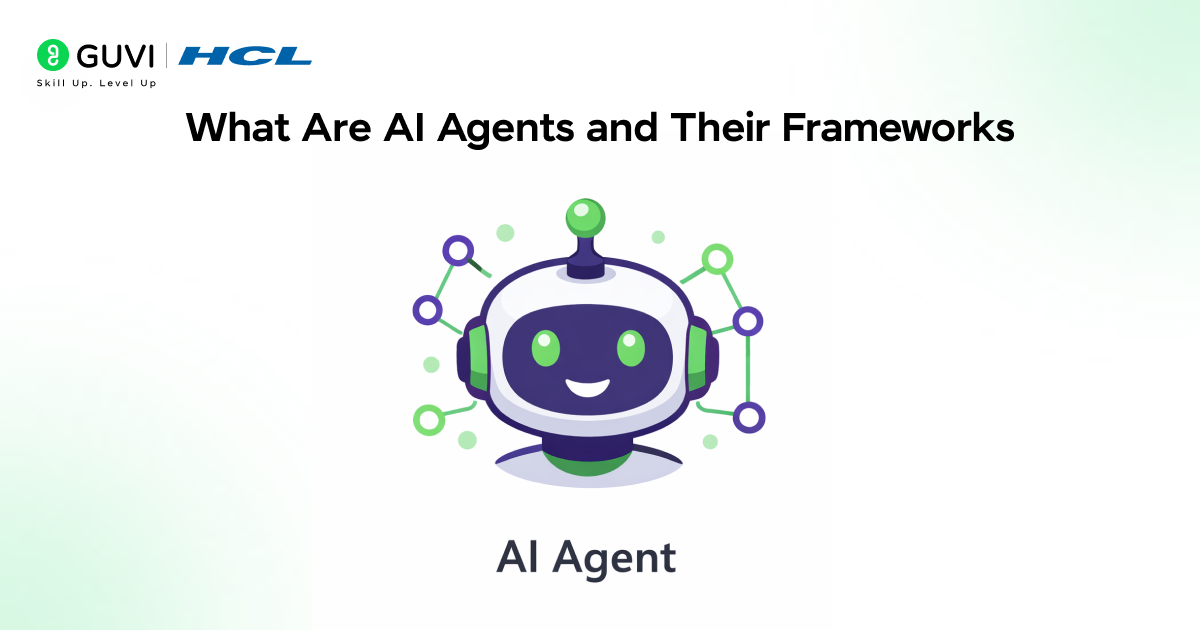
An AI agent is a system that senses its environment (text, data) → performs reasoning using a model → and decides & acts to achieve goals.
It employs components such as a language model that performs reasoning, memory to store context, and tools or APIs to interact with systems – thus it can plan, act, and adapt until the task is done.
Example:
A customer support bot that knows what question you are asking, finds the answers from company data, responds and can create tickets and follow-ups automatically.
AI Agent Framework
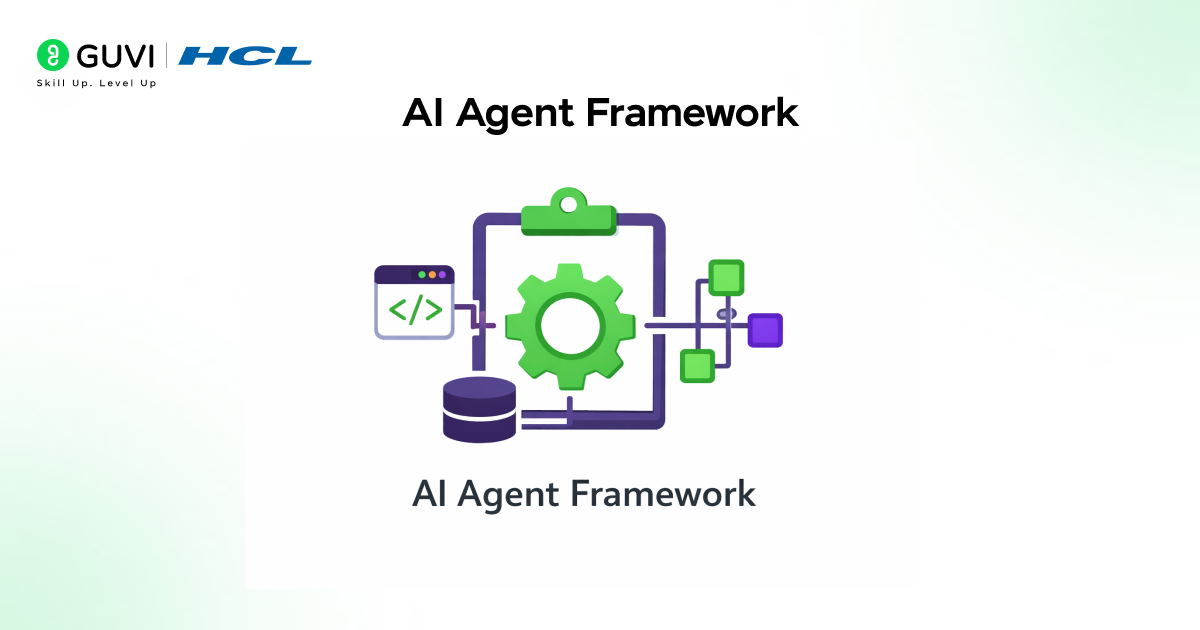
AI Agent Frameworks are a collection of tools, libraries, and structures that allow developers to build, connect, and manage AI agents without losing control over the workflow while reducing development time by avoiding the need to assemble everything from scratch.
Explore AI/ML with HCL GUVI’s free resource and build a strong foundation in how AI works and shapes real-world innovation: AI/ML Email Course
The AI Agent Framework Market in 2026
This space isn’t a niche curiosity anymore. The global AI agent market reached an estimated $7.84 billion in 2025 and is projected to hit $52.62 billion by 2030, growing at a 46.3% CAGR, according to MarketsandMarkets.
That growth shows up in the framework landscape itself. In 2026 alone, Microsoft merged AutoGen and Semantic Kernel into a single Microsoft Agent Framework, reaching general availability in April 2026.
OpenAI’s Agents SDK fully replaced its earlier experimental Swarm library, LangGraph crossed 1.0 GA, and new entrants like Google’s Agent Development Kit (ADK) and the renamed Claude Agent SDK joined the field.
Top 10 AI Agent Frameworks in 2026
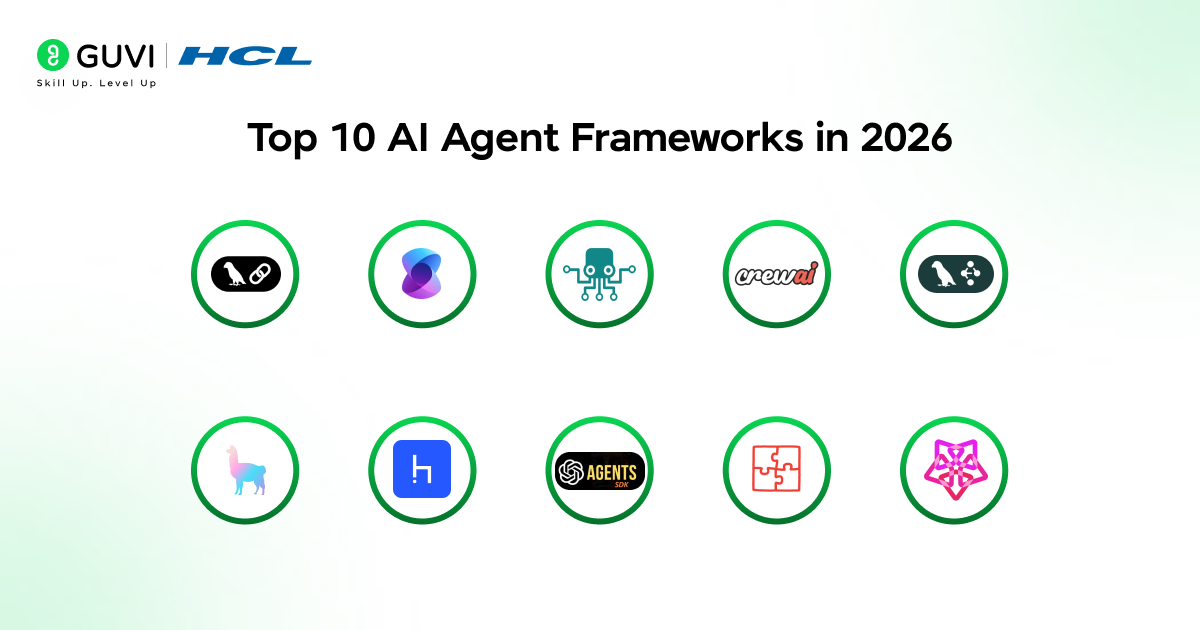
The following are the top 10 AI agent frameworks in 2026, widely used for building, managing, and scaling intelligent AI agents across different applications:
1. LangChain
Official Link: LangChain
LangChain is a widely used framework to create applications powered by large language models. It enables developers to link models to tools, data sources, and APIs to build intelligent workflows.
Its modular approach enables you to easily link one or more steps, such as creating chatbots, assistants, and automations, without manually coding everything, with better memory control.
Key Features
- Modular components for building AI workflows
- Integration with APIs, tools, and data sources
- Memory support for context handling
What You’ll Learn
- Building LLM-powered applications step by step
- Connecting tools and external data
- Managing context and memory in apps
Also Read: How to Build Agentic AI with LangChain and LangGraph
2. Microsoft Semantic Kernel
Official Link: Microsoft Semantic Kernel
Microsoft Semantic Kernel is a lightweight framework that enables developers to blend AI models with existing code. This enables the development of skills, planners and functions that can be integrated with language models.
This aids the development of intelligent applications that can reason, plan, and interact with systems, while still serving as a manageable structure for practical applications.
Key Features
- Integration of AI with traditional code
- Skill and function-based architecture
- Planning and orchestration capabilities
What You’ll Learn
- Combining code with AI models
- Creating reusable AI functions
- Building structured AI-driven applications
3. AutoGPT
Official Link: AutoGPT
AutoGPT is a system that uses autonomous AI Agents to perform tasks with minimal human intervention. You have a goal, and AutoGPT uses structured planning to decompose it into subgoals, then uses internet search and APIs to accomplish those subgoals.
It employs persistent (continuous) reasoning and looping until the goal is achieved, making AutoGPT suitable for automation, research, and experimental AI systems.
Key Features
- Goal-driven autonomous task execution
- Self-planning and task breakdown
- Tool usage for automation
What You’ll Learn
- Building autonomous AI workflows
- Task automation using AI agents
- Working with goal-based AI systems
4. CrewAI
Official Link: CrewAI
CrewAI is a system that lets many AI agents work together as a single unit. Individual agents can work in specific roles and, as a group, execute complex tasks.
It can be used in workflows such as research, reporting, content generation, analysis, and so on, where many agents work in a structured manner.
Key Features
- Multi-agent collaboration system
- Role-based agent design
- Task coordination between agents
What You’ll Learn
- Designing multi-agent systems
- Assigning roles to AI agents
- Coordinating tasks across agents
Explore: AG-UI: How the Agent-User Interaction Protocol Works?
5. LangGraph
Official Link: LangGraph
LangGraph is built on top of LangChain to define structured, graph-based AI flows. It enables developers to specify how an AI system transitions from one step to the next using nodes and edges.
It provides greater control over decision-making and makes it straightforward to build stateful, multi-step, reliable AI agents with a clear flow and logic.
Key Features
- Graph-based workflow design
- Stateful agent execution
- Fine-grained control over flows
What You’ll Learn
- Designing structured AI workflows
- Managing state in AI systems
- Building controlled agent pipelines
Explore: Wumpus World in AI: Intelligent Agents, Logic & Reasoning
6. LlamaIndex
Official Link: LlamaIndex
LlamaIndex is a tool for connecting LLMs with your data. It allows you to index, organise, and search for data sources, including documents, PDFs, and even your own database, streamlining the creation of AI apps that can respond to questions based on private data rather than general knowledge.
Key Features
- Data indexing and retrieval
- Integration with external datasets
- Querying structured and unstructured data
What You’ll Learn
- Connecting AI to custom data sources
- Building retrieval-based systems
- Handling structured and unstructured data
7. Haystack
Official Link: Haystack
Haystack is an open-source framework to build search and question-answering systems using AI. It makes it easy to build pipelines that combine retrieval, ranking and generation.
This supports building applications that search and return accurate results from large datasets, such as document search engines, chatbots, and enterprise AI applications.
Key Features
- Pipeline-based architecture
- Document retrieval and ranking
- Question-answering capabilities
What You’ll Learn
- Building AI-powered search systems
- Creating QA pipelines
- Handling large document collections
8. OpenAI Agents SDK
Official Link: OpenAI Agents SDK
The OpenAI Agents SDK is a toolkit for creating and operating AI agents on top of OpenAI models. The SDK enables specifying an agent’s behaviour, controlling tool invocation, and orchestrating multiple actions during an interaction.
The toolkit enables its users to develop intelligent applications capable of thinking, querying, and completing tasks by integrating language model responses with external actions.
Key Features
- Tool and function calling support
- Agent behaviour control
- Integration with OpenAI models
What You’ll Learn
- Building agents using OpenAI models
- Managing tool-based interactions
- Designing controlled AI behaviours
9. DSPy
Official Link: DSPy
DSPy is a toolbox that enables developers to tune prompts and pipelines for language models. Instead of tediously tuning prompts, it lets you write a programmatic framework and automatically boost performance.
This makes it easier to build reliable AI systems that are optimised for accuracy, efficiency, and consistency.
Key Features
- Programmatic prompt optimization
- Modular pipeline design
- Automatic performance tuning
What You’ll Learn
- Optimising AI prompts systematically
- Building structured AI pipelines
- Improving model performance
10. Pydantic AI
Official Link: Pydantic AI
Pydantic AI is a platform designed to create trustworthy AI systems that include robust validation techniques. Merging AI results with well-defined data schemas ensures accuracy and consistency.
Particularly valuable in scenarios involving predictable outputs, issuing APIs, and developing applications where data precision and adherence to specified schemas are essential.
Key Features
- Strong data validation
- Structured output handling
- Type-safe AI responses
What You’ll Learn
- Ensuring reliable AI outputs
- Working with structured data models
- Building type-safe AI systems
If you are interested in learning AI agent frameworks, don’t limit yourself to just that. Extend your learning by joining our exclusive Zen program.
Unlock your future in AI with HCL GUVI’s Intel & IITM Pravartak Certified AI/ML course and move beyond theory into real, job-ready skills. This program is designed to help you build strong practical expertise through hands-on projects that reflect real industry challenges. If you’re serious about stepping into the AI space with confidence and standing out in the job market, this is the right place to start. Take the leap now and shape a future that’s built on skills, not just ambition.
AI Agent Frameworks Comparison Table
Not sure which one to reach for first? Here’s a quick side-by-side comparison of all 10 AI Agent Frameworks covered above.
| Framework | Best For | Language Support | Key Strength | Learning Curve |
|---|---|---|---|---|
| LangChain | Rapid prototyping across model providers | Python, JavaScript | Huge ecosystem, model-agnostic | Moderate |
| Microsoft Agent Framework | Teams on the Microsoft/Azure stack | Python, .NET | Unified successor to AutoGen and Semantic Kernel | Moderate |
| AutoGPT | Learning goal-driven agent design | Python | Fully autonomous, self-looping planning | Low to Moderate |
| CrewAI | Role-based multi-agent teams, fast prototyping | Python | Fastest prototyping, intuitive mental model | Low |
| LangGraph | Complex, stateful production workflows | Python, JavaScript | Graph-based control, checkpointing | Moderate to High |
| LlamaIndex | Data-heavy, document-based AI apps | Python, TypeScript | Best-in-class data indexing and retrieval | Moderate |
| Haystack | Search and question-answering pipelines | Python | Purpose-built for RAG pipelines | Moderate |
| OpenAI Agents SDK | Teams committed to OpenAI models | Python | Clean handoff model, built-in tracing | Low |
| DSPy | Systematic prompt and pipeline optimization | Python | Automatic prompt tuning | Moderate to High |
| Pydantic AI | Type-safe, schema-validated agent outputs | Python | Strong data validation, structured outputs | Low to Moderate |

AI Agent Frameworks Learning Path for Developers in India (2026)
Indian IT services firms and product companies alike are hiring for AI Agent Frameworks skills right now, not as a future bet. Here’s a practical path based on where you are in your career.
| Career Stage | Recommended Framework(s) | Why | Typical Salary in India |
|---|---|---|---|
| Beginner, learning fundamentals | LangChain or CrewAI | Large communities, strong documentation, plenty of tutorial content | Not applicable yet |
| Job-hunting at product companies | LangGraph | Fintech, edtech, and e-commerce companies increasingly expect stateful, production-grade orchestration skills | ₹12 to ₹25 LPA at mid-level |
| IT services and client-facing roles | OpenAI Agents SDK or Microsoft Agent Framework | Indian service companies with Microsoft or OpenAI partnerships often standardise on one of these two stacks | ₹3 to ₹12 LPA at entry level, ₹25+ LPA at senior level |
A quick note on pay: AI Agent Frameworks skills currently fall under the broader “AI Engineer” or “Agentic AI Developer” title in most Indian salary data, rather than having their own dedicated salary band.
If you want a structured path instead of piecing tutorials together, HCL GUVI’s Intel & IITM Pravartak Certified AI/ML course covers the fundamentals that every one of these AI Agent Frameworks builds on.
AI Agent Framework Use Cases by Industry (2026)
Different industries tend to converge on different AI Agent Frameworks, mostly based on what the work actually demands: fast prototyping, strict data handling, or long-running autonomy.
| Industry | Common Framework Choice | Example Use Case |
|---|---|---|
| Customer support and SaaS | LangGraph, OpenAI Agents SDK | Multi-step support agents that check order status, issue refunds, and escalate to a human when needed |
| Healthcare and life sciences | Pydantic AI, LlamaIndex | Structured, schema-validated outputs from patient data and medical literature retrieval |
| Finance and fintech | LangGraph, Microsoft Agent Framework | Auditable, stateful agents for fraud checks, compliance workflows, and reporting |
| Research and data-heavy teams | LlamaIndex, Haystack | Retrieval-augmented pipelines over large document sets and internal knowledge bases |
| Marketing and content teams | CrewAI | Role-based agent teams that draft, review, and publish content collaboratively |
| Rapid prototyping and hackathons | CrewAI, AutoGPT | Getting a working multi-step agent demo running with minimal setup |
Emerging AI Agent Frameworks to Watch in 2026
The 10 AI Agent Frameworks covered above are the established leaders, but a few newer entrants are gaining real traction and are worth knowing about.
- Google Agent Development Kit (ADK): built around Google’s A2A protocol, letting agents built in different frameworks discover and communicate with each other. Optimised for Gemini but supports other models too.
- Claude Agent SDK: renamed from the earlier Claude Code SDK in late 2025, it’s evolved into a general-purpose agent runtime available as both a Python and a TypeScript package, with a safety-first design and native support for extended thinking and computer use.
- Mastra: a TypeScript-native framework that’s crossed 20,000+ GitHub stars, built for teams that want agent tooling (studio, evals, tracing) without leaving the JavaScript ecosystem.
- Smolagents (Hugging Face): designed to be the fastest path to a working single-agent loop, popular for learning the mechanics of agents without heavy abstraction.
Keeping an eye on this group is worth it if you’re choosing an AI Agent Framework for a brand-new project in 2026, since interoperability standards like A2A are starting to shape how frameworks connect to each other.
Which AI Agent Framework Should You Choose by Model Provider?
If you already know which LLM provider you’re building on, that alone narrows the decision considerably. Here’s how the frameworks line up by ecosystem.
| If You’re Building On | Best-Aligned Framework | Why |
|---|---|---|
| OpenAI models | OpenAI Agents SDK | Built by OpenAI, deepest native integration, cleanest handoff model |
| Anthropic (Claude) models | Claude Agent SDK | Built by Anthropic, safety-first design, native extended thinking and computer use support |
| Google (Gemini) models | Google ADK | Built by Google, optimised for Gemini, native A2A interoperability |
| Microsoft or Azure stack | Microsoft Agent Framework | Unified successor to AutoGen and Semantic Kernel, with Azure AI Foundry guardrails |
| Any provider, model-agnostic | LangChain, LangGraph, CrewAI, or LlamaIndex | Work across OpenAI, Anthropic, Google, and open models without locking you into one vendor |
Real Adoption Numbers Behind the Top AI Agent Frameworks
Beyond feature lists, adoption data gives a useful reality check on where the industry is actually placing its bets in 2026:
- LangGraph leads enterprise production adoption, with roughly 34.5 million monthly downloads.
- OpenAI Agents SDK has crossed 26,900+ GitHub stars and 10.3 million monthly downloads since its March 2025 launch.
- AutoGen (the framework AutoGPT-style autonomous agents evolved from) sits around 48,000 GitHub stars, but Microsoft has moved it into maintenance mode after folding it into the new Microsoft Agent Framework.
- Mastra has crossed 20,000+ GitHub stars, notable for a framework that’s barely a couple of years old and TypeScript-native.
Star counts and download numbers are a lagging indicator of community size, not proof of production readiness, but they’re a useful sanity check when a framework’s marketing claims outpace its actual adoption.
Unlock your future in AI with HCL GUVI’s Intel & IITM Pravartak Certified AI/ML course and move beyond theory into real, job-ready skills. This program is designed to help you build strong practical expertise through hands-on projects that reflect real industry challenges. If you’re serious about stepping into the AI space with confidence and standing out in the job market, this is the right place to start. Take the leap now and shape a future that’s built on skills, not just ambition.
Conclusion
In conclusion, based on these 10 AI Agent Frameworks, it’s clear that the right tools and architecture can enable more advanced applications to achieve greater autonomy in a shorter timeframe.
As each framework has its strengths, there are many ways to build robust, real-world AI applications using them. Exploring and understanding them is a strong step toward building intelligent systems for the future.
FAQs
Are AI Agent Frameworks difficult for beginners?
Some frameworks have a learning curve, but starting with small projects makes them easier to understand.
Do I need to know advanced AI to use these AI Agent frameworks?
Basic programming and API knowledge are enough to get started, while deeper AI knowledge helps with advanced use.
Can these frameworks be used in real production systems?
They are used in real applications, but need proper testing, optimisation, and monitoring before deployment.
How do these frameworks connect with real data?
They connect through APIs, databases, and retrieval systems to access and use external data.
Are these frameworks only useful for developers?
They are mainly for developers, but also useful for teams building AI-based products and automation.
How do I choose the right framework for my project?
It depends on your goal—some suit simple apps, others work better for complex or data-heavy systems.
What is the difference between an AI course and an AI & ML course?
An AI course focuses on artificial intelligence concepts, while an AI & ML course includes machine learning, deep learning, NLP, computer vision, and practical model-building skills. If you’re looking for hands-on AI and ML training, explore the HCL GUVI AI & ML Programme.
Why is SQL important for AI & ML professionals?
SQL helps AI & ML professionals extract, clean, and analyze data from databases, making it essential for building accurate machine learning models. Most industry-focused AI & ML programmes include SQL as a core data skill.
What job roles can I apply for after completing an AI & ML course?
You can apply for roles such as AI Engineer, Machine Learning Engineer, Data Scientist, NLP Engineer, Computer Vision Engineer, and AI Developer. To prepare for these roles, consider a project-based AI & ML Programme with career support.
How do I choose the best AI course for my career goals?
Choose an AI course based on your career goals, curriculum, hands-on projects, mentor support, industry tools, and placement assistance. A structured AI & ML Programme can help you build practical skills and a strong portfolio.
What should I look for before enrolling in an AI & ML course?
Look for a structured curriculum, practical projects, experienced mentors, updated AI tools, certification value, and career support. Compare programmes carefully before enrolling in an AI & ML Programme.
How should I evaluate AI & ML certifications before enrolling?
Evaluate AI & ML certifications based on industry recognition, curriculum relevance, hands-on learning, project experience, and career outcomes. You can also compare what’s included in the HCL GUVI AI & ML Programme before making a decision.
Why is SQL important for AI & ML professionals?
SQL helps AI & ML professionals extract, clean, and analyze data from databases, making it essential for building accurate machine learning models. Most industry-focused AI & ML programmes include SQL as a core data skill.
Success Stories

About the Author
Jebasta
I translate the language of data into stories that anyone can understand. As a writer with a data science background, I simplify analytics, AI, and decision-making so beginners and enthusiasts can confidently explore the world of data.
View all posts by Jebasta
Connect with me @






Did you enjoy this article?