


Artificial Intelligence and Machine Learning Articles
Finance Manager to Data Analytics: Career Growth, Salary and Seniority
How to Evaluate LLM Outputs in Production Deployments
AI/ML Skills Gap 2026: Why Companies Can't Find Job-Ready Talent
20 AI/ML Interview Questions Recruiters Can Use Without a Tech Background - Best Guide


Get In Touch For Details! Request More Information
Wumpus World in AI: How a Dangerous Cave Teaches Intelligent Agents to Reason
Aug 18, 2026 7 Min Read 1634 Views
(Last Updated)
How does an intelligent agent make decisions when it cannot see the full picture? This is one of the most fundamental questions in artificial intelligence, and the Wumpus World problem provides a concrete, well-defined environment in which to answer it.
The Wumpus World places an agent inside a cave filled with hidden dangers: a deadly monster called the Wumpus, bottomless pits, and a glittering gold prize. The agent perceives only its immediate surroundings and must use logical inference to map the cave, avoid hazards, and retrieve the gold safely.
In this article, we explore the Wumpus World environment in full detail, its structure, rules, percepts, and actions and show exactly how a knowledge-based agent applies propositional logic and inference to survive and succeed. By the end, you will understand why this deceptively simple cave remains one of the most instructive examples in all of AI.
Table of contents
- TL;DR
- The Wumpus World Environment: Layout and Rules
- The Hazards and Rewards
- The Performance Measure
- Percepts: How the Intelligent Agent Senses the Wumpus World
- The Percept Sequence
- The Agent's Actions: How It Moves and Interacts With the Environment
- The Knowledge-Based Agent: Reasoning Through the Wumpus World
- Propositional Logic in Action: A Step-by-Step Wumpus World Walkthrough
- Step 1: Starting Square [1,1]
- Step 2: Moving to [2,1]
- Step 3: Moving to [1,2]
- Types of Reasoning the Wumpus World Demonstrates
- Deductive Reasoning
- Inductive Reasoning
- Abductive Reasoning
- Reasoning Under Uncertainty
- Why the Wumpus World Problem Still Matters in Modern AI
- Conclusion
- FAQs
- What is the Wumpus World in artificial intelligence?
- What are the five percepts in the Wumpus World?
- What is a knowledge-based agent, and how does it work in the Wumpus World?
- Why is propositional logic used in the Wumpus World?
- What are the key lessons the Wumpus World teaches about AI?
TL;DR
- The Wumpus World is a 4×4 grid cave containing a Wumpus, pits, gold, and a starting agent.
- The agent perceives its environment through five percepts: Stench, Breeze, Glitter, Bump, and Scream.
- It cannot see the full grid; it must reason from percepts using propositional logic and inference.
- A knowledge-based agent builds and queries a knowledge base to determine safe moves.
- The Wumpus World illustrates logical reasoning, knowledge representation, and intelligent decision-making in AI.
What Is the Wumpus World Problem in AI?
The Wumpus World is a classic AI problem-solving environment used to demonstrate how a knowledge-based agent applies logical reasoning, percepts, and inference to navigate a dangerous, partially observable cave grid. Originally introduced by Gregory Yob in 1972 and later popularized by Russell and Norvig’s AI textbook, the Wumpus World problem shows how an intelligent agent can build a knowledge base from limited sensory information and use propositional logic to make safe and informed decisions under uncertainty.
The Wumpus World Environment: Layout and Rules
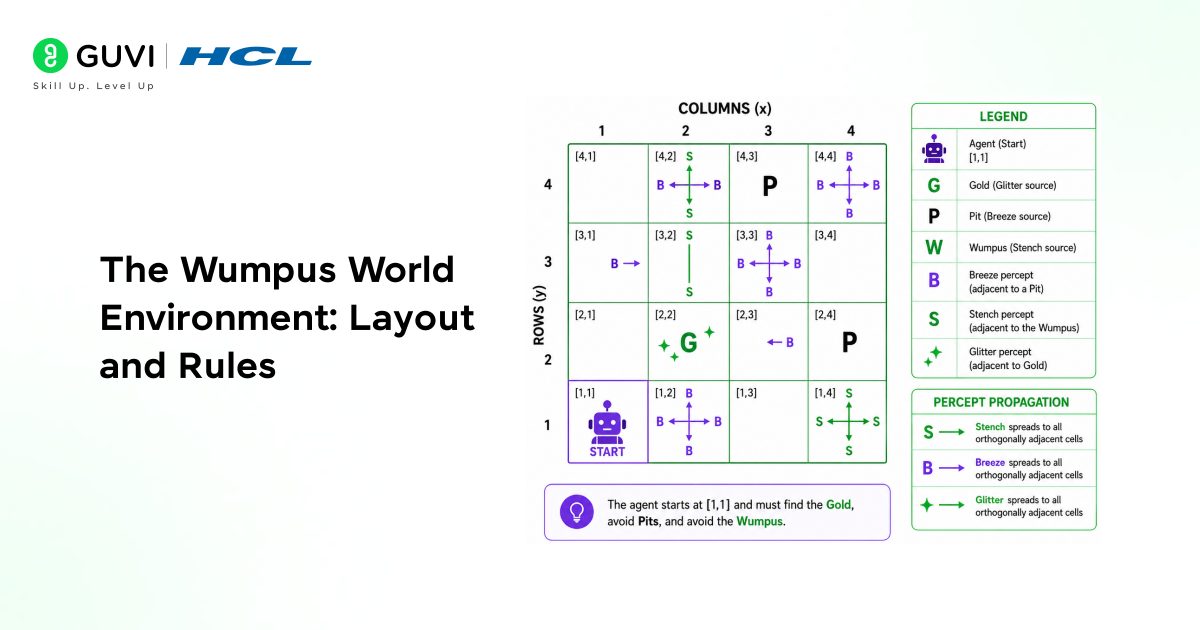
The Wumpus World is defined by a precise set of structural rules that govern the cave, its hazards, and the agent’s situation. Understanding this environment is the first step to understanding how the intelligent agent must reason to survive.
The Grid
The cave consists of a 4×4 grid of rooms, 16 squares in total. The agent begins in the bottom-left square, position [1,1], facing right. The grid is surrounded by walls on all sides. Every room is connected to its orthogonal neighbours (up, down, left, right) but not to diagonal ones.
The Hazards and Rewards
• The Wumpus: A large, stationary monster occupying exactly one room in the cave. Any agent that enters the Wumpus’s room is killed and eaten immediately unless the Wumpus has already been eliminated by a shot from the agent’s arrow.
• Pits: Bottomless holes in the floor. Any agent that falls into a pit is lost forever. Each non-starting square has a 0.2 probability of containing a pit. Pits are fixed and do not move.
• Gold: A pile of gold in exactly one room of the cave. The agent’s primary objective is to reach the gold, pick it up, and return safely to the starting square [1,1] to exit the cave.
• The Agent: The intelligent agent starts in square [1,1] with no prior knowledge of the cave layout. It has one arrow, which can be fired in the direction the agent is currently facing and must explore the cave using only its percepts.
The Performance Measure
• +1000 points for picking up the gold and climbing out of the cave.
• −1000 points for dying either by falling into a pit or being eaten by the Wumpus.
• −1 point per action taken, incentivizing the agent to find the gold as efficiently as possible.
• −10 points for firing the arrow discouraging wasteful shooting.
Percepts: How the Intelligent Agent Senses the Wumpus World
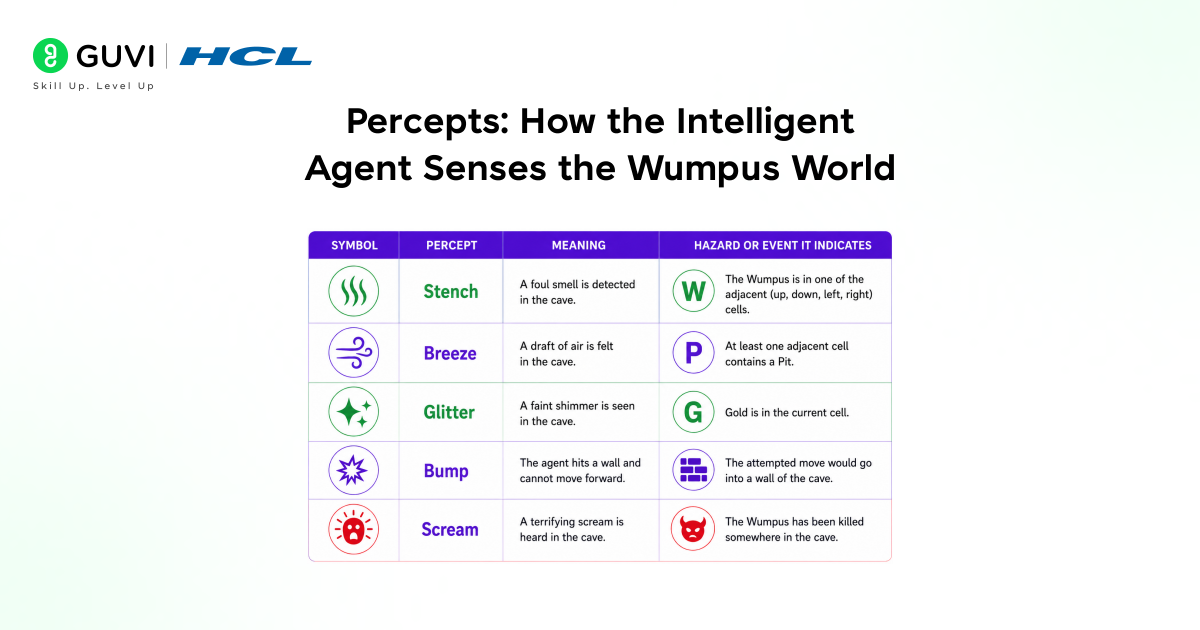
The agent cannot see the full cave. It has no map, no omniscient view, and no direct knowledge of where the Wumpus or the pits are located. Its only source of information about the environment is a set of five percepts it receives each time it enters a new room.
These percepts are the raw sensory data from which the agent must construct its entire understanding of the cave.
The Five Percepts
- Stench: Perceived in any square orthogonally adjacent to the Wumpus’s location. The agent cannot smell the Wumpus from two rooms away, only from directly next to it. A stench tells the agent that the Wumpus is in one of the adjacent squares, but not which one.
- Breeze: Perceived in any square orthogonally adjacent to a pit. Like the stench, the breeze propagates to all four neighbouring squares of a pit. Detecting a breeze tells the agent that at least one adjacent square contains a pit.
- Glitter: Perceived only in the exact square where the gold is located. This percept tells the agent unambiguously that the gold is in the current room, so it should grab it immediately.
- Bump: Perceived when the agent walks into a wall, the boundary of the grid. This tells the agent it has reached the edge of the cave and helps it map the cave’s dimensions without knowing them in advance.
- Scream: Heard anywhere in the cave when the Wumpus is killed by the agent’s arrow. This global percept confirms that the Wumpus has been eliminated, making its former room safe to enter.
The Percept Sequence
At each time step, the agent receives its full percept as a five-element list in the order [Stench, Breeze, Glitter, Bump, Scream]. A percept might look like:
[None, Breeze, None, None, None]
This tells the agent: no Wumpus nearby, a pit is adjacent, no gold here, no wall hit, Wumpus is still alive. Every percept sequence the agent has received since starting becomes part of its knowledge base, the cumulative evidence from which it reasons.
The Agent’s Actions: How It Moves and Interacts With the Environment
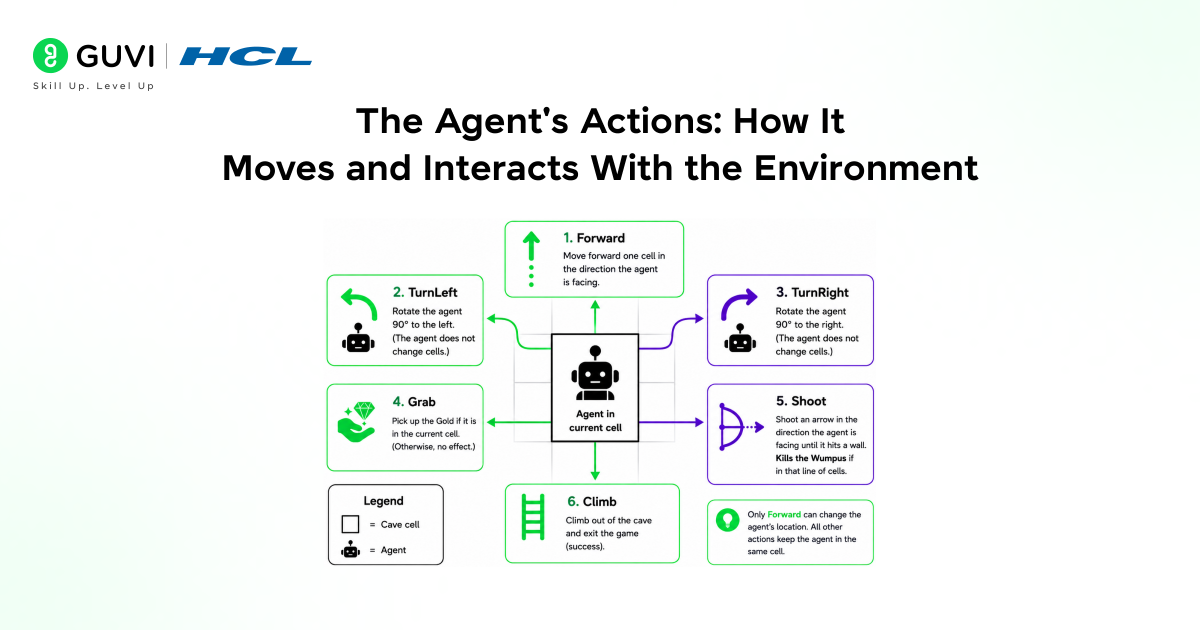
- Forward: Move one square in the direction the agent is currently facing. If the agent is facing a wall, it perceives a Bump and stays in the same square.
- TurnLeft: Rotate the agent 90 degrees to the left without changing its position. The agent now faces a new direction for future Forward actions.
- TurnRight: Rotate the agent 90 degrees to the right without changing its position.
- Grab: Pick up any object in the current square. Used to collect the gold when Glitter is perceived.
- Shoot: Fire the single arrow in the direction the agent is currently facing. The arrow travels through every square in that direction until it hits a wall. If it passes through the Wumpus’s square, the Wumpus is killed, and the agent hears a Scream. Once fired, the arrow is gone.
- Climb: Exit the cave but only from the starting square [1,1]. Climbing out without the gold scores nothing. Climbing out after grabbing the gold completes the mission.
The Knowledge-Based Agent: Reasoning Through the Wumpus World
What separates a knowledge-based agent from a simple reactive system is its ability to build and maintain an internal model of the world and to use logical inference to draw conclusions that go beyond what it has directly perceived.
The Knowledge Base
The knowledge base (KB) is the agent’s memory. It contains all the logical sentences the agent knows to be true, both its background knowledge about the rules of the Wumpus World and all the facts it has inferred from its percept history.
Background knowledge encoded in the KB includes rules like: ‘If a square is adjacent to the Wumpus, it contains a Stench.’
The Tell-Ask Inference Loop
- TELL: The agent adds its current percepts to the knowledge base as new logical sentences. If it is in square [1,1] and perceives nothing, it asserts: ¬Stench[1,1], ¬Breeze[1,1], ¬Glitter[1,1].
- ASK: The agent queries the knowledge base: ‘Is it safe to move to square [1,2]?’ The inference engine determines whether this can be proven from everything currently in the KB.
- ACT: The agent performs the action that the inference result recommends moving to a proven-safe square, staying put to gather more information, or shooting if the Wumpus’s location can be determined.
This loop repeats at every time step. The knowledge base grows richer with each new square visited, and the agent’s ability to make safe inferences improves accordingly.
Propositional Logic in Action: A Step-by-Step Wumpus World Walkthrough
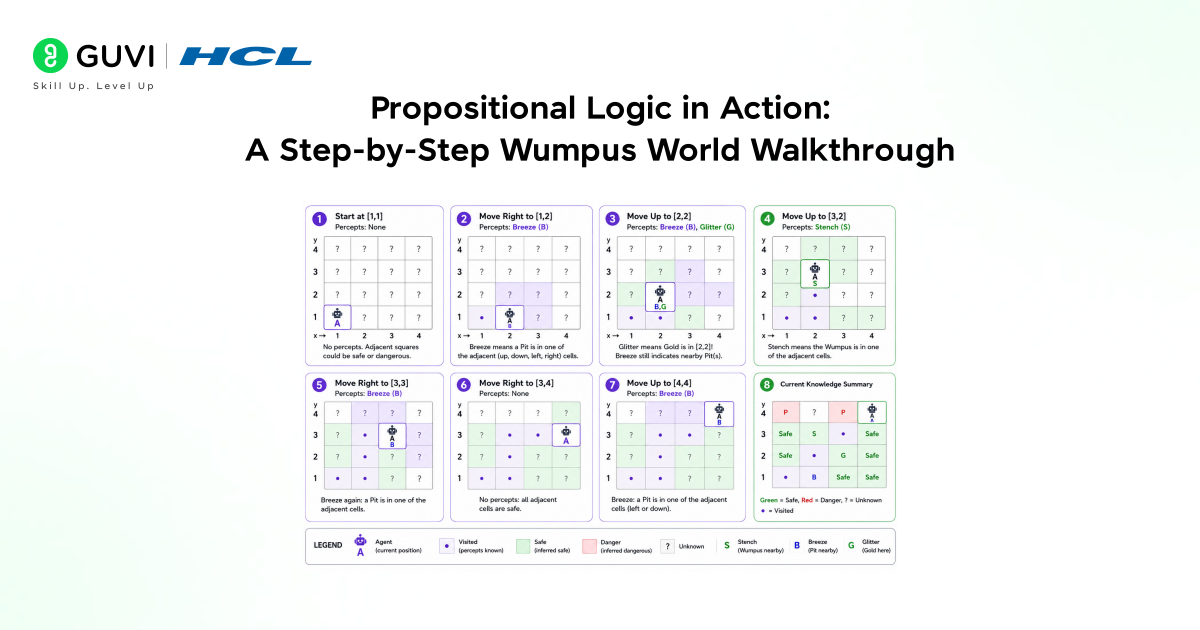
Step 1: Starting Square [1,1]
The agent begins at [1,1] and perceives [None, None, None, None, None], no stench, no breeze, no glitter, no bump, no scream. This is extremely informative.

• No breeze → the squares adjacent to [1,1] (which are [1,2] and [2,1]) contain no pits.
• No stench → neither [1,2] nor [2,1] contains the Wumpus.
• Conclusion: Both [1,2] and [2,1] are provably safe to enter.
Step 2: Moving to [2,1]
The agent moves to [2,1] and perceives [None, Breeze, None, None, None]. A breeze is detected; this is significant.
• Breeze at [2,1] → at least one square adjacent to [2,1] contains a pit.
• Adjacent squares of [2,1]: [1,1] (known safe), [3,1], and [2,2].
• Therefore, the pit is in [3,1] or [2,2], but the agent cannot yet determine which.
• Conclusion: [3,1] and [2,2] are marked as possibly dangerous. The agent should not enter them yet.
Step 3: Moving to [1,2]
The agent backtracks to [1,1] and then moves to [1,2]. It perceives [Stench, None, None, None, None]. A stench, the Wumpus is nearby.
• Stench at [1,2] → the Wumpus is in a square adjacent to [1,2].
• Adjacent squares of [1,2]: [1,1] (agent’s start, known safe), [2,2], [1,3].
• No breeze at [1,2] → squares [2,2] and [1,3] contain no pits.
• Combining with earlier inference: if [2,2] has no pit, the pit found at step 2 must be in [3,1].
• Combining stench and known-safe squares: the Wumpus must be in [1,3] (since [1,1] and [2,2] are safe).
• Conclusion: The agent now knows the Wumpus is at [1,3] with logical certainty. It can choose to shoot upward from [1,2] or continue exploring [2,2] safely.
Types of Reasoning the Wumpus World Demonstrates
Each challenge the agent faces in the cave maps to a specific reasoning concept that applies to real-world AI problem solving.
Deductive Reasoning
Deductive reasoning derives certain conclusions from known facts using logical rules. When the agent infers ‘The Wumpus is at [1,3]’ from its percept history and the rules of the environment, it is engaging in deductive reasoning; the conclusion is guaranteed to be true given the premises.
Inductive Reasoning
Inductive reasoning draws general conclusions from specific observations. When the agent generalizes that ‘squares adjacent to the Wumpus always produce a Stench’, it is applying an inductively formed rule that it can then use deductively in future inferences.
Abductive Reasoning
Abductive reasoning selects the most likely explanation for a set of observations. When the agent detects a Stench at [1,2] and infers that the Wumpus is the most probable cause given everything it knows, it is using abductive reasoning, the best explanation given the available evidence.
Reasoning Under Uncertainty
In the early stages of exploration, the agent cannot always reach a certain conclusion. It may be known that a pit is in [3,1] or [2,2] without being able to determine which. This partial knowledge, where the agent must act despite incomplete information, models the realistic condition of virtually every real-world AI system.
The Wumpus World in AI was inspired by the 1972 text-based game Hunt the Wumpus, created by Gregory Yob, where players navigated a maze of interconnected caves using sensory clues like smells and breezes to infer the location of hidden dangers and hunt the Wumpus monster without directly seeing it.
PEAS Description: Formally Defining the Wumpus World Agent
In AI, any intelligent agent’s problem can be formally characterized using the PEAS framework: Performance measure, Environment, Actuators, and Sensors.
- Performance Measure: +1000 for exiting with gold, −1000 for dying, −1 per action, −10 for shooting. The agent must maximize its cumulative score over the episode.
- Environment: A 4×4 grid cave that is partially observable, deterministic, sequential, static, and discrete. The agent cannot see beyond its current square. The environment does not change except in response to the agent’s actions.
- Actuators: The six actions available to the agent are Forward, TurnLeft, TurnRight, Grab, Shoot, and Climb. These are the only ways the agent can interact with and affect the Wumpus World environment.
- Sensors: The five percepts are Stench, Breeze, Glitter, Bump, and Scream. These are the only channels through which the agent receives information about the world around it.
Why the Wumpus World Problem Still Matters in Modern AI
- Knowledge representation: How to encode what an agent knows and what the rules of its world are, directly applicable to expert systems, semantic knowledge graphs, and ontology engineering.
- Logical inference: How to derive provably correct conclusions from available evidence, the foundation of automated theorem proving, formal verification, and constraint solving.
- Decision making under uncertainty: How to act wisely when only partial information is available, the core challenge of reinforcement learning, probabilistic planning, and autonomous systems design.
- Agent architecture: How to structure a system that perceives, reasons, and acts in a continuous loop, the blueprint for every deliberative AI agent from robotic exploration to multi-agent systems.
If you want to learn more about building skills for Claude Code and automating your procedural knowledge, do not miss the chance to enroll in HCL GUVI’s Intel & IITM Pravartak Certified Artificial Intelligence & Machine Learning courses. Endorsed with Intel certification, this course adds a globally recognized credential to your resume, a powerful edge that sets you apart in the competitive AI job market.
Conclusion
The Wumpus World problem is far more than a classroom exercise. It is a precisely engineered microcosm of the challenges every intelligent agent faces in any real-world environment: incomplete information, hidden dangers, limited sensing, and the need to reason carefully before acting.
By following the agent through its percept-driven exploration from a silent first step in [1,1] to a logically certain conclusion about the Wumpus’s location, we see propositional logic and knowledge-based inference doing real work. The agent does not guess. It reasons. And in a cave filled with death, the difference between the two is everything.
FAQs
1. What is the Wumpus World in artificial intelligence?
The Wumpus World is a classic AI environment a 4×4 grid cave containing a deadly Wumpus monster, bottomless pits, and a pile of gold. An intelligent agent must navigate the cave using only its five percepts (Stench, Breeze, Glitter, Bump, Scream) and logical inference to find the gold and exit safely.
2. What are the five percepts in the Wumpus World?
The five percepts are: Stench (the Wumpus is in an adjacent square), Breeze (a pit is in an adjacent square), Glitter (gold is in the current square), Bump (the agent has walked into a wall), and Scream (the Wumpus has been killed by the agent’s arrow).
3. What is a knowledge-based agent, and how does it work in the Wumpus World?
A knowledge-based agent maintains an internal knowledge base (KB) containing logical sentences about what it knows. In the Wumpus World, the agent uses a Tell-Ask-Act loop: it adds new percept-derived sentences to the KB (TELL), queries the KB to determine which squares are safe (ASK), and then performs the safest available action (ACT).
4. Why is propositional logic used in the Wumpus World?
Propositional logic provides a formal, precise language for representing what the agent knows and for deriving new knowledge through inference. The rules of the Wumpus World, such as ‘a stench in square X means the Wumpus is adjacent to X’, can be encoded as propositional sentences.
5. What are the key lessons the Wumpus World teaches about AI?
The Wumpus World teaches five foundational AI concepts: (1) How to represent knowledge formally using propositional logic. (2) How an agent builds a world model from limited sensory percepts. (3) How logical inference allows certainty to be derived from partial information. (4) How to act safely under uncertainty by distinguishing proven-safe from unproven squares.
Success Stories

About the Author
Vishalini Devarajan
An Aerospace Engineer turned content writer, I focus on making complex concepts easy to understand through well-structured, reader-friendly blogs. Whether it’s a technical topic or a non-technical one, I love creating content that is clear, engaging, and impactful.
View all posts by Vishalini Devarajan
Connect with me @






Did you enjoy this article?