


Artificial Intelligence and Machine Learning Articles
Finance Manager to Data Analytics: Career Growth, Salary and Seniority
How to Evaluate LLM Outputs in Production Deployments
AI/ML Skills Gap 2026: Why Companies Can't Find Job-Ready Talent
20 AI/ML Interview Questions Recruiters Can Use Without a Tech Background - Best Guide


Get In Touch For Details! Request More Information

Types of Environment in AI: A Complete Guide
Jul 04, 2026 6 Min Read 1935 Views
(Last Updated)
When we talk about artificial intelligence, we often focus on the algorithms, the models, and the data. But there is something just as important that rarely gets the spotlight, the environment. In AI, an environment is everything that surrounds an agent. It is the world the agent lives in, perceives through its sensors, and acts upon through its actuators.
Just as a fish behaves differently in an ocean compared to a small tank, an AI agent behaves and performs differently depending on the type of environment it operates in.
Understanding environments is not just an academic exercise. The kind of environment an AI agent is placed in directly decides what kind of design, algorithm, and decision-making strategy will work best. A chess-playing AI operates in a very different world than a self-driving car. One environment has clear, fixed rules.
The other is unpredictable, fast-changing, and full of variables no one can fully control. Getting the environment classification right is step one in building effective AI systems.
In this article, we will explore all the major types of environments in AI, explain them in simple terms, and back each one with real-world examples so you can walk away with a clear and confident understanding of this foundational concept.
Table of contents
- Quick TL;DR
- The Role of Environment in AI
- Fully Observable vs. Partially Observable
- Deterministic vs. Stochastic
- DETERMINISTIC
- STOCHASTIC ENVIRONMENT
- Episodic vs. Sequential
- Static vs. Dynamic
- STATIC
- DYNAMITE
- Discrete vs. Continuous
- DISCRETE
- CONTINUOUS
- Single-Agent vs. Multi-Agent
- SINGLE AGENT
- MULTI-AGENT
- Known vs. Unknown
- KNOWN ENVIRONMENT
- UNKNOWN ENVIRONMENT
- Why Does Environment Classification Matter?
- Conclusion
- FAQs
- What's the difference between fully observable and partially observable environments?
- When is a deterministic environment vs. a stochastic one?
- Episodic vs. sequential: Give examples.
- Why distinguish discrete from continuous environments?
- Single-agent vs. multi-agent environments?
Quick TL;DR
- Core Idea: AI environment shapes agent design, sensors perceive, actuators act.
- Observability: Full (chess) vs. partial (driving).
- Predictability: Deterministic (button) vs. stochastic (stocks).
- Tasks: Episodic (spam filter) vs. sequential (chess).
- Change: Static (board games) vs. dynamic (traffic).
- Match Agent: Simpler envs need basic rules; complex ones demand learning/memory.
What Is an Environment in AI?
An AI environment is the external world in which an AI agent operates. The agent receives inputs from the environment through sensors and produces outputs through actuators. The environment can be physical, such as roads for a self-driving car, or virtual, such as a chessboard for a game-playing AI.
The Role of Environment in AI
The environment in artificial intelligence refers to the external factors that an agent interacts with while trying to accomplish a specific goal. A physical or virtual environment can be created to simulate actual events or to represent abstract ideas.
This makes the environment an absolutely central concept in AI, because without understanding the world around it, no agent can make meaningful decisions.
Think of an AI agent like a new employee joining a company. How that employee performs depends heavily on the workplace, whether it is organized or chaotic.
Are the rules clearly laid out, or do they need to figure things out on their own? Similarly, an AI agent’s behavior is shaped by the properties of the environment it inhabits.
These dimensions, observability, determinism, dynamics, continuity, episodes, and knowledge dictate algorithm choice, training strategy, and deployment success.
Now, let us go through each type of environment one by one.
1. Fully Observable vs. Partially Observable
- One of the first things to ask about any AI environment is how much the agent can actually see. When an agent’s sensors are capable of sensing or accessing the complete state of an agent at each point in time, it is said to be a fully observable environment. Otherwise, it is partially observable.
- In a fully observable environment, the agent has complete, up-to-date information about everything it needs to make a decision.
- There is no guessing, no memory required. Chess is a classic example; both players can see the entire board at all times. The agent knows exactly what state the world is in at every move.
- A partially observable environment is more realistic and more common. An environment could be partially observable due to noisy or inaccurate sensors or an inability to measure everything that is needed.
- Often, if other agents are involved, their intentions are not observable, but their actions are. Driving on a road is a perfect real-world example.
- You can see what is directly in front of you, but you cannot see what is around the next bend. Self-driving car systems must make decisions even with this incomplete picture of the world, which makes their design far more complex.
2. Deterministic vs. Stochastic
The next dimension to consider is predictability. In deterministic environments, the outcome of every action is certain. The agent can predict the exact result of any action. In stochastic environments, the outcome of actions is uncertain.
DETERMINISTIC
- Deterministic environments are clean and straightforward. A traffic signal is a deterministic environment where the next signal is known to the agent (pedestrian).
- If you press a button, the same thing happens every single time. This makes it much easier to design AI agents because they can rely on their predictions being accurate.
STOCHASTIC ENVIRONMENT
- Stochastic environments are the opposite. A radio station is a stochastic environment where the listener is not aware of the next song.
- Playing soccer is also stochastic. The stock market is another strong example; even if you know everything about the current state, the next moment is still unpredictable.
- AI agents operating in stochastic environments must think in terms of probabilities rather than certainties, which requires more sophisticated algorithms and a tolerance for uncertainty.
- Most real-world environments fall into the stochastic category, which is why AI research places so much emphasis on handling uncertainty.
3. Episodic vs. Sequential
- This dimension describes whether the agent’s past actions have any influence on its current decisions. In an episodic environment, each task is independent, and the outcome of one action does not affect the next.
- A sequential environment, like a long-term strategy game, means that each action influences future states and outcomes, making long-term planning essential.
- A spam filter is a good example of an episodic environment. Each email is evaluated on its own. What the filter decided about the previous email has zero impact on how it evaluates the current one. Each email is a fresh, isolated episode.
- This simplicity makes episodic environments easier to work with, since the agent does not need to remember past decisions.
- Sequential environments are much more complex. In a game of chess, every move you make shapes the possibilities available in future moves. Sequential environments require memory of past actions to determine the next best action.
- An AI playing chess must think several moves ahead, understanding how today’s decision creates tomorrow’s constraints.
- Most strategic and long-term AI applications, from robotics to game playing to driving, involve sequential environments where planning and memory matter greatly.
4. Static vs. Dynamic
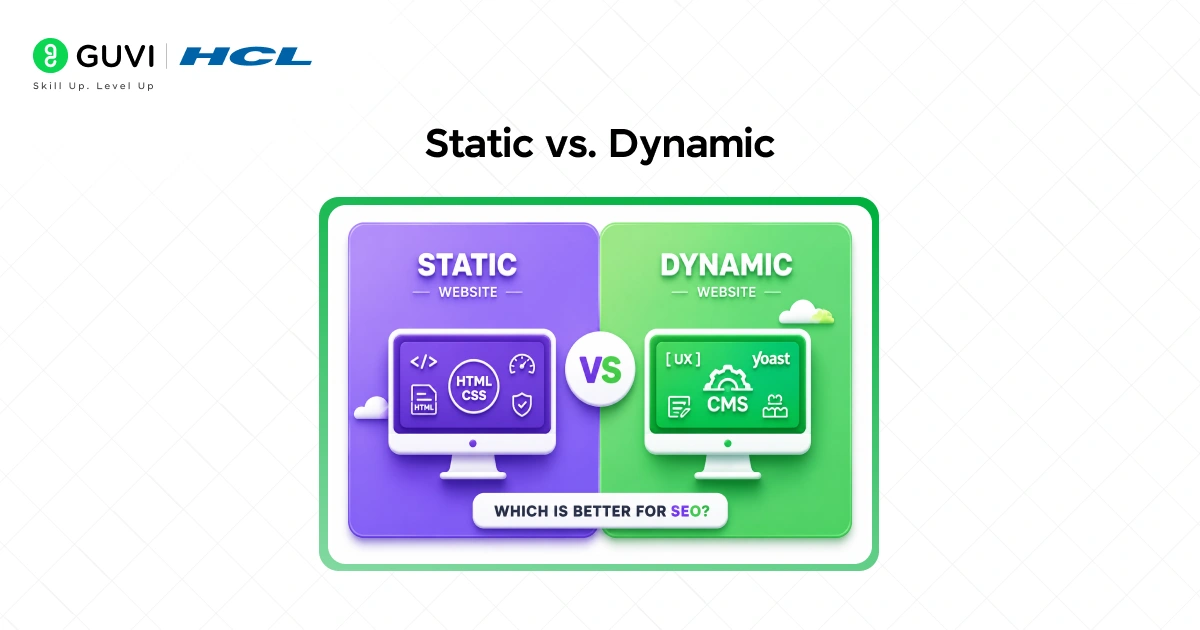
Does the world wait for the AI to think, or does it keep moving? Static environments do not change while the agent is thinking. Dynamic environments change regardless of whether the agent is acting or not.
STATIC
- Turn-based board games like chess or tic-tac-toe are static. When it is the AI’s turn, the opponent waits.
- The board does not rearrange itself while the AI is deciding its next move. This gives the agent all the time it needs to think without worrying that the situation will change mid-thought.
DYNAMITE
- Dynamic environments are far more challenging. Real-time systems like video surveillance are dynamic.
- Traffic management systems deal with cars that are constantly moving. A robot on the factory floor faces equipment, people, and objects in constant motion.
- In these cases, the AI must not only make smart decisions but must also do so fast before the world moves on and the decision becomes irrelevant. Speed of reasoning becomes just as important as quality of reasoning in dynamic environments.
5. Discrete vs. Continuous
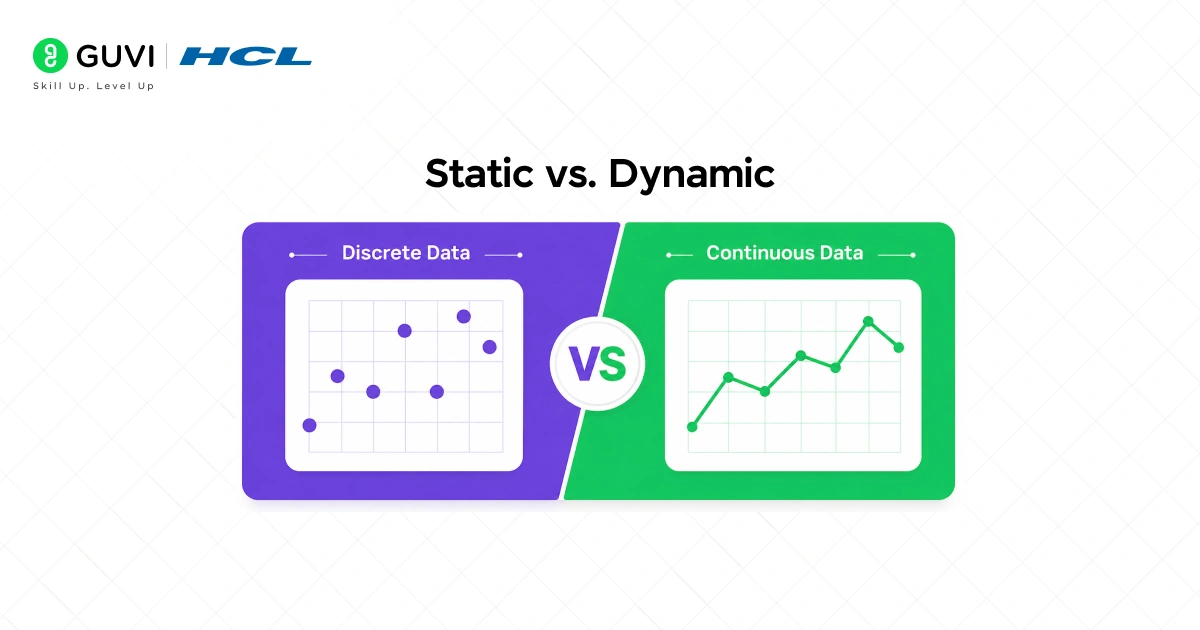
This dimension is about how the states and actions in the environment are structured. A discrete environment has a finite number of states and actions, like a board game environment. A continuous environment has an infinite range of states and actions, like controlling a robotic arm in car manufacturing.
DISCRETE
- Discrete environments are clean and countable. In a game of tic-tac-toe, there are a limited number of positions and a limited number of moves. The agent can list them all, evaluate them, and pick the best one.
- This makes the decision-making process manageable and the algorithms relatively straightforward. In discrete environments, agents can easily enumerate and evaluate all possible states and actions.

CONTINUOUS
- Continuous environments are a different story entirely. Self-driving cars are an example of continuous environments, as their actions, driving, parking, and steering cannot be numbered. The car’s position, speed, and direction can take any value within a range, not just a set of fixed choices.
- In continuous environments, agents must deal with an infinite range of possibilities, making decision-making and control more complex. Techniques like neural networks and calculus-based optimization become essential in these settings.
6. Single-Agent vs. Multi-Agent
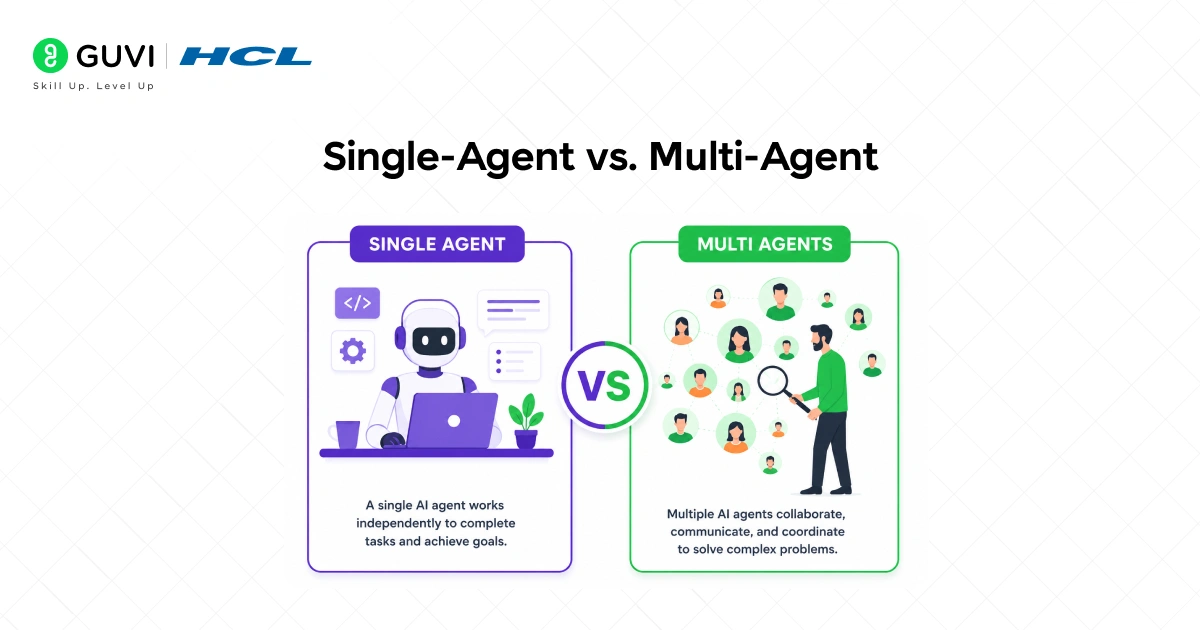
Some AI systems operate alone. Others must work alongside, or compete against, other agents. If there is at least one other agent in the environment, it is a multi-agent environment. These other agents might be apathetic, cooperative, or competitive.
SINGLE AGENT
- A single-agent environment is one where only one AI agent is making decisions. A Sudoku-solving program, for example, does not need to worry about anyone else. It simply evaluates the puzzle and works toward the solution on its own. This isolation simplifies design considerably.
- Multi-agent environments introduce a whole new layer of complexity. Multi-agent systems involve multiple autonomous agents working together to handle complex, decentralized tasks too big for a single AI agent.
- In fraud detection, for instance, one agent might analyze transactions, another reviews customer history, an aggregator synthesizes the findings, and a validator checks the results.
MULTI-AGENT
- Multi-agent environments can be cooperative, where agents team up toward a shared goal, or competitive, where agents work against each other.
- Online multiplayer games, financial trading systems, and traffic management networks are all multi-agent environments where the behavior of one agent directly affects others.
7. Known vs. Unknown
The final key dimension is how much the agent knows about the rules of its own environment. Known environments are those where the agent has a complete model or understanding of how the environment works; the rules are known and fixed. Unknown environments are those where the agent must learn how the environment works through exploration.
KNOWN ENVIRONMENT
- Chess is a known environment. The rules do not change. The agent knows exactly what moves are legal, how the pieces behave, and what winning looks like.
- It can plan with full confidence in those rules. An AI that looks at radiology images to determine if there is a sickness is an example of an episodic environment. One image has nothing to do with the next.
UNKNOWN ENVIRONMENT
- Unknown environments demand something very different: the ability to learn from scratch. An autonomous drone navigating a new terrain has no pre-programmed rulebook for what obstacles it might encounter.
- It must explore, observe outcomes, and gradually build up an understanding of how its world works.
- An environment could be known and partially observable, or unknown and fully observable.
- The choice of which characterization to use depends on the specific problem being addressed and the capabilities of the agent. These combinations are what make real AI design both challenging and fascinating
Modern ideas about AI environments were heavily shaped by Russell & Norvig’s classic book Artificial Intelligence: A Modern Approach, which classifies environments across multiple dimensions for intelligent agent design.
Traditional games like chess became the “gold standard” because they are fully observable, deterministic, and relatively predictable.
Real-world systems, however, are far more complex. Applications like self-driving cars operate in partially observable, stochastic, and multi-agent environments filled with uncertainty.
Early robotics research explored these continuous, dynamic environments, while systems like AlphaGo mastered structured sequential decision-making.
Fun twist: reinforcement learning agents, such as autonomous drones, can even learn in unknown environments by exploring and mapping the world in real time.
Why Does Environment Classification Matter?
Understanding environment types is not just theory. It directly guides how you design and choose your AI system. Understanding the different types of environments in AI is crucial for designing intelligent agents.
- Each type of environment, whether fully observable, deterministic, competitive, or unknown, poses unique challenges and requires different approaches for effective decision-making.
- A simple rule-based agent might work perfectly in a deterministic, fully observable, static, discrete environment.
- But place that same agent in a stochastic, partially observable, dynamic, continuous environment, and it will fail almost immediately. The design of the agent must match the demands of its environment.
- As the environment gets more complex, the agent needs more flexibility, memory, and learning ability. Understanding this match between agent and environment is a good starting point for anyone building or studying AI systems.
If you’re serious about mastering AI environment types—fully observable vs partially observable, deterministic vs stochastic, episodic vs sequential, static vs dynamic—don’t miss the chance to enroll in HCL GUVI’s Intel & IITM Pravartak Certified Artificial Intelligence & Machine Learning Course, co-designed by Intel.
Conclusion
The environment is not just a backdrop in AI; it is the stage on which intelligence either succeeds or fails. Every AI system you interact with, from the autocomplete on your phone to a recommendation system on Netflix to the navigation on Google Maps, has been designed with a specific environment type in mind.
Understanding whether that environment is fully observable or partial, deterministic or stochastic, static or dynamic, episodic or sequential, discrete or continuous, single-agent or multi-agent, and whether it is known or unknown, all of this shapes every design decision that goes into building an intelligent system.
As you continue learning AI, keep this framework close. Whenever you encounter a new AI problem or application, ask yourself: What kind of environment is this agent living in?
The answer will tell you more about the challenge ahead than almost anything else. These categories are the foundation of smart AI design, and mastering them puts you well ahead on your journey into artificial intelligence.
FAQs
1. What’s the difference between fully observable and partially observable environments?
Fully observable gives the agent complete state info (e.g., chessboard visible entirely). Partial observability hides parts via noisy sensors or limits (e.g., a self-driving car can’t see around corners), forcing memory and prediction.
2. When is a deterministic environment vs. a stochastic one?
Deterministic: Actions yield exact outcomes every time (e.g., traffic light button). Stochastic: Uncertain results needing probabilities (e.g., stock market, soccer), common in real-world AI.
3. Episodic vs. sequential: Give examples.
Episodic: Independent tasks, no past impact (e.g., spam filter per email). Sequential: Actions affect future states, requiring planning (e.g., chess moves).
4. Why distinguish discrete from continuous environments?
Discrete: Finite states/actions (e.g., tic-tac-toe). Continuous: Infinite ranges (e.g., robotic arm steering), demanding neural nets or optimization for decisions.
5. Single-agent vs. multi-agent environments?
Single: Solo operation (e.g., Sudoku solver). Multi: Interacts with others cooperatively (fraud detection team) or competitively (multiplayer games), adding strategy layers.
Success Stories

About the Author
Vishalini Devarajan
An Aerospace Engineer turned content writer, I focus on making complex concepts easy to understand through well-structured, reader-friendly blogs. Whether it’s a technical topic or a non-technical one, I love creating content that is clear, engaging, and impactful.
View all posts by Vishalini Devarajan
Connect with me @










Did you enjoy this article?