


Artificial Intelligence and Machine Learning Articles
AI/ML Skills Gap 2026: Why Companies Can't Find Job-Ready Talent
20 AI/ML Interview Questions Recruiters Can Use Without a Tech Background - Best Guide
How Industry-Backed AI/ML Bootcamps Are Changing the AI/ML Hiring Pipeline - Best Guide 2026
From IT Support to AI Engineer: A Realistic Career Switch Guide 2026


Get In Touch For Details! Request More Information
LLM Distillation for NLP and Deep Learning
Aug 18, 2026 5 Min Read 774 Views
(Last Updated)
Large Language Models are advancing rapidly. Today, models with billions of parameters can generate code, summarize documents, answer complex questions, and solve problems step by step. However, this intelligence comes with high GPU requirements, expensive inference pipelines, and significant energy consumption.
This is where LLM distillation becomes important. Instead of deploying massive models everywhere, companies are building smaller and faster AI models that retain strong performance while reducing deployment costs.
In this article, we’ll explore how LLM distillation for NLP works, why it matters in NLP and deep learning, modern distillation techniques, real-world applications, and how lightweight AI models are transforming production AI systems.
Table of contents
- TL;DR
- Why Large Language Models Are Difficult to Deploy?
- How Exactly Does LLM Distillation Work?
- Training the Teacher Model
- Generating Soft Outputs
- Student Model Learning
- Deployment and Optimization
- Soft Labels and Their Significance
- Types of Modern Distillation Techniques
- Knowledge Distillation
- Self Distillation
- Multi-Teacher Distillation
- Prompt Distillation
- Distillation vs Quantization vs Pruning
- Distillation
- Quantization
- Pruning
- Real World Applications of Distilled Models
- Chatbots and Virtual Assistants
- Mobile AI Applications
- Search Engines
- Recommendation Systems
- Healthcare AI
- Chain of Thought and Reasoning Distillation
- Practical Example of Knowledge Distillation
- Benefits of LLM Distillation
- Faster Inference
- Lower Infrastructure Costs
- Better Scalability
- Edge AI Deployment
- Improved Accessibility
- Challenges and Limitations
- Knowledge Loss
- Task-Specific Limitations
- Expensive Distillation Training
- Ethical Concerns
- The Future of Lightweight AI Models
- Conclusion
- FAQs
- What is LLM distillation?
- Why is LLM distillation important?
- What is the difference between distillation and quantization?
- Where is LLM distillation used?
- What are soft labels in knowledge distillation?
- Can distilled models replace large language models completely?
TL;DR
- LLM distillation is a technique in which a smaller student model learns from a larger teacher model to enable fast and cheap AI inference.
- Modern distillation is about creating deployable AI systems instead of just model compression.
- Distilled models can learn from soft probabilities, reasoning traces, and hidden states rather than only ground truth labels.
- Distillation is used by companies to decrease GPU utilization, memory usage, latency, and infrastructure costs.
- Common NLP applications of distillation include chatbots, recommendation systems, AI assistants, search engines, and mobile AI systems.
- Current AI pipelines involve pruning, quantization, and distillation for developing highly optimized, lightweight AI models.
What is LLM Distillation?
LLM distillation is a deep learning optimization strategy where a smaller AI model learns from a larger, more capable language model. In this setup, the larger model acts as the teacher, while the smaller model acts as the student. Instead of training entirely from scratch, the student model learns the teacher’s language understanding, reasoning patterns, probabilities, and knowledge representations to achieve strong performance with fewer computational resources.
Why Large Language Models Are Difficult to Deploy?
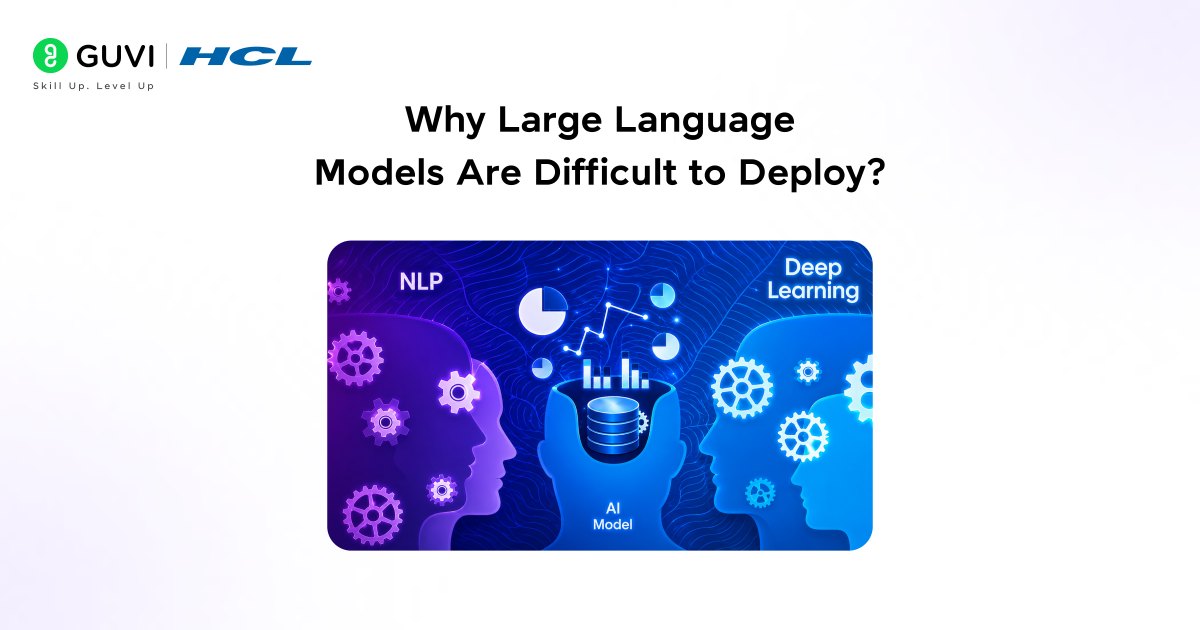
Large language models are highly advanced but difficult to deploy at scale, especially when businesses must handle millions of user requests daily. Running such models for every request can significantly increase infrastructure and inference costs.
Large models create several challenges:
- Large GPU memory utilization.
- Low inference speed.
- Expensive infrastructure costs.
- High power consumption.
- Scaling bottlenecks.
- Difficult edge deployment.
Consider an enterprise customer service chatbot. To handle millions of requests efficiently, it cannot rely entirely on massive language models because latency becomes a critical concern. Even a few seconds of delay can negatively impact user experience.
This is why AI research is shifting from “bigger models win” to “efficient models win production.” You can also explore how Large Language Models work to better understand the foundation behind modern LLM optimization.
How Exactly Does LLM Distillation Work?
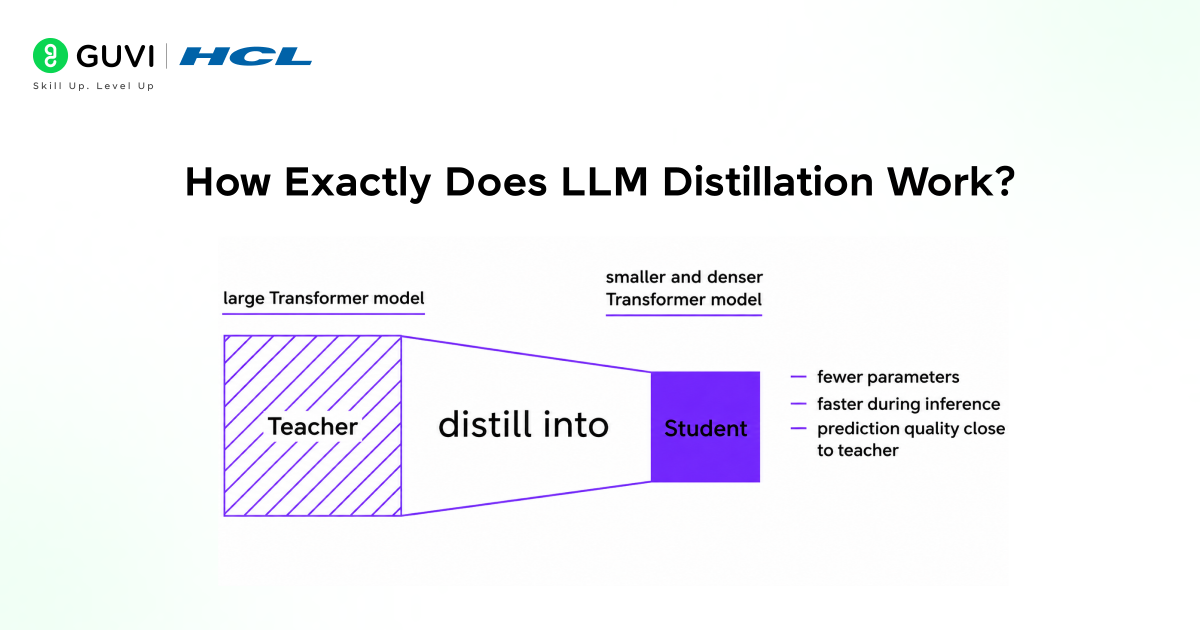
LLM distillation involves a few important stages. Every stage helps the student model absorb information from the teacher model.
1. Training the Teacher Model
Usually, a large pretrained language model known to perform well on NLP tasks serves as the teacher.
Examples include:
GPT models.
BERT variants.
Llama models.
PaLM models.
These models already exhibit strong language understanding and reasoning capabilities.
2. Generating Soft Outputs
The teacher model does not only produce the exact correct output. Rather, it provides the class probability distribution for outputs.
For example:
Positive sentiment = 88%.
Neutral sentiment = 9%.
Negative sentiment = 3%.
These probability distribution values convey deep contextual understanding.
3. Student Model Learning
The student model takes guidance from the teacher’s outputs, attempting to reproduce its prediction during training. As the student model iterates, it progressively improves its capacity to mirror the teacher’s behavior.
4. Deployment and Optimization
Following training, the distilled model will be faster, smaller, and ideal for production across numerous devices and cloud infrastructures.
Soft Labels and Their Significance
Soft labels are one of the most misunderstood aspects of distillation.
The student model can also learn from the confidence values behind predictions. Traditional training uses hard labels.
Let’s assume a teacher model predicts:
Paris = 92%.
Lyon = 5%.
France = 3%.
Now the student model can also learn that both Lyon and France are contextually similar to Paris. The student is given deeper insight into how to make decisions from diverse possibilities.
Through soft labels, the model learns:
- Confidence of each possible output.
- Relative proximity between various elements.
- Relationships between terms (semantic similarity).
- Uncertainty in decisions.
- Level of complexity in reasoning.
This is the primary reason why a smaller distilled model can maintain a high level of NLP performance. You can also explore top generative AI models in 2026 to understand how modern AI systems are evolving.
Model distillation can allow surprisingly small AI models to outperform much larger ones on specialized tasks.Researchers at Google Research demonstrated that a distilled model with only 770 million parameters could surpass a 540 billion parameter model on certain NLP benchmarks. The smaller model achieved this by learning from the larger model’s reasoning traces, capturing high-quality decision patterns while using hundreds of times fewer parameters. This highlights why modern AI progress is not only about building bigger models, but also about creating more efficient and specialized systems.
Types of Modern Distillation Techniques
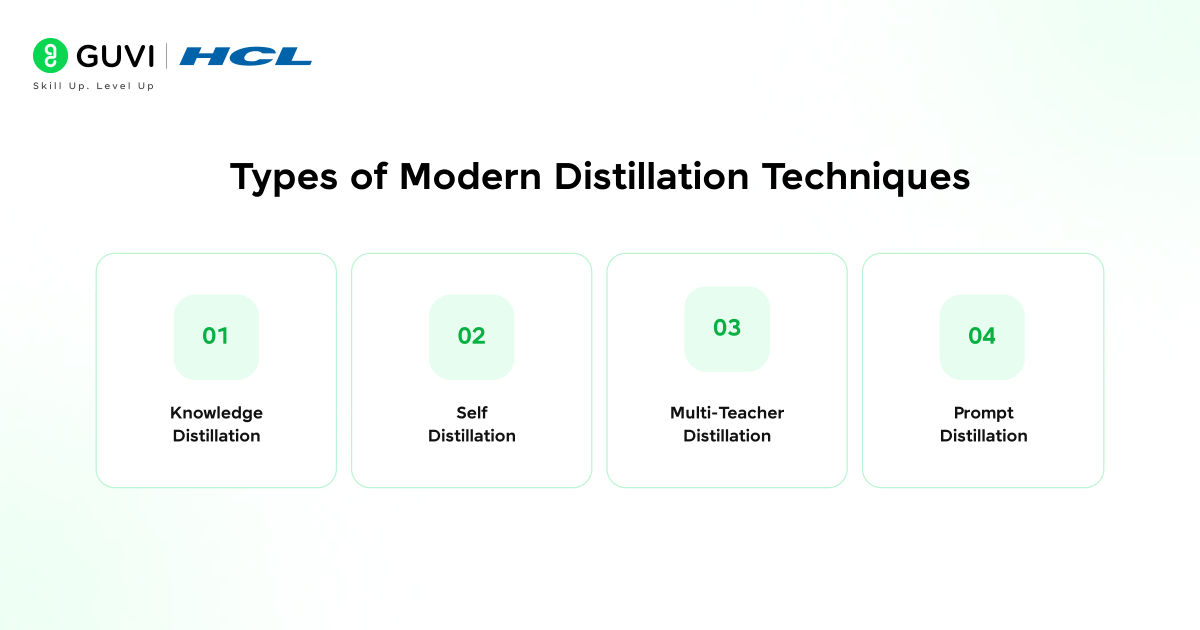
In recent times, distillation methods have seen major advancements. Traditional methods of simple output mimicry have been surpassed, and contemporary systems employ a range of modern approaches.
1. Knowledge Distillation
This traditional technique uses a teacher model to predict the probability distributions, which the student model tries to replicate. This remains a fundamental technique in most modern distillation methods.
2. Self Distillation
A model attempts to predict its previous self to make the overall performance better and more consistent.
3. Multi-Teacher Distillation
This is when more than one teacher model is used to teach a student model. This technique can improve the model’s ability to generalize and also increase robustness.
4. Prompt Distillation
Large prompts are simplified into their smallest possible equivalent representation. This is highly efficient and used in production AI models.
Distillation vs Quantization vs Pruning
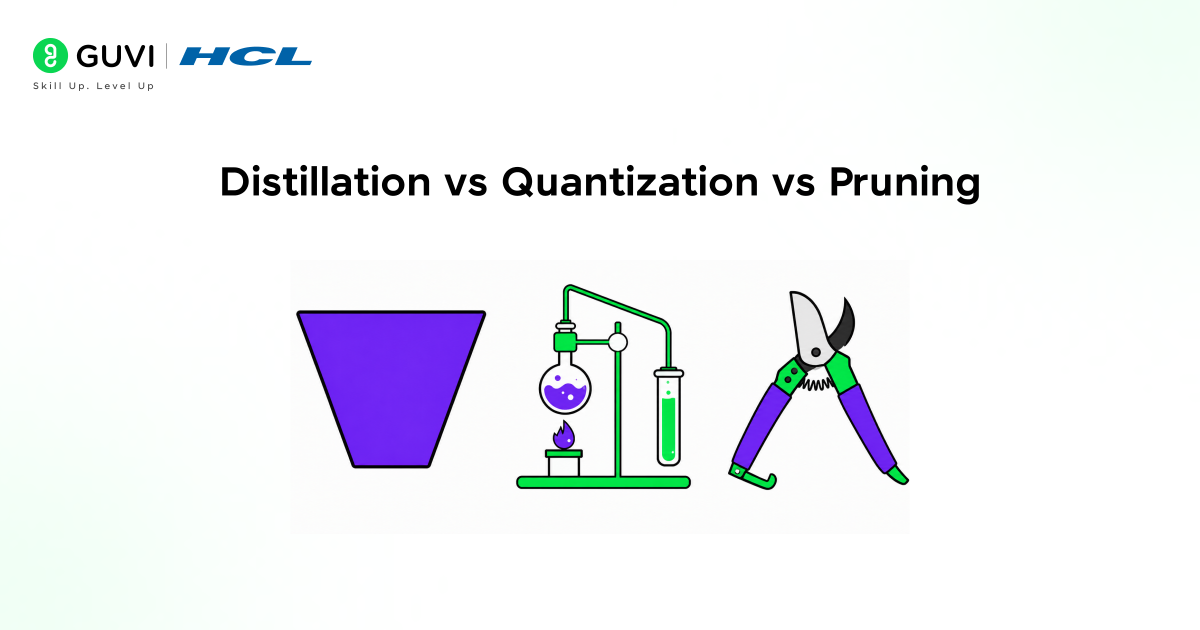
It is a common mistake that distillation is one of the optimization techniques, similar to quantization and pruning. But all these different approaches cater to different problems.
Distillation
Distillation basically involves teaching intelligence from a teacher model to a student model.
The goal here is to:
Reduce the size of the model.
Preserve model intelligence.
Enhance deployability efficiency.
Quantization
Quantization simply refers to the reduction in numerical precision.
Examples:
FP32 → FP16.
FP16 → INT8.
Quantization leads to a reduction in storage space and makes inference speed higher.
Pruning
Pruning helps eliminate unnecessary connections and parameters of the model without affecting its accuracy. It tries to make a model lightweight by removing redundancy.
Modern AI systems typically include distillation, quantization, and pruning for overall AI pipelines, which can effectively be deployed in the real world and run on limited resources.
Real World Applications of Distilled Models
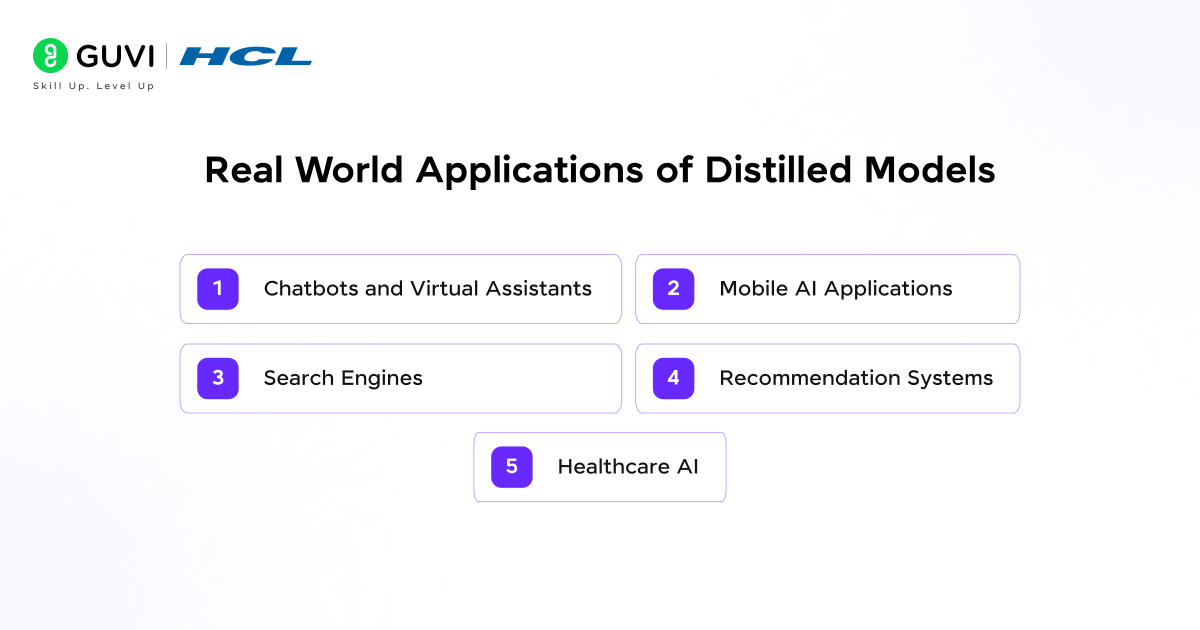
Today, distilled models are used in many modern AI systems because they retain intelligence while operating efficiently.

1. Chatbots and Virtual Assistants
Such applications demand high scalability and fast response rates. Reduced latency in distilled models leads to quicker customer query responses, along with decreasing infrastructure costs.
2. Mobile AI Applications
Massive language models are not ideal for small portable devices like smartphones. The efficient and lightweight nature of distilled models makes features like mobile voice assistants, instant language translators, smart keyboards, and offline AI tools possible. This is also explained in AI applications built with LLMs on edge devices.
3. Search Engines
The scale of searches globally is immense. Optimized and lightweight models reduce the cost per inference while maintaining the quality and relevance of the search results.
4. Recommendation Systems
Platforms like Netflix or Amazon utilize distilled NLP models to personalize recommendations for users and improve ranking systems.
5. Healthcare AI
Often, for privacy reasons and compliance regulations, on-device inference is preferred for medical AI applications. NLP models can be effectively implemented in mobile devices, avoiding the need for a heavy cloud-based approach.
Chain of Thought and Reasoning Distillation
One of the most exciting areas in NLP that has seen major progress in recent years is reasoning distillation. Unlike prior models, which were primarily focused on replicating outputs, modern systems focus on distilling reasoning pathways.
For example, instead of simply producing:
“Answer = 42”.
A teacher could produce:
Problem understanding.
Deconstruct the equation.
Calculate the steps to achieve the result.
Produce the final answer.
This “reasoning trace” serves as an additional layer of supervision for the student. The outcome is that a more lightweight model is able to reason more accurately than a previously much larger model.
This is becoming highly influential in the development of:
AI coding assistants.
Autonomous AI agents.
Scientific reasoning systems.
Advanced NLP pipelines.
This trend is also shaping modern AI agent frameworks for developers focused on autonomous workflows and intelligent task execution.
Practical Example of Knowledge Distillation
The following shows an example in PyTorch:
import torch
import torch.nn.functional as F
teacher_logits = torch.tensor([5.0, 2.0, 1.0])
student_logits = torch.tensor([4.5, 2.2, 1.3])
teacher_probs = F.softmax(teacher_logits, dim=0)
student_probs = F.log_softmax(student_logits, dim=0)
loss = F.kl_div(student_probs, teacher_probs, reduction=’batchmean’)
print(loss)
Here, we have:
- The teacher outputs a probability distribution that the student model tries to replicate.
- Kullback-Leibler (KL) divergence between the student and teacher is computed.
This demonstrates the fundamental concept behind knowledge distillation in the realm of deep learning.
To further expand your knowledge of machine learning and deep learning topics, such as distillation, advanced optimization strategies for models, and NLP implementation, an ebook such as Generative AI: The Next Intelligence Revolution can be quite insightful.
Benefits of LLM Distillation
Distilling LLMs offers multiple benefits to production AI systems.
1. Faster Inference
Small models perform much faster when generating output, enhancing user experience.
2. Lower Infrastructure Costs
Enterprises can realize significant savings on GPU expenses and energy consumption.
3. Better Scalability
Small models can be deployed and scaled up for massive implementations more effectively.
4. Edge AI Deployment
These models can be effectively run on a variety of devices:
- Smartphones.
- Laptops.
- Embedded systems.
- IoT devices.
5. Improved Accessibility
Organizations with less robust infrastructure are still able to deploy capable AI solutions.
Challenges and Limitations
Distillation still has limitations.
1. Knowledge Loss
Smaller models may not fully capture all the capabilities of the teacher model.
2. Task-Specific Limitations
Some distilled models are only effective in specialized use cases.
3. Expensive Distillation Training
Although deployment costs are reduced, the actual training phase for distillation can be computationally intensive.
4. Ethical Concerns
Unauthorized model distillation, where organizations allegedly train systems using proprietary AI outputs without permission, is an increasing and complex issue.
The Future of Lightweight AI Models

The direction of NLP and deep learning is leaning heavily toward building efficient AI systems. Instead of pushing huge models across the board, organizations are moving toward:
- Small Language Models.
- Edge AI systems.
- Real-time inference pipelines.
- On-device AI applications.
- Cost-optimized enterprise AI solutions.
The focus of AI engineering is shifting from purely size to practical deployment efficiency.
Future AI systems will be built around a combination of:
- Distillation.
- Quantization.
- Retrieval systems.
- Semantic caching.
- Specialized AI architectures.
For those interested in developing practical AI solutions and learning about model optimization, deep learning, NLP pipelines, and production AI deployment, HCL GUVI’s AI & Machine Learning course provides practical, industry-focused learning experiences.
Conclusion
LLM distillation is evolving from a model compression technique into a core AI deployment strategy. As language models continue to grow, the focus is shifting toward efficiency, scalability, and real-world deployment.
By enabling smaller models to retain the intelligence of larger systems, distillation helps reduce memory usage, latency, and operational costs. The future of NLP and deep learning will not depend only on bigger models, but on intelligent, efficient, and deployable AI systems.
FAQs
1. What is LLM distillation?
LLM distillation is a technique where a smaller student model learns knowledge and behavior from a larger teacher model to create faster and more efficient AI systems.
2. Why is LLM distillation important?
LLM distillation reduces inference cost, memory usage, and latency while maintaining strong NLP performance, making AI deployment more practical.
3. What is the difference between distillation and quantization?
Distillation transfers knowledge from one model to another, while quantization reduces numerical precision to optimize memory and inference speed.
4. Where is LLM distillation used?
LLM distillation is used in chatbots, AI assistants, recommendation systems, mobile AI applications, search engines, and edge AI systems.
5. What are soft labels in knowledge distillation?
Soft labels are probability distributions generated by the teacher model that help the student learn contextual relationships and reasoning confidence.
6. Can distilled models replace large language models completely?
Not always. Distilled models are highly efficient for many practical tasks, but extremely complex reasoning tasks may still require larger models.
Success Stories

About the Author
Vishalini Devarajan
An Aerospace Engineer turned content writer, I focus on making complex concepts easy to understand through well-structured, reader-friendly blogs. Whether it’s a technical topic or a non-technical one, I love creating content that is clear, engaging, and impactful.
View all posts by Vishalini Devarajan
Connect with me @










Did you enjoy this article?