


Artificial Intelligence and Machine Learning Articles
How to Evaluate LLM Outputs in Production Deployments
AI/ML Skills Gap 2026: Why Companies Can't Find Job-Ready Talent
20 AI/ML Interview Questions Recruiters Can Use Without a Tech Background - Best Guide
How Industry-Backed AI/ML Bootcamps Are Changing the AI/ML Hiring Pipeline - Best Guide 2026


Get In Touch For Details! Request More Information

Expert Systems in AI: How Machines Make Decisions
Jul 04, 2026 7 Min Read 730 Views
(Last Updated)
A doctor with thirty years of experience retires. A senior engineer who knows every quirk of a complex system walks out the door. A financial analyst who spent a career developing intuition for market patterns moves on to something else.
And everything they knew goes with them.
This has always been one of the most expensive problems in knowledge-intensive industries. Hard-won expertise is fragile. It lives in people. And people leave.
Expert systems were built to solve exactly this problem. The idea was genuinely audacious: capture human expertise in a form that a computer could use and preserve that knowledge permanently, making it available to anyone who needed it at any time without requiring the expert to be in the room.
This guide explains how expert systems are architected, how they reason through problems, where they work brilliantly, and where they fall short.
Table of contents
- Quick TL;DR Summary
- Why Expert Systems Were Such a Breakthrough Idea
- The Architecture of an Expert System: Every Component Explained
- How Expert Systems Reason: Forward and Backward Chaining
- How to Build an Expert System: Step-by-Step
- Step 1: Define the Problem Domain With Precision
- Step 2: Identify and Engage Your Domain Experts
- Step 3: Conduct Thorough Knowledge Acquisition
- Step 4: Represent Knowledge in the Knowledge Base
- Step 5: Build and Configure the Inference Engine
- Step 6: Design the User Interface and Explanation Facility
- Step 7: Validate Rigorously Against Real Cases
- Common Mistakes in Expert System Development
- Getting Maximum Value From Expert System Architecture
- Real Applications of Expert Systems Today
- Conclusion
- FAQs
- Are expert systems still relevant with modern machine learning available?
- What is the difference between an expert system and a machine learning model?
- How long does it take to build an expert system?
- Can expert systems learn and update themselves?
- What makes a knowledge base high quality?
Quick TL;DR Summary
- This guide explains what expert systems are and how their architecture enables machines to replicate human expert decision making.
- You will learn how the key components of expert system architecture work together to represent knowledge and apply it to real problems.
- The guide covers the strengths and limitations of expert systems honestly, including where they outperform other AI approaches and where they do not.
- Step-by-step guidance shows exactly how expert systems reason through problems from the knowledge base to the final recommendation.
- You will finish with a solid understanding of one of AI’s most practically successful and widely deployed technologies.
What Is an Expert System in AI?
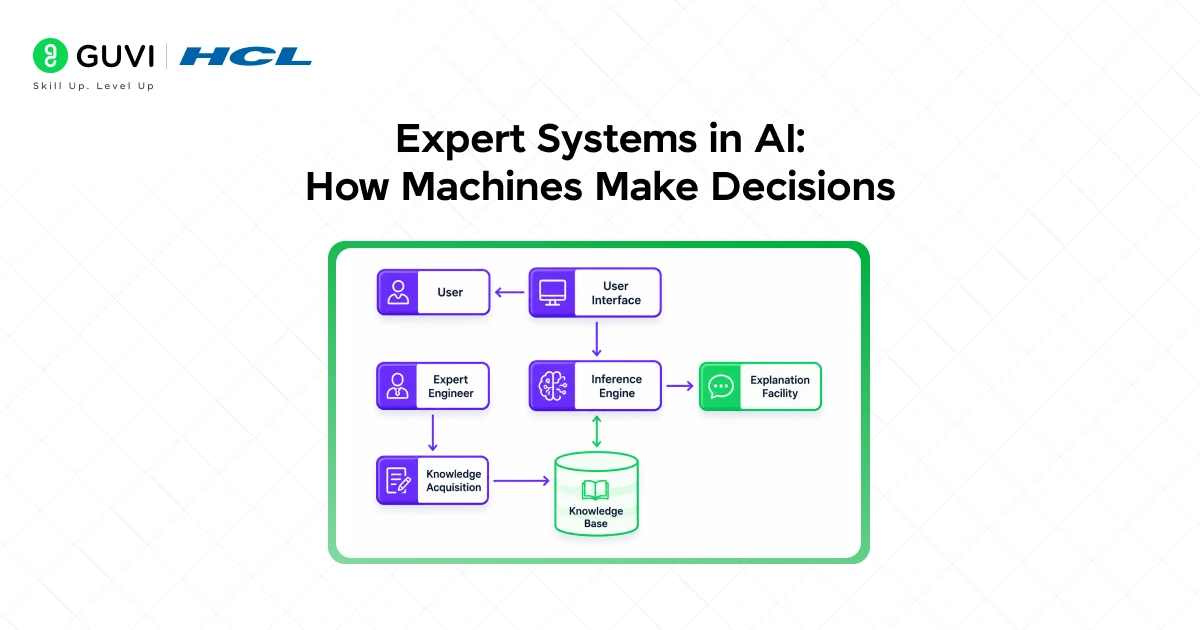
An expert system is an AI program designed to replicate the decision-making ability of a human expert in a specific domain. It does this by storing specialized knowledge in a structured knowledge base and using an inference engine to apply logical rules. This allows the system to generate recommendations, diagnoses, or decisions that closely match expert-level reasoning within a well-defined problem area.
Why Expert Systems Were Such a Breakthrough Idea
- Human expertise is scarce and expensive
An expert system makes that expertise available simultaneously to anyone who needs it, at any hour, at a fraction of the cost of individual expert consultations. Unlike machine learning systems that require vast amounts of training data, expert systems capture and codify existing knowledge directly from human experts.
- Expertise is inconsistent without a system
Even the best human experts are inconsistent. Fatigue, mood, and cognitive bias affect judgment in ways nobody fully controls. An expert system applies the same knowledge the same way every single time. For high-stakes decisions where consistency matters as much as accuracy, this is a significant advantage.
- Knowledge walks out the door when experts leave
Decades of accumulated expertise live in the minds of individuals. When those individuals retire or change roles, that knowledge disappears. Expert systems capture and preserve expertise in a form that outlasts any individual contributor. That alone justifies their existence in many organizations.
- Some domains are structured enough for systematic representation
These domains involve large bodies of knowledge that are complex but structured. They are exactly the kind of domains where rule-based expert system reasoning works remarkably well. Unlike deep learning and neural networks that excel at unstructured pattern recognition, expert systems thrive on structured, rule-based logic where artificial intelligence reasoning must be transparent and explainable.
Read More: Build AI Workflows That Keep Humans in Control
The Architecture of an Expert System: Every Component Explained
- The Knowledge Base
The brain of the entire system
The knowledge base contains everything the system knows about its domain. Facts, rules, relationships, and heuristics drawn from human experts through a process called knowledge acquisition. Rules are expressed in IF-THEN format. IF the patient has a fever AND a rash AND joint pain THEN consider Lyme disease. The quality of the knowledge base is the primary determinant of the system’s real-world performance. Everything else serves this component.
- The Inference Engine
The reasoning mechanism that puts knowledge to work
The inference engine reads the knowledge base and applies its rules to the current problem to reach conclusions. Two main reasoning strategies exist. Forward chaining starts from known facts and derives new conclusions. Backward chaining starts from a hypothesis and works backwards to determine if available facts support it. The inference engine is what makes the system think rather than just store information.
- Working Memory
Short-term memory for the current problem
Working memory holds the facts specific to the current problem being solved. Patient symptoms in a medical system. Equipment readings in a diagnostic system. Financial figures in a tax compliance system. The inference engine reads working memory alongside the knowledge base to determine which rules apply right now, in this specific case.
- The User Interface
Where humans and the system actually meet
The user interface collects information from the user, asks the questions the system needs answered, and presents conclusions and recommendations in a form users can act on. A well-designed interface makes the system feel natural and its outputs trustworthy. A poor interface makes even the most brilliant knowledge base practically useless in the real world.
- The Explanation Facility
The component that makes expert systems uniquely trustworthy
Unlike most AI systems that produce outputs with no reasoning attached, expert systems explain their thinking step by step. The explanation facility traces the chain of rules that led to a conclusion and presents this reasoning in plain terms users can understand and verify. This transparency is one of the most valuable properties expert systems offer in high-stakes domains where accountability matters.
- The Knowledge Acquisition Module
The pipeline for getting expertise into the system
Knowledge acquisition is the process of extracting expertise from human experts and encoding it into the knowledge base. This is almost always the hardest and most time-consuming part of building an expert system. Knowledge engineers work with domain experts to surface tacit knowledge that experts apply intuitively but struggle to articulate explicitly in words.
MYCIN, one of the earliest expert systems, was developed at Stanford University in the 1970s to diagnose bacterial blood infections and recommend antibiotic treatments. In formal evaluations, its recommendations were rated acceptable by expert physicians about 65% of the time, compared to roughly 42–62% for non-specialist human physicians, making it an early and influential demonstration that rule-based AI systems could perform at or above the level of general medical practitioners and significantly shaping confidence in expert systems research.
How Expert Systems Reason: Forward and Backward Chaining
- Forward Chaining: Starting From What You Know
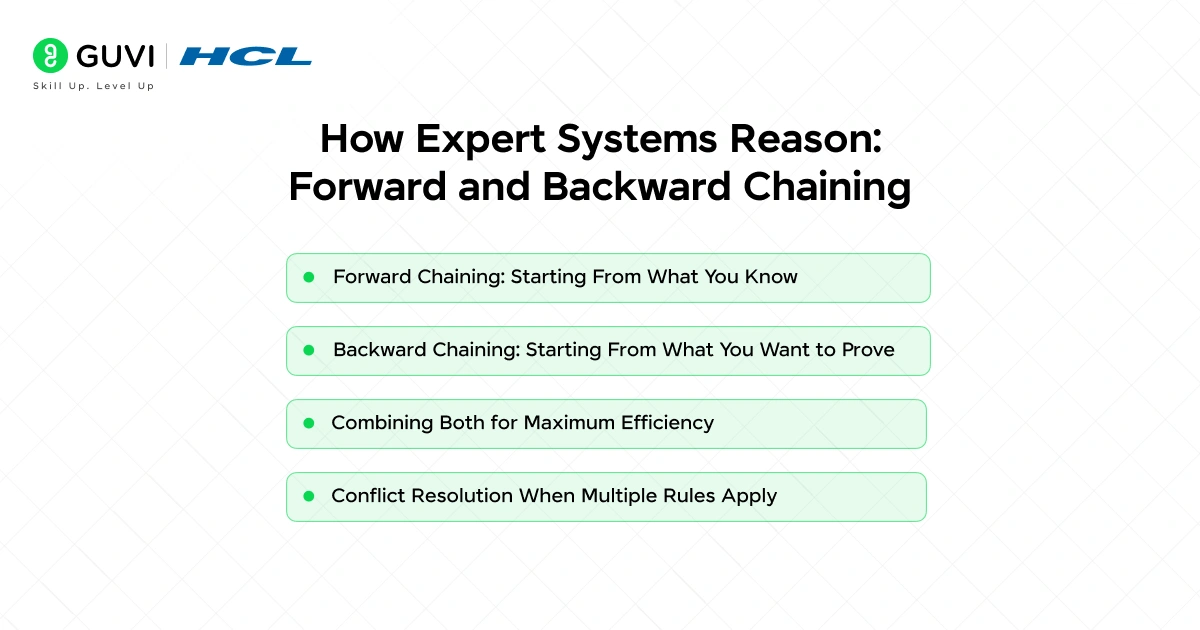
Forward chaining begins with the facts currently in working memory and applies rules to derive new facts until a conclusion is reached or no more rules can fire. It is data-driven reasoning. Start with what you know and see where it leads. This approach works well when you have a collection of facts and want to discover what conclusions follow naturally from them.
- Backward Chaining: Starting From What You Want to Prove
This approach works best for diagnostic problems where you are confirming or ruling out specific hypotheses. Medical diagnosis systems often combine backward chaining with natural language processing to extract symptoms from patient records and machine learning for pattern recognition in diagnostic imaging.
- Combining Both for Maximum Efficiency
Sophisticated expert systems combine forward and backward chaining intelligently. Forward chaining handles initial processing of incoming facts and identifies which hypotheses are worth investigating. Backward chaining then pursues those hypotheses systematically. The combination produces more efficient reasoning than either strategy alone on complex real-world problems.
- Conflict Resolution When Multiple Rules Apply
When multiple rules could fire simultaneously, the inference engine needs a strategy for deciding which to apply first. Common approaches include prioritizing more specific rules over general ones, applying the most recently added rule, and using domain-specific priority schemes. Conflict resolution strategy significantly affects both the efficiency and outcome of the reasoning process and is often where expert system tuning happens.
How to Build an Expert System: Step-by-Step
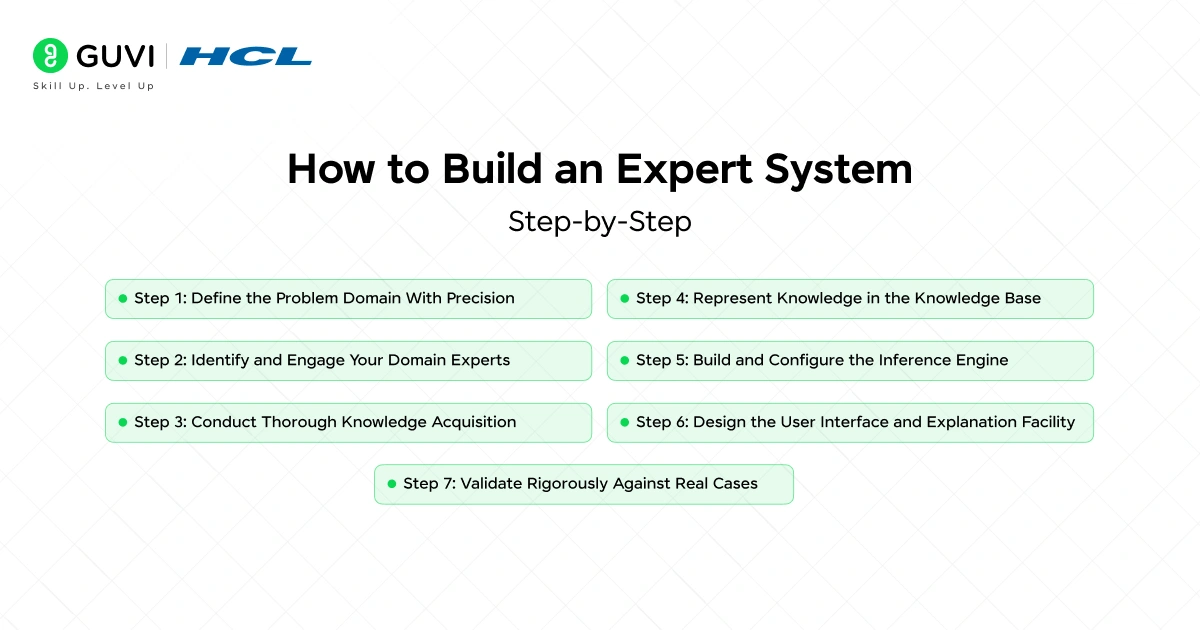
Here is exactly how expert systems get built from initial knowledge acquisition all the way through to deployment.
Step 1: Define the Problem Domain With Precision
Narrow scope is the foundation of expert system success
Expert systems work best in well-defined, bounded domains. Before anything else, define exactly what problems the system will and will not address. A system designed to diagnose one specific category of equipment failure is far more buildable and reliable than one attempting to cover all possible failures across an entire plant. Specificity at this stage determines everything that follows.
Step 2: Identify and Engage Your Domain Experts
The system is only as good as the expertise it captures

Identify the human experts whose knowledge the system will encode. These should be people with demonstrated, reliable expertise in the specific domain you defined. Plan for significant ongoing time investment from these experts throughout development. Knowledge acquisition is not a one-time interview session. It is a sustained collaboration that continues until the system is validated.
Step 3: Conduct Thorough Knowledge Acquisition
Surface the expertise that experts apply without thinking
Work with your domain experts to extract the rules, heuristics, and decision criteria they use in practice. Use structured interviews, problem-solving observation, and case analysis together. Pay special attention to tacit knowledge, the things experts do automatically without being able to easily explain why. Converting this implicit knowledge into explicit rules is the hardest and most important work in the entire project.
Step 4: Represent Knowledge in the Knowledge Base
Encode what you learned in a form the inference engine can use
Translate extracted expertise into IF-THEN rules, facts, and relationships in the knowledge base. Use a knowledge representation language or expert system shell that fits the structure of your domain. Review every rule with the domain expert to verify it captures the intended reasoning correctly before moving forward. Errors here propagate through everything downstream.
Step 5: Build and Configure the Inference Engine
Choose the reasoning strategy that fits your problem type
Decide whether forward chaining, backward chaining, or a combination best suits your domain. Configure conflict resolution strategies for situations where multiple rules apply simultaneously. If using an expert system shell, this component may already be provided. If building from scratch, this is significant engineering work that deserves as much care as the knowledge base itself.
Step 6: Design the User Interface and Explanation Facility
The interface determines whether the system actually gets used
Build a user interface that collects the information the inference engine needs in a natural, guided way. Build the explanation facility to present reasoning chains in terms domain users genuinely understand. Test both with actual end users before finalizing. The most sophisticated knowledge base fails completely if the interface makes it feel opaque or untrustworthy to the people who need to rely on it.
Step 7: Validate Rigorously Against Real Cases
Test against known outcomes before trusting it with real problems
Test the system against historical cases with known correct outcomes. Compare its recommendations to those of human experts on the same cases. Identify rules that produce incorrect conclusions and refine them with domain expert input. Validation is not a one-time step. It is an ongoing process as new cases inevitably reveal gaps in the knowledge base that were not visible during development.
Common Mistakes in Expert System Development
- Defining the domain too broadly and creating a system too complex to build reliably
- Underestimating the time and effort required for proper knowledge acquisition
- Encoding what experts say they do rather than what they actually do when solving real problems
- Neglecting the explanation facility and producing a system users do not trust enough to use
- Failing to validate against enough real cases before deployment
- Not planning for knowledge base maintenance as the domain evolves and changes over time
- Building the inference engine before the knowledge base is well enough defined to test against meaningfully
Getting Maximum Value From Expert System Architecture
- Invest in knowledge acquisition before anything else
- Use the explanation facility as a validation tool during development
- Plan for maintenance from day one
- Start narrow and expand deliberately
Expert systems are among the earliest major success stories in applied AI. One of the most famous examples, XCON (developed by Digital Equipment Corporation in the 1980s), was used to configure computer systems for customer orders. It processed over 80,000 orders annually, achieved accuracy rates above 95%, and saved the company an estimated $40 million per year at its peak, remaining in production use for more than a decade and demonstrating the real-world economic impact of rule-based AI systems.
Real Applications of Expert Systems Today
- Medical diagnosis and clinical decision support
Modern hospitals use expert systems to support clinical decision making, flagging potential drug interactions, suggesting differential diagnoses, and alerting clinicians to patient risk factors based on structured rule sets encoding established medical knowledge. These systems do not replace physicians. They give them better information faster.
- Financial services and credit assessment
Banks and lending institutions use expert systems to assess credit applications against regulatory requirements and internal risk criteria. The rule-based approach ensures consistency across thousands of daily decisions and provides the audit trail that financial regulation requires. Every decision can be explained in terms of the specific rules that drove it.
- Technical fault diagnosis
Manufacturing and infrastructure operators use expert systems to diagnose equipment failures. The system encodes the troubleshooting knowledge of the most experienced engineers, making that expertise available to less experienced technicians at any hour without requiring expert availability on every shift.
- Legal and regulatory compliance
Law firms and corporate legal departments use expert systems to check documents and decisions against regulatory requirements. Tax compliance, contract review, and regulatory filing all involve applying complex but structured rule sets to specific cases, exactly the problem expert systems are built to solve.
To build real skills in AI systems including expert systems, machine learning, and beyond, do not miss the chance to enroll in HCL GUVI’s Intel & IITM Pravartak Certified Artificial Intelligence & Machine Learning course. Endorsed with Intel certification, this course adds a globally recognized credential to your resume, a powerful edge that sets you apart in the competitive AI job market.
Conclusion
Expert systems solved a problem organizations had struggled with forever: how do you preserve expertise that lives only in a few people’s heads?
The answer was simple. Capture the rules. Build the reasoning engine. Create the interface. The knowledge that once walked out the door when an expert retired now stays in the system permanently, available to everyone, applied consistently every time.
Expert systems are not the flashiest AI technology. But in the domains where they work, they deliver something newer AI still struggles to match: reliable, explainable, accountable decision making that organizations can actually trust. That is why they are still being built decades after they were first developed. Some ideas age well because they were genuinely right.
FAQs
1. Are expert systems still relevant with modern machine learning available?
Yes. Where explainability and auditability matter more than pattern recognition, expert systems remain the preferred choice. Healthcare, finance, and legal sectors rely on them precisely because every decision can be explained and verified.
2. What is the difference between an expert system and a machine learning model?
Expert systems use explicit rules written by humans. Machine learning learns patterns from data without explicit rules. Expert systems are more explainable. Machine learning handles messier, less structured problems better.
3. How long does it take to build an expert system?
Simple systems take weeks. Comprehensive medical or legal systems can take years. Knowledge base development is almost always the longest phase regardless of scope.
4. Can expert systems learn and update themselves?
Traditional expert systems cannot. Updates require human knowledge engineers. Hybrid systems combining expert system architecture with machine learning can incorporate some automatic learning while keeping the explainable rule-based core intact.
5. What makes a knowledge base high quality?
Comprehensive coverage, correctly specified rules, proper exception handling, and validation against real cases with known outcomes. Quality is almost entirely determined by the rigor of the knowledge acquisition process.
Success Stories

About the Author
Vishalini Devarajan
An Aerospace Engineer turned content writer, I focus on making complex concepts easy to understand through well-structured, reader-friendly blogs. Whether it’s a technical topic or a non-technical one, I love creating content that is clear, engaging, and impactful.
View all posts by Vishalini Devarajan
Connect with me @













Did you enjoy this article?