


Artificial Intelligence and Machine Learning Articles
Finance Manager to Data Analytics: Career Growth, Salary and Seniority
How to Evaluate LLM Outputs in Production Deployments
AI/ML Skills Gap 2026: Why Companies Can't Find Job-Ready Talent
20 AI/ML Interview Questions Recruiters Can Use Without a Tech Background - Best Guide

Get In Touch For Details! Request More Information
AI Speech Recognition: How Machines Understand Voice
Jul 04, 2026 6 Min Read 855 Views
(Last Updated)
You say “Hey Siri” and your phone wakes up. You dictate a message while driving and it arrives perfectly typed. You call customer support and a voice bot handles your entire query without a single human involved.
None of this feels remarkable anymore. That is exactly how completely speech recognition has embedded itself into daily life.
But underneath every one of these moments is a genuinely fascinating piece of technology. Teaching a machine to understand human speech is one of the hardest problems in all of artificial intelligence. Accents. Background noise. Filler words. Mumbling. Speed. Emotion. Human speech is messy in ways that make it extraordinarily difficult to process reliably.
This guide explains how AI Speech Recognition solved that problem, what the technology looks like today, and why it matters far more than most people realize.
Table of contents
- Quick TL;DR Summary
- Why Teaching Machines to Understand Speech Was So Hard
- How Modern AI Cracked the Speech Recognition Problem
- Step 1: Audio Signal Processing
- Step 2: Feature Extraction
- Step 3: Acoustic Modeling With Deep Learning
- Step 4: Language Modeling
- Step 5: Decoding and Output
- What Modern Speech Recognition Makes Possible
- How Speech Recognition Systems Are Built: Step-by-Step
- Step 1: Audio Capture and Preprocessing
- Step 2: Segmentation
- Step 3: Feature Extraction
- Step 4: Acoustic Model Processing
- Step 5: Beam Search Decoding
- Step 6: Post-Processing
- Step 7: Integration and Delivery
- Common Mistakes in Speech Recognition Implementation
- Getting the Most From Speech Recognition Technology
- Conclusion
- FAQs
- How accurate is modern speech recognition?
- What is the difference between speech recognition and voice recognition?
- Does speech recognition work offline?
- How does speech recognition handle multiple speakers?
- What languages does AI speech recognition support?
Quick TL;DR Summary
- This guide explains how speech recognition works in AI and what makes modern voice recognition dramatically better than earlier approaches.
- You will learn the key components of automatic speech recognition systems and how deep learning transformed the entire field.
- The guide covers real applications of speech recognition across industries with concrete examples of where the impact is already visible.
- Step-by-step guidance shows you how speech recognition systems process audio from raw sound all the way to meaningful text.
- You will finish with a clear understanding of both the capabilities and the current limitations of AI-powered speech recognition.
What Is Speech Recognition in AI?
Speech recognition is the ability of an AI system to identify and convert spoken human language into text or commands. It works by processing audio signals using machine learning models trained on large amounts of voice data, enabling computers to understand, interpret, and respond to natural speech across different languages, accents, and environments.
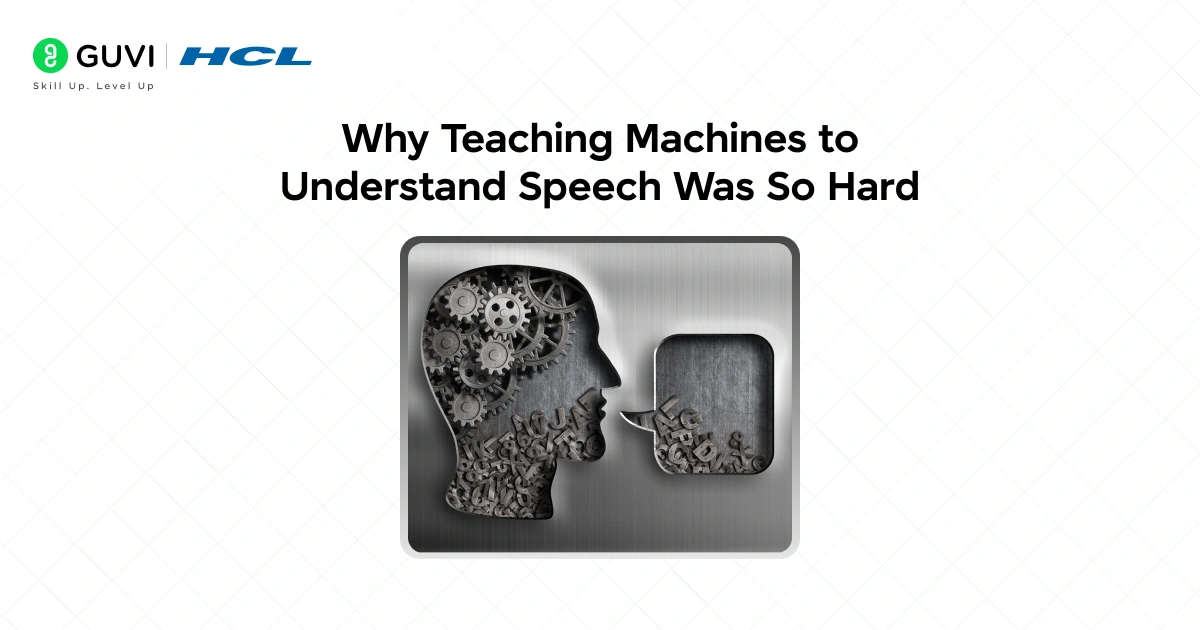
Why Teaching Machines to Understand Speech Was So Hard
- Human speech is never the same twice
Read the same sentence aloud ten times and you will produce ten slightly different audio signals. Speed, emphasis, tone, and breath all vary constantly. Early systems expected consistency they never got and failed because of it.
- Accents and dialects broke everything
The word “water” sounds completely different in Boston, Texas, London, and Sydney. Building rules to handle every regional variation was impossible. The more languages a system tried to support, the faster it collapsed under its own complexity.
- Background noise is everywhere
A conversation in a quiet room is easy. The same conversation in a café, a car, or a crowded office is a completely different audio signal. Separating the voice from the noise is a hard signal processing problem that early systems had no good answer for.
- Words run together in natural speech
Written language has clear spaces between words. Spoken language does not. “Did you eat yet” sounds like “didja eet yet” in natural conversation. Identifying where one word ends and another begins is a core challenge that humans solve effortlessly and machines struggle with for decades.
- Context changes meaning completely
“I need to check the bank” means something completely different depending on whether the speaker is a hiker or a banker. Without understanding context, a speech recognition system cannot reliably interpret what was actually meant.
Read More: How AI and Data Are Rewriting Engineering
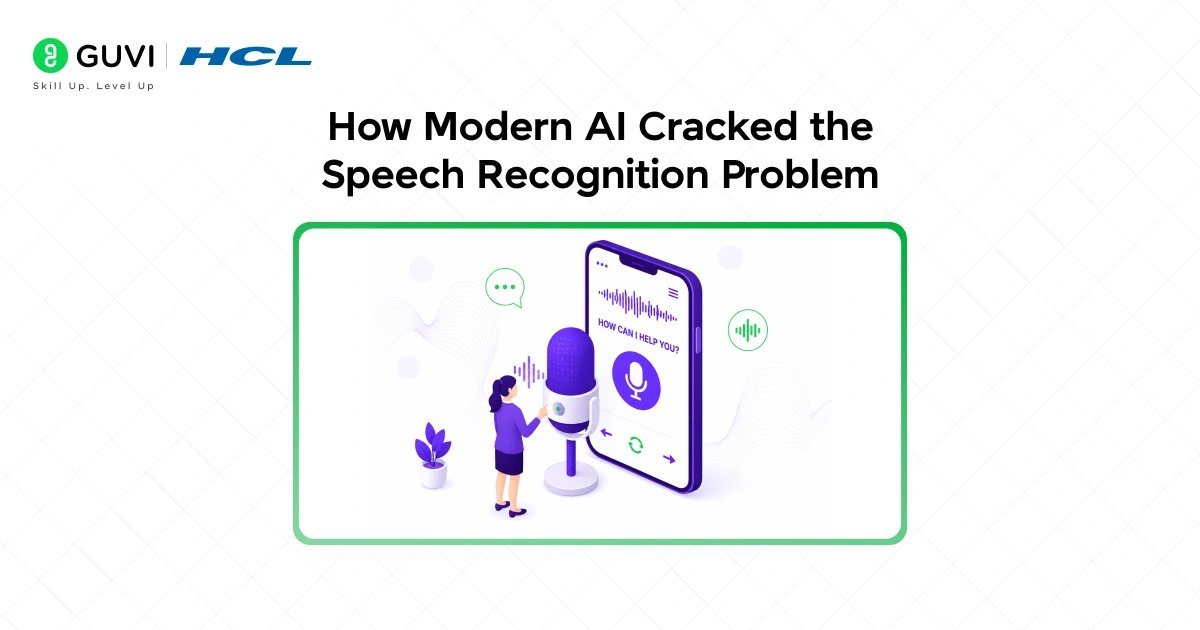
How Modern AI Cracked the Speech Recognition Problem
Step 1: Audio Signal Processing
Converting sound waves into something a computer can work with
Raw audio gets converted into a spectrogram, a visual map of which frequencies are present at which times. This transformation captures the acoustic features of speech in a format that machine learning models can learn from effectively. Everything downstream depends on the quality of this step.
Step 2: Feature Extraction
Finding the patterns that actually matter in the audio
Not all information in an audio signal is useful for recognizing speech. Feature extraction identifies the acoustic properties most relevant to distinguishing phonemes, the basic sound units that make up words. Mel-frequency cepstral coefficients are the most widely used feature representation, capturing how humans naturally perceive pitch and tone.
Step 3: Acoustic Modeling With Deep Learning
Teaching the AI what different sounds look like
Deep neural networks learn to map acoustic features to phonemes and words by training on thousands of hours of transcribed speech. The more diverse the training data, covering different accents, environments, and speaking styles, the more accurately the model performs in real-world conditions.
Step 4: Language Modeling
Using context to pick the right word
When the acoustic model is uncertain between two similar-sounding words, the language model steps in. It knows which words commonly follow others and uses this knowledge to select the most probable interpretation. This is why modern speech recognition handles ambiguous audio so much better than older systems ever could.
Step 5: Decoding and Output
Turning probabilities into actual words
The decoder combines the acoustic model’s output with the language model’s predictions to produce the final transcription. It searches through possible word sequences and selects the one with the highest combined probability. The result is the text that appears on screen the moment you stop speaking.
OpenAI’s Whisper model was trained on approximately 680,000 hours of multilingual audio and achieves near human-level transcription accuracy across many languages, including strong performance on heavily accented speech that earlier systems struggled to understand. Its breakthrough largely comes from the scale and diversity of training data, which significantly improved robustness and generalization in real-world audio conditions.
What Modern Speech Recognition Makes Possible
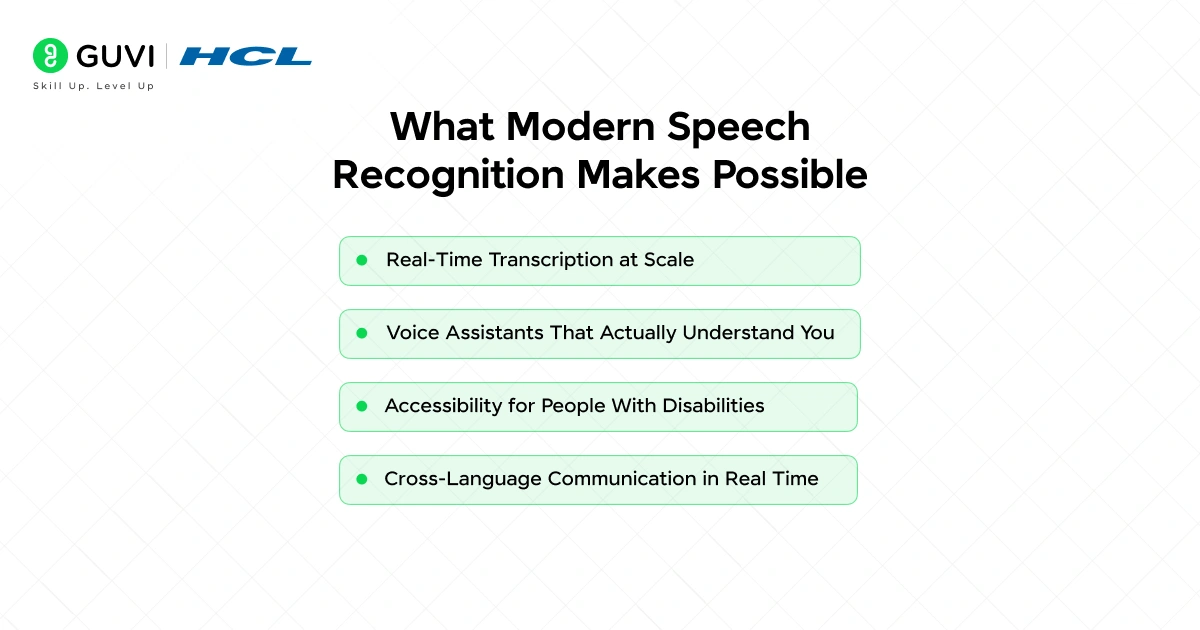
- Real-Time Transcription at Scale
Meetings get transcribed automatically as they happen. Medical consultations are documented without a physician typing a single word. Legal proceedings are recorded with automatic transcription running alongside. What once required a skilled human transcriptionist now happens instantly and at any scale without any human involvement.
- Voice Assistants That Actually Understand You
Siri, Alexa, Google Assistant, and Cortana all run on speech recognition at their core. The difference between the clunky voice interfaces of ten years ago and today’s assistants is almost entirely explained by improvements in deep learning-based speech recognition. The interface looks similar. The understanding underneath it transformed completely.
- Accessibility for People With Disabilities
Speech recognition gives people with mobility impairments the ability to control computers, write documents, and navigate the web entirely by voice. For people with conditions that make typing impossible or painful, high-accuracy voice recognition is not a convenience. It is independence. This might be the most important application of the technology and the least talked about.
- Cross-Language Communication in Real Time
Real-time speech translation, where spoken words in one language are recognized and translated into another almost instantly, is becoming practical across industries. The combination of speech recognition with machine translation is breaking down language barriers in customer service, healthcare, education, and international business in completely impractical ways just a few years ago.
How Speech Recognition Systems Are Built: Step-by-Step
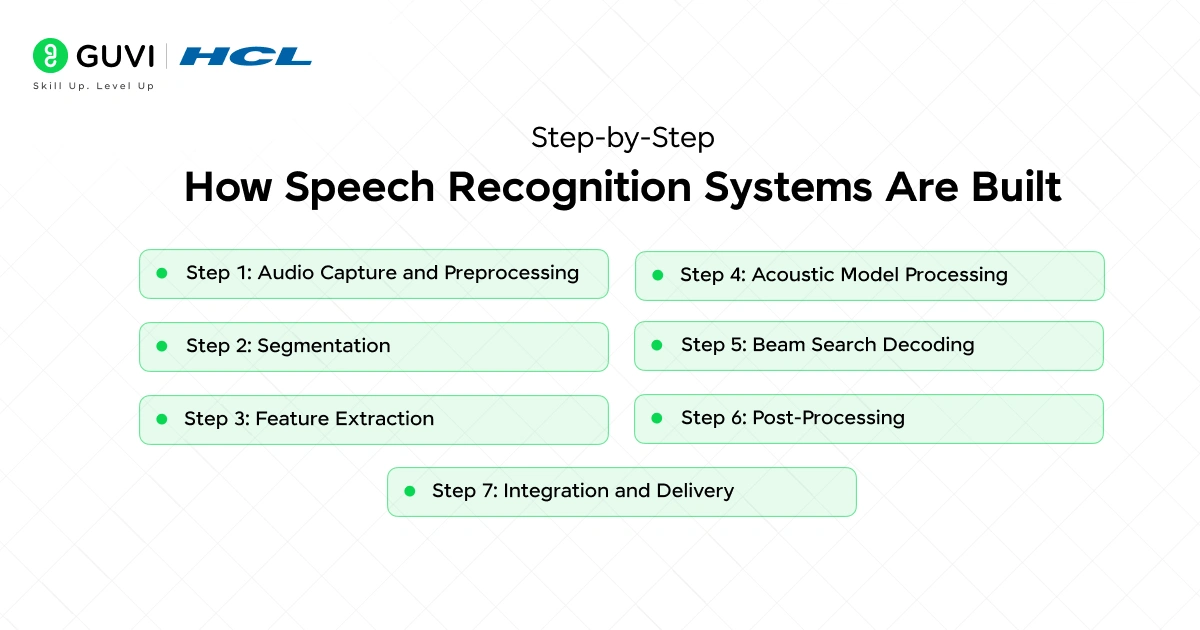
Here is exactly how a modern automatic speech recognition system works from microphone input to meaningful output.
Step 1: Audio Capture and Preprocessing
Clean input produces accurate output every time
The audio signal is captured and immediately preprocessed to reduce noise, normalize volume, and remove silence. The quality of this step directly affects everything that follows. Systems deployed in noisy real-world environments invest heavily in noise reduction before any speech recognition processing even begins.
Step 2: Segmentation
Breaking continuous audio into processable chunks

Continuous audio gets divided into small overlapping frames, typically around 25 milliseconds each. Each frame captures a snapshot of the audio at that exact moment. These frames form the basic unit of analysis for the feature extraction step that follows and their correct sizing matters more than most people realize.
Step 3: Feature Extraction
Pulling out the acoustic information that actually matters
Each audio frame gets transformed into a compact numerical representation of its acoustic properties. The most common approach produces mel-frequency cepstral coefficients that capture how frequency content changes over time in a way that aligns with how humans naturally perceive speech sounds.
Step 4: Acoustic Model Processing
The deep learning engine doing the heavy lifting
The sequence of feature vectors flows through a deep neural network trained to recognize phonemes and words from acoustic patterns. Modern systems use transformer architectures that consider long-range context within the audio rather than just immediate local features, dramatically improving accuracy on natural conversational speech where meaning spans multiple words.
Step 5: Beam Search Decoding
Finding the most likely word sequence from thousands of possibilities
The decoder uses beam search to explore multiple possible transcription hypotheses simultaneously, keeping the most promising ones at each step. The language model scores each hypothesis for linguistic plausibility. The hypothesis with the highest combined acoustic and linguistic score becomes the final output.
Step 6: Post-Processing
Cleaning up the raw output into something actually readable
Raw transcription output gets post-processed to add punctuation, capitalize proper nouns, format numbers and dates correctly, and handle domain-specific terminology. This step is what makes the difference between output that is technically accurate and output that is genuinely readable and useful in practice.
Step 7: Integration and Delivery
Getting recognized speech to where it needs to go
The final transcription gets delivered to whatever application is using it. A voice assistant interprets it as a command. A transcription service stores it as text. A translation system feeds it into the next stage. The integration approach depends entirely on the use case the system was built for.
Common Mistakes in Speech Recognition Implementation
- Underestimating the impact of audio quality on recognition accuracy
- Training on insufficient diversity of accents and speaking styles
- Not building fallback handling for low-confidence transcriptions
- Ignoring domain-specific vocabulary the base model does not know
- Failing to test in the actual acoustic environments where the system will be deployed
- Treating lab accuracy as representative of real-world performance
- Not giving users any way to correct recognition errors when they occur
The word error rate of leading automatic speech recognition systems has dropped from around 43% in the early 1990s to below 5% on modern benchmarks, and even below 3% in clean, quiet audio conditions. Most of this progress has occurred in the last decade, driven largely by the shift from traditional statistical methods to deep learning–based models, which significantly improved robustness, accuracy, and generalization.
Getting the Most From Speech Recognition Technology
- Fix the audio input before anything else
A better microphone and noise reduction at the capture stage improves accuracy more than any model upgrade. Fix the input first. This is the highest-leverage improvement available in most real-world deployments and the one most teams skip in favor of more complicated solutions.
- Fine-tune on your specific domain vocabulary
General models struggle with technical jargon, brand names, and specialized terminology. Fine-tuning on domain-specific transcribed audio dramatically improves accuracy for medicine, law, engineering, and any other terminology-heavy field. Generic accuracy numbers mean nothing if the system cannot recognize the words your users actually say.
- Build confidence thresholds into every output
Modern speech recognition models output confidence scores alongside transcriptions. Use these scores to trigger human review for low-confidence outputs rather than passing uncertain transcriptions directly to downstream systems. This single design decision prevents the majority of recognition errors from becoming real problems.
- Test on your actual user population
Accuracy on benchmark datasets does not predict accuracy on your specific users. Test with speakers representative of your actual user base before deployment. If your users skew toward non-native speakers or specific regional accents, your evaluation must reflect that reality.
To build real skills in the AI technologies powering speech recognition and beyond, do not miss the chance to enroll in HCL GUVI’s Intel & IITM Pravartak Certified Artificial Intelligence & Machine Learning course. Endorsed with Intel certification, this course adds a globally recognized credential to your resume, a powerful edge that sets you apart in the competitive AI job market.
Conclusion
Teaching machines to understand human speech seemed impossibly hard for decades. The messiness of real human language. The variability of real acoustic environments. The ambiguity of words that sound alike but mean completely different things.
Deep learning cracked it. Not by writing better rules but by training on enough data that patterns emerged naturally. Today’s speech recognition systems did not follow instructions about how to recognize speech. They learned to do it the same way humans do, by hearing enough of it.
The applications built on top of this technology are transforming accessibility, healthcare, customer service, and daily human interaction with machines. And the technology is still improving rapidly with no ceiling in sight.
FAQs
1. How accurate is modern speech recognition?
On clear audio in quiet conditions, the best systems achieve word error rates below 3 percent, matching or exceeding human transcription accuracy. Performance drops in noisy environments and heavy accents but continues to improve rapidly.
2. What is the difference between speech recognition and voice recognition?
Speech recognition converts spoken words into text. Voice recognition identifies who is speaking based on the unique characteristics of their voice. They are related but different problems and modern systems increasingly combine both.
3. Does speech recognition work offline?
Increasingly yes. On-device models from Apple, Google, and open-source projects handle common tasks without an internet connection. Cloud-based systems still outperform on-device models for accuracy and language diversity.
4. How does speech recognition handle multiple speakers?
Speaker diarization separates and labels speech from multiple speakers in the same audio. Modern systems handle it reasonably well in controlled conditions but still struggle with overlapping speech and large groups in noisy environments.
5. What languages does AI speech recognition support?
Major systems support dozens of languages. English, Spanish, Mandarin, French, and German have the best accuracy due to the largest training datasets. Hundreds of lower-resource languages have limited support, though this gap is narrowing rapidly
Success Stories

About the Author
Vishalini Devarajan
An Aerospace Engineer turned content writer, I focus on making complex concepts easy to understand through well-structured, reader-friendly blogs. Whether it’s a technical topic or a non-technical one, I love creating content that is clear, engaging, and impactful.
View all posts by Vishalini Devarajan
Connect with me @














Did you enjoy this article?