


Career Articles
Accountant vs Data Analyst Salary in India After Switching Careers - Best Guide
Finance Managers: Could Data Science Be Your Next Career Move?
Insurance Claims Executive to Data Analyst: Is It a Good Switch?
Banking Executive (Loans, KYC) to Data Analyst: Skills and Career Path


Get In Touch For Details! Request More Information
How to Become a Robotics Engineer: A Beginner’s Guide [2026]
Aug 13, 2026 7 Min Read 6665 Views
(Last Updated)
Ever watched a factory floor where robotic arms build cars faster and more precisely than any human team could, and wondered who actually builds the robots doing that? That’s the robotics engineer’s job.
A robotics engineer designs, builds, programs, and maintains robots by combining mechanical engineering, electrical engineering, and computer science. Robotics engineering combines these disciplines to create machines that work autonomously.
This guide covers exactly what the job involves, the skills and education you need, how it differs from related roles like mechatronics, and a realistic path to your first robotics job in India.
Table of contents
- TL;DR Summary
- What does a robotics engineer do?
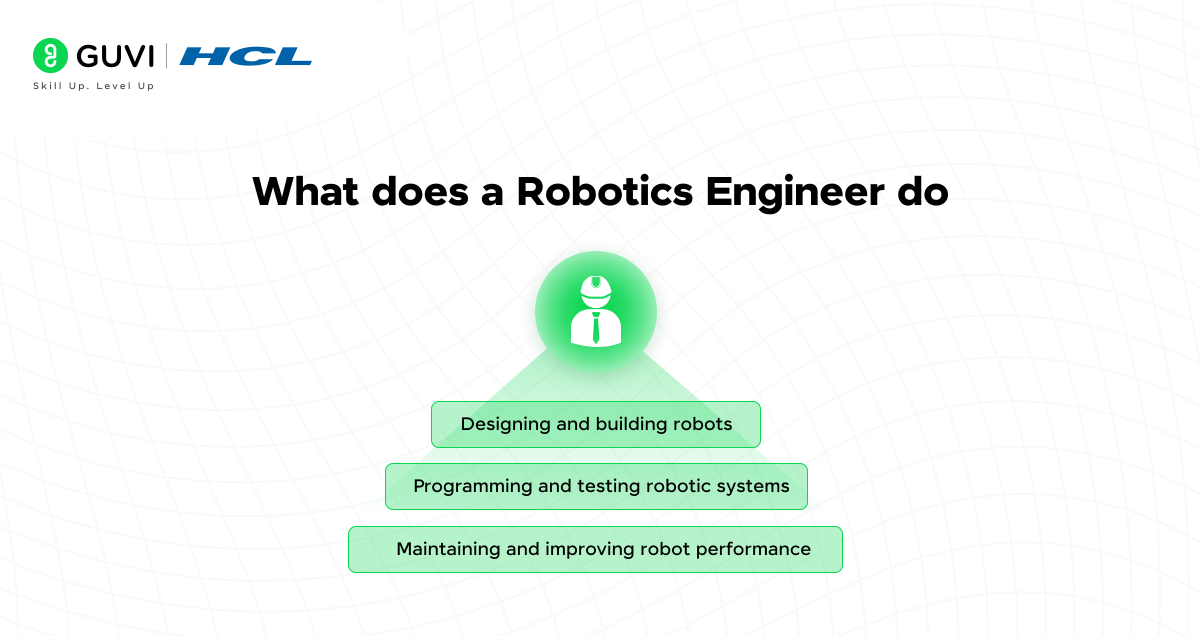
- Designing and Building Robots
- Programming and Testing Robotic Systems
- Maintaining and Improving Robot Performance
- Top Skills Every Robotics Engineer Needs
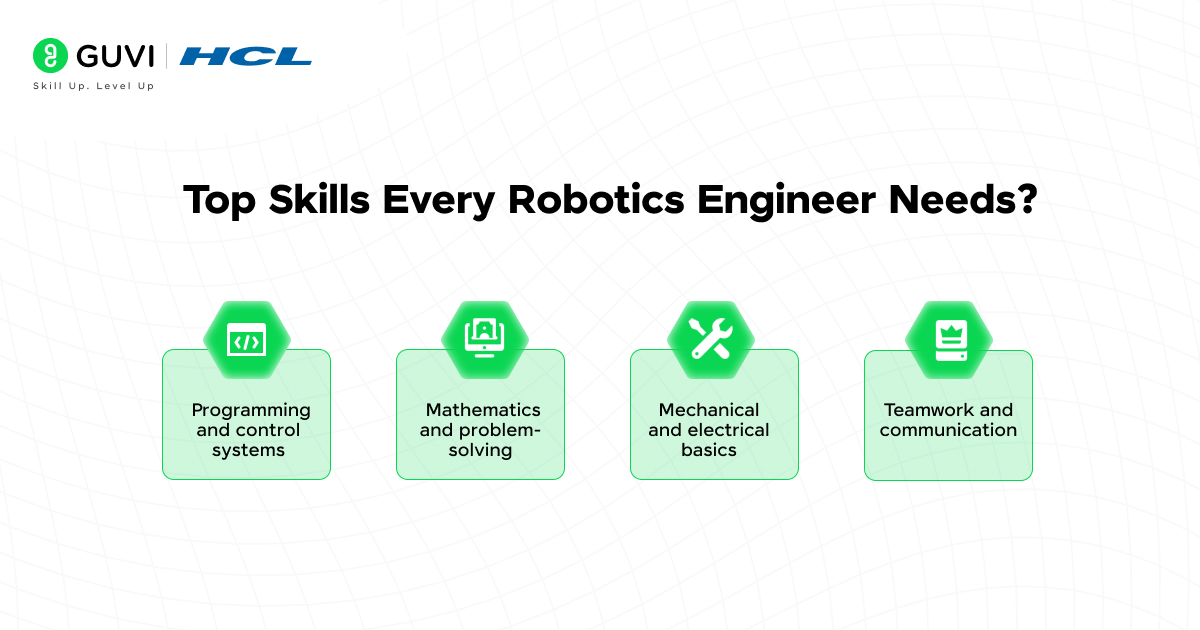
- Programming and Control Systems
- Mathematics and Problem-Solving
- Mechanical and Electrical Basics
- Teamwork and Communication
- Robotics Engineer vs Mechatronics Engineer vs Automation Engineer: What's the Difference?
- How to become a robotics engineer in 2026
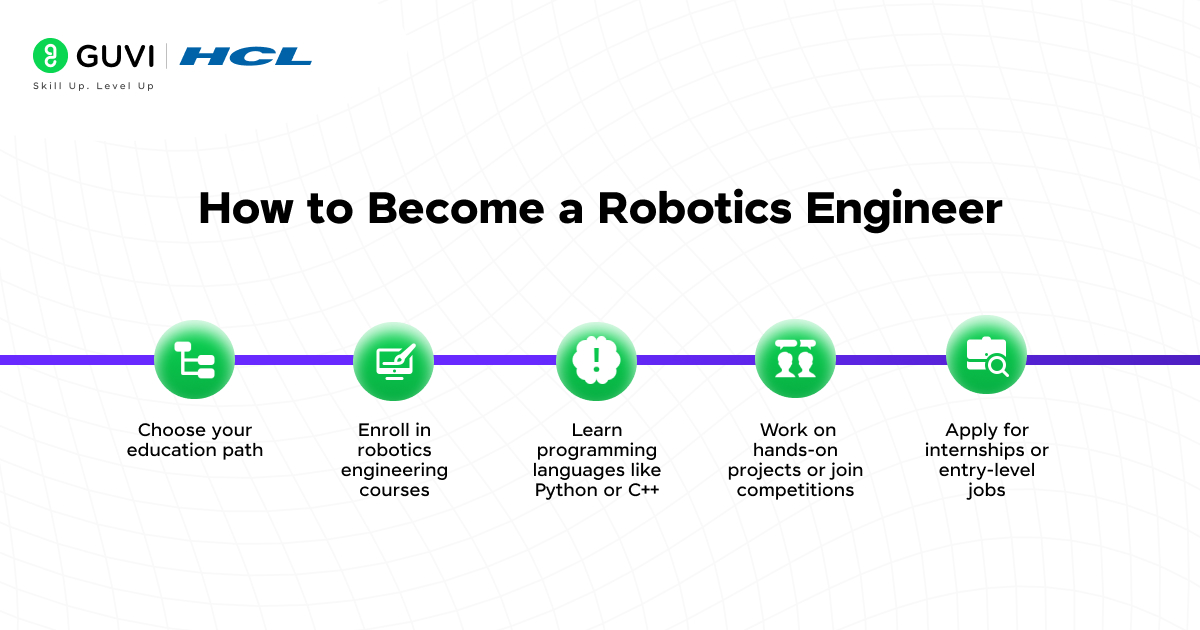
- Choose Your Education Path (Diploma, Degree, or Self-Taught)
- Enroll in Robotics Engineering Courses
- Build Fluency With Robotics-Specific Libraries
- Work on Hands-On Projects or Join Competitions
- Apply for Internships or Entry-Level Jobs
- Robotics Engineering Specializations: Which Path Should You Choose?
- Software Track vs Hardware Track: Where the Money Actually Is in 2026
- Tools, certifications, and learning resources
- Popular Robotics Kits and Platforms
- Certifications in Python, ROS, or AI
- Top Online Robotics Engineering Courses
- Best Robotics Engineering Colleges and Programs in India (2026)
- How Long Does It Take to Become a Robotics Engineer?
- Career scope and salary in India
- Entry-Level Robotics Engineer (0 to 2 Years of Experience)
- Mid-Level Robotics Engineer (2 to 5 Years of Experience)
- Senior Robotics Engineer / Robotics Architect (5+ Years of Experience)
- Common Mistakes Aspiring Robotics Engineers Make
- Concluding Thoughts…
- FAQs
- Q1. What educational background is required to become a robotics engineer?
- Q2. What programming languages are essential for robotics engineering?
- Q3. How much can a robotics engineer earn in India?
- Q4. What industries hire robotics engineers in India?
- Q5. What skills are most important for a career in robotics engineering?
TL;DR Summary
- What they do: Design robot hardware, write the software that controls it, and maintain it after deployment
- Core skills: Python/C++, control systems, math (linear algebra, calculus), and mechanical/electrical basics
- Education paths: A 4-year engineering degree, an advanced degree for research roles, or a self-taught route
- India salary range: Roughly ₹3.5L to ₹25L+ depending on experience
- Where the growth is: Manufacturing, autonomous vehicles, medical robotics, defense, and AI-driven robotics
What does a robotics engineer do?
A robotics engineer’s day-to-day activity sits right at the crossroads of mechanical, electrical, and computer engineering. One day you’re sketching out a robot design; the next you’re maintaining a system that’s already out in the field.
1. Designing and Building Robots
Robotics engineers begin by researching and determining exactly what a robot will be used for and how it will accomplish its goals. During this phase, they:
- Create mechanical components, including physical structures, joints, and end-effectors
- Design automated systems that increase production and precision levels
- Use computer-aided design (CAD) software to conceive, draft, and simulate a robot’s functionality
- Estimate costs and select the most cost-efficient methods for construction
Before a robot is constructed, engineers perform design calculations to optimize the system’s performance and develop the processes necessary for it to operate correctly.
2. Programming and Testing Robotic Systems
Once the physical robot is built, robotics engineers bring it to life through programming:
- They develop software systems that control how the robot operates
- Create algorithms and write code using languages like Python or C++
- Configure the robot to perform specific tasks with precision
- Analyze sensor data and use it to improve the robot’s efficiency
Teach pendants, handheld devices with buttons or touchscreens, remain the most common programming method, used in the large majority of industrial robots. Other methods include offline programming (simulation) and lead-through demonstration, where an engineer physically moves a robot through desired tasks.
3. Maintaining and Improving Robot Performance
The work doesn’t end after deployment. Maintaining and improving robotic systems is an ongoing responsibility:
- Regular inspections and preventative maintenance to keep robots running efficiently
- Analyzing and evaluating systems, making adjustments as needed
- Troubleshooting issues and providing technical support
- Updating software to enhance performance and address security concerns
This proactive approach increases uptime, improves performance, reduces errors, and saves money in the long run.
Top Skills Every Robotics Engineer Needs
So what does it actually take to become a robotics engineer who gets hired? A handful of technical and soft skills, done well, make almost all the difference.
1. Programming and Control Systems
Programming is non-negotiable. You must be proficient in several key languages:
- Python: Popular for its simplicity and versatility, ideal for beginners
- C++: Essential for performance-critical applications running at 100+ Hz
- Java: Known for its portability and ease of use
Control systems serve as the “brain” of a robot, using algorithms and software to dictate how a robot responds to stimuli. Understanding sensors and actuators is equally important, since these components help robots perceive and respond to their environment.
2. Mathematics and Problem-Solving
Mathematics is one of the only “core” skills in robotics that you can’t simply learn as you go along. At minimum, you need:
- Algebra and calculus for understanding abstract concepts
- Geometry for kinematics and technical drawing
- Linear algebra for representing probability distributions
These mathematical tools let you model and reason about uncertainty, which is critical when working with systems that interact with the unpredictable real world.
3. Mechanical and Electrical Basics
You don’t need an electrical engineering degree to pick up the basics a robotics engineer needs, they’re genuinely learnable on your own. You should understand:
- Basic circuit concepts (open circuit, closed circuit)
- Voltage (volts) and current (amperes)
- How batteries store DC electricity at set voltages
You’ll also need familiarity with tools like multimeters for measuring voltage, current, and resistance, plus basic soldering skills.
4. Teamwork and Communication
Robotics is rarely a solo endeavor. You’ll likely work alongside five or six other engineers, project managers, and UX experts. Robotics teams benefit from members with diverse backgrounds, since they bring different perspectives and problem-solving approaches.
Robotics Engineer vs Mechatronics Engineer vs Automation Engineer: What’s the Difference?
“Robotics engineer,” “mechatronics engineer,” “automation engineer”, job listings throw these titles around almost interchangeably, and it trips up a lot of beginners. Here’s how they actually differ.
| Role | Primary Focus | Typical Background | Common Employers |
|---|---|---|---|
| Robotics Engineer | Designs, programs, and maintains robots for specific applications | Robotics, mechanical, or CS with a robotics focus | Robotics startups, automotive, ISRO/DRDO |
| Mechatronics Engineer | Broader integration of mechanical, electronics, and control systems | Mechatronics degree | Manufacturing, automotive, general industrial |
| Automation Engineer | Builds systems that reduce manual intervention in production | Mechanical, electrical, or instrumentation | Manufacturing plants, process industries |
| Control Systems Engineer | Designs and optimizes the control logic for machinery | Electrical or instrumentation | Manufacturing, process industries, robotics firms |
Want maximum flexibility across industries? Mechatronics gives you the broadest base. Specifically drawn to robots themselves? Becoming a robotics engineer is the more focused path.
How to become a robotics engineer in 2026
Becoming a robotics engineer isn’t one giant leap; it’s a series of smaller, deliberate choices about education, skills, and hands-on practice. Here’s your roadmap.
1. Choose Your Education Path (Diploma, Degree, or Self-Taught)
- Bachelor’s degree: A 4-year degree in robotics engineering, mechanical engineering, electrical engineering, or computer science provides comprehensive knowledge. Carnegie Mellon, Worcester Polytechnic Institute, and Michigan University offer specialized robotics programs internationally.
- Master’s or PhD: For research or specialized roles, advanced degrees can give you an edge, typically taking 2 to 3 additional years.
- Self-taught route: More challenging, but achievable through online courses, certifications, and personal projects, typically taking 5 to 8 years to reach professional competency.
2. Enroll in Robotics Engineering Courses
Focus on courses that build core robotics knowledge:
- Core robotics courses covering kinematics, dynamics, and control systems
- Machine learning and artificial intelligence fundamentals
- Mechanical design and electrical systems
- Control theory and embedded systems development
Look for programs that include lab components and team projects, since these build the practical intuition theory alone doesn’t.
3. Build Fluency With Robotics-Specific Libraries
Here’s something a lot of beginners miss: knowing a language’s syntax isn’t the same as knowing how to actually build with it as a robotics engineer. The libraries below are what actually turn general-purpose code into working robot behavior:
- ROS/ROS2: the standard middleware connecting sensors, actuators, and control logic, effectively the “glue” that lets different parts of a robot talk to each other
- OpenCV: for computer vision tasks like object detection and tracking
- MoveIt: for motion planning on robotic arms, handling the math behind smooth, collision-free movement
Most production robots run C++ for the performance-critical core, like real-time motor control, with Python wrapped around it for scripting, testing, and rapid iteration. Getting comfortable moving between both is what separates someone who can write code from someone who can actually build a working robot.
4. Work on Hands-On Projects or Join Competitions
Reading about robots won’t make you a robotics engineer; practical experience is what actually gets you there:
- Build simple robots using platforms like Arduino or Raspberry Pi
- Participate in FIRST Robotics Competition, which reports that a majority of alumni go on to declare engineering or computer science majors
- Join the RoboMaster University Series, which attracts hundreds of universities globally each year
- Create a GitHub portfolio showcasing your projects and code
5. Apply for Internships or Entry-Level Jobs
- Seek robotics internships at companies, research labs, or startups
- Look for positions requiring skills in mechanical design, programming, control systems, or machine vision
- Prepare a portfolio demonstrating your projects and technical skills
Robotics Engineering Specializations: Which Path Should You Choose?
Once you’ve got the fundamentals down, picking a specialization sharpens both your job search and how you learn as a robotics engineer. Here’s how the major paths compare in India right now.
| Specialization | Focus Area | Key Skills | Where It’s Growing in India |
|---|---|---|---|
| Industrial and Manufacturing Robotics | Factory automation, assembly lines | PLC programming, robot arms, SCADA | Pune, Chennai, Gurugram (automotive hubs) |
| Autonomous Vehicles and Mobile Robots | Self-driving systems, warehouse robots (AMRs) | ROS/ROS2, sensor fusion, computer vision | Bengaluru, e-commerce and logistics warehouses nationwide |
| Medical and Surgical Robotics | Surgical assist systems, rehabilitation devices | Precision control, biomedical basics, regulatory compliance | Emerging, concentrated around top hospital-tech hubs |
| Aerospace and Defense Robotics | UAVs/drones, defense automation | Embedded systems, real-time control | Hyderabad and Bengaluru (ISRO/DRDO ecosystem) |
| AI-Driven and Humanoid Robotics | Robots that learn and adapt using AI/ML | Deep learning, reinforcement learning | Fast-growing, tied closely to India’s broader AI and ML job market |
Software Track vs Hardware Track: Where the Money Actually Is in 2026
Most beginner advice for anyone wanting to become a robotics engineer still points toward mechanical assembly, analog circuits, and PLC programming. That advice hasn’t kept pace with where the highest-paying roles actually sit in 2026.
The field has effectively split into two tracks, and knowing which one you’re building toward changes what you should be learning right now.
| Track | Core Focus | Key Skills | Companies Hiring This Way |
|---|---|---|---|
| Software Track | Perception, controls, localisation, physical AI (embodied intelligence), systems and middleware | ROS 2, C++, Python, computer vision, reinforcement learning, edge-deployed neural networks | NVIDIA, Boston Dynamics, Tesla, Anduril, and India’s fast-growing autonomous vehicle and AMR startups |
| Hardware Track | Mechanical design, PLC programming, analog circuits, assembly-line robotics | CAD, PLC/SCADA, mechanical design, traditional automation | Established manufacturing, automotive assembly lines, industrial automation firms |
Both tracks are legitimate, and industrial and manufacturing robotics still runs heavily on hardware-track skills.

But if you’re optimizing specifically for the highest-paying roles, the trend is clear: engineers who can bridge physics and software, not just build mechanical systems, are commanding salaries that now rival top software engineering roles.
Practically, this means: if you’re choosing what to learn next and have to pick, ROS 2, C++, and applied machine learning will open more doors, and higher-paying ones, than deepening your PLC or analog circuit skills alone.
Tools, certifications, and learning resources
To build your robotics engineering toolkit, you’ll need access to the right hardware, certifications, and learning resources. These building blocks will accelerate your journey into this innovative field.
Popular Robotics Kits and Platforms
- Arduino Uno: A microcontroller designed to run single C++ programs with 20 I/O pins
- Raspberry Pi: A complete single-board computer with significantly more capabilities
For beginners, robotics kits provide structured learning paths with components for building simple robots like line-followers or obstacle-detecting rovers.
Certifications in Python, ROS, or AI
- Python certifications: PCEP (Certified Entry-Level Python Programmer) from the Python Institute validates foundational knowledge
- ROS certifications: The Construct offers Robot Operating System certifications for this widely used robotics framework
- AI in Robotics certifications: Programs like the Advanced AI & Robotics certificate from Nexford University cover AI applications across industries
These credentials typically range from ₹15,000 to ₹30,000 in India.
Top Online Robotics Engineering Courses
- HCL GUVI’s Robotics Operating System (ROS) course is designed to help you master practical robotics skills and real-world automation systems from scratch
- Coursera’s Robotics Specialization covers kinematics, dynamics, and control systems
- “ROS for Beginners” on Udemy teaches the fundamentals of this essential robotics framework
Best Robotics Engineering Colleges and Programs in India (2026)
Planning your education path from India as a future robotics engineer? Here’s what actually matters when picking a program.
- Look for dedicated robotics or mechatronics departments, not just a robotics elective bolted onto a mechanical or ECE degree; the difference shows up in lab access and project depth.
- Check for lab infrastructure, specifically access to robotic arms, sensors, and embedded systems kits, not just simulation software.
- Prioritize programs with industry tie-ups, since these usually translate into better internship pipelines with automotive, defense, or robotics startups.
- Government-linked institutions carry real weight, particularly for defense and aerospace robotics roles tied to ISRO and DRDO recruitment.
- Don’t discount structured online certification paths. For students without access to a strong campus robotics program, project-based online courses combined with hands-on kits (Arduino, Raspberry Pi) can close much of the gap.
How Long Does It Take to Become a Robotics Engineer?
How long does it take to become a robotics engineer? Honestly, it depends heavily on where you’re starting from.
- With a 4-year engineering degree: You’re job-ready at graduation for entry-level roles, assuming you’ve done at least one or two hands-on projects alongside your coursework.
- Self-taught, working alongside another job or degree: Realistically 2 to 4 years of consistent, part-time learning and project-building before you’re competitive for entry-level robotics roles.
- Career switchers from mechanical, electrical, or CS backgrounds: Often the fastest path, since you’re adding robotics-specific skills (ROS, control systems, sensor integration) on top of an existing technical foundation, typically 6 to 12 months of focused upskilling.
Across all these paths, the deciding factor is rarely just time spent studying; it’s whether you have a portfolio of real, hands-on projects to show for it.
Career scope and salary in India
Being a robotics engineer in India right now means riding a genuine wave. The “Make in India 2.0” push toward advanced manufacturing, plus Industry 4.0 spreading across automotive, healthcare, and logistics, is creating real jobs, not just headlines.
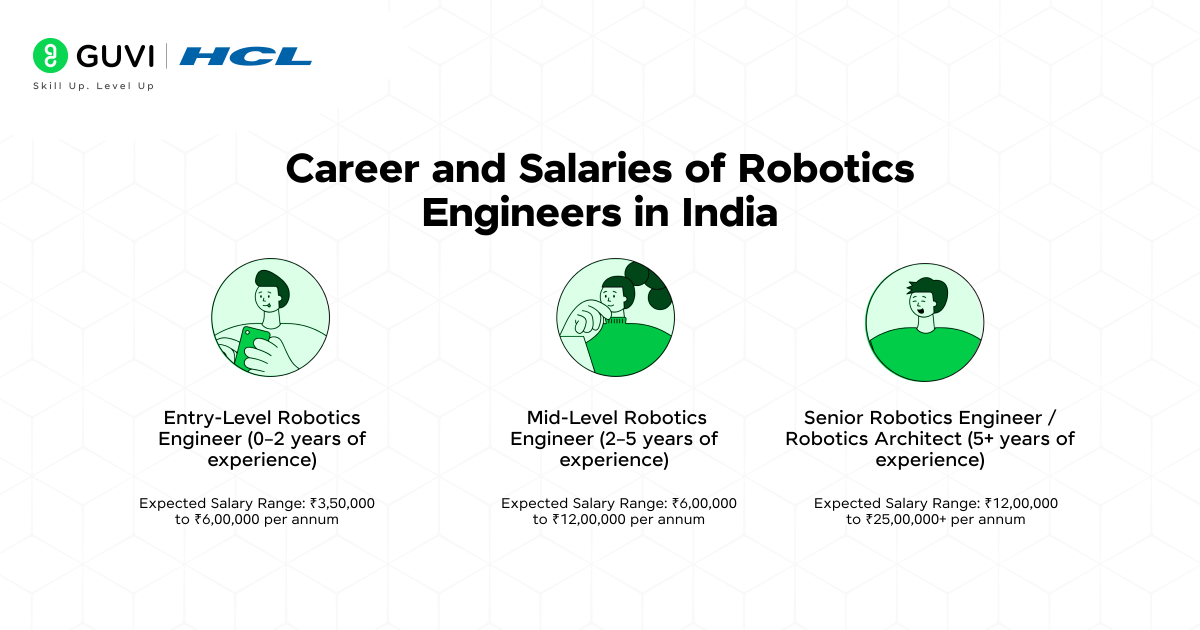
1. Entry-Level Robotics Engineer (0 to 2 Years of Experience)
Freshers typically begin as Robotics Intern, Junior Robotics Engineer, or Automation Engineer, doing hands-on work assembling robotic systems, testing components, and learning tools like ROS and microcontrollers.
- Expected salary range: ₹3,50,000 to ₹6,00,000 per annum
- Key responsibilities: Support design and prototyping, program basic automation scripts, test sensors and actuators, work under senior engineers
2. Mid-Level Robotics Engineer (2 to 5 Years of Experience)
Engineers move into roles like Robotics Developer, Control Systems Engineer, or Mechatronics Engineer, requiring deeper knowledge of machine learning, vision systems, and autonomous navigation.
- Expected salary range: ₹6,00,000 to ₹12,00,000 per annum
- Key responsibilities: Design and optimize robotic subsystems, integrate hardware with software (ROS, C++, Python), implement computer vision or motion planning algorithms
3. Senior Robotics Engineer / Robotics Architect (5+ Years of Experience)
Senior professionals lead R&D, system architecture, and large-scale robotics deployments in industry or research organizations.
- Expected salary range: ₹12,00,000 to ₹25,00,000+ per annum
- Key responsibilities: Lead robotics projects end to end, architect scalable autonomous systems, mentor junior engineers, drive innovation in AI and embedded systems
If Pune’s growing product and automotive ecosystem interests you specifically, Top Product Based Companies in Pune in 2026 is a useful companion read.
Common Mistakes Aspiring Robotics Engineers Make
Even motivated beginners heading toward robotics engineer roles fall into these traps. Watch out for:
- Learning only simulation, never real hardware. Simulators (Gazebo, Webots) are great for practice, but robots behave differently in the real world; friction, sensor noise, and mechanical slack don’t show up in simulation the same way.
- Picking a programming language and stopping there. Robotics genuinely needs both Python (fast iteration) and C++ (performance-critical control); relying on just one limits which teams will hire you.
- Ignoring the mechanical and electrical fundamentals. Software-focused learners sometimes skip circuits and mechanics entirely, then struggle the moment a project involves real actuators and sensors.
- Underestimating math. Skipping linear algebra and control theory catches up with you fast once you move past toy projects into anything involving real kinematics or state estimation.
- Building projects nobody can see. A robot that works but was never documented, photographed, or pushed to GitHub does very little for your job search compared to one with a clear writeup.
Ready to build real project experience alongside structured learning? Top HCL GUVI Courses in 2026 is a good starting point if you’re deciding which program fits your goals.
Concluding Thoughts…
If you’re weighing whether to actually become a robotics engineer, here’s the honest takeaway: it’s a genuinely promising path in India right now, but it rewards people who put in real hands-on work, not just people who collect certificates.
The clearest signal for where to focus: engineers who can bridge hardware and software, not just build mechanical systems, are the ones commanding the strongest offers right now, as AI-driven robotics roles increasingly rival top software salaries.
Your journey to becoming a robotics engineer might feel overwhelming at first. But keep learning, keep building, and it genuinely does get easier from here.
FAQs
Q1. What educational background is required to become a robotics engineer?
A bachelor’s degree in robotics engineering, mechanical engineering, electrical engineering, or computer science is typically the minimum requirement. However, some pursue master’s or PhD degrees for advanced roles, while others take a self-taught route through online courses and certifications.
Q2. What programming languages are essential for robotics engineering?
Python and C++ are the most crucial programming languages for robotics engineers. Python is great for rapid prototyping and testing, while C++ is preferred for performance-critical applications and hardware compatibility.
Q3. How much can a robotics engineer earn in India?
Entry-level robotics engineers in India can earn between ₹2 lakh to ₹9 lakh annually. With 3-5 years of experience, salaries can range from ₹2 lakh to ₹9.3 lakh, while those with 6+ years of experience can command ₹2 lakh to ₹30 lakh or higher annually.
Q4. What industries hire robotics engineers in India?
Robotics engineers are in demand across various sectors in India, including manufacturing, healthcare, automotive, aerospace and defense, and logistics. Major employers include TCS, Infosys, Wipro, ABB India, Tata Motors, and government organizations like ISRO and DRDO.
Q5. What skills are most important for a career in robotics engineering?
Key skills for robotics engineers include programming and control systems, mathematics and problem-solving, mechanical and electrical basics, and strong teamwork and communication abilities. Proficiency in tools like Arduino and Raspberry Pi is also valuable.
Success Stories

About the Author
Jebasta
I translate the language of data into stories that anyone can understand. As a writer with a data science background, I simplify analytics, AI, and decision-making so beginners and enthusiasts can confidently explore the world of data.
View all posts by Jebasta
Connect with me @














Did you enjoy this article?