


Project Articles
Automated Resume Screener: NLP-Based Python Project with Source Code
Business Analysis in Digital Transformation Projects - Best Guide
Build No-Code AI Agents with Flowise AI: Step-by-Step Beginner Guide

Get In Touch For Details! Request More Information
10 Unique SQL Project Ideas [With Source Code]
Oct 16, 2026 11 Min Read 60699 Views
(Last Updated)
SQL is one of the most important skills for working with databases and data. But learning commands alone is not enough. You need to know how to apply them to real problems.
That is where SQL projects help. They give you hands-on practice with database design, joins, queries, indexing, reporting, and data analysis.
In this guide, you will explore 10 SQL project ideas from beginner to advanced level. Each project includes the required SQL skills, estimated time, technology stack, key features, and source code so you can choose the right one for your learning or portfolio goals.
Table of contents
- Quick Answer
- SQL Project Ideas at a Glance: Comparison Table
- How to Choose the Right SQL Project
- Top 10 SQL Project Ideas
- Beginner Level SQL Projects
- Library Management System
- Student Grading System
- Hotel Reservation System
- Intermediate Level SQL Projects
- E-commerce Product Catalog
- Employee Payroll Management System
- Hospital Patient Management System
- Customer Feedback Management System
- Advanced Level SQL Projects
- Online Retail Sales Analysis
- Financial Portfolio Management System
- Movie Recommendation System
- Best SQL Project Ideas for Resume and Portfolio
- How to Showcase SQL Projects in Your Portfolio
- SQL Skills You Should Demonstrate in Your Projects
- How to Build an SQL Project Step by Step
- Step 1: Define the Problem
- Step 2: Identify the Main Entities
- Step 3: Design the Database Schema
- Step 4: Create the Tables
- Step 5: Add Data
- Step 6: Write Practical Queries
- Step 7: Improve Performance
- Step 8: Document the Project
- Best Tools and Databases for SQL Projects
- Conclusion
- FAQs
- What are the best SQL project ideas for beginners?
- How do I make an SQL project for my resume?
- Which SQL project is best for a data analyst portfolio?
- What SQL skills should I include in a project?
- Where can I find datasets for SQL projects?
Quick Answer
SQL projects help you turn SQL theory into practical database skills. The best project depends on your current level and career goal.
- Beginners: Practice CRUD operations, joins, and database design.
- Intermediate learners: Work with views, triggers, stored procedures, and indexing.
- Advanced learners: Use CTEs, window functions, analytics, and query optimization.
- For resumes: Choose projects that solve a clear business problem.
- For portfolios: Add the schema, SQL queries, sample data, outputs, and source code.

SQL Project Ideas at a Glance: Comparison Table
| SQL Project | Level | Estimated Time | Important SQL Skills | Best For |
|---|---|---|---|---|
| Library Management System | Beginner | 3–5 days | CRUD, joins, indexing | First SQL project |
| Student Grading System | Beginner | 4–6 days | Joins, aggregates, subqueries | Students and freshers |
| Hotel Reservation System | Beginner | 5–7 days | Joins, constraints, transactions | Database design practice |
| E-commerce Product Catalog | Intermediate | 5–7 days | Complex joins, indexing, stored procedures | Backend and e-commerce roles |
| Employee Payroll Management | Intermediate | 7–10 days | Triggers, procedures, aggregates | Business database projects |
| Hospital Patient Management | Intermediate | 6–9 days | Views, joins, indexing, triggers | Relational modeling |
| Customer Feedback Management | Intermediate | 6–8 days | CRUD, joins, subqueries | Analytics-focused portfolios |
| Online Retail Sales Analysis | Advanced | 5–8 days | CTEs, window functions, analytical queries | Data analyst portfolios |
| Financial Portfolio Management | Advanced | 8–12 days | Advanced queries, procedures, indexing | Finance and analytics roles |
| Movie Recommendation System | Advanced | 7–10 days | Window functions, joins, ranking | Data and recommendation projects |
How to Choose the Right SQL Project
The right SQL project should challenge your current skills without becoming too difficult to complete.
Beginners should start with a project that has a small number of related tables. A library or student database lets you practice primary keys, foreign keys, basic joins, and CRUD operations without creating an overly complex schema.
Intermediate learners can move toward projects that include business rules. Payroll and hospital databases are useful because they require stronger relationships, views, triggers, stored procedures, and indexes.
Advanced learners should choose projects where SQL is also used for analysis. Retail and financial projects can demonstrate CTEs, window functions, ranking, reporting, and optimization. Before starting, revise commonly used commands through HCL GUVI’s SQL Queries with Examples guide. It covers SQL from basic retrieval to joins, subqueries, and window functions.
Top 10 SQL Project Ideas
Beginner SQL projects are ideal for learning how relational databases work in real-world applications. They help you practice creating tables, defining relationships, inserting and updating records, writing joins, and retrieving useful information with SQL queries.
If you are learning SQL from scratch, start with projects that have a limited number of tables and clear relationships. These projects can also strengthen your resume by showing that you can apply database concepts beyond theoretical exercises.
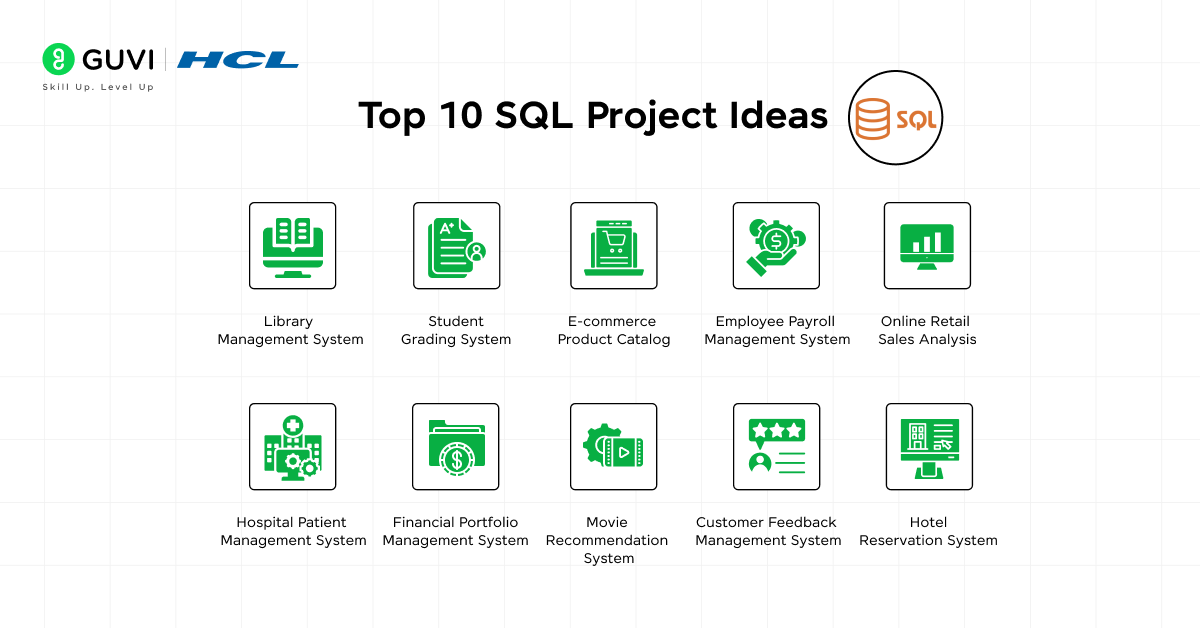
Beginner Level SQL Projects
1. Library Management System
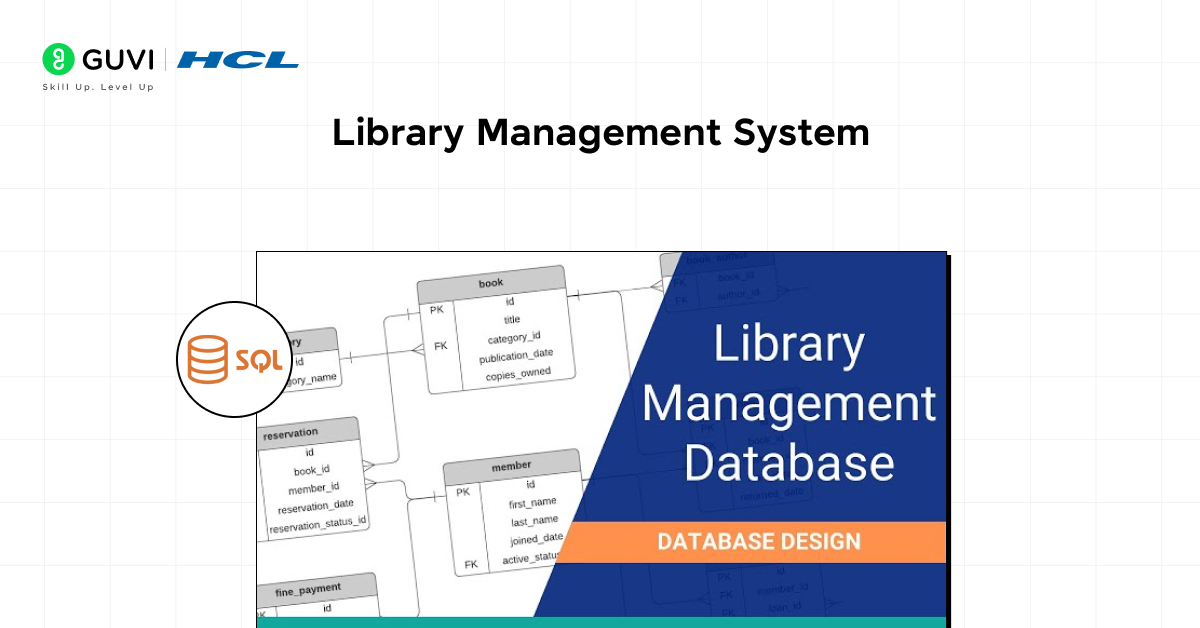
A Library Management System is one of the most practical SQL project ideas for beginners. It creates a relational database for managing books, authors, members, borrowing records, return dates, and fines.
The project helps you understand how multiple tables work together through primary and foreign keys. You can create separate tables for books, members, authors, transactions, and fines. SQL queries can then track book availability and borrowing activity.
This project is particularly useful for practicing one-to-many relationships. For example, one member can borrow multiple books while one book can have several borrowing records over time.
Time Taken: 3-5 days
Project Complexity: Beginner
Technology Stack: SQL, Python
Features of the Project:
- Book inventory management
- Author and category management
- Borrower registration
- Borrowing and return records
- Book availability tracking
- Due-date management
- Late-fee calculation
- Admin and borrower roles
Ready to turn your interest in data into a rewarding career? HCL GUVI’s Zen Class Data Science Course helps you build practical skills in Python, SQL, data analytics, machine learning, deep learning, and Generative AI through structured learning and hands-on projects.
Required SQL Knowledge: Basic queries, CRUD operations, joins, primary keys, foreign keys, aggregate functions, and indexing
SQL Queries You Can Practice: You can write queries to find available books, list overdue returns, identify the most borrowed books, calculate fines, count books by category, and retrieve each member’s borrowing history.
What You Will Learn: This SQL database project helps you understand relational database design, table relationships, constraints, query writing, and basic indexing.
Integration with Other Systems: Python can be used to create a simple user interface that communicates with the SQL database for borrowing, returning, searching, and updating books.
Security Measures: Role-based authentication can separate administrator privileges from borrower access. Input validation can also prevent invalid book or member records.
Source Code: Library Management System
If you are still learning how tables and relationships should be structured, read HCL GUVI’s Database Design: Principles and Best Practices before creating the schema.
2. Student Grading System
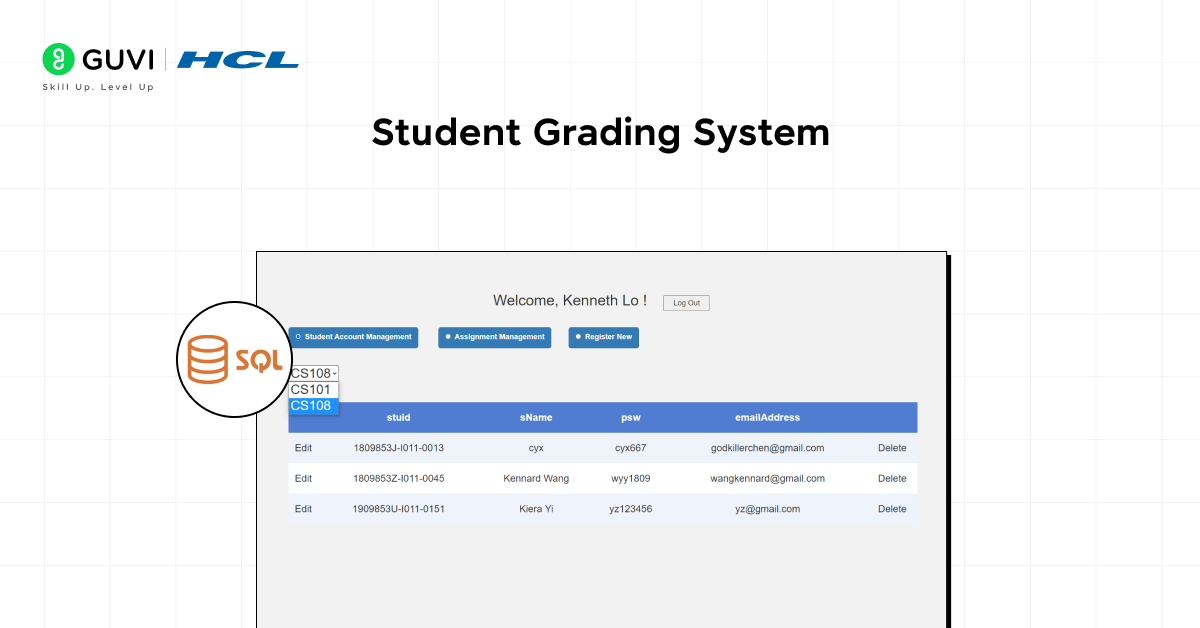
A Student Grading System is another beginner-friendly SQL project that manages students, courses, enrollments, marks, and grades in a structured database.
The project is particularly useful for understanding many-to-many relationships. A student can enroll in multiple courses while each course can contain multiple students. An enrollment table can connect these records while storing marks or grades.
You can also use aggregate functions to calculate GPA, class averages, highest scores, and course-wise performance.
Time Taken: 4-6 days
Project Complexity: Beginner
Technology Stack: SQL, PHP
Features of the Project:
- Student record management
- Course management
- Course enrollment
- Marks and grade tracking
- GPA calculation
- Student and teacher roles
- Course-wise reports
- Academic performance reports
Required SQL Knowledge: Joins, subqueries, aggregate functions, GROUP BY, HAVING, primary keys, and foreign keys
SQL Queries You Can Practice: Calculate average marks, find the highest-performing students, identify failed subjects, compare course results, calculate GPA, and rank students based on performance.
What You Will Learn: This project strengthens your knowledge of relational modeling, joins, grouping, aggregation, and data reporting.
Integration with Other Systems: PHP can be used to build a dynamic interface where teachers update grades while students access their results.
Security Measures: Students should have read-only access to their academic records. Grade creation and modification should remain restricted to authorized teachers or administrators.
Source Code: Student Grading System
3. Hotel Reservation System
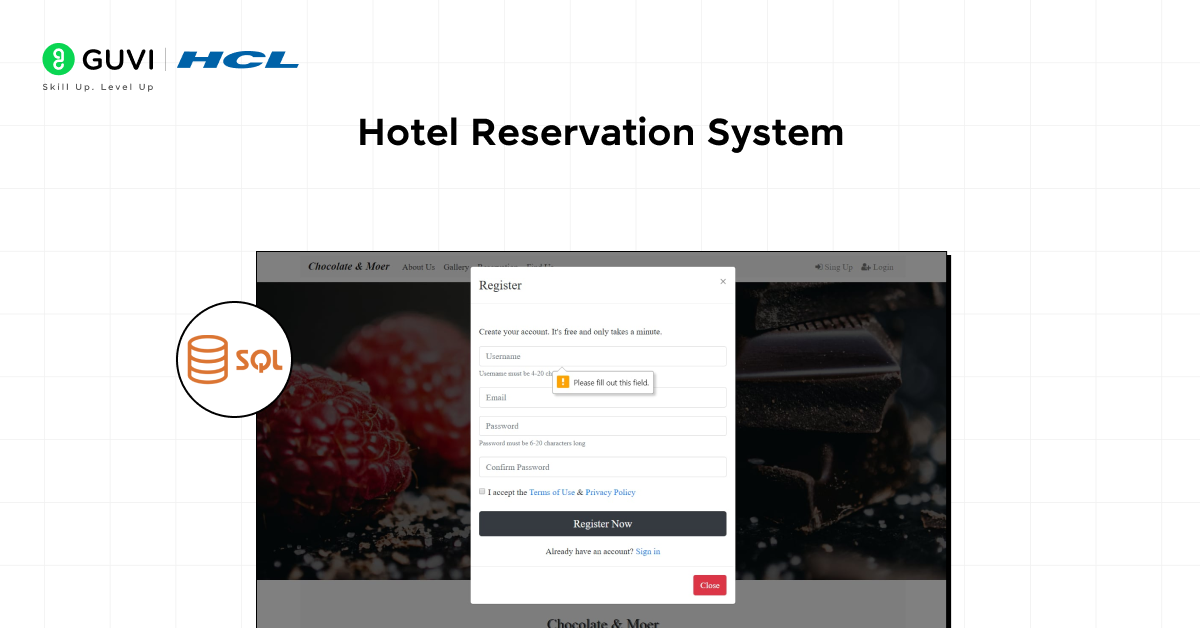
A Hotel Reservation System is a useful SQL project for learning how databases manage bookings, customers, rooms, dates, and transactions.
The system can include separate tables for rooms, customers, reservations, payments, and room types. SQL queries can determine whether rooms are available for particular dates and retrieve booking histories.
One of the most valuable challenges in this project is preventing overlapping reservations. This gives you practical exposure to constraints, date comparisons, and transaction logic.
Time Taken: 5-7 days
Project Complexity: Beginner
Technology Stack: SQL, Java
Features of the Project:
- Room inventory management
- Customer records
- Reservation tracking
- Room availability checking
- Check-in and check-out management
- Booking status updates
- Payment tracking
- Admin and customer roles
Required SQL Knowledge: Basic queries, joins, date functions, constraints, transactions, primary keys, and foreign keys
SQL Queries You Can Practice: Find available rooms within a date range, calculate occupancy rate, retrieve customer booking histories, list upcoming check-ins, calculate total booking revenue, and identify popular room categories.
What You Will Learn: This SQL project provides practical experience with date-based queries, transactions, relational modeling, and business rules.
Integration with Other Systems: Java can provide the application interface while SQL manages reservations, room inventory, and customer information.
Security Measures: User authentication and input validation can protect customer information and reduce duplicate or invalid reservations.
Source Code: Hotel Reservation System
Build practical SQL skills to work on unique SQL project ideas with HCL GUVI’s SQL Server Course. Learn database basics, queries, joins, data handling, and real-world SQL workflows through structured training designed for beginners and aspiring data professionals.
Intermediate Level SQL Projects
Intermediate SQL project ideas are suitable for learners who already understand basic queries and joins. These projects introduce larger database schemas and more complex business requirements.
You can use them to practice stored procedures, views, triggers, indexing, advanced joins, reporting, and automated database operations.
4. E-commerce Product Catalog
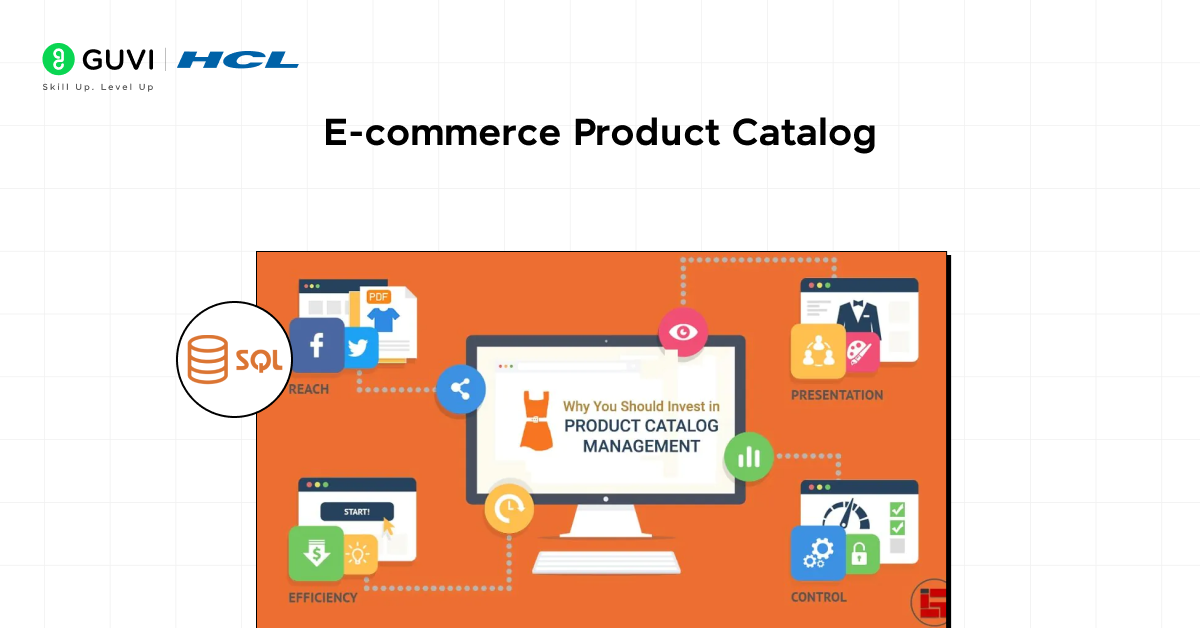
An E-commerce Product Catalog is an excellent SQL project for understanding how online stores organize products, categories, suppliers, prices, ratings, and inventory.
The database can contain separate tables for products, categories, suppliers, stock, customers, and ratings. SQL can then be used to search products, filter items based on different criteria, and monitor inventory.
This project also introduces database performance concepts because product searches need to remain fast even when the catalog grows.
Time Taken: 5-7 days
Project Complexity: Intermediate
Technology Stack: SQL, Java
Features of the Project:
- Product management
- Product categories
- Supplier management
- Pricing information
- Product search and filtering
- Inventory tracking
- Rating management
- Low-stock alerts
Required SQL Knowledge: Complex joins, indexing, stored procedures, views, aggregate functions, and subqueries
SQL Queries You Can Practice: Find products within a price range, identify low-stock items, calculate average product ratings, compare category-wise inventory, find top suppliers, and retrieve best-selling or highest-rated products.
What You Will Learn: This project teaches relational database design, search optimization, inventory management, and advanced query writing.
Integration with Other Systems: Java can provide the front-end application while SQL manages products, stock levels, and supplier records.
Security Measures: Validate user input and restrict inventory changes to authorized administrators.
Source Code: E-commerce Product Catalog
Take your ChatGPT skills to the next level at absolutely no cost! Through HCL GUVI’s Bharat AI Initiative, powered by OpenAI, you can now learn advanced ChatGPT skills, like better prompting techniques, in English, Hindi, Tamil, Telugu, and Marathi. Start Your Free AI Journey
5. Employee Payroll Management System
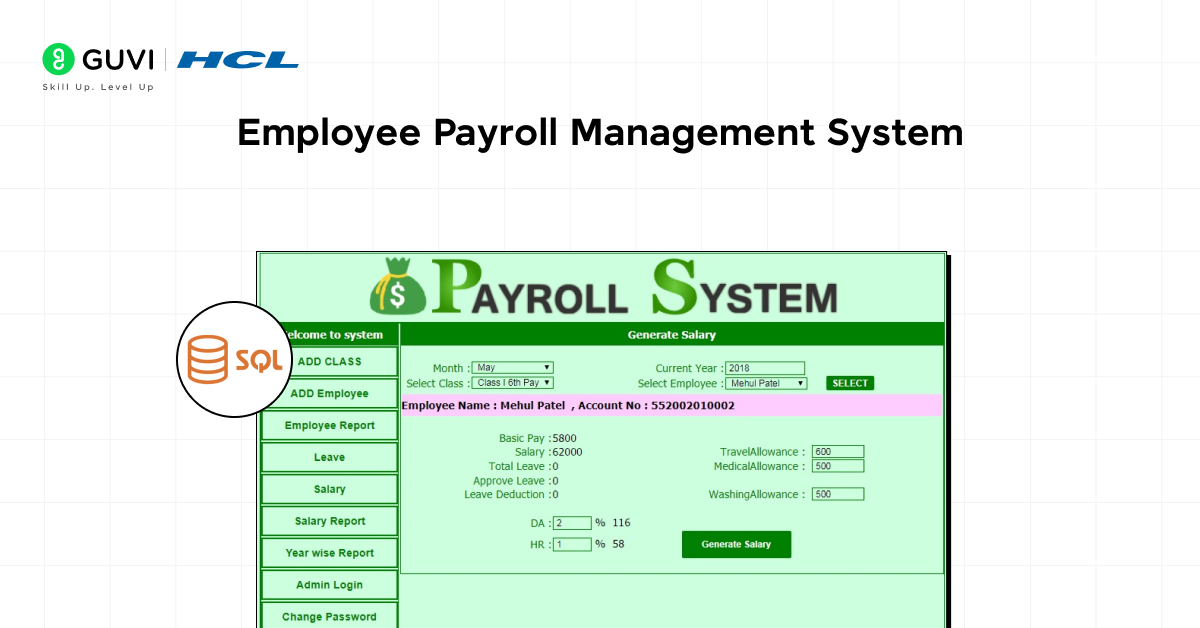
An Employee Payroll Management System is a business-focused SQL project that stores employee information, salaries, bonuses, deductions, attendance, and payroll records.
Unlike a simple employee database, this project requires SQL to support calculations and recurring business rules. Stored procedures and triggers can automate payroll-related operations.
It is a strong SQL project for resumes because it demonstrates how databases support real business processes.
Time Taken: 7-10 days
Project Complexity: Intermediate
Technology Stack: SQL, Python
Features of the Project:
- Employee records
- Department management
- Salary structures
- Tax calculations
- Deduction management
- Bonus calculations
- Payroll generation
- Salary history
- Payroll reports
Required SQL Knowledge: Triggers, stored procedures, joins, aggregate functions, CASE statements, views, and indexing
SQL Queries You Can Practice: Calculate monthly salaries, compare department-wise payroll expenses, retrieve salary histories, calculate bonuses, identify highest-paid employees, and generate payroll summaries.
What You Will Learn: You will practice SQL automation, calculations, reporting, business rules, and performance optimization.
Integration with Other Systems: Python can automate payroll generation and provide an interface for HR teams.
Security Measures: Salary information should be accessible only to authorized HR personnel. Employees can receive restricted access to their own payroll records.
Source Code: Employee Payroll Management System
Preparing for SQL interviews or placement assessments? Revise joins, normalization, DBMS concepts, SQL commands, constraints, and query writing with the beginner-friendly HCL GUVI DBMS & SQL Tutorial
6. Hospital Patient Management System
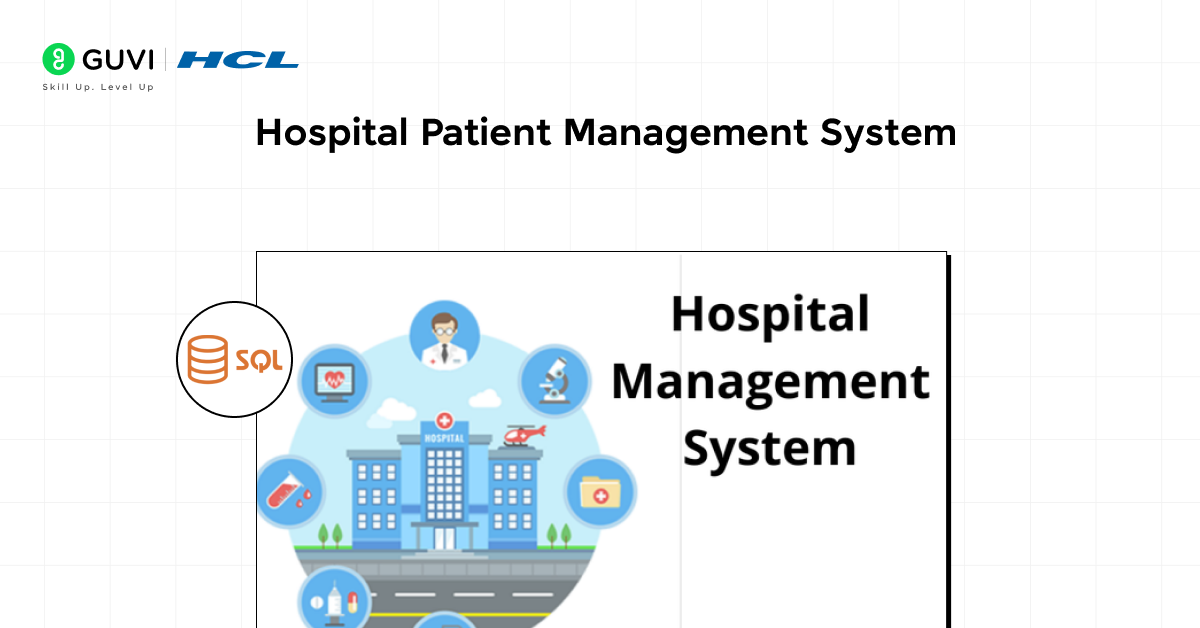
A Hospital Patient Management System is a relational database project that connects patients, doctors, appointments, treatments, prescriptions, and medical histories.
This project requires several tables to work together accurately. It therefore provides strong practice in database normalization, joins, constraints, transactions, and access management.
The project can also be extended with appointment scheduling and doctor workload analysis.
Time Taken: 6-9 days
Project Complexity: Intermediate
Technology Stack: SQL, JavaScript
Features of the Project:
- Patient records
- Doctor information
- Appointment scheduling
- Medical history
- Treatment records
- Prescription records
- Discharge details
- Doctor availability
Required SQL Knowledge: Joins, views, indexing, triggers, constraints, transactions, and aggregate functions
SQL Queries You Can Practice: Retrieve patient histories, find upcoming appointments, analyze doctor schedules, count patients by department, identify frequent treatments, and generate treatment summaries.
What You Will Learn: This SQL project strengthens database design, relationship management, transaction handling, and data security skills.
Integration with Other Systems: JavaScript can provide a web-based interface while SQL stores and retrieves hospital records.
Security Measures: Role-based access should restrict sensitive patient information to authorized doctors, nurses, and administrators.
Source Code: Hospital Patient Management System
7. Customer Feedback Management System
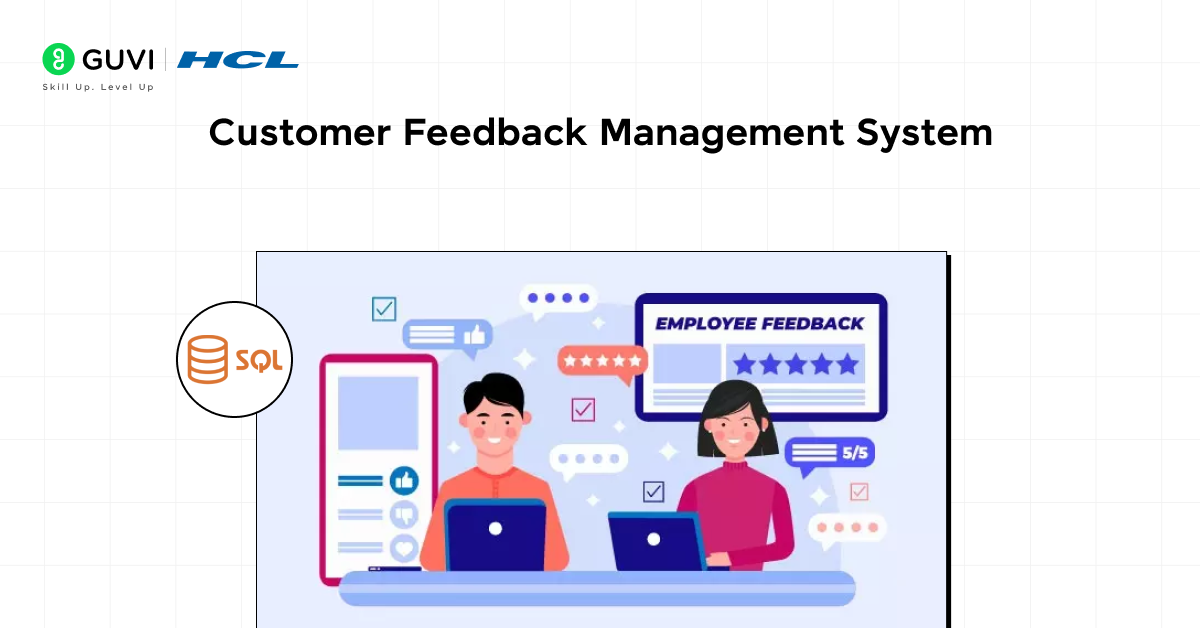
A Customer Feedback Management System stores customer reviews, ratings, categories, products, complaints, and response status.
It combines database management with basic customer analytics. SQL queries can reveal frequently reported problems and changes in customer satisfaction.
This makes the project useful for learners interested in data analysis as well as database development.
Time Taken: 6-8 days
Project Complexity: Intermediate
Technology Stack: SQL, PHP
Features of the Project:
- Feedback submission
- Customer ratings
- Feedback categorization
- Complaint tracking
- Response management
- Reporting and insights
- User roles
Required SQL Knowledge: CRUD operations, joins, subqueries, aggregate functions, GROUP BY, views, and indexes
SQL Queries You Can Practice: Calculate average ratings, identify products receiving the most complaints, compare feedback categories, find unresolved complaints, and track rating changes over time.
What You Will Learn: This project demonstrates how SQL can support both operational databases and analytical reporting.
Integration with Other Systems: PHP can provide the customer-facing interface while SQL stores and organizes feedback.
Security Measures: Input validation can prevent invalid submissions while role-based access can limit administrative changes.
Source Code: Customer Feedback Management System
Advanced Level SQL Projects
Advanced SQL project ideas are designed for learners who want to demonstrate stronger analytical and database skills. These projects go beyond CRUD operations and require CTEs, window functions, complex joins, ranking, transactions, reporting, and query optimization.
They are particularly useful for data analyst, business intelligence, data science, and backend development portfolios.
8. Online Retail Sales Analysis
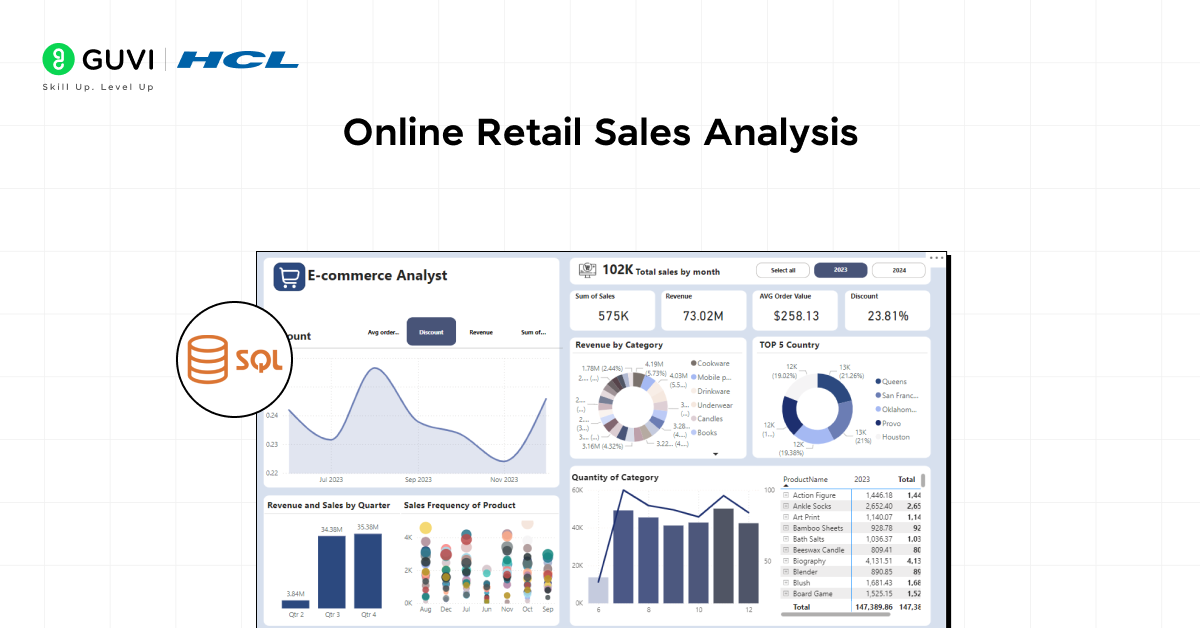
An Online Retail Sales Analysis project uses transactional data to answer business questions related to revenue, products, customers, and purchasing trends.
This is one of the best SQL projects for aspiring data analysts because the focus is not only on storing information. The database is used to generate actionable business insights.
You can build tables for customers, products, orders, order items, categories, and payments. SQL queries can then analyze sales performance across time periods and customer segments.
Time Taken: 5-8 days
Project Complexity: Advanced
Technology Stack: SQL, R
Features of the Project:
- Sales trend analysis
- Revenue reporting
- Customer purchase analysis
- Product performance
- Category performance
- Repeat customer analysis
- Monthly and yearly comparisons
- Visual reports
Required SQL Knowledge: CTEs, window functions, date functions, complex joins, aggregates, ranking functions, and analytical queries
SQL Queries You Can Practice: Calculate monthly revenue, average order value, top-selling products, repeat purchase rates, customer rankings, month-over-month growth, cumulative sales, and category-wise performance.
What You Will Learn: This project strengthens SQL analytics, KPI calculation, trend analysis, customer segmentation, and business reporting skills.

Integration with Other Systems: R can visualize SQL output. You can also connect query results to Power BI. HCL GUVI’s Power BI Project Ideas guide can help you turn SQL analysis into interactive dashboards.
Security Measures: Customer data should be anonymized when personally identifiable information is not required for the analysis.
Source Code: Online Retail Sales Analysis
9. Financial Portfolio Management System

A Financial Portfolio Management System is an advanced SQL database project for managing investments and transactions across stocks, bonds, mutual funds, real estate, and other assets.
The system can track purchase transactions, current holdings, historical values, and portfolio performance.
This project is useful for learners interested in financial analytics because SQL queries can calculate returns, asset allocation, and investment performance.
Time Taken: 8-12 days
Project Complexity: Advanced
Technology Stack: SQL, Python
Features of the Project:
- Investment records
- Asset categorization
- Buy and sell transactions
- Portfolio tracking
- Historical values
- Performance analysis
- Risk analysis
- Profit and loss reporting
Required SQL Knowledge: Advanced queries, stored procedures, CTEs, indexing, aggregate functions, window functions, and transactions
SQL Queries You Can Practice: Calculate total invested value, asset allocation, realized profit, portfolio returns, investment performance, historical trends, and best-performing assets.
What You Will Learn: This project provides practical experience with financial data modeling, analytical queries, transactions, and performance reporting.
Integration with Other Systems: Python can handle additional financial calculations and data visualization while SQL manages investment and transaction records.
Security Measures: Financial records require strict authentication, restricted database access, and secure handling of sensitive information.
Source Code: Financial Portfolio Management System
10. Movie Recommendation System
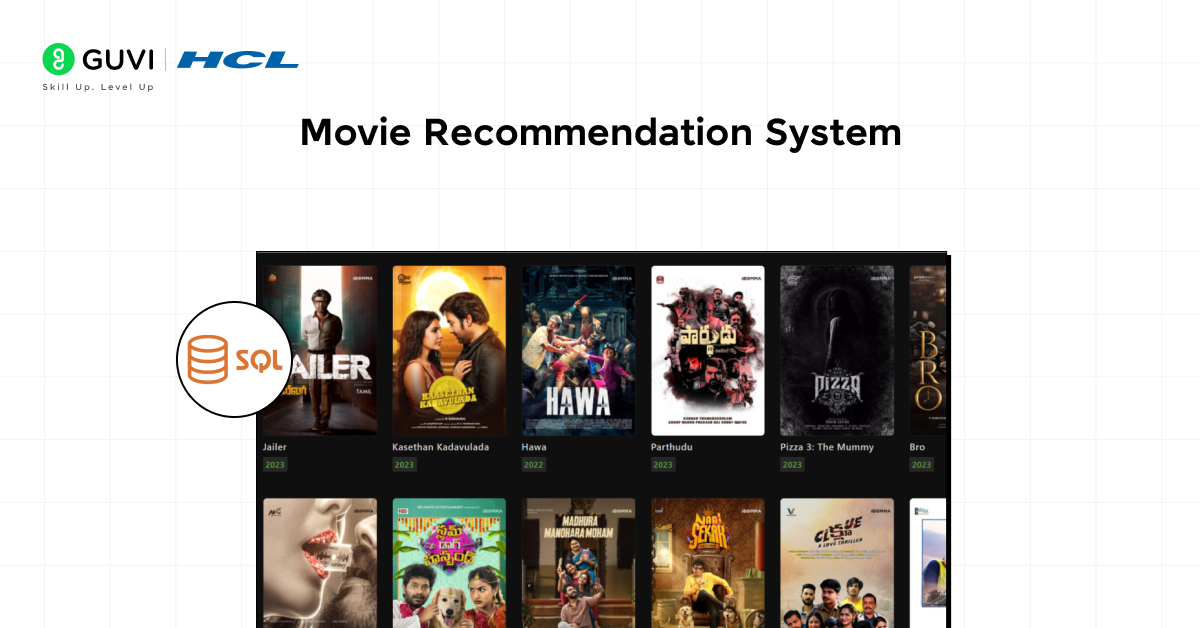
A Movie Recommendation System is an advanced SQL project that stores movies, genres, users, ratings, viewing histories, and preferences.
SQL can analyze user ratings to identify popular movies and generate basic recommendations. Window functions and ranking functions are particularly useful for this project.
You can also integrate Python to create a more sophisticated recommendation algorithm while SQL remains responsible for structured data storage and retrieval.
Time Taken: 7-10 days
Project Complexity: Advanced
Technology Stack: SQL, Python
Features of the Project:
- Movie database
- Genre management
- User profiles
- User ratings
- Viewing preferences
- Popularity rankings
- Genre-based recommendations
- Personalized movie recommendations
Required SQL Knowledge: Window functions, CTEs, ranking functions, advanced joins, aggregate functions, and subqueries
SQL Queries You Can Practice: Find top-rated movies, rank movies within each genre, identify active users, calculate average ratings, discover popular genres, find movies a user has not rated, and generate recommendation candidates.
What You Will Learn: This project helps you practice analytical SQL, ranking, recommendation logic, relational modeling, and integration with Python.
Integration with Other Systems: Python can add recommendation algorithms while SQL manages movie, rating, and user information.
Security Measures: User information and viewing behavior should be anonymized whenever individual identity is not required.
Source Code: Movie Recommendation System
Preparing for software developer or data analyst roles? Strengthen your SQL, DBMS, normalization, relational modeling, and database querying skills with the HCL GUVI DBMS & SQL Tutorial
Best SQL Project Ideas for Resume and Portfolio
Choosing the right SQL project for your resume depends on the role you want to target. A strong project should show how you design databases, write useful queries, and solve a clear real-world problem.
- For Beginners- Library Management System:
A good first portfolio project for demonstrating CRUD operations, joins, primary keys, foreign keys, and basic indexing. It also shows that you understand how different database tables connect. - For Students and Freshers- Student Grading System: This project helps demonstrate table relationships, aggregate functions, subqueries, and reporting. You can also add GPA calculations and course-wise performance analysis to make it more practical.
- For Backend Development Roles-E-commerce Product Catalog: A strong choice for showing complex joins, indexing, stored procedures, product filtering, supplier management, and inventory operations. It also demonstrates how SQL can support a larger application.
- For Data Analyst Roles-Online Retail Sales Analysis: One of the best SQL projects for an analytics portfolio. It allows you to demonstrate CTEs, window functions, aggregations, customer analysis, product performance, and sales trend reporting.
- For Business Database Roles-Employee Payroll Management System: This project shows how SQL can automate recurring business processes. It can demonstrate triggers, stored procedures, salary calculations, deductions, and payroll reporting.
- For Advanced SQL Portfolios-Financial Portfolio Management System: A strong project for demonstrating advanced queries, indexing, CTEs, transactions, historical analysis, and portfolio performance reporting.
- For SQL + Python Portfolios-Movie Recommendation System: This project combines SQL with Python and is useful for candidates targeting data or analytics roles. SQL can manage users, movies, ratings, and rankings while Python handles additional recommendation logic.
Students searching for larger academic projects can also explore HCL GUVI’s Data Science Projects for Final Year for ideas that combine database work with analytics and machine learning.
How to Showcase SQL Projects in Your Portfolio
Completing a SQL project is only the first step. You also need to make it easy for recruiters and hiring managers to understand your work.
Follow these steps to turn your SQL project into a portfolio piece.
1. Upload your project to GitHub
Create a separate repository for each project. Include your SQL scripts, sample data or a link to the dataset, and any supporting files.
2. Write a clear README file
Your README should explain:
- The problem the project addresses
- The dataset and database used
- The database schema and table relationships
- The SQL concepts demonstrated
- The main business questions and queries
- The key findings and conclusions
- Instructions for running the queries
3. Organize your SQL scripts
Separate scripts into logical files, such as database creation, data cleaning, analysis, and reporting. Use meaningful filenames and comments so another person can follow your work.
4. Show your results
Include selected query outputs, charts, or dashboard screenshots where relevant. Explain what the results mean instead of displaying tables without context.
5. Add the project to your resume
Use two or three concise bullet points to describe the problem, your SQL techniques, and the outcome. Be specific about what you implemented, and include measurable results only when you have actually calculated them.
For example:
E-Commerce Sales Analysis | PostgreSQL
- Analyzed order and customer datasets using joins, CTEs, and window functions to evaluate revenue trends and product performance.
- Developed queries to identify repeat customers, monthly sales patterns, and top-performing categories.
- Documented the schema, analytical queries, and findings in a GitHub repository.
Pin your strongest three to five repositories on your GitHub profile so visitors can find your most relevant work quickly. GitHub’s official guidance also recommends highlighting selected projects and providing helpful README files. (GitHub Docs)
A well-documented project gives recruiters evidence of how you approach problems, not just which SQL commands you know.
SQL Skills You Should Demonstrate in Your Projects
A strong SQL project should show a progression from basic database operations to meaningful problem-solving.
- Database Design
Start with a logical schema. Define tables based on real entities and connect them with primary and foreign keys.
- CRUD Operations
Demonstrate how records are created, retrieved, updated, and deleted. These operations form the foundation of database applications.
- Joins
Use joins to connect information stored across multiple tables. Your project should demonstrate that you understand when to use an INNER JOIN or LEFT JOIN.
- Aggregate Functions
Functions such as COUNT(), SUM(), AVG(), MIN(), and MAX() help convert raw records into meaningful summaries.
- Subqueries and CTEs
Use subqueries and CTEs when a problem requires multiple stages of filtering or calculation.
- Window Functions
Advanced projects can use ROW_NUMBER(), RANK(), DENSE_RANK(), LAG(), and LEAD() for ranking and trend analysis.
- Indexing
Indexes can improve retrieval performance when tables grow. They should be created based on actual query patterns rather than added to every column.
Explore: HCL GUVI’s Advanced Indexing Techniques for – Database Performance explains indexing strategies and performance considerations in more detail.
- Transactions and Constraints
Use constraints to protect data quality. Transactions help keep related operations consistent when multiple database changes must succeed together.
How to Build an SQL Project Step by Step
A useful SQL project begins with a problem rather than a collection of tables.
Step 1: Define the Problem
Decide exactly what the database should manage or analyze.
For a retail project, you may want to understand product sales, customer behavior, and monthly revenue.
Step 2: Identify the Main Entities
Determine the objects that need separate tables.
An e-commerce database may include customers, products, categories, orders, order items, and payments.
Step 3: Design the Database Schema
Define the columns required for each table. Add primary and foreign keys to create relationships.
An ER diagram can make the structure easier to understand before you start writing SQL.
Step 4: Create the Tables
Use CREATE TABLE statements and suitable data types. Add PRIMARY KEY, FOREIGN KEY, UNIQUE, NOT NULL, and other constraints when needed.
Step 5: Add Data
Insert sample records or import a suitable dataset. Make sure the data contains enough variety to test different queries.
Step 6: Write Practical Queries
Start with basic retrieval. Then move toward joins, aggregates, subqueries, CTEs, and window functions.
Focus on queries that answer meaningful questions instead of writing commands without a use case.
Step 7: Improve Performance
Review queries that repeatedly scan large tables. Add indexes where they can improve common search and join operations.
Step 8: Document the Project
Explain the problem, schema, dataset, important queries, and results. Add the SQL files and ER diagram to your repository.
Clear documentation can make a simple project far more useful in a portfolio.
Best Tools and Databases for SQL Projects
Choosing the right tool depends on the size and purpose of the project.
| Tool | Best Use |
| MySQL | Beginner projects and web applications |
| PostgreSQL | Intermediate and advanced relational projects |
| SQLite | Small local SQL projects |
| MySQL Workbench | Schema design and MySQL queries |
| pgAdmin | PostgreSQL administration |
| DBeaver | Working with multiple database systems |
| Python | Application logic and data analysis |
| Power BI | Dashboards and SQL-based reporting |
For your first SQL project, one relational database is enough. Focus on understanding database design and querying instead of switching between several tools.
Conclusion
Building SQL projects is one of the best ways to move from knowing database syntax to solving real data problems. Beginners can start with a Library Management System or Student Grading System. Intermediate learners can move to payroll, hospital, or e-commerce projects. Advanced learners can build retail analytics, financial portfolio, or recommendation projects.
Do not choose a project only because it sounds complicated. A smaller project with a clean schema, useful queries, proper documentation, and clear outputs can demonstrate your SQL skills more effectively. Start with one idea and build it yourself. Each table you design and each query you solve will strengthen your understanding of SQL.
FAQs
What are the best SQL project ideas for beginners?
Some of the best SQL project ideas for beginners are a Library Management System, Student Grading System, Hotel Reservation System, Inventory Management System, and Employee Database. These projects help you practice essential concepts such as CRUD operations, joins, primary keys, foreign keys, aggregate functions, and basic database design.
Start with a small database containing three to five related tables. Once the basic project works, you can add features such as reports, user roles, stored procedures, or a simple application interface.
How do I make an SQL project for my resume?
Choose a project that solves a clear real-world problem and demonstrates more than basic SELECT queries. Your project should include a well-designed database schema, meaningful relationships, sample data, and queries that answer practical questions.
For a stronger resume project, include:
1. An ER diagram
2. Primary and foreign keys
3. Joins and aggregate queries
4. Subqueries or CTEs
5. Views or stored procedures where relevant
6. Sample outputs
7. A GitHub repository
8. A README explaining the project
Which SQL project is best for a data analyst portfolio?
An Online Retail Sales Analysis project is one of the strongest options for a data analyst portfolio. It allows you to demonstrate business-focused SQL skills such as aggregations, CTEs, window functions, customer analysis, product performance, and sales trend analysis.
You can strengthen the project by answering questions such as monthly revenue, top-performing products, repeat customer rate, average order value, and month-over-month growth. Pairing SQL results with a visualization tool such as Power BI can make the portfolio more complete.
What SQL skills should I include in a project?
A good SQL project should demonstrate database design, primary and foreign keys, CRUD operations, joins, aggregate functions, GROUP BY, subqueries, CTEs, views, indexing, transactions, and constraints. Advanced projects can also include stored procedures and window functions when they are relevant to the problem.
Where can I find datasets for SQL projects?
You can find SQL project datasets on Kaggle, GitHub, government open-data portals, and public research repositories. Retail transactions, e-commerce orders, movies, customer behavior, healthcare records, sports data, and financial datasets are useful for SQL practice. Choose structured datasets that let you practice filtering, grouping, joins, and analysis.
Success Stories

About the Author
Vaishali
I'm a seasoned writer with four years of experience across technical, non-technical, and just about every genre or niche you can imagine. Adaptable and curious, I enjoy exploring new topics and making information engaging and easy to understand. Fueled by a steady stream of tea, I approach each project with creativity, reliability, and genuine enthusiasm for storytelling.
View all posts by Vaishali
Connect with me @











Did you enjoy this article?