


Project Articles
Business Analysis in Digital Transformation Projects - Best Guide
Build No-Code AI Agents with Flowise AI: Step-by-Step Beginner Guide


Get In Touch For Details! Request More Information
Automated Resume Screener: NLP-Based Python Project with Source Code
Aug 17, 2026 4 Min Read 1006 Views
(Last Updated)
Recruiters often receive hundreds of applications for a single job opening, making manual resume screening slow, repetitive, and difficult to scale. An automated resume screener helps streamline this process by identifying relevant candidates more efficiently.
Table of contents
- TL;DR
- Direct Answer Box
- What Is an Automated Resume Screener?
- Key Components of a Resume Screener
- Why Learn Resume Screening with Python?
- Benefits of Building a Resume Screening Python Project
- Automated Resume Screener: NLP-Based Python Project with Source Code
- Step 1: Install Required Libraries
- Step 2: Import Required Modules
- Step 3: Create a Job Description
- Step 4: Add Sample Resume Data
- Step 5: Convert Text into Numerical Features
- Step 6: Calculate Resume Scores
- Step 7: Rank Candidates
- How Does an NLP-Based Resume Screener Work?
- Key Stages
- Real-World Applications of Resume Screening Systems
- Applicant Tracking Systems
- Campus Recruitment
- Internal Hiring
- Talent Acquisition Teams
- Recruitment Agencies
- Key Takeaways
- What To Do Next
- Conclusion
- FAQs
- What is a resume screening Python project?
- Which Python libraries are commonly used for resume screening?
- Can NLP improve resume screening accuracy?
- Is this project suitable for beginners?
- Can resume screeners process PDF resumes?
- How can machine learning enhance resume screening?
- What skills can I learn from this project?
TL;DR
- An Automated Resume Screener is a Python application that analyzes resumes and matches them against job requirements.
- Natural Language Processing (NLP) helps extract skills, education, experience, and keywords from resumes.
- Python libraries such as NLTK, spaCy, Pandas, and Scikit-learn simplify resume screening automation.
- The project reduces manual recruitment effort and improves candidate shortlisting efficiency.
- Building a resume screening Python project helps developers learn NLP, text processing, machine learning, and automation.
Using Python and NLP, developers can build intelligent screening systems while gaining practical experience in automation and text processing through HCL GUVI’s Python Course.
Data Point
According to industry recruitment studies, recruiters often spend only a few seconds reviewing a resume during initial screening, making automated filtering tools increasingly valuable in modern hiring workflows.
Source: https://business.linkedin.com/talent-solutions
Direct Answer Box
A resume screening Python project is an automated system that uses Python and Natural Language Processing (NLP) to analyze resumes, extract important information, compare candidate profiles with job descriptions, and rank applicants based on relevance. The system helps recruiters reduce manual screening effort and identify qualified candidates more efficiently.
Source: https://docs.python.org/3/
What Is an Automated Resume Screener?
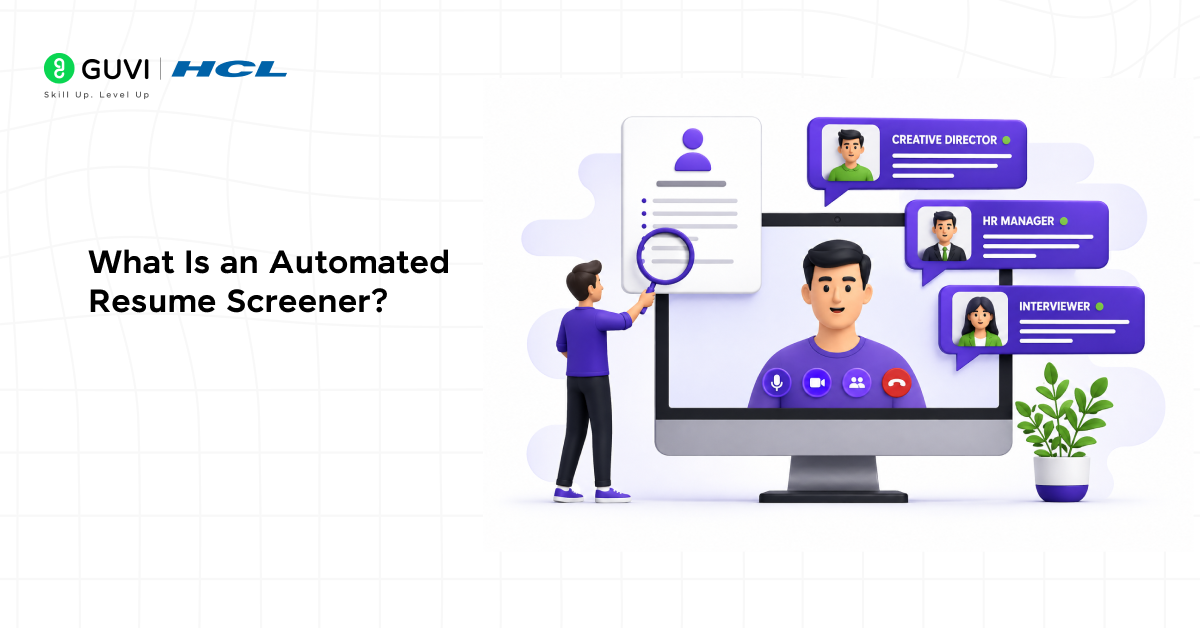
An Automated Resume Screener is a software application that evaluates resumes using predefined rules, keyword matching, and NLP techniques.
Instead of manually reading every application, recruiters can use the system to identify suitable candidates based on skills, education, certifications, experience, and job-specific requirements.
Modern resume screeners often use NLP to understand context rather than simply searching for exact keyword matches. This helps improve screening accuracy and candidate ranking.
Key Components of a Resume Screener
- Resume Parser – Extracts text from resumes.
- NLP Engine – Identifies skills, entities, and important information.
- Keyword Matcher – Compares resumes against job descriptions.
- Scoring System – Assigns relevance scores to candidates.
- Database Storage – Stores applicant information.
- Ranking Module – Sorts candidates based on suitability.
Did You Know?
Semantic matching allows modern recruitment systems to evaluate candidate relevance based on context and meaning rather than simple keyword matching.
Why Learn Resume Screening with Python?
Python is one of the most popular languages for building recruitment automation tools because of its rich ecosystem of NLP and machine learning libraries.
Benefits of Building a Resume Screening Python Project
| Benefit | Why It Matters |
| NLP Experience | Learn real-world text processing |
| Recruitment Automation | Solve practical hiring challenges |
| Machine Learning Exposure | Build intelligent ranking systems |
| Portfolio Development | Showcase industry-relevant skills |
| Data Processing Skills | Work with structured and unstructured data |
Data Point
According to the World Economic Forum, AI, big data, and technological literacy remain among the fastest-growing skills, increasing demand for professionals who can build intelligent automation and NLP-based solutions.
Source: https://www.weforum.org/reports/the-future-of-jobs-report-2025
If you’re getting started with Python, HCL GUVI’s Python eBook can help strengthen your understanding of programming fundamentals, data structures, functions, and object-oriented concepts before building NLP-based projects.
Automated Resume Screener: NLP-Based Python Project with Source Code
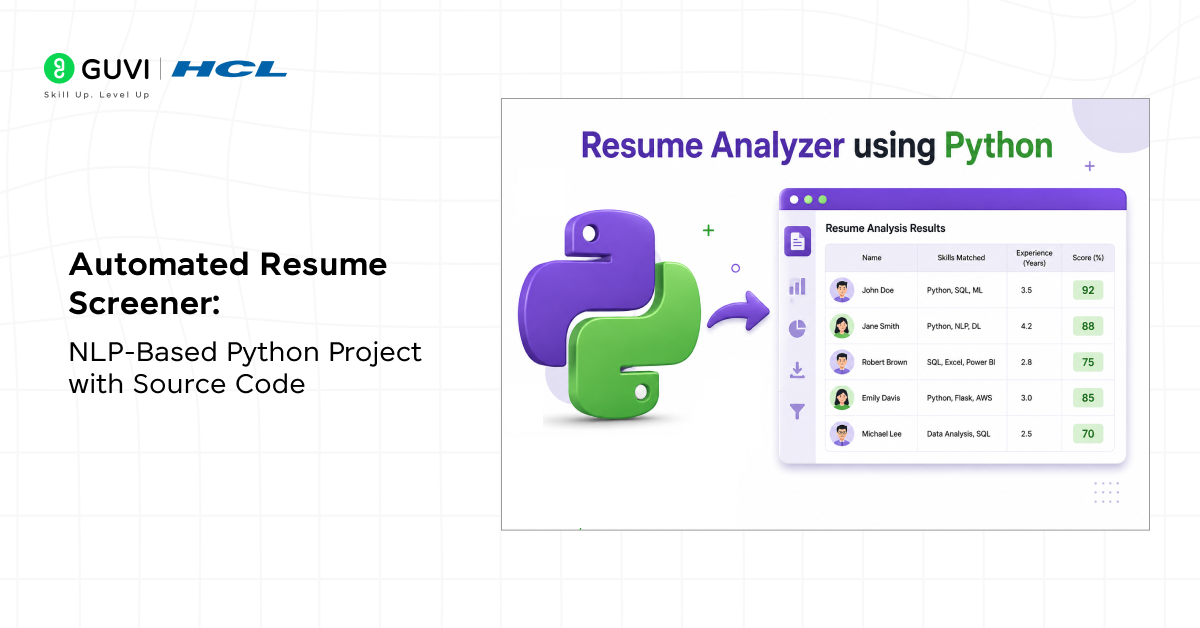
Let’s build a simple resume screening system using Python.
Step 1: Install Required Libraries
pip install pandas

pip install nltk

pip install scikit-learn

pip install spacy

Verify installation:

import pandas as pd

import nltk

import spacy

print("Libraries Installed Successfully")
Step 2: Import Required Modules
import pandas as pd

import nltk

from sklearn.feature_extraction.text import CountVectorizer

from sklearn.metrics.pairwise import cosine_similarity
These libraries help process text data, extract keywords, and calculate similarity scores between resumes and job descriptions.
Step 3: Create a Job Description
job_description = """

Python Developer with experience in Django,

Machine Learning, SQL, APIs, and Git.

"""
The job description acts as the reference document against which resumes will be evaluated.
Step 4: Add Sample Resume Data
resumes = [

   "Python developer with Django and SQL experience",

   "Frontend developer skilled in React and JavaScript",

   "Machine learning engineer with Python and APIs"

]
In a production system, resumes can be extracted from PDF or DOCX files.
Step 5: Convert Text into Numerical Features
documents = [job_description] + resumes

vectorizer = CountVectorizer()

matrix = vectorizer.fit_transform(documents)
Text vectorization converts words into numerical representations that machine learning algorithms can process.
Step 6: Calculate Resume Scores
similarity_scores = cosine_similarity(

   matrix[0:1],

   matrix[1:]

)

print(similarity_scores)
This calculates how closely each resume matches the job description.
Step 7: Rank Candidates
scores = similarity_scores[0]

for index, score in enumerate(scores):

   print(

       f"Resume {index+1}: {score:.2f}"

   )
The resume with the highest score is considered the strongest match for the role.

Python’s NLP ecosystem enables developers to create scalable screening systems capable of analyzing thousands of resumes efficiently while reducing repetitive recruitment tasks.
Warning
Avoid relying solely on keyword matching for hiring decisions. Candidates may possess relevant skills that are expressed differently from the exact terms used in a job description. Combining NLP with human review improves fairness and accuracy.
Interested in more NLP projects? Explore these ideas to expand your practical AI skills.
How Does an NLP-Based Resume Screener Work?
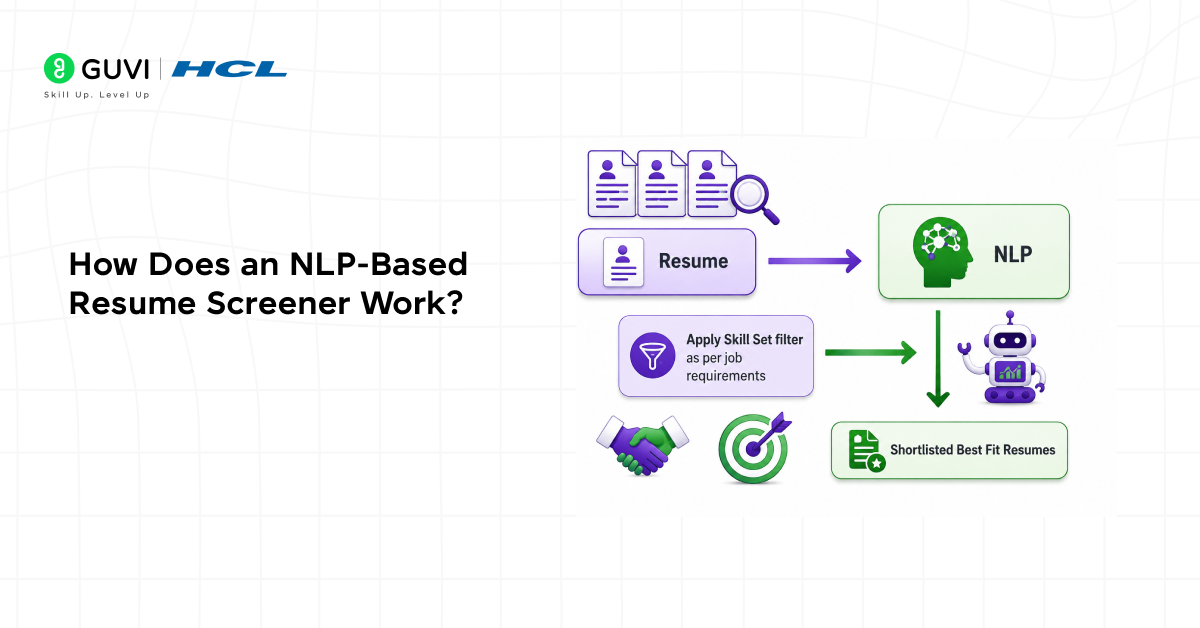
A resume screening system follows a structured workflow to analyze candidate profiles and identify suitable applicants.
Key Stages
- Resume Collection
- Text Extraction
- Data Cleaning
- NLP Processing
- Skill Identification
- Keyword Matching
- Candidate Scoring
- Resume Ranking
- Recruiter Review
The system automates repetitive screening activities while allowing recruiters to focus on final candidate evaluation and interviews.
Data Point
Organizations worldwide continue to invest in AI-powered recruitment technologies to improve hiring efficiency, reduce administrative workload, and accelerate candidate discovery.
Source: https://www.mckinsey.com/capabilities/people-and-organizational-performance/our-insights
Real-World Applications of Resume Screening Systems
Resume screening solutions are widely used across recruitment and talent management processes.
1. Applicant Tracking Systems
ATS platforms use automated screening to prioritize candidates based on job requirements.
2. Campus Recruitment
Organizations can process large volumes of student applications efficiently.
3. Internal Hiring
Companies can identify suitable employees for promotions and internal opportunities.
4. Talent Acquisition Teams
Recruiters can accelerate shortlisting and reduce manual screening effort.
5. Recruitment Agencies
Staffing firms can quickly match candidates with client requirements.
Best Practice
Use a combination of NLP techniques, semantic matching, and recruiter validation to improve candidate evaluation quality. Balanced screening methods produce more reliable hiring outcomes than keyword matching alone.
To strengthen your Python development skills further, HCL GUVI’s Python Course offers project-based learning experiences that help developers build automation, NLP, machine learning, and data-driven applications for real-world business scenarios.
Key Takeaways
- Resume screeners automate candidate evaluation and ranking.
- NLP helps extract meaningful information from resumes.
- Python provides powerful libraries for text analysis and automation.
- Candidate scoring improves recruitment efficiency.
- Building a resume screening Python project strengthens practical AI and NLP skills.
What To Do Next
After completing this project, explore:
- ATS-style resume management systems
- Semantic skill matching engines
- PDF resume parsing automation
- AI-powered resume-building tools
- Machine learning-based candidate ranking
Conclusion
An Automated Resume Screener demonstrates how Python and NLP can transform traditional recruitment workflows. By automating resume analysis, skill extraction, and candidate ranking, organizations can significantly reduce manual effort while improving hiring efficiency. For developers, this project offers an excellent opportunity to gain hands-on experience with NLP, machine learning, automation, and real-world problem-solving. As recruitment technology continues to evolve, mastering these skills can open doors to building more sophisticated AI-powered talent acquisition solutions.
FAQs
1. What is a resume screening Python project?
A resume screening Python project is an application that analyzes resumes using Python and NLP techniques to identify qualified candidates and rank them according to job requirements.
2. Which Python libraries are commonly used for resume screening?
Popular libraries include NLTK, spaCy, Pandas, Scikit-learn, PyPDF2, and NumPy.
3. Can NLP improve resume screening accuracy?
Yes. NLP helps understand context, identify skills, and extract meaningful information beyond simple keyword matching.
4. Is this project suitable for beginners?
Yes. Developers with basic Python knowledge can build a simple version and gradually add advanced NLP features.
5. Can resume screeners process PDF resumes?
Yes. Libraries such as PyPDF2 and pdfplumber can extract text from PDF documents for analysis.
6. How can machine learning enhance resume screening?
Machine learning models can improve candidate ranking, skill matching, and predictive hiring analysis.
7. What skills can I learn from this project?
You can learn Python programming, NLP, text processing, machine learning, automation, and recruitment technology development.
Success Stories

About the Author
Vishalini Devarajan
An Aerospace Engineer turned content writer, I focus on making complex concepts easy to understand through well-structured, reader-friendly blogs. Whether it’s a technical topic or a non-technical one, I love creating content that is clear, engaging, and impactful.
View all posts by Vishalini Devarajan
Connect with me @









Did you enjoy this article?