


Artificial Intelligence and Machine Learning Articles
How to Audit LLM Models for Backdoors: Tools & Frameworks for Developers
AI Governance & Compliance in Web Apps: Why You Can’t Ignore Data Risk When Using LLMs
How to Evaluate LLMs for Production: Beyond Benchmarks (A Developer’s Guide)


Get In Touch For Details! Request More Information
From Web Dev to AI Engineer: A Career Transition Roadmap for Indian Developers
Feb 06, 2026 6 Min Read 2063 Views
(Last Updated)
Have you been working as a web developer already, and now you are interested in artificial intelligence? If yes, you’re not alone. Lots of Indian developers are investigating the possibility of moving beyond web development to AI engineering, as AI is emerging as one of the quickest growing professions. With startups, IT companies, and global tech firms rapidly adopting AI, the demand for skilled AI and machine learning engineers is rising every year.
Although it might sound complicated, your existing experience in web development already provides you with a solid foundation in coding, logic, APIs, and scalable systems, and the transition will be far easier than you might assume.
As salaries increase, opportunities and career advancement are also improved, and the number of AI jobs grows rapidly, 2026-2027 is an ideal moment when Indian developers can switch to it. This blog will take you through the most important skills, tools, and steps that will see you move comfortably into artificial intelligence.
Let’s get started on your AI career journey.
Quick answer:
Indian developers can transition from web dev to AI engineer by learning Python, basic math, machine learning, deep learning, and MLOps. Developers with solid AI project portfolios and successfully deployed machine learning models in a cloud environment will likely find themselves qualifying for the most competitive ML/AI engineering roles and future-proofing their careers in India’s growing AI job market.
Table of contents
- The reason Indian Developers Are Moving Out of Web Dev to AI Engineer
- Shared Skills Between Web Developers & AI Engineers
- Transferable Abilities
- Skills You Must Learn to Become an AI Engineer in India
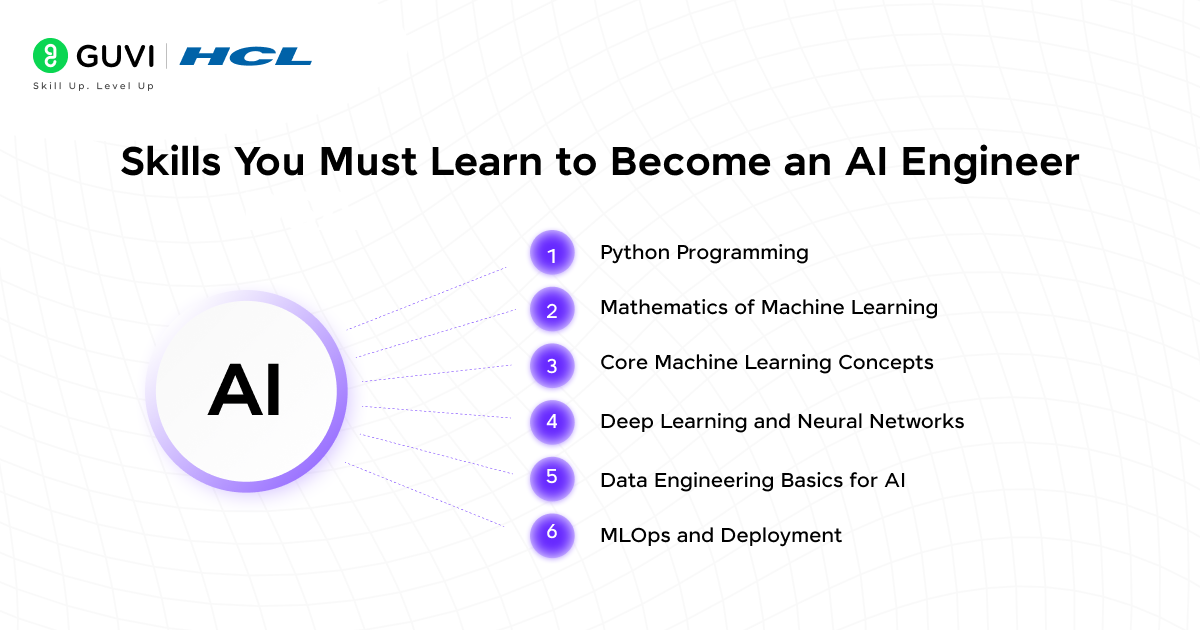
- A. Python Programming
- B. Mathematics of Machine Learning
- C. Core Machine Learning Concepts
- D. Deep Learning and Neural Networks
- E. Data Engineering Basics for AI
- F. MLOps and Deployment
- A Clear Roadmap for Indian Developers Moving to AI
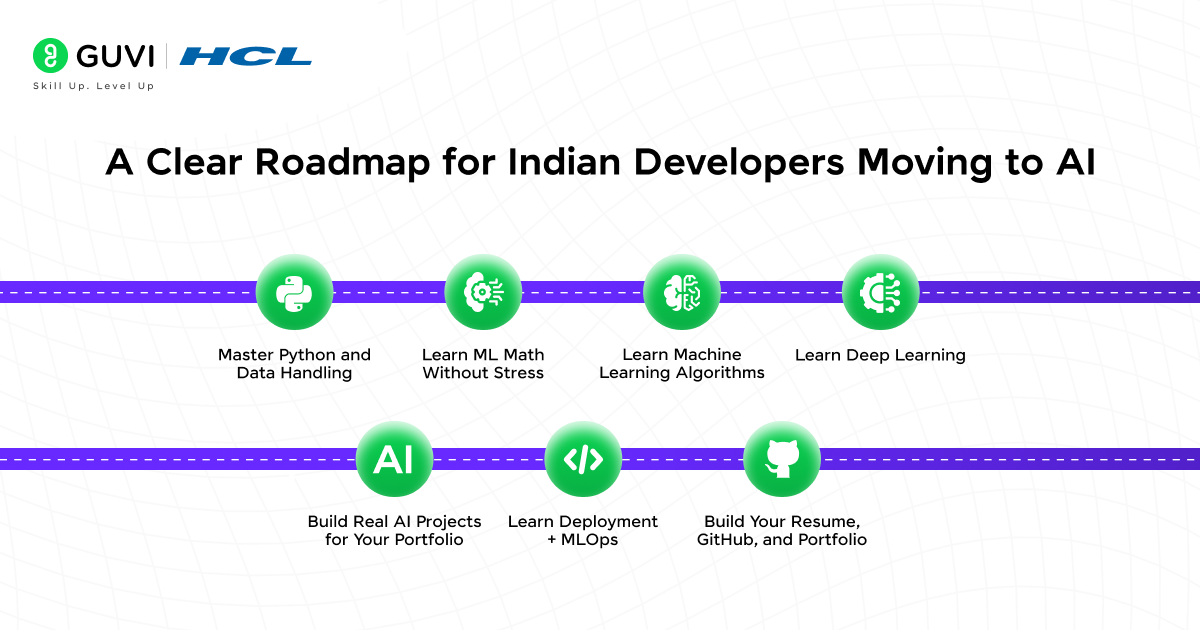
- Step 1: Master Python and Data Handling
- Step 2: Learn ML Math Without Stress
- Step 3: Learn Machine Learning Algorithms
- Step 4: Learn Deep Learning (DL)
- Step 5: Build Real AI Projects for Your Portfolio
- Step 6: Learn Deployment + MLOps
- Step 7: Build Your Resume, GitHub, and Portfolio
- Portfolio Must Include
- Resume Tips
- AI Career Opportunities for Indian Developers
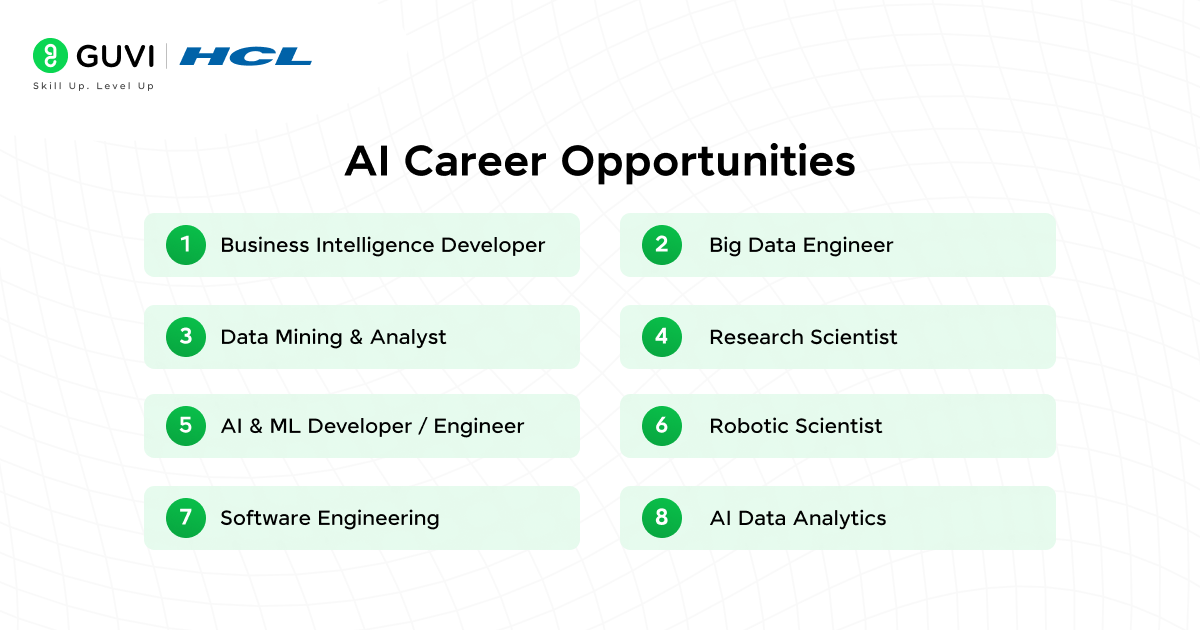
- Popular Job Titles
- Industries Hiring Actively
- AI Salary Expectations in India
- Entry-Level AI Engineer Salary: ₹6 - ₹15 LPA
- Mid-Level AI Engineer Salary: ₹8L- ₹20.0 LPA
- Senior-Level AI Engineer Salary: ₹11.9 - ₹35.0 LPA+
- Specialized AI Roles: ₹50 LPA+
- Why AI Salaries Are Higher Than Web Development
- Cities in India Offering the Highest AI Salaries
- Common Challenges & How to Overcome Them
- Wrapping it up:
- FAQs
- Can a web developer switch to AI engineering?
- Do I need a degree to work in AI?
- Is advanced math required?
- How long does the transition take?
The reason Indian Developers Are Moving Out of Web Dev to AI Engineer
Artificial intelligence today is the main support of the digital transformation in India. While web development remains important, AI engineering is a source of new opportunities to become innovative, experiment, and earn higher wages.
Key Reasons Developers Are Making the Switch:
- Massive job growth: AI employment in India will exceed to over 2 million in 2027.
- Higher salaries: AI jobs pay 30-70% more than web development jobs.
- Future-proof skills: AI engineers deal with trending technologies, which are LLMs, transformers, neural networks, automation, and predictive systems.
- Greater impact: AI is applied to health care, climate change, agriculture, electronic commerce, finances and state services.
- Skill overlap: Web development expertise such as APIs, code development, Git, cloud computing, and system architecture easily converts into artificial intelligence processes.
Why AI Feels More Rewarding
- There are important issues you work on.
- You do not create interfaces but intelligent solutions.
- You have the opportunity to work with models and data.
- AI systems are constantly being enhanced in the field.
Shared Skills Between Web Developers & AI Engineers
| Skill | Web Developer | AI Engineer |
| Programming | Writes frontend/backend code | Writes ML pipelines and model training code |
| Math | Basic logic, algorithms | Linear algebra, probability, statistics |
| Data Handling | API data, JSON, DB queries | Data preprocessing, feature engineering |
| Problem Solving | Debugging UI/API | Debugging model performance, tuning |
| Cloud | Deploying web apps | Deploying ML models, scaling predictions |
| Version Control | Git branching & merging | Tracking experiments and models |
| System Design | APIs, microservices | AI pipelines, data flow, model serving |
Transferable Abilities
- Understanding REST APIs
- Working with cloud platforms
- Writing modular, clean code
- Debugging complex systems
- Designing scalable architectures
- Using Git and CI/CD tools
Your web development background gives you a head start.
Skills You Must Learn to Become an AI Engineer in India

A. Python Programming
Machine learning is built on Python. So learn:
- Variables, loops, functions
- OOPS concepts
- File handling
- List/dict comprehension
- Error handling
Important Python Libraries
- NumPy: Mathematical functions.
- Pandas: Manipulating data and cleaning data.
- Matplotlib / Sea Bears: Data visualization.
These are libraries that you need in the process of your AI.
B. Mathematics of Machine Learning
The math part is one that many Indian developers are scared of, yet you only need:
- Linear algebra: Vectors, matrices.
- Statistics: Mean, median, variance, distribution.
- Probability: Incidents, possibilities.
- Calculus: Unconditional derivatives.
Why Math Matters
- Learning about model behavior
- Algorithms tuning and optimization
- Improving accuracy
- Avoiding overfitting
Math helps you think like an AI engineer, but you don’t need advanced research-level knowledge.
- You don’t need a high-end system to learn AI — platforms like Google Colab offer free GPU access, making AI development accessible to everyone.
- Many AI models in production are deployed using simple APIs built with Flask or FastAPI, not complex enterprise systems.
- Core skills such as Python, APIs, Git, and cloud deployment are shared between web development and AI engineering, making career transitions far smoother than most people expect.
C. Core Machine Learning Concepts
It is at this point that you can start with your AI.
Key ML Topics
- Supervised learning (regression, classification)
- Unsupervised learning (clustering, PCA)
- Feature engineering
- Outlier detection
- Train-test split
- Cross-validation
- Evaluation metrics
Beginner-Friendly Algorithms
- Linear Regression
- Logistic Regression
- Decision Trees
- Random Forest
- KNN
- Naive Bayes
- K-means clustering
The knowledge of these algorithms prepares the groundwork for advanced AI.
D. Deep Learning and Neural Networks
When you get the basics of ML under your belt, you can dive into deep learning.
- Neural Network Basics
- Layers (input, hidden, output)
- Activation functions (ReLU, Sigmoid, Softmax)
- Loss functions
- Optimizers (Adam, RMSprop)
- Important Deep Learning Areas
- CNNs (Computer Vision)
- Image classification
- Object detection
- Medical imaging
- RNNs/LSTMs (Sequence Data)
- Text classification
- Stock predictions
- Chatbots
- Transformers (Modern NLP)
- BERT
- GPT
- LLaMA
- Embedding models
Knowing these tools enables you to create real-world AI systems.
E. Data Engineering Basics for AI
AI engineers also waste about 60% of their time dealing with data.
Important Skills
- Pandas for cleaning data
- SQL for queries
- Data preprocessing
- Handling missing values
- Working with large datasets
Tools Used in India
- Hadoop
- Spark
- Azure Data Factory
- AWS Glue
F. MLOps and Deployment
AI engineers are not supposed to simply train models but implement them.
Key Deployment Tools
- Flask / FastAPI
- Docker
- Kubernetes
- CI/CD pipelines
- AWS, GCP, Azure
Why MLOps Matters
- Keeps your model reliable
- Makes predictions scalable
- Permits non-down time updates.
The AI engineers with MLOps experience are of high value to companies.
A Clear Roadmap for Indian Developers Moving to AI
Step 1: Master Python and Data Handling
- Introduction to Python 101: Python basic syntax, loops, functions, and data types.
- Practice NumPy and Pandas: Use these libraries to process and examine data effectively.
- Work with CSV/JSON/APIs: Learn how to load and manipulate data of various sources.
- Build simple data cleaning scripts: Write a simple script to clean up basic operations such as sorting out the nulls or formatting columns.
Goal: Be comfortable writing Python code daily.
Step 2: Learn ML Math Without Stress
- Study vectors and matrices: Build the foundation needed for ML computations.
- Basics of statistics: Understand averages, variance, and distributions used in models.
- Understand distributions: Explore distributions to select appropriate ML methods.
- Learn gradient descent conceptually: Grasp how models learn by reducing errors.
Goal: Understand why ML models behave a certain way.
Step 3: Learn Machine Learning Algorithms
- Build ML models using Scikit: Start training models with beginner-friendly tools.
- Learn classification vs regression: Learn about the two general types of predictions.
- Train models on Kaggle datasets: Practice real-world data challenges.
- Understand evaluation metrics: Measure model performance using accuracy, precision, recall, etc.
Goal: To build 5 or more MAchine learning projects
Step 4: Learn Deep Learning (DL)
- Build neural networks from scratch: Learn how layers, weights, and activations work together.
- Train CNNs on image datasets: Apply deep learning to image-based tasks.
- Train RNNs/LSTMs on text: Work with sequential data like text or time series.
- Explore transformers: Learn modern NLP architecture used in models like BERT and GPT.
Goal: Build end-to-end DL projects.
Step 5: Build Real AI Projects for Your Portfolio
Machine Learning Projects
- Credit card fraud detection: A credit card fraud detector is trained to detect fraudulent transactions.
- House price predictor: House price predictor using regression models.
- Customer churn prediction: Analyze trends to identify those users who may be leaving a service.
Deep Learning Projects
- Face recognition: Use CNNs to identify faces from images.
- Emotion recognition: Recognition of emotions based on facial expression.
- Handwritten digit classification: Train a neural network to recognize handwritten digits.
NLP Projects
- Sentiment analysis: classifies text into positive, negative or neutral.
- Chatbot using transformers: Build smart conversational agents.
- Resume parser: Automatically extracts skills and information contained in resumes.
Goal: To build 5 or 6 strong projects for your portfolio.
Step 6: Learn Deployment + MLOps
- Deploy models with FastAPI: Convert models to serviceable API endpoints.
- Create a Docker container: Build an app and make it run everywhere.
- Deploy on AWS/GCP: Host models on scalable cloud environments.
- Starter learning in CI/CD: Automation of the integration and deployment processes.
- Automate training pipelines: Build pipelines that retrain models on new data.
Goal: Deploy at least 3 AI models publicly.
Step 7: Build Your Resume, GitHub, and Portfolio
Portfolio Must Include
- Project folders: Upload clean, organized repositories for each project.
- Clean READMEs: Include setup steps, explanations, and demo usage.
- Demo videos: Show projects working in real-time through a short video.
- Diagrams explaining workflows: Add architecture diagrams to clarify model pipelines.
Resume Tips
- Highlight AI skills above web dev: Position yourself for AI-focused roles.
- Add performance metrics: Show measurable model improvements and results.
- Showcase deployment experience: Mention tools like Docker, FastAPI, and cloud hosting.
Goal: Present yourself as an AI engineer, not just a web developer.
AI Career Opportunities for Indian Developers
Popular Job Titles
- Machine Learning Engineer
- AI Engineer
- NLP Engineer
- Data Scientist
- Computer Vision Engineer
- MLOps Engineer
Industries Hiring Actively
- Fintech
- E-commerce
- Healthcare
- Cybersecurity
- Logistics
- EdTech
AI Salary Expectations in India
With the expansion of AI throughout India, the need to hire experienced engineers is always increasing, and this has led to greater pay and opportunities of meaningful work and career opportunities in the future.
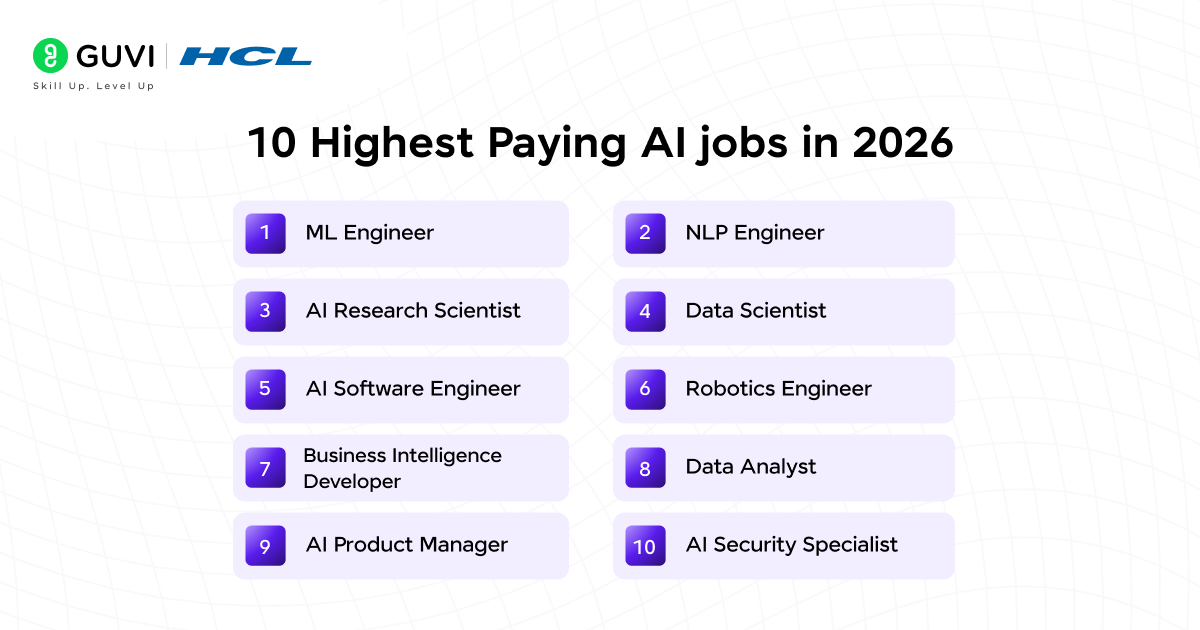
Entry-Level AI Engineer Salary: ₹6 – ₹15 LPA
- Those freshers who come out of web development or software jobs can be included in this range.
- Python, ML algorithms, basic deep learning, and knowledge of at least 3-5 projects will find the higher end of this bracket.
- Startups, fintech institutions, and AI-based product firms tend to be pay more than conventional IT service firms.
Mid-Level AI Engineer Salary: ₹8L- ₹20.0 LPA
- Here developers having 2-4 years of AI experience or good end-to-end ML deployment skills will be included.
- MLOps, cloud deployment, and working with real-world datasets experience are added value.
- Business organizations want you to independently develop, optimize, and deploy machine learning models on your own.
Senior-Level AI Engineer Salary: ₹11.9 – ₹35.0 LPA+
- Professionals with 5+ years of AI/ML experience or deep specialization (NLP, CV, MLOps) receive these salaries.
- Project lead and mentor teams, as well as working with scalable ML pipelines, are led by senior engineers.
- MNCs, global products, and startups with high growth give the highest compensation.
Specialized AI Roles: ₹50 LPA+
Roles that require advanced expertise often pay extremely high salaries:
- NLP Engineer (LLMs, transformers, RAG systems): ₹40 – 60 LPA
- Computer Vision Engineer: ₹35 – 55 LPA
- Machine Learning Architect: ₹50 – 70 LPA
- MLOps Engineer: ₹30 – 65 LPA
- Lead AI Scientist / Research Engineer: ₹60 LPA and beyond
You can refer to AmbitionBox or Glassdoor for the salary of the respective job roles.
Why AI Salaries Are Higher Than Web Development
- AI roles require deeper analytical thinking and model optimization skills.
- AI has become an important tool in automation, predictions, and the competitive edge of companies
- There’s a shortage of skilled AI professionals in India, with increasing demand and pay.
- In advanced pipelines, the task of AI engineers is to unite software engineering + machine learning + cloud infrastructure.
Cities in India Offering the Highest AI Salaries
- Bengaluru – Highest salaries and most AI opportunities
- Hyderabad – Strong demand from product and cloud companies
- Pune & Chennai – Growing AI hubs with competitive pay
- Gurgaon (Gurugram) – Many fintech and AI-driven startups
Common Challenges & How to Overcome Them
- Fear of Math: Most beginners are afraid of math, but only practical ML math is necessary, such as simple statistics and linear algebra to build models.
- Too Many Resources: There are too many courses and tutorials, which may be overwhelming, and have one formal learning roadmap to follow through with.
- GPU Requirement: Training deep learning models can also be slow on ordinary laptops, so use free GPU on Google Colab to practice without hardware problems.
- No Mentor or Guidance: Learning is not an easy task, and thus, it is recommended to become an active member of LinkedIn, Kaggle, and Discord to receive feedback and support.
- Challenge Deploying Models: Deployment is complicated initially, and it is best to start by deploying simple Flask or FastAPI applications and proceed to Docker and cloud-based deployment.
Also, check out Join HCL GUVI’s IITM Pravartak Certified Artificial Intelligence & Machine Learning Course, designed by industry experts and backed by NSDC, to build your career in the world of intelligent systems from foundational ML concepts to hands-on LLM projects.
Wrapping it up:
The transition from Web dev to AI engineer is not as hard as it might appear; it is just the new step in your tech career. With your current skillsets in coding, APIs, and solving problems, you are in a good position to develop more modern AI skills such as machine learning, deep learning, and MLOps. All you need is the right guidance to start your AI engineer journey.
FAQs
1. Can a web developer switch to AI engineering?
Web developers are usually quite well skilled to move into the field of AI due to their ability to code and think logically.
2. Do I need a degree to work in AI?
No, you do not need a separate degree and many believe that practical skills (and the ability to provide examples of those practical skills through real-world projects) will have a greater impact
3. Is advanced math required?
No, only basic mathematics will be necessary such as statistical methods and Linear Algebra
4. How long does the transition take?
It depends on the individual, it might take 2 months for some and 6 months for others.
Success Stories

About the Author
Vishalini Devarajan
An Aerospace Engineer turned content writer, I focus on making complex concepts easy to understand through well-structured, reader-friendly blogs. Whether it’s a technical topic or a non-technical one, I love creating content that is clear, engaging, and impactful.
View all posts by Vishalini Devarajan
Connect with me @








Did you enjoy this article?