


Artificial Intelligence and Machine Learning Articles
Model Cards and Datasheets: Documenting AI Responsibly
AI Watermarking: Detecting AI-Generated Content


Get In Touch For Details! Request More Information
AI Career Paths for Non-Coders : Top 10 Roles Without Programming in 2026
Sep 04, 2026 6 Min Read 6764 Views
(Last Updated)
Artificial Intelligence may be powered by code, but not every career in AI requires you to write it. As businesses use AI across marketing, content, operations, product management, analytics, and compliance, they also need professionals who can apply these tools, evaluate their outputs, manage projects, and connect AI capabilities with actual business needs.
That opens up several AI career paths for non-coders, including roles in AI project management, content, workflow automation, data analysis, training, and governance. In this guide, we’ll explore some of the most promising AI roles for non technical people, the skills they require, salary prospects, and how you can get started without a programming background.
Table of contents
- TL;DR Summary
- AI Career Opportunities For Non-Coders
- AI Project Manager
- Prompt Engineer
- No-Code Data Analyst
- AI Content Creator
- AI Product Strategist
- AI Trainer And Data Labeling Specialist
- Workflow Automation Specialist
- AI Ethics And Compliance Analyst
- AI Business Analyst
- Conversational AI Designer
- Skills You Need for AI Careers Without Coding
- Which AI Career Path Is Right for You?
- Conclusion
- FAQs
- Which AI career paths for non-coders are best for beginners?
- Can I build a career in AI without learning Python?
- Are non-coding AI jobs suitable for freshers?
- Which AI roles for non technical people pay well?
- Do I need a technical degree for AI careers without coding?
- How can I build a portfolio for non-coding AI roles?
- Can non-coding AI roles eventually lead to technical AI careers?
TL;DR Summary
- You can build an AI career without becoming a programmer.
- Non-coding opportunities span project management, content, analytics, automation, AI training, and governance.
- Most roles require AI literacy, domain knowledge, and strong problem-solving skills rather than advanced coding.
- No-code and AI-powered tools can help you build practical skills and a portfolio.
- The right career path depends on your existing strengths, interests, and willingness to learn AI tools.
AI Career Opportunities For Non-Coders
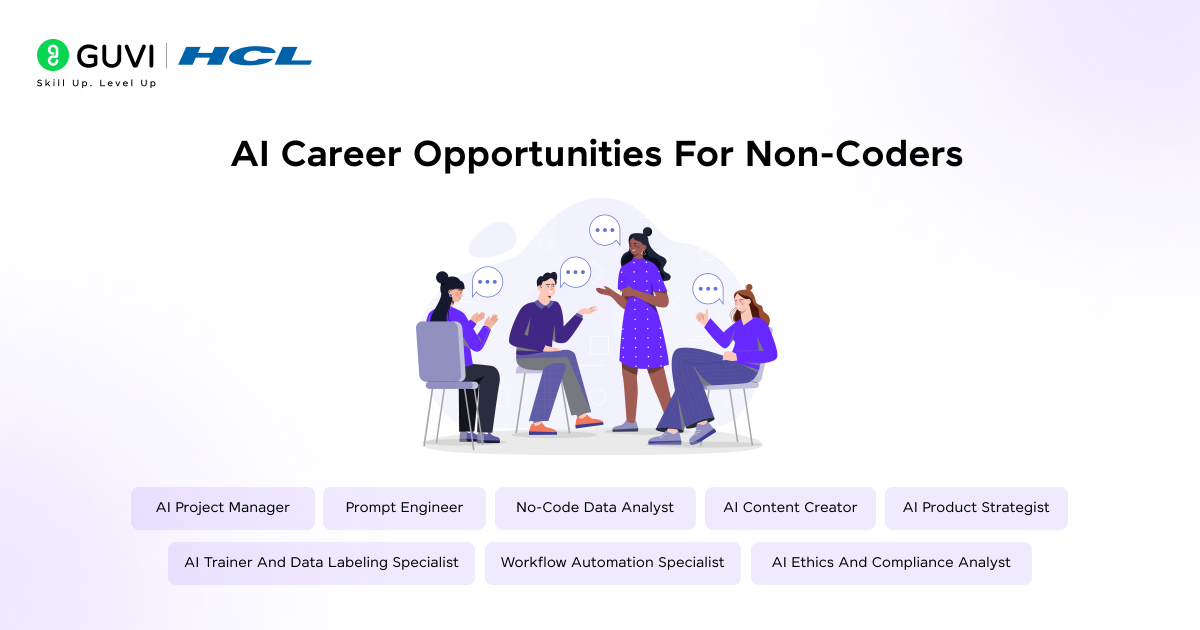
AI adoption is rapidly expanding across industries, creating strong demand for AI careers for non-coders who can contribute using creativity, analysis, communication, and strategic decision-making rather than programming. These roles help businesses use AI effectively through planning, content creation, research, data interpretation, automation, and ethical monitoring. The roles covered in this section are:
1. AI Project Manager
2. Prompt Engineer
3. No-Code Data Analyst
4. AI Content Creator
5. AI Product Strategist
6. AI Trainer And Data Labeling Specialist
7. Workflow Automation Specialist
8. AI Ethics And Compliance Analyst.
1. AI Project Manager
Role Description:
An AI project manager leads AI initiatives by connecting business requirements with practical outcomes. This role focuses on defining clear objectives, aligning multiple teams, managing expectations, and ensuring AI tools solve real business needs. It is a top choice among AI roles for non-technical people because success depends on communication, planning, and strategic thinking rather than programming.
Responsibilities:
- Convert business problems into structured project requirements
- Coordinate data teams, designers, and decision-makers
- Track progress, identify risks, and maintain timelines
- Ensure every feature delivers user value
Skills Required:
Leadership, communication, documentation, and critical thinking.
Salary range:
₹22.8L – ₹25L/yr ( Glassdoor ) , ₹6.2 L – ₹9 L/yr ( Ambitionbox )
Tips:
Study AI workflows, learn project tools, and practice writing concise requirement briefs.
2. Prompt Engineer
Role Description:
A prompt engineer designs instructions that guide AI tools to produce accurate, creative, and context-aware outputs. The role involves constant experimentation, pattern analysis, and refining prompt structures. It is one of the fastest-growing ai jobs without programming because it relies on writing skill, curiosity, and logic rather than code.
Responsibilities:
- Create and refine prompt frameworks
- Test variations to improve model accuracy
- Build prompt libraries for different use cases
- Support teams by optimizing AI interactions
Skills Required:
Writing clarity, creativity, and analytical thinking.
Salary range:
₹4L – ₹8L/yr ( Glassdoor )
Tips:
Practice prompt variations daily and study how different models respond to different instructions.
Prompt engineering is a learnable skill — and HCL GUVI’s AI & ML course includes dedicated GenAI and prompt engineering modules alongside LLMs and Agentic AI. You don’t need to code to become effective at prompt design: AI & ML Course — Prompt Engineering, GenAI, LLMs
3. No-Code Data Analyst
Role Description:
A no-code data analyst uses dashboards, spreadsheets, and AI-powered analytics to extract insights without writing code. You interpret patterns, analyze performance metrics, and support business decisions through visual data exploration. This role is ideal for AI opportunities; for beginners who want analytical work without programming.
Responsibilities:
- Build dashboards and interpret data visually
- Track KPIs and identify performance trends
- Present insights to teams for decision-making
- Use no-code tools for exploration and reporting
Skills Required:
Numerical reasoning, data literacy, and communication.
Salary range:
₹11.6 L – ₹12.4 L/yr ( Glassdoor )
Tips:
Learn dashboard tools, practice with sample datasets, and understand business metrics like ROI.
4. AI Content Creator
Role Description:
An AI content creator uses AI tools to craft blogs, social posts, visuals, scripts, and long-form content. Instead of coding, the role relies on creativity, storytelling, editing, and understanding what content performs well. It is one of the most accessible non-coding tech jobs for writers, marketers, designers, and editors.
Responsibilities:
- Generate content drafts using AI tools
- Edit and refine outputs for clarity and engagement
- Create visuals, captions, or scripts
- Maintain tone, accuracy, and brand consistency
Skills Required:
Creativity, editing, storytelling, and audience insight.
Salary range:
₹9.49 L/yr ( Glassdoor )
Tips:
Build a portfolio using AI tools and study trending content formats.
5. AI Product Strategist
Role Description:
An AI product strategist shapes AI product direction by studying user needs, analyzing competition, and planning long-term features. You determine what should be built, why it matters, and how it fits market expectations. This makes it a strong AI business role for people who enjoy research and planning.
Responsibilities:
- Conduct user research and market analysis
- Define product goals and feature requirements
- Prioritize features with cross-functional teams
- Align AI capabilities with customer expectations
Skills Required:
Research, product thinking, communication, analytical reasoning.
Salary range:
₹60.1 L – ₹65.1 L/yr ( Glassdoor )
Tips:
Study popular AI products, analyze feature decisions, and learn basic UX principles.
6. AI Trainer And Data Labeling Specialist
Role Description:
An AI trainer improves model accuracy by labeling data, reviewing predictions, identifying bias, and correcting errors. This role forms the foundation of all AI systems and is a strong entry path for AI analyst jobs because it requires observation rather than coding.
Responsibilities:
- Label datasets such as text, images, or audio
- Evaluate model predictions and correct inaccuracies
- Identify recurring errors or bias
- Maintain consistent annotation standards
Skills Required:
Attention to detail, logical thinking, and patience.
Salary range:
₹2 L – ₹6 L/yr ( Glassdoor ) , ₹6 L – ₹8 L/yr ( Glassdoor )
Tips:
Learn annotation techniques and explore open-source datasets for practice.
AI Trainers who understand how models use data — what good labels look like and why — advance faster than those who just label. HCL GUVI’s AI & ML course explains the training pipeline from the model’s perspective, giving you a much stronger understanding of why your work matters: AI & Machine Learning Course. Free Python foundation to understand ML inputs: Python Tutorial
7. Workflow Automation Specialist
Role Description:
A workflow automation specialist uses no-code automation platforms to replace repetitive tasks with automated systems. You connect apps, create triggers, optimize operations, and save teams significant time. It is one of the most practical AI career options without coding for people who enjoy building efficient systems.
Responsibilities:
- Design and test automated workflows
- Integrate tools and apps for smooth data transfer
- Identify inefficiencies and automate repetitive tasks
- Improve team productivity using no-code tools
Skills Required:
Problem solving, system thinking, organization.
Salary range:
₹11.6 L – ₹12.4 L/yr ( Glassdoor )
Tips:
Start with simple automations and gradually build multi-step workflow systems.
8. AI Ethics And Compliance Analyst
Role Description:
An AI ethics and compliance analyst ensures that AI systems are safe, transparent, fair, and aligned with ethical guidelines. You evaluate AI outputs, identify risks, study decision-making patterns, and create policies that ensure responsible AI use. This role is growing quickly as companies prioritize responsible AI development.

Responsibilities:
- Test models for fairness and accuracy
- Identify bias or harmful patterns
- Document risks and compliance requirements
- Create guidelines for safe and responsible AI usage
Skills Required:
Critical thinking, research, judgment, and policy awareness.
Salary range:
₹3 L – ₹40 L/yr ( Glassdoor )
Tips:
Study global AI regulations and analyze real-world cases of biased AI systems.
The Artificial Intelligence and Machine Learning course with IIT-M Pravartak certification from HCL GUVI helps non-coders build a strong understanding of AI and ML concepts. It focuses on practical applications, showing how AI can be used in analytics, automation, content creation, and decision-making. Hands-on projects make it easy to gain real-world experience without heavy coding. The certification adds credibility and prepares for a future-ready career in AI.
9. AI Business Analyst
Role Description:
An AI Business Analyst identifies business problems that AI can help solve and translates them into clear requirements for technical teams. The role involves understanding workflows, gathering requirements, evaluating AI use cases, and ensuring solutions align with business goals. It is well suited to professionals with strengths in analysis, communication, and business processes.
Responsibilities:
- Identify business processes where AI can add value
- Gather and document requirements for AI solutions
- Coordinate between business stakeholders and technical teams
- Evaluate AI outputs and recommend improvements
Skills Required:
Business analysis, AI literacy, communication, documentation, and problem-solving.
Salary Range:
₹17.2 L/yr
Tips:
Learn AI fundamentals, requirement gathering, process mapping, and how businesses evaluate AI use cases.
10. Conversational AI Designer
Role Description:
A Conversational AI Designer creates natural and useful interactions for AI chatbots, virtual assistants, and voice-based systems. The role involves designing conversation flows, defining tone and responses, understanding user behaviour, and improving interactions based on testing and feedback. Current Indian openings also combine conversation design with UX writing, LLMs, and chatbot platforms.
Responsibilities:
- Design conversation flows for chatbots and AI assistants
- Define tone, prompts, responses, and interaction patterns
- Test conversations and identify usability issues
- Collaborate with product, UX, and AI teams
Skills Required:
UX writing, communication, conversation design, AI literacy, and user empathy.
Salary Range:
₹9.6-10.7 L/yr
Tips:
Practise designing chatbot conversations and build sample flows that demonstrate how you would improve common AI interactions.
One of the earliest chatbots, ELIZA, was created at MIT in the 1960s. Despite relying on relatively simple rules, some users became emotionally invested in their conversations with it.
Skills You Need for AI Careers Without Coding
You may not need programming for every AI role, but you still need to understand how to work with AI effectively. Some useful skills include:
- AI literacy: Understand basic AI concepts, capabilities, limitations, and common use cases.
- Prompting skills: Learn how to give AI tools clear instructions and refine their outputs.
- Critical thinking: Evaluate AI-generated information instead of accepting every output at face value.
- Data literacy: Understand basic data, metrics, patterns, and how they support decisions.
- Domain knowledge: Combine AI skills with expertise in areas like marketing, finance, HR, operations, or product.
- Communication: Explain AI-driven ideas, findings, and requirements clearly to different teams.
- No-code tools: Learn to use AI, analytics, automation, or workflow platforms relevant to your chosen role.
Which AI Career Path Is Right for You?
Your best AI career path depends on the skills you already enjoy using. A simple way to narrow your options is:
- Good at planning and coordination? Explore AI Project Management.
- Strong writer or communicator? Consider Prompt Engineering, AI Content Creation, or Conversational AI Design.
- Enjoy numbers and insights? Look into No-Code Data Analysis.
- Interested in products and strategy? Explore AI Product Strategy or AI Business Analysis.
- Detail-oriented and patient? AI Training and Data Labeling may suit you.
- Love improving processes? Consider Workflow Automation.
- Interested in policy and responsible technology? Explore AI Ethics and Compliance.
Conclusion
AI is no longer limited to programmers or technical specialists. In India, demand for AI skills has been growing rapidly, with a 2026 Government of India report noting that demand for AI skills grew 75% faster than for non-AI roles. As AI adoption expands across industries, skills in analytics, automation, content, product, business analysis, and other areas can open new career possibilities beyond traditional programming roles.
To take this knowledge further, start applying AI tools to real tasks and problems. Experiment with workflows, automations, prompt techniques, and no-code platforms relevant to the career path you want to pursue. Building practical AI skills alongside your existing domain expertise can help you explore AI career opportunities without making programming your primary focus.
FAQs
1. Which AI career paths for non-coders are best for beginners?
AI content creation, data annotation, prompt engineering, and no-code data analysis can be relatively accessible starting points. The right choice depends on your existing skills, interests, and familiarity with AI tools.
2. Can I build a career in AI without learning Python?
Yes, some AI roles do not require Python as a core skill. However, learning basic programming later can expand your options, especially if you want to move into more technical AI or data roles.
3. Are non-coding AI jobs suitable for freshers?
Some are. Entry-level opportunities may exist in AI training, data annotation, content, and related areas. Roles such as AI Project Manager or AI Product Strategist usually require prior professional experience.
4. Which AI roles for non technical people pay well?
Earning potential varies considerably by role and experience. Product, project management, business analysis, and specialised AI roles can offer strong earning potential, but they also typically require relevant domain experience.
5. Do I need a technical degree for AI careers without coding?
Not necessarily. For many non-coding roles, employers may value domain expertise, AI literacy, communication, analytical thinking, and practical experience with AI tools alongside formal qualifications.
6. How can I build a portfolio for non-coding AI roles?
Create projects related to your target role. You could build an automated workflow, analyse data using no-code tools, design chatbot conversations, create an AI-assisted content campaign, or document an AI business use case.
7. Can non-coding AI roles eventually lead to technical AI careers?
Yes. You can gradually add skills such as Python, SQL, statistics, APIs, or machine learning fundamentals if you later want to transition toward more technical roles.
Success Stories

About the Author
Jebasta
I translate the language of data into stories that anyone can understand. As a writer with a data science background, I simplify analytics, AI, and decision-making so beginners and enthusiasts can confidently explore the world of data.
View all posts by Jebasta
Connect with me @









Did you enjoy this article?