


Artificial Intelligence and Machine Learning Articles
Finance Manager to Data Analytics: Career Growth, Salary and Seniority
How to Evaluate LLM Outputs in Production Deployments
AI/ML Skills Gap 2026: Why Companies Can't Find Job-Ready Talent
20 AI/ML Interview Questions Recruiters Can Use Without a Tech Background - Best Guide


Get In Touch For Details! Request More Information
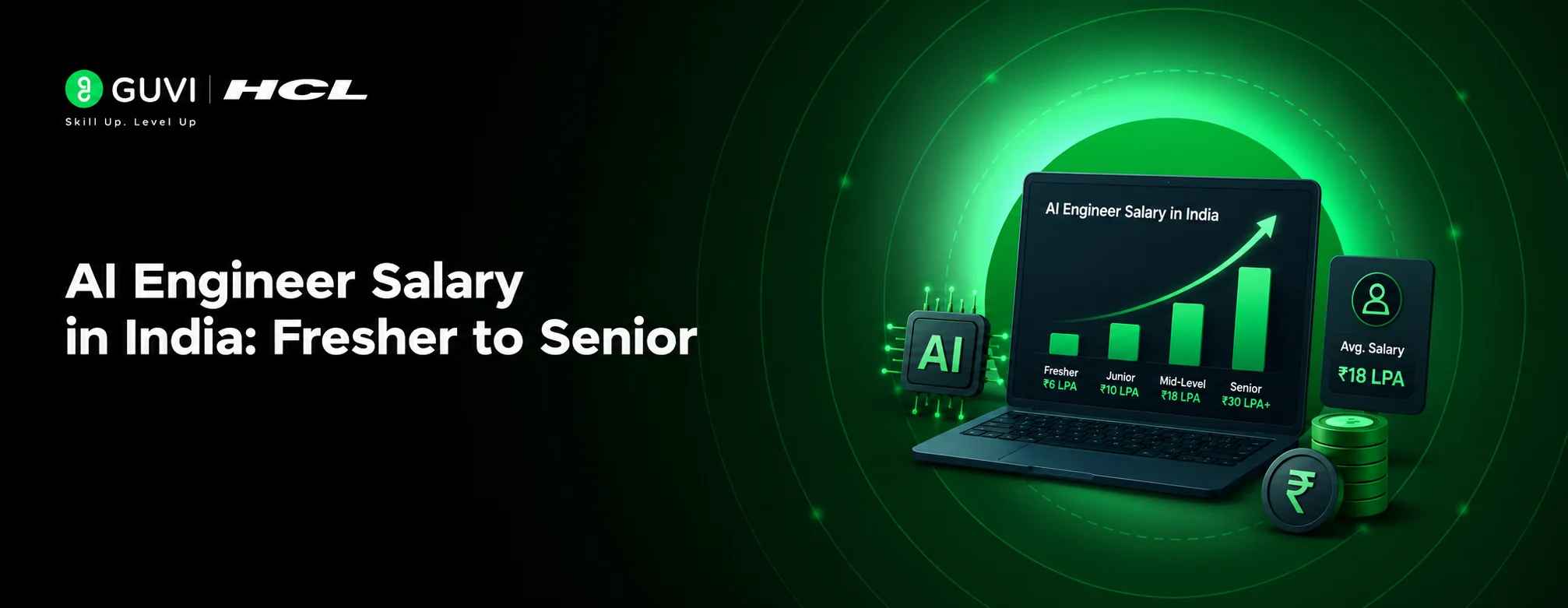
AI Engineer Salary in India 2026: Fresher to Senior (Complete Breakdown)
Jul 14, 2026 4 Min Read 24932 Views
(Last Updated)
The median AI Engineer salary in India in 2026 is around ₹11–12 LPA, but that single number hides a massive range: freshers start at ₹5–8 LPA while senior GenAI specialists at product companies cross ₹60 LPA.
Pay depends heavily on your experience band, the type of company you join, and whether you’ve specialised in GenAI, MLOps, or core ML. This guide breaks down real numbers by experience, company, and skill so you know exactly where you stand.
Table of contents
- TL;DR: AI Engineer Salary in India
- Who Exactly is an AI Engineer?
- Factors That Influence Artificial Intelligence Engineer Salary
- AI Engineer Salary by Experience Level
- AI Engineer Salary: Startup vs Mid-Size vs MAANG India vs Remote
- AI Engineer vs ML Engineer vs Data Scientist Salary Comparison Table
- AI Engineer vs ML Engineer vs Data Scientist Salary Comparison Table
- Skills That Push AI Engineer Salary Above 25 LPA
- Common Mistakes That Cap Your AI Engineer Salary
- Conclusion
- FAQs
- Is AI a High-Paying Job in India?
- Which companies hire AI Engineers in India?
- What is the qualification for an AI job in India?
- Is AI a good career choice in India?
- How much does a career in AI make in India?
- Are remote AI Engineer roles worth more than MAANG India roles?
TL;DR: AI Engineer Salary in India
- Median AI Engineer salary in India in 2025 is around ₹11–12 LPA
- Freshers: ₹5–8 LPA (up to ₹12 LPA with a strong GenAI portfolio)
- Mid-level (3–6 yrs): ₹12–30 LPA
- Senior (7+ yrs): ₹30–65 LPA, with GenAI/LLM specialists crossing ₹70 LPA
- Google India pays the highest average (₹40–50 LPA); Amazon and Microsoft follow closely
- AI/ML Engineers typically out-earn Data Scientists by 15–25% at the same experience level
- GenAI, RAG, and MLOps skills are the fastest way to cross ₹25 LPA
- Remote roles for US/EU companies often pay $35,000–120,000+, rivaling MAANG India comp
Roughly 8,000–12,000 AI engineers in India now earn ₹1 crore or more annually, up from just around 1,500 in 2020. The jump reflects how fast GenAI and MLOps specialisations have pulled senior pay upward in the last two years.
Who Exactly is an AI Engineer?
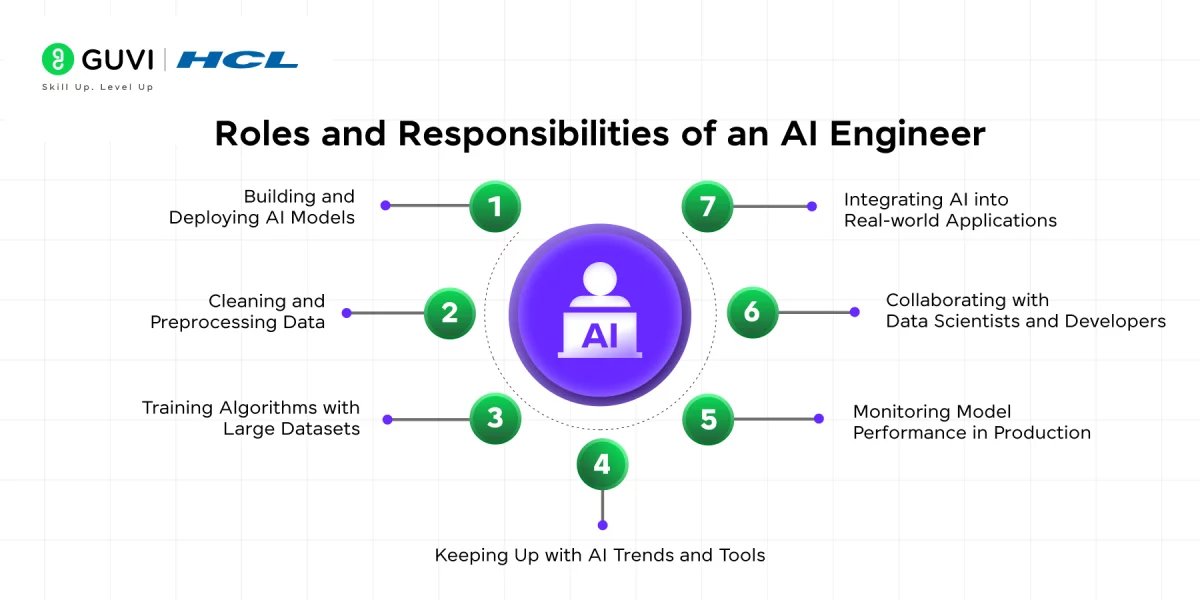
An AI Engineer is someone who builds systems that mimic human intelligence — systems that learn from data, make smart decisions, and get better over time.
An AI Engineer builds systems that learn from data and improve over time — recommendation engines, chatbots, fraud detection models, and increasingly, GenAI products built on LLMs. This could mean:
- Building a model that predicts which students are likely to drop off a course
- Creating an AI tutor that answers doubts in real time
- Using NLP to auto-grade assignments at scale
The role sits at the intersection of software engineering and machine learning, and in 2025 it increasingly means GenAI and LLM work too.
In short, an AI Engineer is not just a coder or data wizard. They’re the intelligence layer of the product — the one that makes the platform smarter, more adaptive, and always one step ahead of user needs.
Factors That Influence Artificial Intelligence Engineer Salary
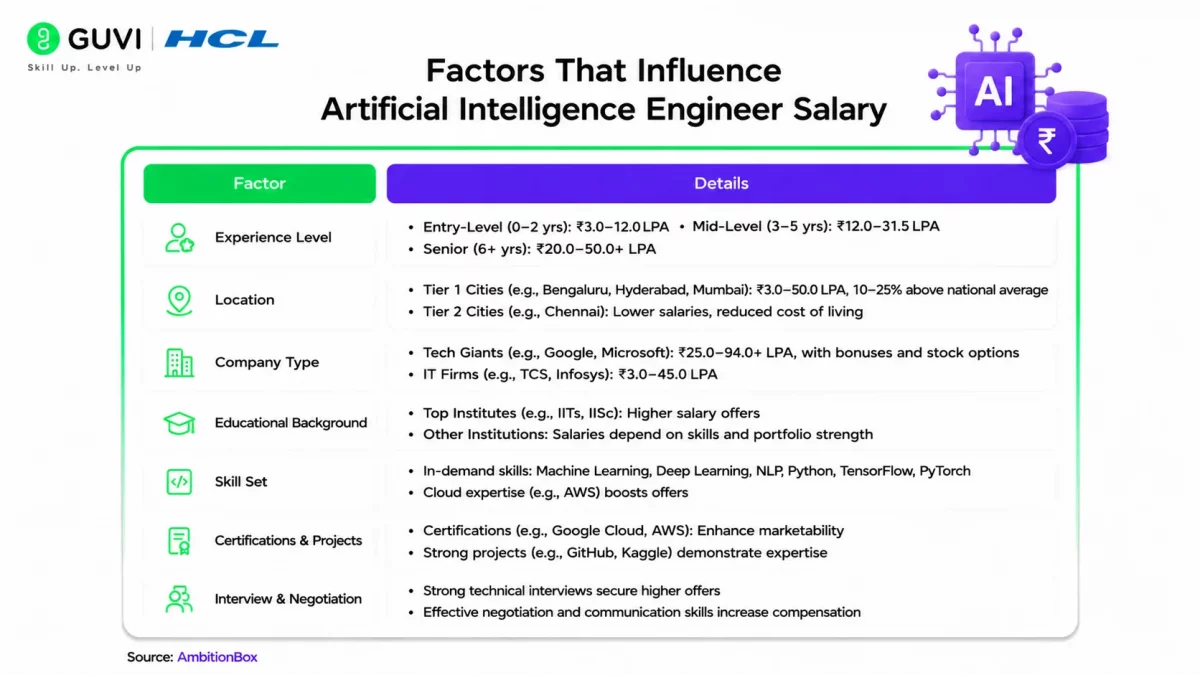
| Factor | Details |
| Experience Level | – Entry-Level (0–2 yrs): ₹3.0–12.0 LPA – Mid-Level (3–5 yrs): ₹12.0–31.5 LPA – Senior (6+ yrs): ₹20.0–50.0+ LPA |
| Location | – Tier 1 Cities (e.g., Bengaluru, Hyderabad, Mumbai): ₹3.0–50.0 LPA, 10–25% above national average – Tier 2 Cities (e.g., Chennai): Lower salaries, reduced cost of living |
| Company Type | – Tech Giants (e.g., Google, Microsoft): ₹25.0–94.0+ LPA, with bonuses and stock options – IT Firms (e.g., TCS, Infosys): ₹3.0–45.0 LPA |
| Educational Background | – Top Institutes (e.g., IITs, IISc): Higher salary offers – Other Institutions: Salaries depend on skills and portfolio strength |
| Skill Set | – In-demand skills: Machine Learning, Deep Learning, NLP, Python, TensorFlow, PyTorch – Cloud expertise (e.g., AWS) boosts offers |
| Certifications & Projects | – Certifications (e.g., Google Cloud, AWS): Enhance marketability – Strong projects (e.g., GitHub, Kaggle) demonstrate expertise |
| Interview & Negotiation | – Strong technical interviews secure higher offers – Effective negotiation and communication skills increase compensation |
AI Engineer Salary by Experience Level
Experience is still the biggest lever. But what kind of experience matters more than the number of years — a fresher with a deployed RAG project can out-earn a three-year generalist.
| Experience | Salary Range (₹ LPA) | What Moves the Needle |
|---|---|---|
| Fresher (0–2 yrs) | 5 – 12 | GitHub/Kaggle portfolio, GenAI project exposure |
| Mid-level (3–6 yrs) | 12 – 30 | Specialisation (NLP, CV, GenAI), company tier |
| Senior (7+ yrs) | 30 – 65+ | Architecture ownership, MLOps at scale, leadership |
| GenAI/LLM specialists | 20 – 70 (any level) | Fine-tuning, RAG, prompt engineering, evals |
Freshers with strong GenAI project work are now landing ₹8–12 LPA offers at product companies — well above the ₹5–8 LPA that generalist fresher roles at IT services firms still pay.
AI Engineer Salary: Startup vs Mid-Size vs MAANG India vs Remote
Where you work changes your pay band as much as your experience does. Here’s how the same experience level plays out across company types.
| Experience | Startup (₹ LPA) | Mid-size (₹ LPA) | MAANG India (₹ LPA) | Remote (USD/year) |
|---|---|---|---|---|
| Fresher (0–2 yrs) | 6 – 10 | 8 – 14 | 15 – 22 | $15,000 – 25,000 |
| Mid-level (3–6 yrs) | 15 – 28 | 20 – 35 | 35 – 55 | $35,000 – 60,000 |
| Senior (7+ yrs) | 30 – 55 (+ ESOPs) | 40 – 65 | 55 – 100+ | $70,000 – 120,000+ |
Startups often pay a lower base but add equity that can be worth significantly more if the company scales. MAANG India roles pay the highest fixed cash but come with the toughest interview bar. Remote roles for US or European companies pay in USD and can beat even MAANG India comp once converted, though they usually skip Indian statutory benefits like PF and gratuity.
AI Engineer vs ML Engineer vs Data Scientist Salary Comparison Table
These three titles get used interchangeably by recruiters, but the actual pay and work differ. At mid-level (3–5 years), here’s how they stack up.
| Role | Salary Range (₹ LPA) | Core Focus | Best Fit For |
|---|---|---|---|
| AI Engineer | 20 – 45 | Building and deploying AI/GenAI systems end-to-end | Engineers who like shipping production systems |
| ML Engineer | 18 – 40 | Model training, pipelines, deployment | Engineers who enjoy the ML lifecycle, not just modelling |
| Data Scientist | 14 – 30 | Analysis, experimentation, business insight | People who like statistics and stakeholder storytelling |
The gap isn’t really about the title — it’s about whether your day-to-day is closer to research and analysis (Data Scientist) or production engineering (AI/ML Engineer). If you’re titled “Data Scientist” but spend most of your time building and deploying models, you may be underpaid relative to the actual work.
AI Engineer vs ML Engineer vs Data Scientist Salary Comparison Table
Company-specific numbers give a clearer picture than national averages.

- Google India: AI engineers average around ₹40–50 LPA, with senior specialists and researchers crossing ₹90 LPA plus stock.
- Microsoft India: Typically ₹25–45 LPA for AI/ML roles, scaling higher for principal-level positions.
- Amazon India: ₹26–48 LPA, roughly ₹2.2–4 lakh a month at mid-to-senior levels.
- Flipkart: AI leads earn around ₹35–40 LPA, with mid-level AI/ML roles in the ₹18–30 LPA band.
Product companies and global R&D centres (Google, Microsoft, Amazon) consistently outpay IT services firms like TCS and Infosys, where comparable AI roles still sit in the ₹7–20 LPA range even at a few years of experience.
Skills That Push AI Engineer Salary Above 25 LPA
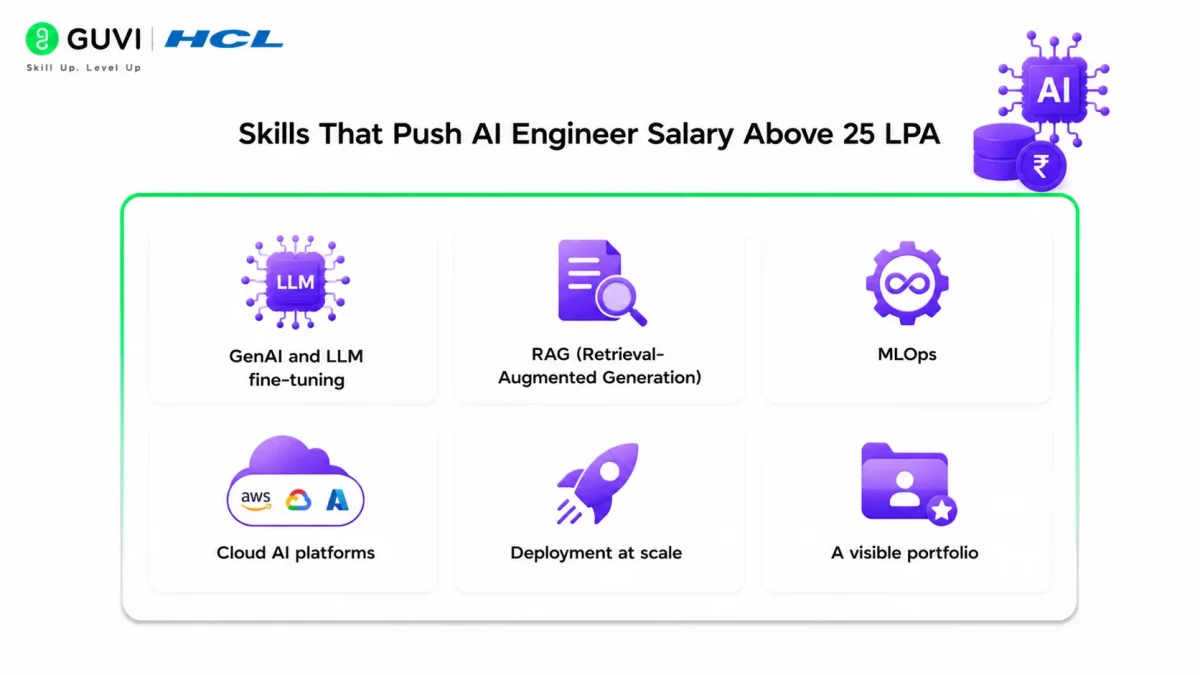
Crossing the 25 LPA mark isn’t really about years of experience — it’s about specific, in-demand skills.
- GenAI and LLM fine-tuning: Working with models like GPT-4, Llama, or Claude for real product use cases
- RAG (Retrieval-Augmented Generation): Building systems that combine LLMs with your own data
- MLOps: Docker, Kubernetes, CI/CD pipelines, and tools like MLflow or Kubeflow
- Cloud AI platforms: AWS SageMaker, Google Vertex AI, Azure ML
- Deployment at scale: Optimising for low latency and high throughput in production
- A visible portfolio: Deployed projects on GitHub or Kaggle carry more weight than certificates alone
GenAI and MLOps specialists typically earn a 20–40% premium over generalist AI engineers doing similar-tenure work, which is currently the fastest and most reliable way to break past the 25 LPA ceiling.
Common Mistakes That Cap Your AI Engineer Salary
- Chasing certificates over projects: Recruiters weigh a deployed GitHub project far more than a stack of course completion certificates. Build something real, even if it’s small.
- Ignoring deployment skills: Knowing how to train a model isn’t enough anymore. Learn Docker, basic CI/CD, and cloud deployment early.
- Treating “AI Engineer” as a fixed title: Since titles overlap heavily across companies, negotiate based on the actual work (GenAI, MLOps, research) rather than the job title alone.
- Not negotiating equity at senior levels: Startup offers often have negotiable ESOP refresh terms that candidates leave on the table.
- Staying purely generalist: Generalist AI/ML roles plateau faster than specialised ones. Pick a niche — NLP, computer vision, or GenAI — once you have the basics down.
Want to Be the AI Engineer Recruiters Remember?
Reading about top salaries is one thing. Earning them is another. If you’re serious about breaking into the top tier, your portfolio needs more than just course certificates. It needs real, deployable AI projects that prove you can apply your skills in practical settings.
That’s where HCL GUVI’s Zen Class in AI & ML delivers real value.
If you’re stuck in endless tutorials and want to build a portfolio that truly gets you noticed, this is the route that makes a difference. Explore HCL GUVI’s Zen Class in AI & ML Course
Conclusion
AI engineering remains one of India’s highest-paying tech careers in 2025, but the “average salary” figure hides a wide spread driven by company type, specialisation, and deployment skills. Freshers with a real portfolio are already landing offers well above their peers, and GenAI or MLOps skills remain the fastest route past the 25 LPA mark. The next step isn’t reading more salary data — it’s building the specific, deployable skills companies are actually paying for.
FAQs
1. Is AI a High-Paying Job in India?
Yes, AI roles are among the top-paying tech jobs in India. AI/ML Architects can earn up to ₹95 LPA, with mid-level engineers earning ₹12–20 LPA.
2. Which companies hire AI Engineers in India?
Top recruiters include TCS, Cognizant, Infosys, Wipro, Amazon, Flipkart, and HCL. Companies are expanding AI teams across cities like Bengaluru, Hyderabad, Pune, and GIFT City to drive innovation.
3. What is the qualification for an AI job in India?
A bachelor’s degree in CS, IT, or Maths is preferred. You also need Python, ML, and cloud skills. AI certifications from IITs, Coursera, or HCL GUVI can boost chances.
4. Is AI a good career choice in India?
Definitely. AI is in high demand across healthcare, finance, edtech, and e-commerce. Government AI missions and rising startup adoption make it a future-proof, opportunity-rich career in India.
5. How much does a career in AI make in India?
Freshers earn ₹5–10 LPA, mid-level engineers ₹12–20 LPA, and seniors ₹30–50+ LPA. Salaries vary by city, domain, and expertise. Niche roles like GenAI lead pay even more.
6. Are remote AI Engineer roles worth more than MAANG India roles?
Often, yes, once converted to INR — remote US/EU roles can pay $35,000–120,000+ depending on experience, which can match or beat MAANG India cash comp, though without Indian statutory benefits.
Success Stories

About the Author
Kirupa
An avid fiction reader and a health science graduate who found writing most at home. I have worked as a freelancer with a diverse range of brands and projects, turning complex ideas into relatable content. You can find me at GUVI, in the exciting world of EdTech, where I continue to blend my words with creativity and clarity.
View all posts by Kirupa
Connect with me @














Did you enjoy this article?