


Artificial Intelligence and Machine Learning Articles
Finance Manager to Data Analytics: Career Growth, Salary and Seniority
How to Evaluate LLM Outputs in Production Deployments
AI/ML Skills Gap 2026: Why Companies Can't Find Job-Ready Talent
20 AI/ML Interview Questions Recruiters Can Use Without a Tech Background - Best Guide

Get In Touch For Details! Request More Information
Artificial Intelligence vs Human Intelligence: A Definitive Comparison
Jul 29, 2026 5 Min Read 22311 Views
(Last Updated)
One of the hot topics that’s been trending these days is that artificial intelligence will replace human intelligence and make us lose our jobs. This has been the trend for the last couple of years as AI innovations like ChatGPT were made public. As people started using it extensively, there has been a growing concern that Artificial Intelligence will slowly take over human intelligence.
But, is that true? Will there be a future where humans will be slaves to Artificial Intelligence? The answer lies in this article. It is indeed true that people started to depend too much on artificial intelligence these days but those who know how to use AI will be on the safe side.
Let us explore more about artificial intelligence and the way it’s been developing over the years. You’ll also understand what we mean when we say human intelligence, and finally, a brief comparison between those two. So, without further ado, let’s get started.
Quick Answer
AI outperforms humans at processing speed, data volume, and repetitive precision, while humans remain far ahead in creativity, empathy, ethical judgment, and adapting to genuinely new situations. Most AI researchers see the two as complementary rather than competing — AI is expected to augment human work in most fields rather than fully replace human intelligence.
Table of contents
- AI vs Human Intelligence: Comparison Table
- What is Artificial Intelligence?
- Machine Learning (ML)
- Deep Learning
- Natural Language Processing (NLP)
- Computer Vision
- Robotics
- Tasks AI Does Better Than Humans in 2026 (With Examples)
- Tasks Humans Still Do Better Than AI (Creativity, Empathy, Ethics)
- What is Meant by Human Intelligence?
- Reasoning and Problem-Solving
- Learning and Adaptation
- Memory
- Language and Communication
- Self-awareness and Consciousness
- Ethical and Moral Decision-Making
- Will AI Replace Human Intelligence? Current Expert Consensus
- Human Intelligence Types (Gardner) vs AI Capabilities Mapping
- Conclusion
- FAQs
- What is the fundamental difference between artificial intelligence and human intelligence?
- Which tasks can AI perform better than humans?
- Can AI learn from experience?
- Is it possible for AI to develop consciousness like humans?
- Is there a future where AI could surpass human intelligence?
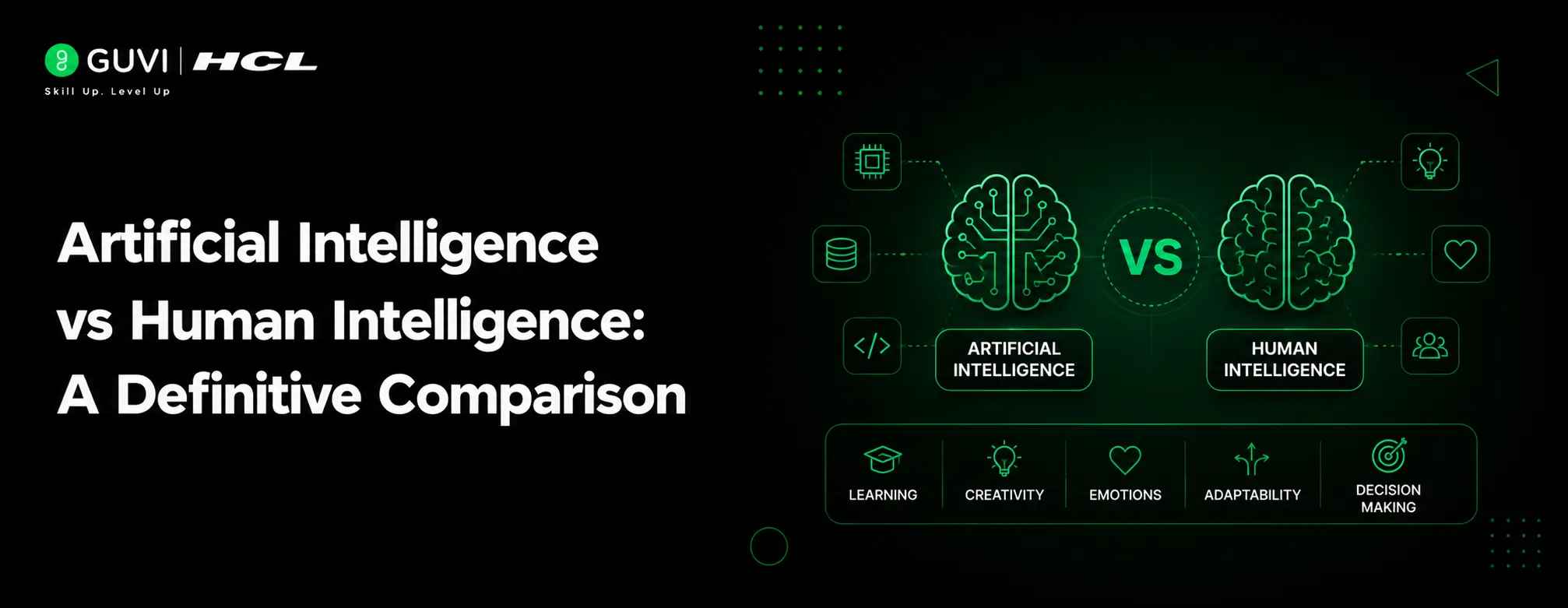
AI vs Human Intelligence: Comparison Table
| Dimension | Artificial Intelligence (AI) | Human Intelligence | Who Wins? |
|---|---|---|---|
| Processing speed & scale | Processes massive datasets in seconds; never tires. | Slower, sequential processing; fatigue affects performance. | AI |
| Learning & adaptation | Learns fast from large labeled datasets; struggles outside its training distribution. | Learns from small amounts of experience; adapts to genuinely new situations. | Humans (novel situations) / AI (data-rich tasks) |
| Creativity | Recombines patterns from training data into new-looking outputs. | Originates ideas from lived experience, emotion, and intent. | Humans |
| Emotional intelligence & empathy | Can simulate/recognize emotional cues in text or voice. | Feels and responds to emotion with genuine understanding. | Humans |
| Ethical & moral judgment | Follows programmed rules and guardrails consistently. | Reasons through context, competing values, and consequences. | Humans |
| Consistency & availability | Available 24/7 with no performance drop from fatigue. | Performance varies with mood, health, and energy. | AI |
| Self-awareness & consciousness | No subjective experience or self-awareness. | Reflects on its own thoughts, motives, and actions. | Humans |
| Handling ambiguity / common sense | Weak outside patterns seen in training. | Strong intuitive grasp of context and unwritten rules. | Humans |
| Energy efficiency | Large models require significant compute and power. | The brain runs on roughly the power of a dim light bulb. | Humans |
| Repetitive, high-volume tasks | Executes with high precision at scale without boredom or error drift. | Prone to fatigue-driven errors on repetitive tasks over time. | AI |
Now that we have discussed the key points here, let’s discuss the difference between artificial intelligence and human intelligence in detail and understand them.
Before moving forward, make sure you understand the basics of Artificial Intelligence & Machine Learning, including algorithms, data analysis, and model training. If you want to learn more, join HCL GUVI’s AI & Machine Learning Course with job placement assistance. You’ll discover important tools like TensorFlow, PyTorch, scikit-learn, and others. Plus, you’ll work on real projects to gain practical experience and improve your skills in this fast-growing field.
What is Artificial Intelligence?

Artificial Intelligence (AI) is a vast field of computer science that focuses on creating systems and technologies that can perform tasks typically requiring human intelligence.
These tasks include learning, reasoning, problem-solving, understanding natural language, perceiving the environment, and adapting to changing circumstances. AI aims to develop machines and software that can help simulate human cognitive functions and automate complex processes, making them more efficient and capable.
AI encompasses a broad range of techniques, technologies, and subfields, including:
1. Machine Learning (ML)
Machine learning is a subset of AI that focuses on developing algorithms that allow computers to learn from data. This involves training algorithms on large datasets to recognize patterns and make predictions or decisions without being explicitly programmed. Standard ML techniques include supervised learning, unsupervised learning, and reinforcement learning.
2. Deep Learning
Deep learning is a subfield of ML that uses artificial neural networks to model and process complex data. It has been particularly successful in tasks like image and speech recognition. Deep learning models, such as convolutional neural networks (CNNs) and recurrent neural networks (RNNs), have achieved remarkable results in various applications.
3. Natural Language Processing (NLP)
NLP is the branch of AI that deals with the interaction between computers and human language. It enables machines to understand, interpret, and generate human language. NLP powers chatbots, language translation, sentiment analysis, and text summarization, among other applications.
4. Computer Vision
Computer vision involves the development of algorithms and systems that allow computers to interpret and understand visual information from the world, such as images and videos. This field is critical for applications like facial recognition, object detection, and autonomous vehicles.
5. Robotics
AI is essential in robotics, enabling machines to perceive their environment, make decisions, and perform physical tasks. Robots can be found in manufacturing, healthcare, and even in space exploration.
AI has seen rapid advancements and real-world applications in recent years. It is used in virtual voice assistants like Siri and Alexa, recommendation systems like those on Netflix and Amazon, self-driving cars, fraud detection, medical diagnosis, and much more.
AI has the potential to revolutionize industries, and every techie must learn Artificial Intelligence to boost their resume and stand out from the competitive crowd.
Tasks AI Does Better Than Humans in 2026 (With Examples)

AI has a clear, well-documented edge in tasks defined by scale, speed, and pattern recognition:
- Data analysis at scale — spotting patterns across millions of records in seconds (fraud detection, medical image screening support).
- Repetitive precision tasks — quality-control checks on assembly lines, document data extraction, code linting.
- Rapid first-draft generation — producing initial drafts of code, summaries, or reports for a human to refine.
- 24/7 consistency — customer-support chatbots and monitoring systems that never need a break.
- Complex calculation and simulation — weather modeling, financial risk modeling, route optimization.
Tasks Humans Still Do Better Than AI (Creativity, Empathy, Ethics)
Despite rapid AI progress, several categories of tasks remain firmly human-led:
- Original creative work — art, music, and writing that draws on lived experience and genuine intent, not just pattern recombination.
- Empathetic care — therapy, nursing, teaching, and any role where trust and emotional attunement are the actual product.
- Ethical and high-stakes judgment calls — situations with competing values and no single “correct” data-driven answer.
- Leadership and negotiation — reading a room, managing conflicting interests, and building consensus.
- Genuinely novel problem-solving — situations with no historical precedent for a model to pattern-match against.

What is Meant by Human Intelligence?

Human intelligence refers to the cognitive and intellectual abilities possessed by humans, which allow them to think, reason, learn, adapt, and solve problems. It is a complex phenomenon that encompasses a wide range of mental capabilities, both innate and acquired through experience and education.
Key aspects of human intelligence include:
1. Reasoning and Problem-Solving
Humans can think critically and solve complex problems. This involves the ability to analyze information, draw logical conclusions, and make informed decisions. Human intelligence allows for abstract and creative thinking, enabling individuals to tackle novel challenges.
2. Learning and Adaptation
One of the defining features of human intelligence is the ability to acquire knowledge and skills through learning. Humans can learn from experience, instruction, and observation. Moreover, human intelligence allows individuals to adapt to new situations and environments, using their existing knowledge to make sense of unfamiliar circumstances.
3. Memory
Human intelligence includes memory functions, which enable individuals to store, recall, and use information over time. Memory plays a crucial role in learning, problem-solving, and decision-making.
4. Language and Communication
Humans have the unique ability to use complex language for communication. This includes the understanding of spoken and written language, as well as the ability to express thoughts and ideas effectively through speech and writing.
Language is a fundamental tool for human intelligence, enabling the transmission of knowledge and the collaboration of individuals in society.
5. Self-awareness and Consciousness
Human intelligence includes self-awareness and consciousness. Humans can introspect, reflect on their thoughts and actions, and experience a sense of self. This consciousness is integral to moral and ethical decision-making.
6. Ethical and Moral Decision-Making
Human intelligence includes the capacity for ethical and moral reasoning. It enables individuals to make value-based decisions and consider the consequences of their actions on themselves and others.
Human intelligence is not static but can be developed and refined throughout one’s life through education, experience, and exposure to diverse ideas and challenges.
Will AI Replace Human Intelligence? Current Expert Consensus
| Direct AnswerNo — most AI researchers and cognitive scientists describe AI as a complement to human intelligence, not a replacement for it. AI is a narrow, task-specific intelligence; human intelligence is general, embodied, and socially and ethically grounded. The realistic trajectory experts describe is augmentation — AI handling data-heavy and repetitive work while humans focus on judgment, creativity, and relationships — rather than full replacement. |
This doesn’t mean the impact is small. Entire workflows are being restructured around AI assistance, and roles that are purely repetitive or purely data-processing are genuinely at higher risk. But “AI replacing human intelligence” and “AI reshaping which human skills are valuable” are two very different claims — and the evidence currently supports the second one, not the first.
Human Intelligence Types (Gardner) vs AI Capabilities Mapping
Psychologist Howard Gardner’s Theory of Multiple Intelligences breaks human intelligence into distinct types — a useful lens for seeing exactly where AI genuinely competes with humans, and where it doesn’t.
| Gardner’s Intelligence Type | What It Covers | Where AI Currently Stands |
|---|---|---|
| Logical-mathematical | Reasoning, numbers, abstract patterns | Strong — AI performs very well here |
| Linguistic | Language, reading, writing, argumentation | Strong for pattern-based generation; weaker on genuine intent and nuance |
| Spatial | Visualizing and manipulating space and images | Improving quickly via computer vision, still narrow |
| Musical | Rhythm, pitch, composition | Can generate patterned output; lacks intentional artistic expression |
| Bodily-kinesthetic | Physical coordination and movement | Weak outside controlled robotics environments |
| Interpersonal | Understanding and relating to other people | Weak — simulates cues, doesn’t genuinely understand people |
| Intrapersonal | Self-understanding, self-reflection | Absent — AI has no self-awareness |
| Naturalistic | Recognizing and classifying patterns in nature | Strong for classification tasks (species/image ID), narrow otherwise |
The pattern is consistent: AI is closing the gap fastest on the more computational intelligence types (logical-mathematical, linguistic pattern generation, naturalistic classification) and remains far behind on the socially and self-referentially grounded ones (interpersonal, intrapersonal, bodily-kinesthetic).
Begin your Artificial Intelligence & Machine Learning journey with HCL GUVI’s Artificial Intelligence & Machine Learning Courses. Learn essential technologies like matplotlib, pandas, SQL, NLP, and deep learning while working on real-world projects.
Conclusion
In conclusion, the comparison between artificial intelligence (AI) and human intelligence made us forget about the significance of their coexistence.
AI offers exceptional computational power, speed, and precision in specialized tasks, while human intelligence excels in creativity, emotional depth, and the ability to navigate nuanced contexts.
Rather than seeing these intelligences as competitors, it is more apt to view them as complementary forces.
As we continue to advance in the age of AI, we are reminded that the unique qualities of human intelligence, such as empathy, innovation, and moral reasoning, remain essential in shaping a more balanced, ethical, and harmonious world.
FAQs
What is the fundamental difference between artificial intelligence and human intelligence?
AI is machine-based, driven by data and algorithms, while human intelligence is biological, involving emotions, consciousness, and intuition.
Which tasks can AI perform better than humans?
AI excels in tasks requiring vast data processing, such as data analysis and pattern recognition.
Can AI learn from experience?
Yes, AI can learn from data and experiences, but its learning is limited to the data it’s exposed to.
Is it possible for AI to develop consciousness like humans?
No, current AI lacks consciousness and self-awareness and is unlikely to develop it in the near future.
Is there a future where AI could surpass human intelligence?
While AI continues to advance, it’s unlikely to surpass human intelligence in terms of emotional depth, creativity, and complex understanding, as these are deeply rooted in the human experience.
Success Stories

About the Author
Lukesh S
A professional content writer who has experience in freelancing and now working as a Technical Content Writer at HCL GUVI having sound knowledge in Blog Writing and Creative Writing!
View all posts by Lukesh S
Connect with me @

Did you enjoy this article?
Comments












So good and it helped me in my 20 pages of assignment. Thanks alot . I should be thankful to you 🥰🫠😉👏