


Artificial Intelligence and Machine Learning Articles
Finance Manager to Data Analytics: Career Growth, Salary and Seniority
How to Evaluate LLM Outputs in Production Deployments
AI/ML Skills Gap 2026: Why Companies Can't Find Job-Ready Talent
20 AI/ML Interview Questions Recruiters Can Use Without a Tech Background - Best Guide


Get In Touch For Details! Request More Information

Is Machine Learning Market Saturated in 2026? Honest Answer with Job Data
Sep 30, 2026 7 Min Read 13312 Views
(Last Updated)
Every few months, the same question appears on LinkedIn and Reddit: Is machine learning oversaturated now that everyone is learning it? Opinions differ, but the data offers a clearer answer. Let us examine what job postings, salary reports and hiring trends reveal about the machine learning market in 2026.
ML and AI job postings jumped 89% in June 2025 compared to January 2025, and 150% compared to June 2024, according to job market tracker Public Insight. That’s not a saturated market. That’s a hiring surge.
Quick Answer: Machine learning is not saturated in 2026, but entry-level candidates with only theoretical skills face strong competition.
Here is the crux of the machine learning job market in 2026:
- Basic Python and notebook projects are no longer enough.
- Deployment and MLOps skills improve job opportunities.
- GenAI and LLM experience helps candidates stand out.
- Specialised ML roles face less competition.
- Practical projects matter more than course certificates.
Table of contents
- ML Job Market Data: 2022 to 2026
- Why the Saturation Myth Exists
- ML Roles That Are NOT Saturated in 2026
- ML Role Demand and Salary Snapshot (India, 2026)
- ML is Saturated vs AI Engineering Demand: What's the Difference?
- Traditional Machine Learning
- AI Engineering
- Has GenAI Replaced Traditional Machine Learning?
- Which Skills Help Candidates Stand Out in the ML Job Market?
- Which Industries Are Hiring Machine Learning Professionals in India?
- How Can You Build a Job-Ready Machine Learning Portfolio?
- Common Mistakes Job Seekers Make
- Staying at the Notebook Stage
- Ignoring Model Deployment
- Skipping GenAI Skills
- Applying Only for Data Scientist Roles
- Collecting Certificates Without Building Projects
- Building the Same Projects as Everyone Else
- What Is the Future of the Machine Learning Job Market?
- Conclusion
- FAQs
- Is machine learning saturated in 2026?
- Is machine learning still worth learning in 2026?
- Is the machine learning job market saturated for freshers?
- Will AI and ChatGPT replace machine learning engineers?
- Which machine learning jobs are in demand in 2026?
ML Job Market Data: 2022 to 2026
The saturation fear didn’t come from nowhere. Here’s the actual pattern, year by year:
- Late 2022 to most of 2024: ML job postings stayed relatively flat. Few new roles opened up, which fed the “market is full” narrative among job seekers watching a quiet hiring cycle.
- Early 2025: Postings spiked sharply. One analysis of 1,000 ML job listings found postings jumped from a slow baseline to 425 in March 2025 and 433 in April 2025, a dramatic leap compared to the previous two years.
- January to June 2025: AI and ML postings rose 89% within just six months, with over 5,000 total postings tracked across full-time, part-time, and contract roles in the US alone.
- Longer term view: The World Economic Forum projects AI and ML specialist demand will grow 40%, or roughly 1 million new jobs, between 2022 and 2032.
So the slow 2023 to 2024 period wasn’t a sign of saturation. It was a pause before GenAI adoption pushed companies to hire real ML and AI teams instead of just running pilots. Once enterprises moved from testing large language models to actually building products around them, hiring followed almost immediately.
Why the Saturation Myth Exists
Part of the confusion comes from timing. Thousands of learners finished ML bootcamps and online courses between 2022 and 2024, right when hiring was at its quietest. That created a mismatch: more graduates entering the market at the exact moment fewer roles were opening.
Add to that the visibility of layoffs at large tech companies during the same period, and it’s easy to see why “ML is dead” narratives spread. But those layoffs were mostly unrelated to ML demand itself. They were broader cost-cutting moves, and many of the same companies resumed aggressive ML and AI hiring within a year.
The result is a market that punishes candidates who stopped at course completion, while rewarding anyone who kept building applied, deployable skills through that quiet period.
ML Roles That Are NOT Saturated in 2026
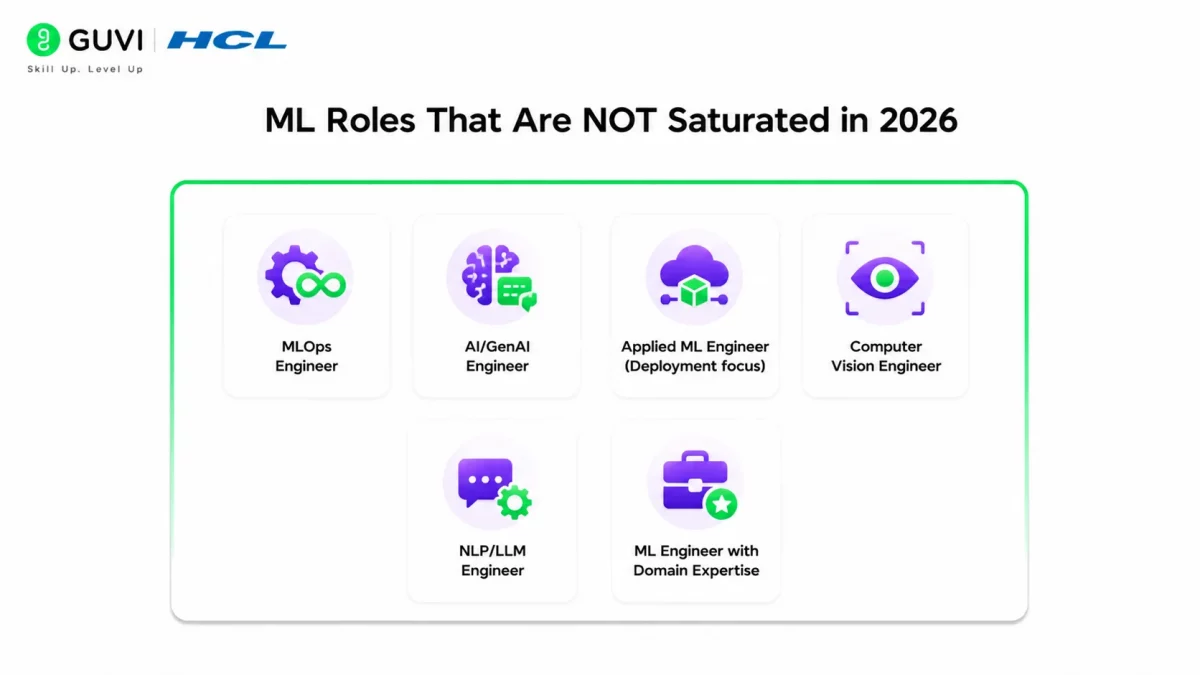
Not every machine learning role faces the same level of competition. Some specialised positions still have more openings than qualified candidates. The difference usually comes down to one question: Can the candidate only train a model or can they also turn it into a working product?
If you want better career opportunities in 2026, these roles are worth exploring:
- MLOps Engineer: Builds the infrastructure required to deploy, monitor and update ML models. Employers look for knowledge of Docker, Kubernetes, CI/CD pipelines, cloud platforms and model-monitoring tools.
- AI/GenAI Engineer: Integrates LLMs, RAG pipelines and vector databases into real applications. These engineers also evaluate model responses and improve the reliability of AI features.
- Applied ML Engineer: Takes a model beyond the experimentation stage. The role involves creating APIs, connecting models with applications and ensuring they perform reliably with real-world data.
- Computer Vision Engineer: Develops systems that analyse images and videos. Opportunities exist in healthcare imaging, manufacturing quality control, retail, security and autonomous vehicle technology.
- NLP/LLM Engineer: Builds language-based systems using embeddings, fine-tuning and retrieval methods. These professionals may work on enterprise search engines, chatbots and document-processing systems.
- ML Engineer With Domain Expertise: Combines machine learning knowledge with an understanding of healthcare, fintech, logistics or manufacturing. This combination is valuable because companies need professionals who understand both the technology and the business problem.
Why are these roles less saturated? They require practical skills that take time to develop. Completing an online course may teach you how to train a model. However, it may not teach you how to deploy that model, monitor its performance or manage failures after launch.
So, which part of the machine learning market is actually saturated? It is the entry-level talent pool where candidates only know basic Python, scikit-learn and small Kaggle-style projects.
Imagine that two candidates apply for the same ML position. One presents a notebook that predicts customer churn. The other presents the same model as a deployed application with an API, monitoring dashboard and retraining workflow. Which candidate appears more job-ready? In most cases, the second candidate will have a clear advantage.
Many beginners get stuck because their portfolios look almost identical. Candidates who add deployment, MLOps, cloud and GenAI skills can differentiate themselves. The goal is not to collect more certificates. It is to prove that you can solve a real problem and turn an ML model into a reliable product.
ML Role Demand and Salary Snapshot (India, 2026)
How much can machine learning professionals earn in India? The answer depends on the role, experience and ability to work with production systems.
| ML Role | Job Demand | Typical Salary Range in India | Competition Level |
|---|---|---|---|
| Machine Learning Engineer | High | ₹6–15 LPA | Moderate to high |
| ML Engineer with deployment skills | High | ₹10–22 LPA* | Moderate |
| MLOps Engineer | High | ₹8–20 LPA | Low to moderate |
| AI or GenAI Engineer | High | ₹6.7–18 LPA | Moderate |
| Computer Vision Engineer | Moderate to high | ₹5–11.1 LPA | Moderate |
| Senior Machine Learning Engineer | High | ₹13.5–22.1 LPA | Low to moderate |
| Lead Machine Learning Engineer | High | ₹20–45 LPA | Low |
Salary ranges are based mainly on Glassdoor India salary data available in 2026. The deployment-focused estimate is indicative because Glassdoor does not report it as a separate standardised job title. Actual compensation varies by experience, location, employer and skill set. Job demand and competition levels are directional assessments rather than Glassdoor metrics.
What does this table tell you? Knowing how to train a model is valuable but it is no longer enough to stand out. The real advantage begins when you can package that model inside an API, deploy it to the cloud and monitor its performance. These production skills help employers see that you can contribute beyond experimentation.
For example, two candidates may understand the same ML algorithm. One can explain it inside a notebook. The other can connect it to an application and keep it working with changing data. The second candidate is likely to face less competition and qualify for more specialised roles.
This does not mean every MLOps or GenAI job is easy to secure. These roles still demand strong technical knowledge and practical experience. However, their applicant pools are usually more specialised than those for basic entry-level ML positions. The takeaway is simple: the wider the gap between “can train a model” and “can ship a model,” the greater the candidate’s value. That is also where many self-taught learners fall short.
ML is Saturated vs AI Engineering Demand: What’s the Difference?
Traditional machine learning is crowded at the beginner level. AI engineering remains less saturated because it requires broader production skills.
This difference explains much of the confusion around the machine learning job market. People often discuss machine learning as one broad field. However, employers evaluate basic ML knowledge and production-focused AI engineering very differently.
Traditional Machine Learning
Traditional ML covers regression, classification, clustering and other foundational algorithms. It also includes small projects completed inside Jupyter Notebooks.
These skills are essential for building a strong foundation. However, they are also widely taught through online courses and bootcamps. As a result, many candidates applying for entry-level positions have almost identical skills.
Does this mean you should skip traditional ML? No. You still need these concepts to understand how models learn and make predictions. The goal is to build upon them rather than stop there.
AI Engineering
AI engineering combines ML fundamentals with software development and production deployment. These roles may require experience with LLM integration, RAG pipelines, fine-tuning, APIs and cloud platforms.
Why is AI engineering less saturated? Fewer candidates can build a complete AI feature and keep it working after deployment. Companies need professionals who can evaluate model responses, manage data pipelines and improve system reliability.
For example, building a chatbot with an LLM API is a useful starting project. However, an AI engineer must also connect it to company data, reduce inaccurate responses and monitor its performance.

Has GenAI Replaced Traditional Machine Learning?
No, GenAI has not replaced traditional machine learning. It has raised the level of skills employers expect from ML professionals.
Employers increasingly want candidates who understand how LLMs work alongside core ML concepts. GenAI skills should support your machine learning foundation rather than replace it.
The practical takeaway is simple. Candidates with only theory-level ML knowledge may face greater competition. Those who add deployment, MLOps and GenAI experience can target more specialised opportunities.
Machine learning itself is not facing rejection. Candidates who stop learning after the foundational stage are the ones most likely to struggle.
Which Skills Help Candidates Stand Out in the ML Job Market?
Employers value candidates who can build complete ML solutions rather than only train models:
- Model Deployment: Learn FastAPI, Flask or similar frameworks to expose trained models through APIs.
- Cloud Computing: Understand how platforms such as AWS support model hosting, storage and monitoring.
- MLOps Fundamentals: Gain experience with Docker, CI/CD, model versioning and automated retraining workflows.
- GenAI Development: Learn LLM APIs, embeddings, prompt design and RAG pipeline development.
- Business Understanding: Connect every ML project with a clear user need or measurable business problem.
Which Industries Are Hiring Machine Learning Professionals in India?
Machine learning opportunities are expanding beyond traditional technology companies into several major industries:
- Banking and Fintech: Companies use ML for fraud detection, credit assessment and customer-risk analysis.
- Healthcare: ML supports medical imaging, patient-risk prediction and clinical workflow automation.
- E-commerce and Retail: Businesses use recommendation systems, demand forecasting and customer-churn models.
- Manufacturing: Computer vision and predictive maintenance help companies improve quality and reduce equipment failures.
- Logistics: ML supports route optimisation, delivery forecasting and warehouse management.
How Can You Build a Job-Ready Machine Learning Portfolio?
A strong ML portfolio should show employers how you approach and solve real-world problems:
- Choose a Relevant Problem: Select a use case connected with healthcare, finance, retail or another industry.
- Use Realistic Data: Work with datasets that require cleaning, validation and thoughtful feature selection.
- Build an End-to-End Solution: Include data preparation, model training, evaluation, deployment and monitoring.
- Document Your Decisions: Explain why you selected each model, metric and deployment method.
- Make the Project Accessible: Share the code on GitHub and provide a working demo whenever possible.
Common Mistakes Job Seekers Make
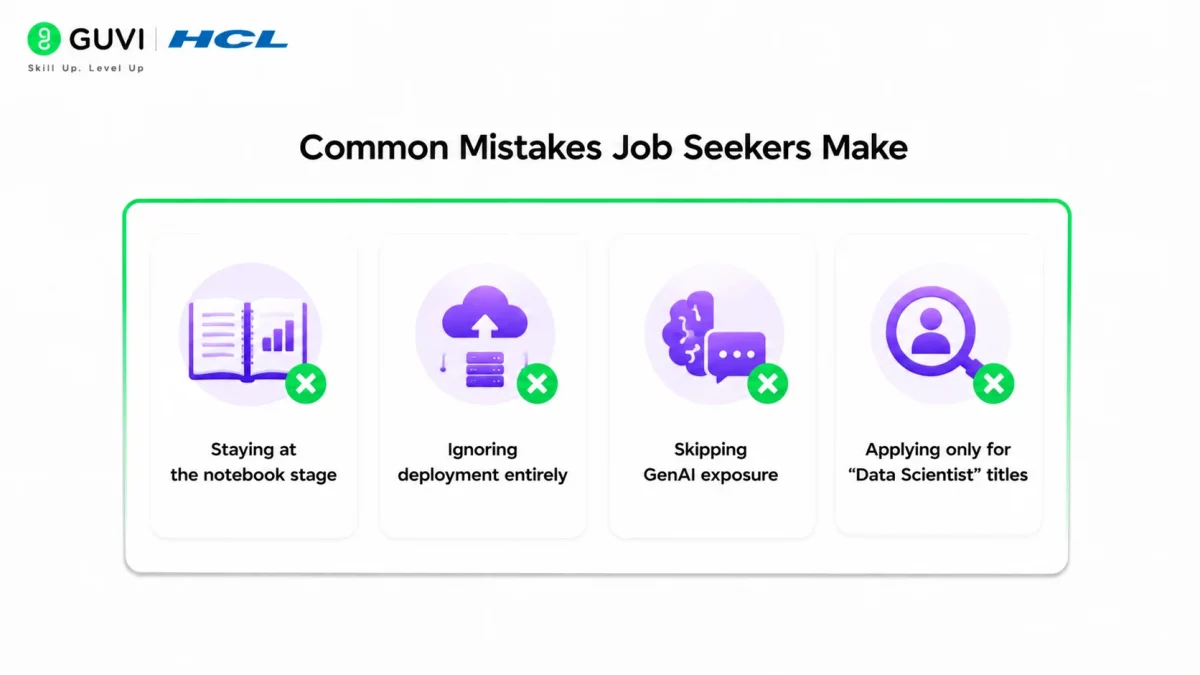
Many candidates struggle to find machine learning jobs because their portfolios do not demonstrate practical ability. Here are the most common mistakes and how you can avoid them.
1. Staying at the Notebook Stage
Completing a course and building a few Jupyter Notebook projects is a useful starting point. However, it may not help you stand out from candidates with similar portfolios.
Take one project beyond the notebook. Build a simple interface, connect the model through an API and allow recruiters to test it.
2. Ignoring Model Deployment
Can you train a model but not deploy it? If so, you are missing an important part of the modern ML workflow.
Learn how to package a model using FastAPI or Flask. You can then deploy it on a cloud platform and monitor how it performs with new data. The AWS guide for beginners can help you understand the cloud concepts needed to get started.
3. Skipping GenAI Skills
You do not need to become an LLM expert immediately. However, basic experience with prompts, embeddings and RAG can strengthen your profile.
Try building a simple application that uses an LLM to answer questions from selected documents. This project can demonstrate that you understand both ML foundations and modern AI workflows.
4. Applying Only for Data Scientist Roles
Searching only for “Data Scientist” jobs can unnecessarily limit your opportunities. Companies use different titles for roles that require similar skills.
Expand your search to include:
- Machine Learning Engineer
- Applied ML Engineer
- AI Engineer
- GenAI Engineer
- MLOps Engineer
- NLP Engineer
- Computer Vision Engineer
Read each job description carefully. The required skills matter more than the job title.
5. Collecting Certificates Without Building Projects
Certificates can show that you completed structured learning. However, they do not automatically prove that you can solve real-world problems.
Create projects that explain the problem, dataset, technical decisions and measurable results. A well-documented project can tell recruiters more than a long list of completed courses.
6. Building the Same Projects as Everyone Else
House-price prediction and sentiment-analysis projects help you understand ML concepts. However, they appear in thousands of beginner portfolios.
Choose a real problem from healthcare, finance, retail or logistics. A focused project can demonstrate technical ability and relevant domain knowledge.
The lesson is simple: do not stop after learning how to train a model. Show employers that you can build, deploy and explain a complete ML solution.
What Is the Future of the Machine Learning Job Market?
The future of machine learning will favour professionals who combine ML knowledge with engineering and business skills:
- More Production-Focused Roles: Companies will need engineers who can move AI systems from pilots into daily operations.
- Greater MLOps Adoption: Model monitoring, governance and automated deployment will become increasingly important.
- Stronger GenAI Integration: ML professionals will work with LLMs, embeddings and retrieval systems across more products.
- Higher Demand for Domain Knowledge: Employers will value candidates who understand industry-specific data and challenges.
- Continued Importance of Fundamentals: Statistics, data quality and model evaluation will remain essential despite changing tools.
Conclusion
So, is machine learning saturated in 2026? No, but the entry-level market has become more competitive.
Knowing Python and training models in a notebook is no longer enough to stand out. Employers increasingly value candidates who can deploy models, build APIs, work with cloud platforms and understand GenAI workflows.
The good news is that you do not need to master everything at once. Start with strong ML fundamentals and turn one project into a complete working application. Then add deployment, MLOps or domain-specific knowledge based on the roles you want to pursue.
Machine learning opportunities are still growing. The candidates who succeed will be those who can move beyond certificates and prove that they can solve real business problems with reliable ML systems.
FAQs
Is machine learning saturated in 2026?
No, machine learning is not completely saturated in 2026. Entry-level roles attract heavy competition because many applicants have similar theoretical skills. However, employers still need professionals who understand deployment, MLOps, cloud platforms and GenAI integration.
Is machine learning still worth learning in 2026?
Yes, machine learning is still worth learning in 2026. It remains essential for recommendation systems, fraud detection, predictive analytics and modern AI applications. The key is to combine ML fundamentals with practical projects and deployment experience.
Is the machine learning job market saturated for freshers?
The machine learning job market is competitive for freshers but not closed. A course certificate and basic notebook projects may not be enough. Freshers can improve their chances by building deployed projects and learning SQL, APIs, cloud basics and model monitoring.
4. Will AI and ChatGPT replace machine learning engineers?
No, AI tools and ChatGPT are unlikely to replace machine learning engineers entirely. They can automate parts of coding and experimentation. However, professionals are still needed to prepare data, design systems, evaluate models and maintain reliable AI products.
Which machine learning jobs are in demand in 2026?
MLOps engineers, AI engineers, GenAI engineers, applied ML engineers and computer vision engineers remain in demand. Employers particularly value candidates who can move models from notebooks into secure and scalable production systems.
Success Stories

About the Author
Vaishali
I'm a seasoned writer with four years of experience across technical, non-technical, and just about every genre or niche you can imagine. Adaptable and curious, I enjoy exploring new topics and making information engaging and easy to understand. Fueled by a steady stream of tea, I approach each project with creativity, reliability, and genuine enthusiasm for storytelling.
View all posts by Vaishali
Connect with me @













Did you enjoy this article?