


Artificial Intelligence and Machine Learning Articles
Weights & Biases Tutorial: A Practical Guide for Machine Learning Engineers
Mage AI Tutorial: A Practical Guide for Data Engineers
Weaviate Tutorial: Build Semantic Search in Minutes
Top Skills for Testing Machine Learning Models in 2026 (Beginner’s Guide)


Get In Touch For Details! Request More Information

What is Informed Search in AI: A Beginner’s Complete Guide
Jul 06, 2026 6 Min Read 82 Views
(Last Updated)
Artificial intelligence is everywhere today, from the GPS guiding your cab to the recommendation system suggesting your next YouTube video. But have you ever wondered how an AI system actually “finds” the best answer from millions of possibilities?
The answer lies in something called search algorithms. These are the methods that allow an AI to explore a problem space and arrive at a solution. Without search, AI would simply be guessing in the dark.
There are two broad families of search algorithms in AI: uninformed search and informed search. Uninformed search algorithms, like Breadth-First Search (BFS) and Depth-First Search (DFS), explore the problem space without any extra guidance.
They check every possible path systematically, which works fine for small problems but becomes painfully slow as the problem grows larger. Think of it like looking for your keys by searching every single drawer, shelf, and corner of your house one by one, with absolutely no idea where you last left them.
In this article, we will explore informed search in AI, understand what makes it smarter than uninformed search, break down the key algorithms like A* and Greedy Best-First Search, and see where these techniques are actually used in the real world. By the end, you will have a solid foundation to understand one of the most important building blocks of modern AI.
Table of contents
- TL;DR Summary
- The Concept of Informed Search
- What Is a Heuristic Function?
- Admissibility and Consistency: Two Properties You Must Know
- Greedy Best-First Search
- A* Algorithm: The Star of Informed Search
- IDA: A Memory-Friendly Alternative
- Informed Search vs Uninformed Search: A Quick Comparison
- Real-World Applications of Informed Search
- How to Choose the Right Search Strategy
- Step 1: Algorithm Selection
- Step 2: Heuristic Mastery
- Conclusion
- FAQs
- What makes informed search better than uninformed?
- Is A* always the best choice?
- How do you create a good heuristic?
- Can informed search fail to find solutions?
- Where is informed search used daily?
TL;DR Summary
- Informed search uses heuristics to guide AI toward goals faster than blind uninformed methods like BFS/DFS.
- Heuristic h(n) estimates cost to goal; must be admissible (optimistic, never overestimates) for optimality.
- Greedy Best-First: f(n) = h(n) only—fast but suboptimal, risks dead ends.
- A*: f(n) = g(n) + h(n)—optimal and complete with good heuristics, powers GPS pathfinding.
- IDA*: Memory-efficient A* variant using iterative deepening for large spaces like puzzles.
- Real apps: GPS routing, game AI, robotics, scheduling—beats exhaustive search in efficiency.
What Is Informed Search in AI?
Informed search is a type of AI search strategy that uses additional knowledge about a problem, known as a heuristic, to guide the search toward the goal more quickly and efficiently than blind exploration. Instead of examining every possible path, it prioritizes the most promising ones.
The Concept of Informed Search
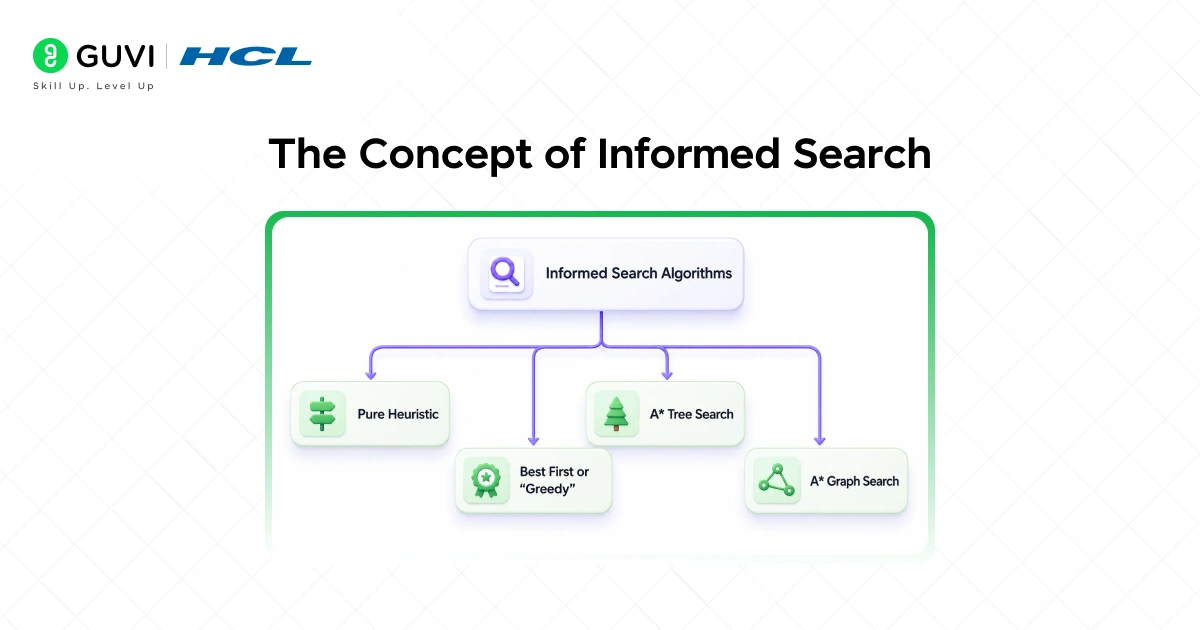
Informed search refers to a search strategy that uses a heuristic function or additional information to guide the search process toward a solution, reducing the search space and computational time.
The key thing that separates it from uninformed search is this piece of extra knowledge, which tells the algorithm roughly how close any given state is to the final goal.
Imagine you are in an unfamiliar city and need to find the nearest hospital. An uninformed approach would mean walking every single street until you stumble upon one.
An informed approach means asking someone, “Which direction is the hospital roughly?” and then walking in that general direction.
You are not guaranteed to take the shortest route, but you are certainly not wasting time going the wrong way. This is exactly the kind of intelligence that informed search brings to AI.
A problem in AI typically consists of states (possible situations), actions (available moves or steps), goal tests (conditions to determine success), and path costs (measuring efficiency).
Informed search algorithms use this structure along with a heuristic estimate to make smarter decisions about which states to explore next.

What Is a Heuristic Function?

The entire idea of informed search rests on something called the heuristic function. The heuristic function, often denoted as h(n), estimates the cost or distance from a given state to the goal state. It is problem-specific and provides a best guess based on available information, designed to accelerate the search process by focusing on promising areas of the search space.
- A classic and beginner-friendly example is the straight-line distance (also called Euclidean distance) between a current city and a destination city on a map. When navigating from Chennai to Mumbai, the straight-line distance tells you roughly how far you still need to travel. It is not the actual road distance, but it is a useful estimate.
- In route planning, when minimizing travel time, a heuristic could use the straight-line distance from the current location to the goal divided by the maximum speed, since it assumes the traveler could drive straight to the destination at top speed, which is never an overestimate.
- The quality of your heuristic directly determines how good your informed search will be. A heuristic that is too inaccurate gives poor guidance, while a well-designed heuristic makes the algorithm remarkably fast.
- The effectiveness of a heuristic function is largely dependent on its ability to accurately estimate the cost to the goal. A good heuristic can significantly reduce the computational time and resources required for the search, while a poor heuristic can mislead the search and result in suboptimal solutions or increased search time.
Admissibility and Consistency: Two Properties You Must Know
Before we jump into the algorithms, it is important to understand two properties of a heuristic that determine whether an informed search will find the best solution or just any solution.
- The first property is admissibility. An admissible heuristic is used to estimate the cost of reaching the goal state in an informed search algorithm. In order for a heuristic to be admissible to the search problem, the estimated cost must always be lower than or equal to the actual cost of reaching the goal state.
- In simple terms, an admissible heuristic is an optimistic one; it never thinks the goal is farther than it actually is. Think of it as a friend who always says, “The restaurant is at most 5 minutes away,” and it actually turns out to be 3 minutes. They never overshoot.
- The second property is consistency (also called monotonicity). A consistent heuristic means the estimated cost should be less than or equal to the cost of reaching a neighboring node plus the heuristic cost from that node to the goal. Consistency ensures that as you move through the search, your estimates never get worse.
- Consistent heuristics are particularly advantageous in informed search algorithms like A*, as they ensure that as the search algorithm progresses, it does not encounter situations where a more promising path is overlooked due to heuristic inconsistencies.
Greedy Best-First Search
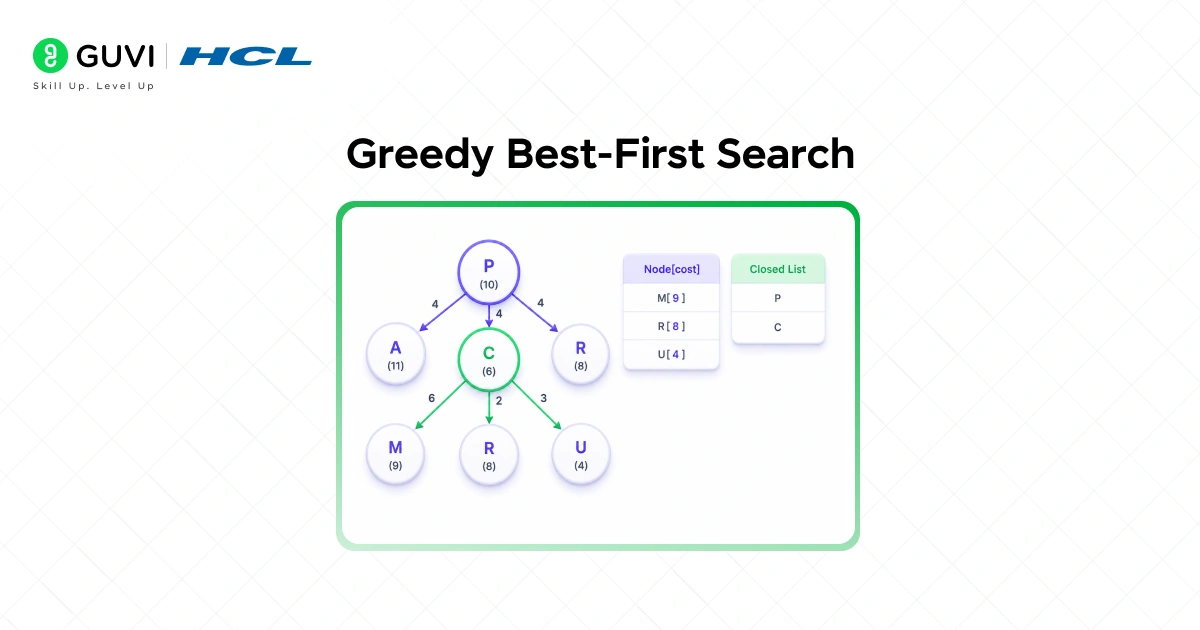
Now, let us look at the actual algorithms. The simpler of the two major informed search algorithms is greedy best-first search.
- As the name suggests, this algorithm is greedy. Greedy Best-First Search always picks the next step that looks closest to the goal, using a guess (heuristic) about which choice is best. It tries to reach the goal as quickly as possible, but it is not guaranteed to find the shortest path.
- The evaluation function here is purely f(n) = h(n), meaning the algorithm only cares about how close a node seems to be to the goal, not how much effort it took to get there. This makes it very fast in many situations but also risky.
- It can rush down a path that looks promising early on, only to end up in a dead end or a much longer route. In a map navigation example, Greedy Best-First might steer you straight toward your destination but take you through heavy traffic, while a longer-looking road would have been quicker.
- The biggest limitation of greedy best-first search is that it is not optimal and not always complete. It prioritizes looking good now over finding the best solution overall. It is the kind of algorithm that gives fast, reasonable answers but should not be trusted when precision matters.
A* Algorithm: The Star of Informed Search
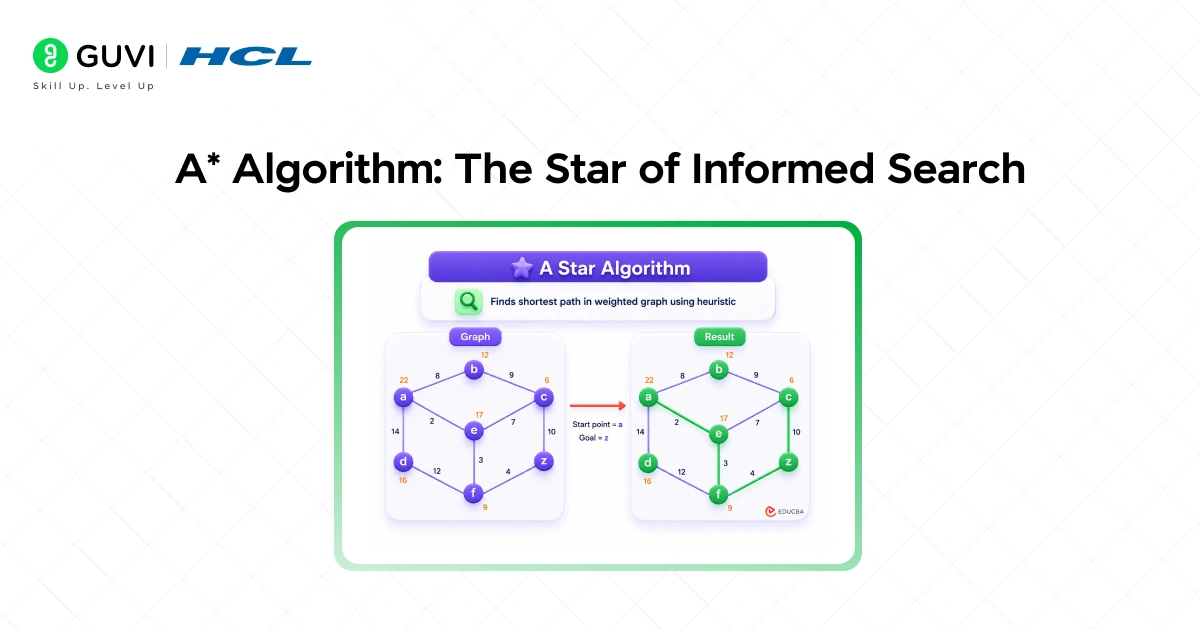
If Greedy Best-First Search is impulsive, A* (pronounced “A-star”) is methodical. A* Search finds the shortest path by combining two things: how far we have already gone and a guess of how far is left to go. It checks both actual progress and potential, making it very reliable if the heuristic is good.
The evaluation function in A* is f(n) = g(n) + h(n)
Here, g(n) is the actual cost to reach the current node from the start, and h(n) is the heuristic estimate from the current node to the goal.
- By adding both together, A* always picks the node that seems most efficient overall, not just the one that looks close to the goal and not just the one that was cheapest to reach, but the best combination of both.
- Uniform cost search is good because it is both complete and optimal, but it can be fairly slow because it expands in every direction from the start state while searching for a goal.
- If we have some notion of the direction in which we should focus the search, we can significantly improve performance and home in on a goal much more quickly. This is exactly the focus of informed search.
- A* is both complete (it will always find a solution if one exists) and optimal (it will find the best solution), provided the heuristic is admissible.
- An admissible heuristic never overestimates the cost to reach the goal. With an admissible heuristic, A* using tree search is guaranteed to be optimal. This makes A* the most trusted and widely used informed search algorithm in AI.
- A* does have one weakness worth noting. A* can consume high memory for large graphs or spaces, since it needs to keep track of all visited and potential nodes throughout the search. For very large or complex environments, this memory usage can become a bottleneck.
Informed search algorithms power many of the intelligent systems people use every day.
Google Maps uses variants of A* with traffic-aware heuristics to continuously optimize routes and reduce commute times in real time. In gaming, engines like Unity rely on informed search for NPC pathfinding, helping characters navigate massive open-world environments efficiently. Even advanced Rubik’s Cube solvers use algorithms like IDA* to solve puzzles in seconds—problems that uninformed brute-force search would take an impractical amount of time to complete. Similar techniques are also used in healthcare AI to explore and recommend optimal treatment paths under complex constraints.
IDA: A Memory-Friendly Alternative
- For situations where memory is limited, IDA* blends A*’s optimality and memory-efficient depth-first search.
- It performs iterative deepening using increasing cost thresholds computed from f(n). It is particularly useful for large search spaces, like puzzle solving, where memory efficiency is crucial.
- IDA* works by repeatedly performing a depth-first search within a cost threshold. If the goal is not found within the current threshold, it raises the threshold slightly and starts again.
- While this means it repeats some work with each iteration, it avoids storing large numbers of nodes in memory, making it practical for problems like the 15-tile puzzle or complex game trees.
Informed Search vs Uninformed Search: A Quick Comparison
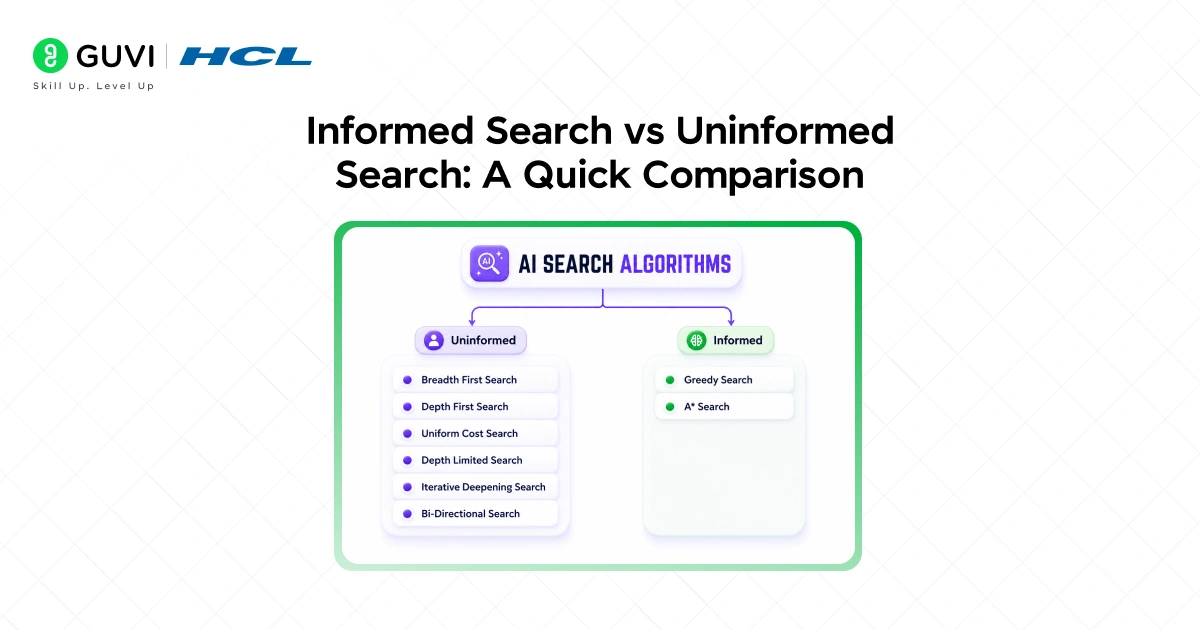
Understanding the difference between the two types makes the value of informed search very clear. Informed search uses additional knowledge or heuristics to direct the search process more efficiently, enabling faster problem-solving.
In contrast, uninformed search explores the entire search space without any additional information, often leading to more exhaustive and resource-heavy searches.
Uninformed search is like a robot that checks every path without any sense of direction. Informed search is like a robot that says, “The goal is probably to the east, let me head east.” The robot might not be perfect, but it will almost certainly get there faster.
Uninformed search lays the foundation of AI problem-solving, while informed search brings in intelligence and efficiency. Most real-world AI applications rely heavily on informed search techniques, especially A* and heuristic-based methods.
Real-World Applications of Informed Search
Informed search is not just a classroom concept. It is the engine behind many tools you use daily. Search algorithms are used in navigation systems like GPS and maps to find the shortest or fastest route between locations.
- AI systems in games such as chess and video games use search algorithms to explore possible moves and choose the best strategy. Robots use search algorithms to plan paths, avoid obstacles, and move efficiently in an environment.
- Route planning using GPS navigation systems uses A* with heuristic functions to find the shortest route between two locations.
- Scheduling problems in project management, resource allocation, and job scheduling can also be efficiently solved using heuristic-based algorithms. Heuristic-based search is also fundamental in solving puzzles like the 8-puzzle, Rubik’s Cube, and crosswords.
- Beyond these, informed search plays a role in natural language processing, where beam search (a variant) helps in machine translation.
- It is used in robotics for motion planning, in healthcare AI for diagnostic pathfinding, and in supply chain optimization for efficient routing of goods.
How to Choose the Right Search Strategy
Step 1: Algorithm Selection
Pick based on priorities:
- Speed over perfection? Greedy Best-First fast, good-enough paths via pure heuristics.
- Guaranteed optimal? A* shortest/least-cost paths, memory-intensive.
- Large spaces, low memory? IDA* A* with depth limits for efficiency.
Step 2: Heuristic Mastery
Success hinges on quality, heuristic problem-specific cost estimates to the goal.
- Design requires domain knowledge (e.g., Manhattan distance for grids).
- Challenges: Balance accuracy vs. computation.
- Pro skill: Crafting heuristics turns good AI into great creative, high-impact expertise.
If you’re serious about mastering informed search strategies like A*, Greedy Best-First, and IDA* with heuristic design for optimal AI pathfinding, don’t miss the chance to enroll in HCL GUVI’s Intel & IITM Pravartak Certified Artificial Intelligence & Machine Learning Course, co-designed by Intel.
Conclusion
Informed search is a cornerstone of artificial intelligence. It transforms the way AI agents solve problems by replacing brute-force exploration with guided, intelligent decision-making. The heuristic function is the brain behind this intelligence it gives the algorithm a sense of direction, allowing it to skip unnecessary paths and focus on what actually matters.
From the A* algorithm powering your Google Maps directions to the pathfinding logic inside your favorite video game characters, informed search is silently at work all around you.
As a beginner, the best way to cement these concepts is to pick a simple problem like navigating a grid and try implementing Greedy Best-First Search and A* yourself. Seeing the difference in the paths they choose will make these ideas click far more than any explanation can. Informed search is where AI stops feeling like magic and starts feeling like a very well-designed compass.
FAQs
1. What makes informed search better than uninformed?
Informed uses heuristics for direction, slashing search time vs. exhaustive exploration.
2. Is A* always the best choice?
Yes for optimality with admissible heuristics, but memory-heavy; use IDA* for large spaces.
3. How do you create a good heuristic?
Problem-specific estimates like straight-line distance (maps) or Manhattan distance (grids) never overestimate.
4. Can informed search fail to find solutions?
Complete algorithms like A*/IDA* always succeed if a solution exists; greedy may get stuck.
5. Where is informed search used daily?
GPS navigation, video game AI, robotics motion planning, and supply chain optimization.
Success Stories

About the Author
Vishalini Devarajan
An Aerospace Engineer turned content writer, I focus on making complex concepts easy to understand through well-structured, reader-friendly blogs. Whether it’s a technical topic or a non-technical one, I love creating content that is clear, engaging, and impactful.
View all posts by Vishalini Devarajan
Connect with me @













Did you enjoy this article?