


Project Articles
Automated Resume Screener: NLP-Based Python Project with Source Code
Business Analysis in Digital Transformation Projects - Best Guide
Build No-Code AI Agents with Flowise AI: Step-by-Step Beginner Guide


Get In Touch For Details! Request More Information

10 Unique Deep Learning Project Ideas 2026 [With Source Code]
Sep 15, 2026 5 Min Read 67582 Views
(Last Updated)
Deep learning is a branch of machine learning that uses layered neural networks to learn patterns from data on its own, without manual feature engineering. You learn it best by building things, not by only reading theory.
Table of contents
- TL;DR Summary:
- Why Deep Learning Project Ideas Matter More Than Certificates
- Top 10 Deep Learning Project Ideas
- Beginner Level Projects
- Handwritten Digit Recognition Using CNN
- Facial Emotion Recognition Using CNN
- Intermediate Level Projects
- Real-Time Object Detection Using YOLO
- Music Genre Classification Using Audio Data
- Neural Style Transfer
- Human Activity Recognition Using LSTMs
- Advanced Level Projects
- Image Caption Generator Using CNN and LSTM
- Text Summarization Using Seq2Seq Model
- Image Super-Resolution Using GANs
- DeepFake Video Detection
- Tools and Resources You'll Need
- Common Mistakes Beginners Make
- Conclusion
- FAQs
- What are the easy Deep Learning project ideas for beginners?
- Why are Deep Learning projects important for beginners?
- What skills can beginners learn from Deep Learning projects?
- Which Deep Learning project is recommended for someone with no prior programming experience?
- How long does it typically take to complete a beginner-level Deep Learning project?
- What is the difference between a machine learning project and a deep learning project?
- Which deep learning projects are best for computer vision roles?
TL;DR Summary:
- Start with image or digit recognition projects if you’re new to neural networks. They teach you CNN basics in under a week.
- Move to NLP and audio projects (sentiment analysis, music genre classification) once you’re comfortable with model training.
- Advanced learners should target GenAI and RAG-based projects, since these match 2026 hiring trends for AI Engineer roles.
- Pick 3 to 5 projects that build on each other instead of 15 disconnected ones. Recruiters value depth over quantity.
- Use free tools like Google Colab, Kaggle Notebooks, and Hugging Face Spaces so cost is never a blocker.
Why Deep Learning Project Ideas Matter More Than Certificates
A certificate tells a recruiter you sat through a course. A project tells them you can actually build something. This gap is exactly why most deep learning job postings now list “practical project experience” as a requirement, not a preference.
You also learn faster by doing. Reading about backpropagation is one thing. Watching your own model’s accuracy improve after you fix a bug is what makes the concept stick.
Top 10 Deep Learning Project Ideas
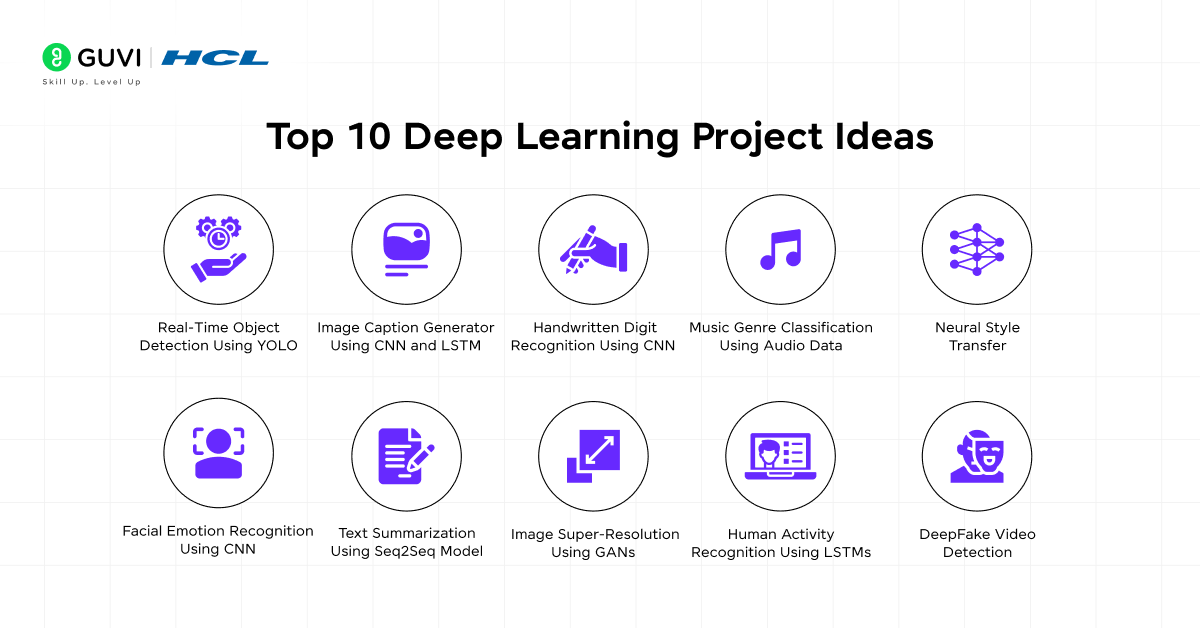
| Project | Level | Skills | Time to Complete |
|---|---|---|---|
| Handwritten Digit Recognition Using CNN | Beginner | CNN basics, image preprocessing, model evaluation | 1 week |
| Facial Emotion Recognition Using CNN | Beginner | Feature extraction, real-time inference | 2 to 3 weeks |
| Real-Time Object Detection Using YOLO | Intermediate | YOLO architecture, video frame processing | 2 to 3 weeks |
| Music Genre Classification Using Audio Data | Intermediate | Audio preprocessing, spectrogram feature extraction | 2 to 3 weeks |
| Neural Style Transfer | Intermediate | Transfer learning, pre-trained CNNs (VGG19) | 1 to 2 weeks |
| Human Activity Recognition Using LSTMs | Intermediate | LSTM networks, time-series sensor data | 3 weeks |
| Image Caption Generator Using CNN and LSTM | Advanced | CNN + LSTM integration, image feature extraction, text generation | 3 to 4 weeks |
| Text Summarization Using Seq2Seq Model | Advanced | Seq2Seq architecture, ROUGE scoring | 3 to 4 weeks |
| Image Super-Resolution Using GANs | Advanced | GAN architecture, PSNR and SSIM evaluation | 4 to 5 weeks |
| DeepFake Video Detection | Advanced | Temporal modelling, forensic AI, video analysis | 4 to 6 weeks |
Working on deep learning projects can seem challenging, but with the right guidance and resources, you can start learning by doing.
Each of these deep learning project ideas is designed to cater to different levels of expertise. So, if you’re ready to dive in, let’s explore these projects.
Beginner Level Projects
1. Handwritten Digit Recognition Using CNN
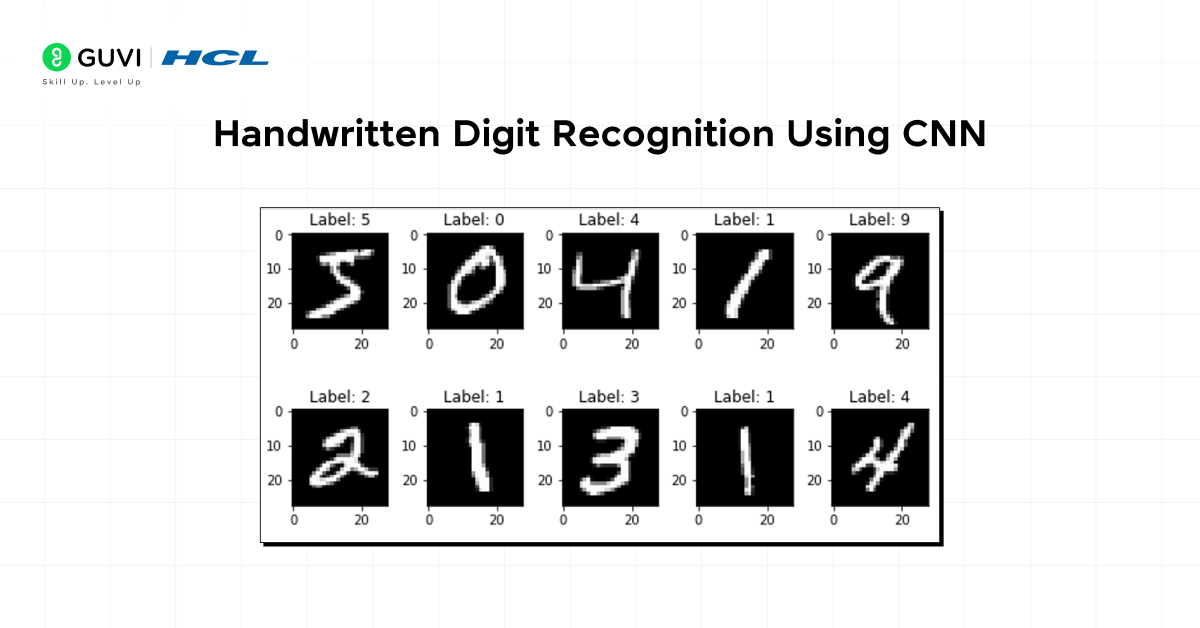
This beginner-friendly project uses a Convolutional Neural Network (CNN) to classify handwritten digits from the MNIST dataset. It’s one of the classic deep-learning projects, ideal for learning how CNNs work.
Time Taken: 1 week
Learning Outcomes:
- Understand the architecture and working of CNNs.
- Learn how to preprocess and classify images.
Features of the Project:
- Simple classification model that recognizes handwritten digits.
- Effective for understanding the basics of image classification.
Source Code: MNIST Handwritten Digit Classification
The MNIST CNN project is the “Hello World” of deep learning. If any CNN concepts — convolution layers, pooling, activation functions — are still unclear, HCL GUVI’s free Python handbook covers the NumPy and array operations that power every CNN: Python Tutorial
2. Facial Emotion Recognition Using CNN
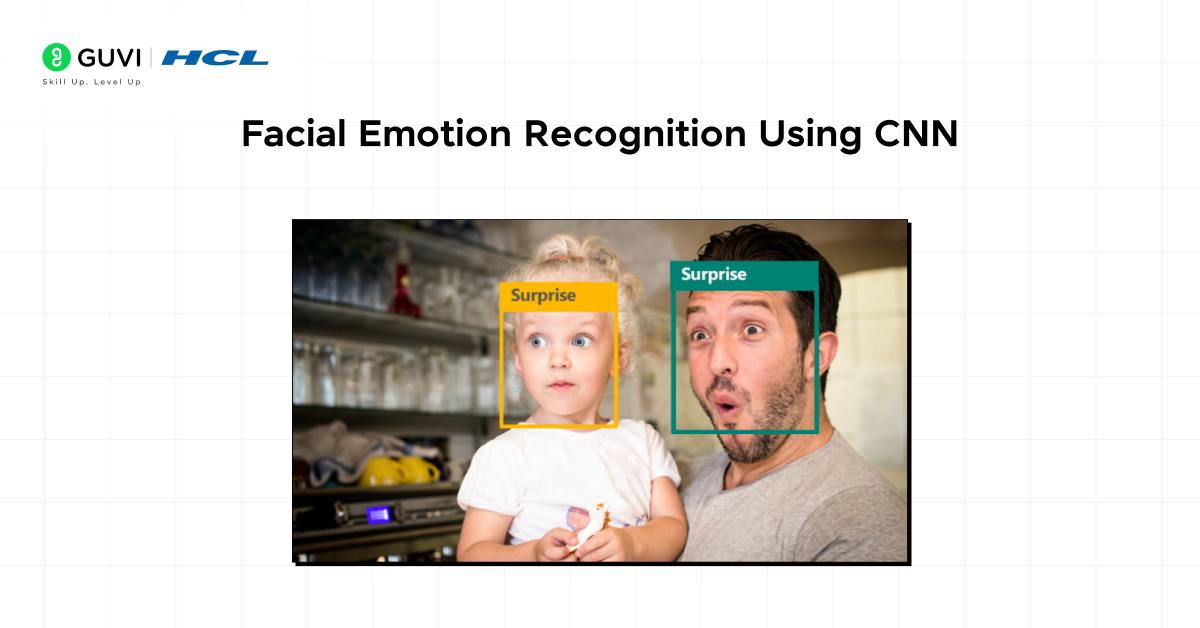
This project involves using a Convolutional Neural Network (CNN) to recognize human emotions from facial expressions in real-time.
You’ll train the model on a dataset of facial images to detect emotions such as happiness, sadness, anger, and surprise.
Time Taken: 2-3 weeks
Learning Outcomes:
- Understand how CNNs can be used for feature extraction in facial recognition tasks.
- Learn about facial emotion recognition techniques using deep learning.
Features of the Project:
- Real-time emotion detection using video feeds or static images.
- Ability to classify multiple emotions from facial expressions.
Source Code: Facial Emotion Recognition
Intermediate Level Projects
3. Real-Time Object Detection Using YOLO
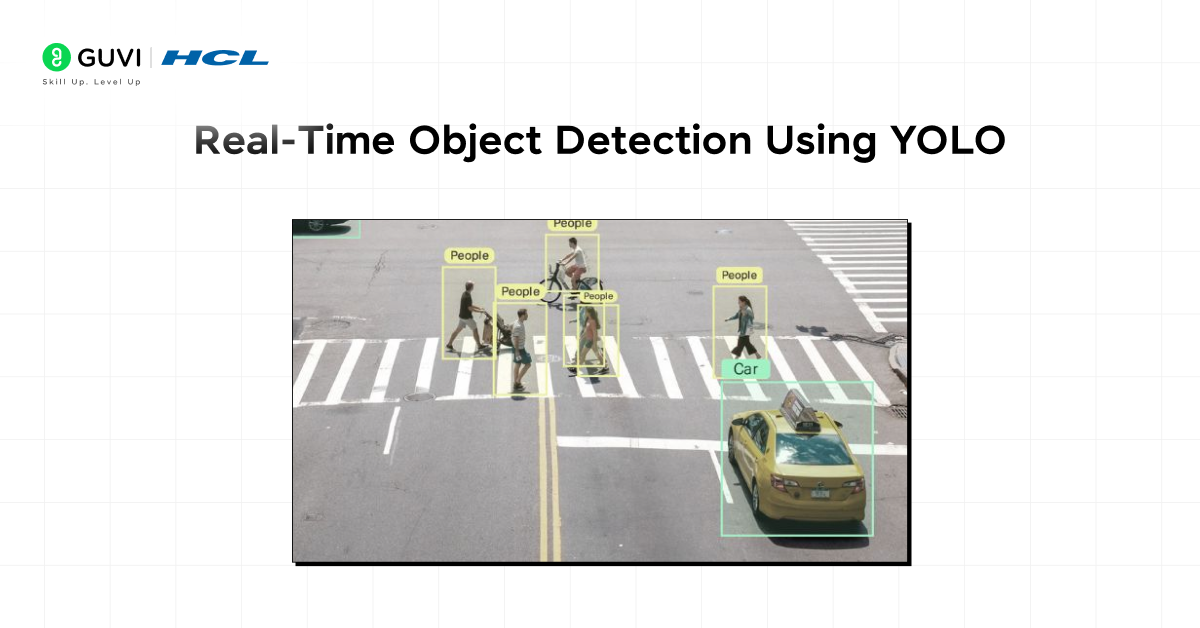
This project focuses on using the YOLO (You Only Look Once) algorithm for real-time object detection in video streams. YOLO is known for its speed and accuracy, making it a preferred choice for applications like autonomous driving and surveillance. The model processes video frames and identifies objects in real-time.
Time Taken: 2-3 weeks
Learning Outcomes:
- Understanding the YOLO architecture and its real-time applications.
- Learn about object detection techniques and preprocessing video streams.
Features of the Project:
- Real-time object detection from video streams.
- Ability to detect multiple objects simultaneously with high accuracy.
Source Code: YOLO Object Detection
4. Music Genre Classification Using Audio Data
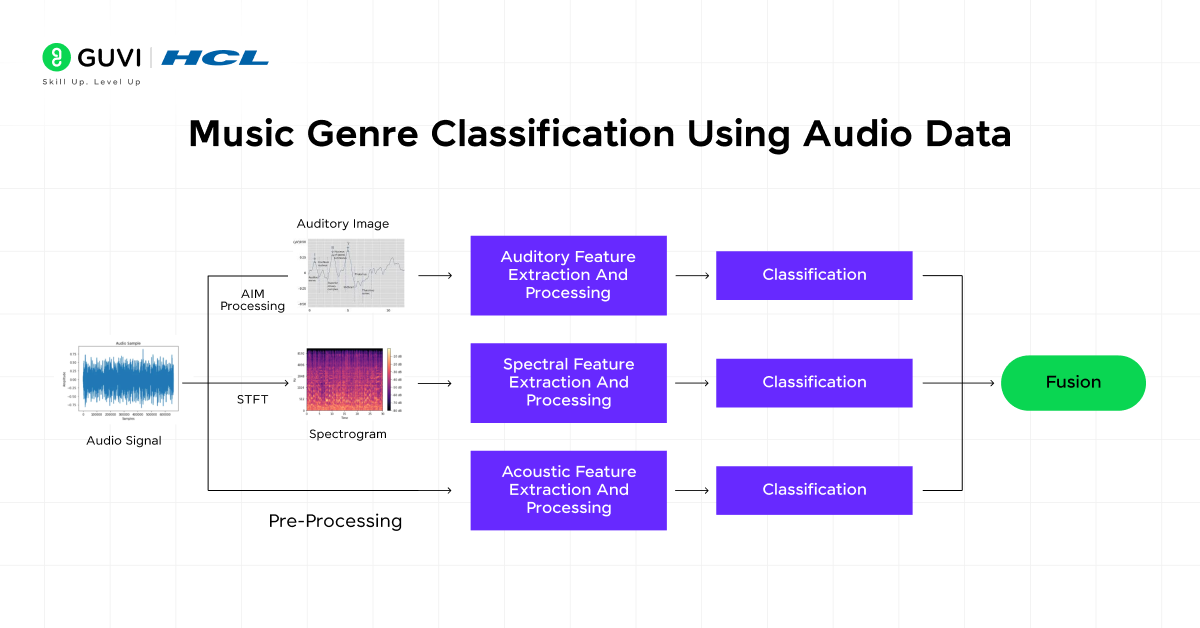
In this project, you’ll build a model to classify music genres using audio data. The project involves extracting features from audio files (e.g., spectrograms) and feeding them into a deep-learning model for genre classification.
Time Taken: 2-3 weeks
Learning Outcomes:
- Learn how to work with audio data and preprocess it for machine learning models.
- Understand feature extraction techniques for audio classification.
Features of the Project:
- Classifies music tracks into different genres based on audio data.
- Demonstrates feature extraction from audio signals using deep learning.
Source Code: Music Genre Classification
5. Neural Style Transfer
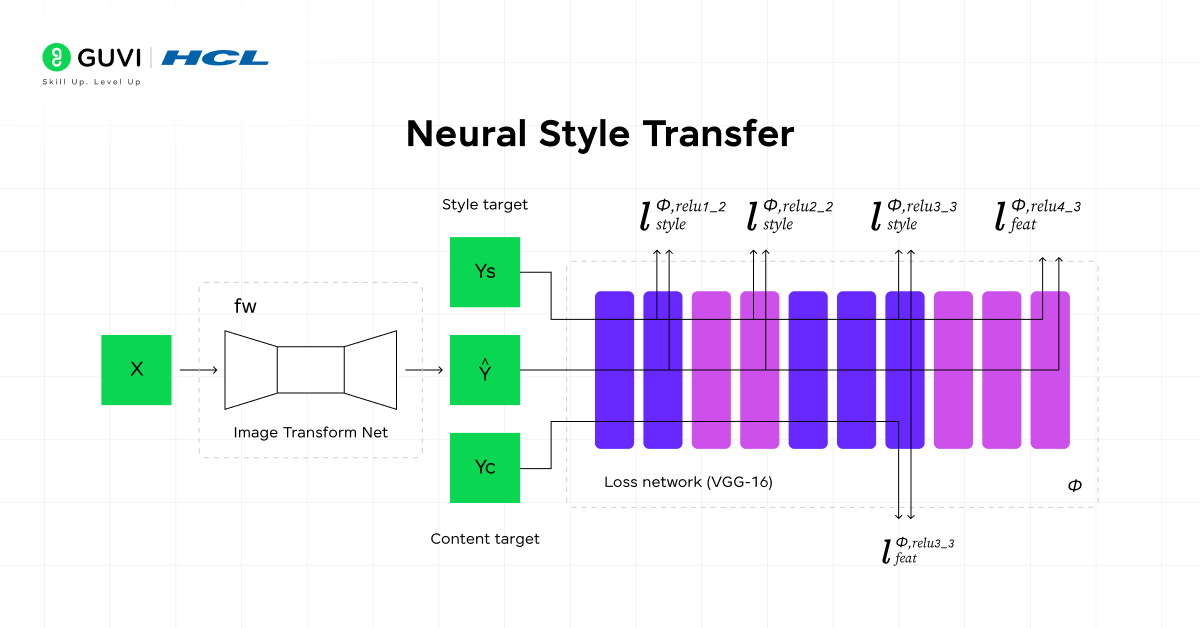
This project is about creating images by transferring the style of one image to another. Neural Style Transfer uses deep learning models to generate artistic images by combining the content of one image with the style of another, giving users the ability to create their own AI-generated artwork.
Time Taken: 1-2 weeks
Learning Outcomes:
- Understand how to apply neural networks for style transfer between images.
- Learn the basics of deep neural networks and their artistic applications.
Features of the Project:
- Allows users to generate artistic images by combining different styles.
- Uses deep neural networks to merge the content and style of images.
Source Code: Neural Style Transfer
Neural Style Transfer uses pre-trained CNN architectures like VGG19 to extract and recombine features — a foundational technique in generative AI. HCL GUVI’s AI & ML course covers transfer learning, GenAI, and image generation models: AI & ML Course
6. Human Activity Recognition Using LSTMs
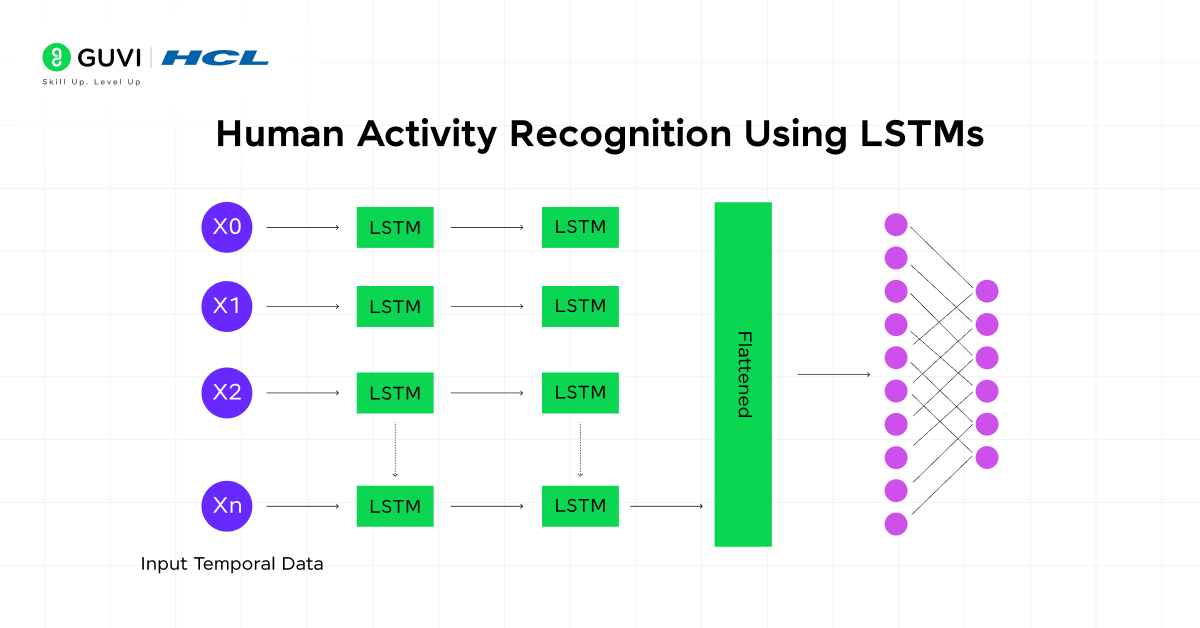
In this project, you’ll build a model using Long Short-Term Memory (LSTM) networks to recognize human activities like walking, running, or sitting based on sensor data.
This project is particularly useful for wearable device applications such as fitness trackers.
Time Taken: 3 weeks
Learning Outcomes:
- Learn how to use LSTMs for time-series data, particularly for sensor-based activity recognition.
- Understand the basics of activity recognition and its applications in health monitoring.
Features of the Project:

- Classifies human activities from sensor data in real-time.
- Can be applied in fitness apps or health monitoring devices.
Source Code: Human Activity Recognition
Advanced Level Projects
7. Image Caption Generator Using CNN and LSTM
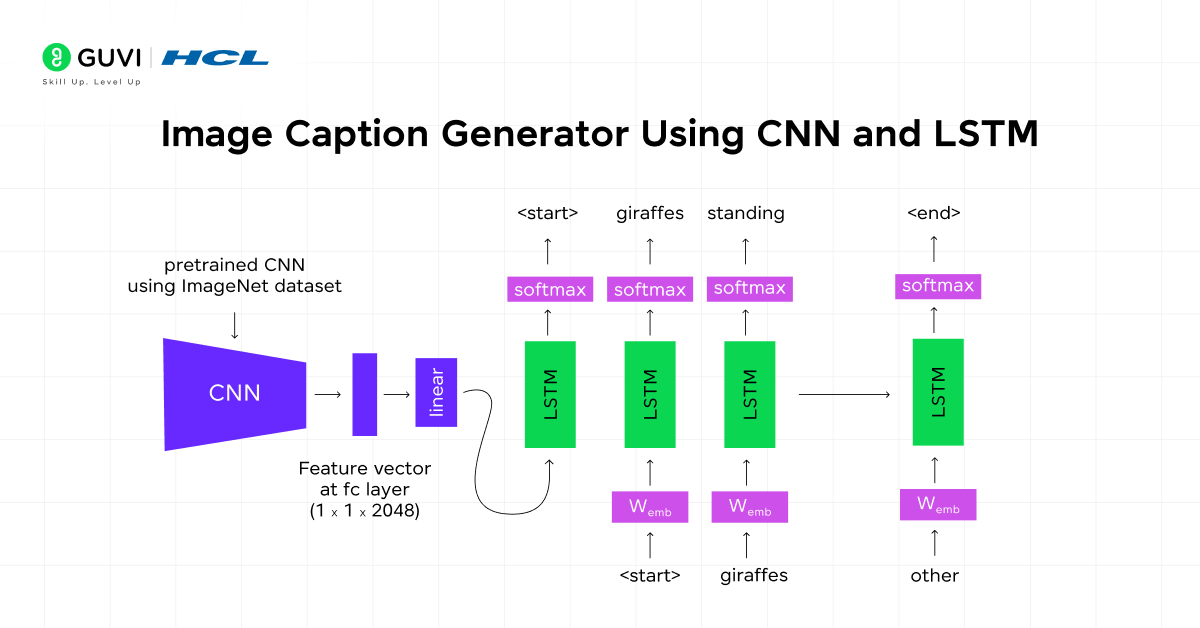
This project integrates computer vision and natural language processing (NLP) to automatically generate captions for images. It uses a Convolutional Neural Network (CNN) to extract features from images and an LSTM (Long Short-Term Memory) model to generate captions.
Time Taken: 3-4 weeks
Learning Outcomes:
- Understand how to integrate CNN and LSTM models.
- Learn about image feature extraction and text generation.
Features of the Project:
- Automatically generates descriptive captions for images.
- Combines deep learning models from both the NLP and computer vision fields.
Source Code: Image Captioning
8. Text Summarization Using Seq2Seq Model
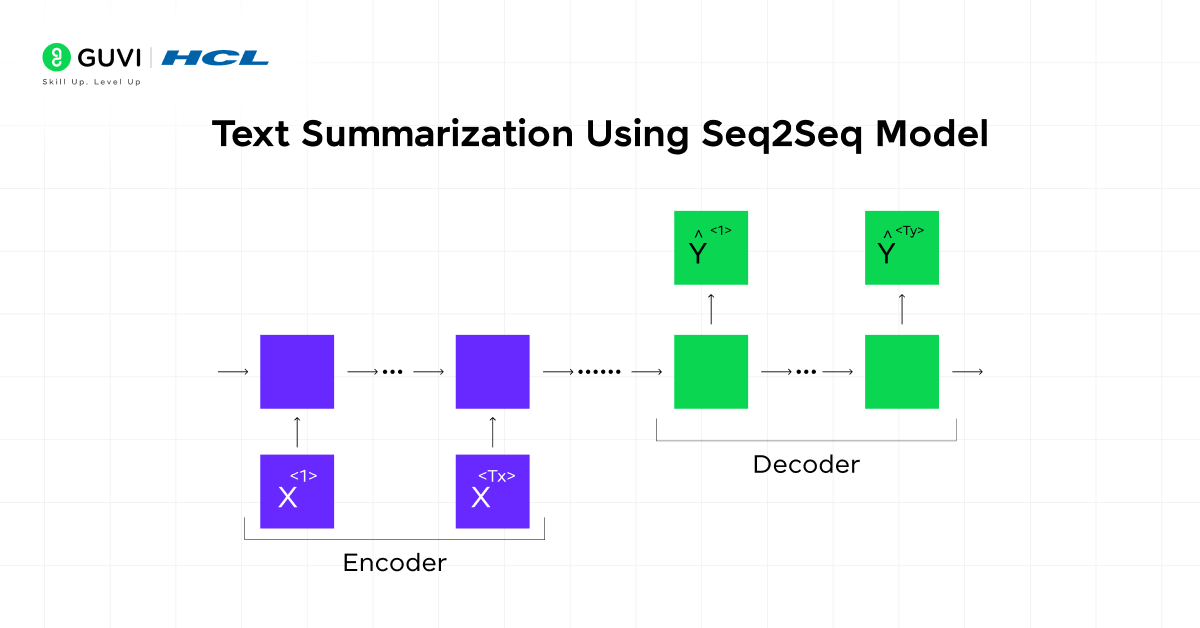
This project focuses on creating a text summarization model using the Sequence-to-Sequence (Seq2Seq) approach.
The model reads a long text and outputs a concise summary, which is particularly useful for summarizing large documents, articles, or even research papers.
Time Taken: 3-4 weeks
Learning Outcomes:
- Gain insights into Seq2Seq models for natural language processing (NLP) tasks.
- Learn how to process and generate text with deep learning models.
Features of the Project:
- Automatically generates summaries from long text inputs.
- Can be used in content summarization applications for various industries.
Source Code: Text Summarization
9. Image Super-Resolution Using GANs
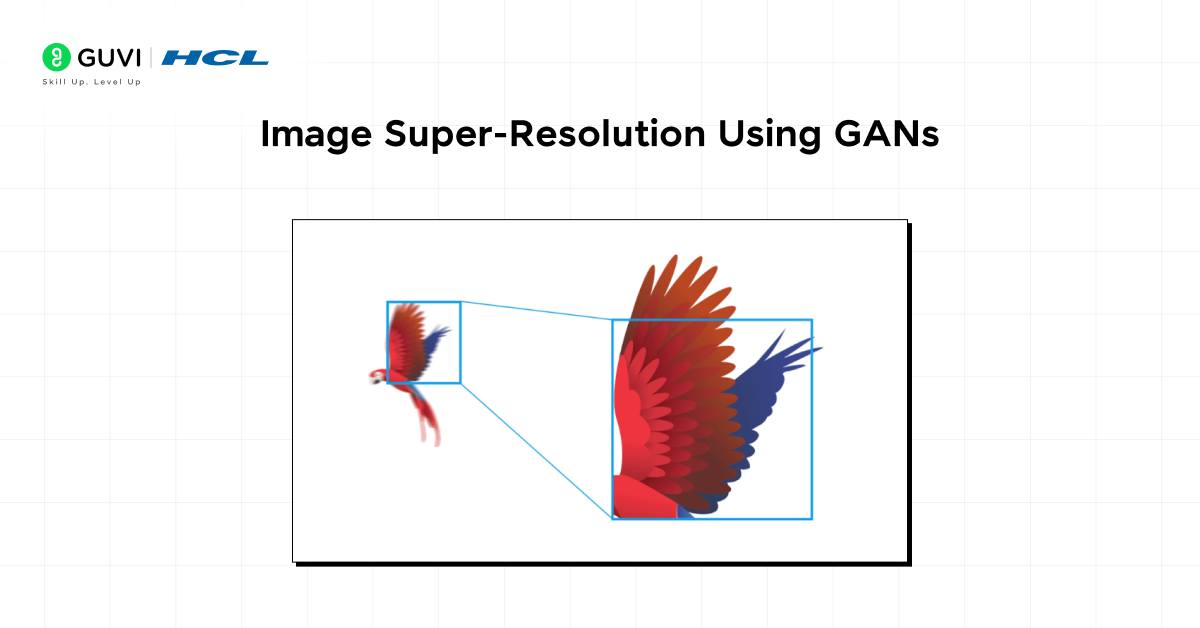
This project uses a Generative Adversarial Network (GAN) to enhance low-resolution images by generating higher-resolution versions of them. This is widely used in image editing, satellite imagery, and medical imaging for enhancing visual quality.
Time Taken: 4-5 weeks
Learning Outcomes:
- Understand the principles of GANs and their application in image enhancement.
- Learn about super-resolution techniques for improving image clarity.
Features of the Project:
- Enhances image resolution using deep learning techniques.
- Can be applied in industries like photography, medical imaging, and more.
Source Code: Image Super-Resolution
10. DeepFake Video Detection
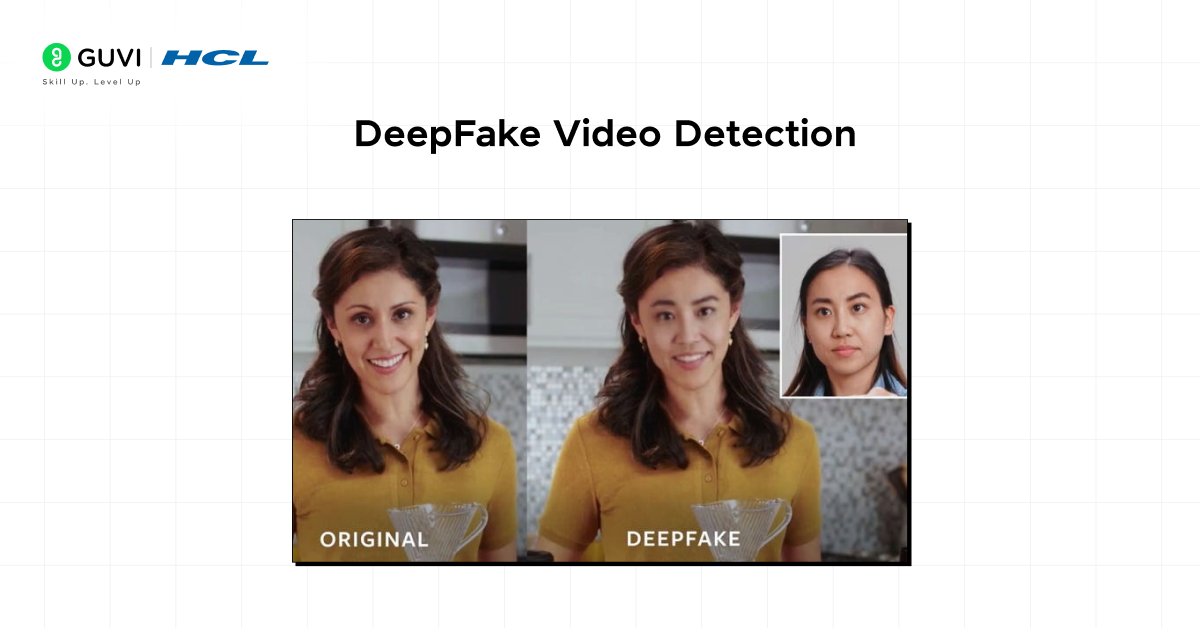
With the growing use of AI-generated DeepFakes, this project focuses on building a model to detect such altered videos. The project involves using CNNs to analyze video frames and identify whether they are manipulated.
Time Taken: 4-6 weeks
Learning Outcomes:
- Understand how CNNs can be used to detect video manipulations.
- Learn about techniques for DeepFake detection and the ethical concerns surrounding them.
Features of the Project:
- Identifies DeepFake videos from real ones with high accuracy.
- Useful for media authentication and protecting the integrity of video content.
Source Code: DeepFake Detection
These deep learning project ideas, coupled with the provided source code, will help you dive deeper into deep learning concepts and get hands-on experience!
Deepfake detection combines computer vision, temporal modelling, and forensic AI — one of the most technically impressive projects you can add to a portfolio. HCL GUVI’s AI & ML course covers the detection and generative models behind this problem: AI & ML Course
Tools and Resources You’ll Need
- Frameworks: TensorFlow with Keras for beginners, PyTorch for research-style work, Hugging Face Transformers for NLP
- Free compute: Google Colab (free T4 GPU), Kaggle Notebooks (30 free GPU hours weekly)
- Free datasets: Kaggle, Hugging Face Datasets, the UCI ML Repository
Common Mistakes Beginners Make
- Skipping data cleaning. Jumping straight to model training without cleaning your dataset leads to misleading results.
- Picking too many projects at once. Five unfinished projects look weaker on a resume than two completed, well-documented ones.
- Ignoring model evaluation. Accuracy alone doesn’t tell the full story. Learn to read a confusion matrix or F1 score.
- Not deploying anything. A model sitting in a notebook is incomplete. Even a simple Streamlit app shows you can ship.
Conclusion
In conclusion, deep learning can be intimidating at first, but once you start working on projects, you’ll realize how exciting and rewarding it is.
By diving into these unique project ideas, you’re not only honing your skills but also solving real-world problems that can make a difference in various industries.
Whether you’re just starting or looking to expand your deep learning portfolio, these projects are sure to challenge and inspire you.
FAQs
1. What are the easy Deep Learning project ideas for beginners?
Some beginner-friendly deep learning projects include Handwritten Digit Recognition, Neural Style Transfer, and Sentiment Analysis of text.
2. Why are Deep Learning projects important for beginners?
Deep learning projects provide hands-on experience, which is crucial for solidifying your understanding of key concepts.
3. What skills can beginners learn from Deep Learning projects?
Beginners can learn skills such as data preprocessing, model building, optimization techniques, and model evaluation. They also gain familiarity with popular libraries like TensorFlow and PyTorch, which are essential for working in deep learning.
4. Which Deep Learning project is recommended for someone with no prior programming experience?
The Handwritten Digit Recognition project is a great starting point for someone with no prior programming experience. It introduces the basics of CNNs in a simple and straightforward way, with ample resources available to guide you.
5. How long does it typically take to complete a beginner-level Deep Learning project?
A beginner-level deep learning project can typically take 1-2 weeks to complete, depending on your familiarity with the tools and the complexity of the project.
6. What is the difference between a machine learning project and a deep learning project?
Machine learning uses simpler models and manual features. Deep learning uses neural networks that learn features automatically.
7. Which deep learning projects are best for computer vision roles?
Image classification, object detection and defect detection projects are the best choices.
Success Stories

About the Author
Salini Balasubramaniam
A curious, information-savvy writer loves to turn deep insights into authentic and engaging content that connects. With experience in writing for brands and driving audience engagement, I believe that words can make a powerful difference.
View all posts by Salini Balasubramaniam
Connect with me @

Did you enjoy this article?
Comments










It is useful for my studies and my final year project