


Artificial Intelligence and Machine Learning Articles
Finance Manager to Data Analytics: Career Growth, Salary and Seniority
How to Evaluate LLM Outputs in Production Deployments
AI/ML Skills Gap 2026: Why Companies Can't Find Job-Ready Talent
20 AI/ML Interview Questions Recruiters Can Use Without a Tech Background - Best Guide


Get In Touch For Details! Request More Information

CNN (Convolutional Neural Network) in Machine Learning: 2026 Guide
Sep 21, 2026 6 Min Read 5657 Views
(Last Updated)
A Convolutional Neural Network (CNN) is a deep learning model designed to process images by detecting patterns like edges, shapes, and textures through layered filters. It’s the backbone behind most modern computer vision systems, from unlocking your phone with your face to helping doctors read medical scans faster.
CNNs stand out in machine learning because they automatically learn which patterns matter in an image, without needing manual feature extraction. That’s why it’s widely used across industries where visual data plays a key role.
Table of contents
- TL;DR Summary
- What is CNN in Machine Learning?
- CNN vs Traditional Neural Networks
- CNN vs Other Machine Learning Approaches: A Quick Comparison
- Why Are CNNs Important in Machine Learning?
- How Do CNNs Work?
- Input Layer
- Convolutional Layer
- ReLU Activation Layer
- Pooling Layer (Downsampling)
- Fully Connected (Dense) Layer
- Output Layer
- Challenge Question
- Applications of CNNs
- Image Classification
- Object Detection
- Facial Recognition
- Medical Imaging
- Self-driving Cars
- Text and Sentiment Classification
- How to Train Your First CNN? (Beginner-Friendly Path)
- Step 1: Install TensorFlow
- Step 2: Load and Prepare the Dataset
- Step 3: Build the CNN Model
- Step 4: Compile and Train the Model
- Step 5: Evaluate the Performance
- What You Just Learned:
- Advantages and Challenges of CNNs
- Advantages of CNNs
- Challenges of CNNs
- Future Scope of CNN in Machine Learning
- Conclusion
- FAQs
- What makes CNN better than a regular neural network for images?
- What are the main layers in a CNN?
- Where is CNN actually used in real products?
- Does training a CNN need a huge amount of data?
- Can CNN be used for anything besides images?
TL;DR Summary
- CNN is a deep learning model that reads images the way our eyes pick up shapes and patterns, without needing manual feature extraction.
- Every CNN runs through a few key layers — convolution, ReLU, and pooling — that break an image down before making sense of it.
- From unlocking your phone with your face to helping self-driving cars “see” the road, CNNs power a huge chunk of everyday tech.
- Training your first CNN isn’t as intimidating as it sounds — a few lines of TensorFlow code can get you a working model.
- Like any model, CNNs have trade-offs—they’re powerful but need solid data and compute to perform well.
The first successful CNN, LeNet-5, was used to recognize handwritten digits on checks in the 1990s, and it was developed before deep learning became mainstream!
What is CNN in Machine Learning?
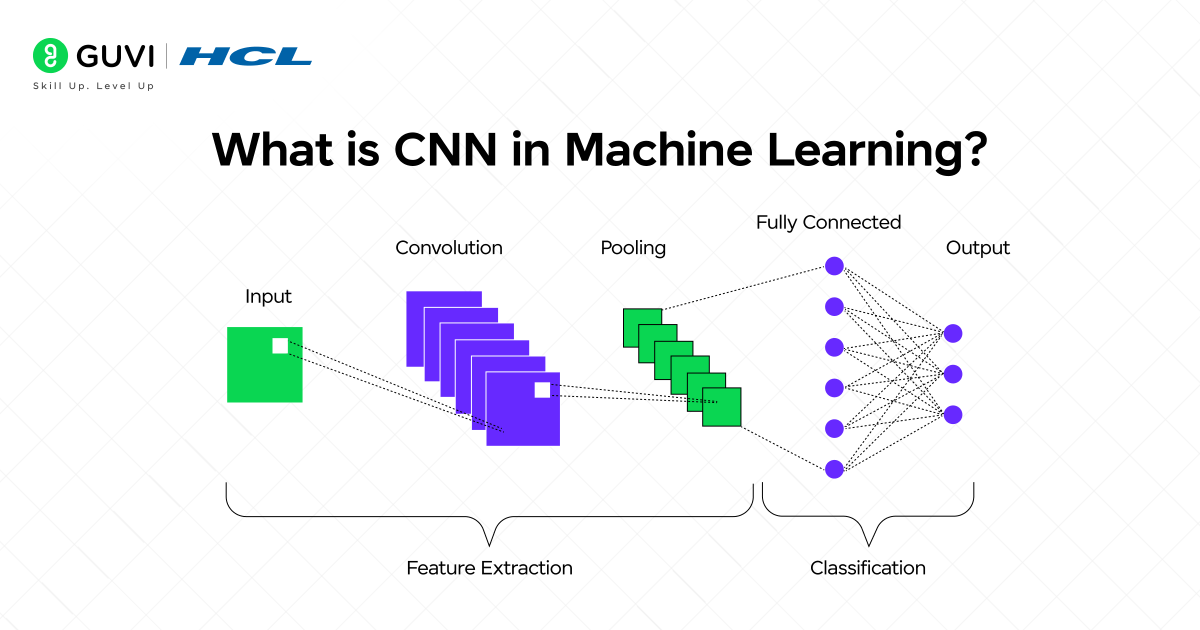
A Convolutional Neural Network (CNN) in Machine Learning is a type of deep learning model specially designed to work with grid-like data, like images. While traditional neural networks treat images as one long vector, CNNs preserve spatial relationships between pixels by using a layered architecture.
They mimic how the human brain’s visual cortex processes images. Instead of analyzing the entire picture at once, they break it down into small regions and learn patterns like edges, textures, and shapes layer by layer.
CNN vs Traditional Neural Networks
Why not just use a regular neural network for images? Because:
- A fully connected neural network (like a simple feedforward ANN) becomes inefficient and error-prone when handling high-dimensional image data.
- It drastically reduces the number of parameters, making training easier and faster.
- It automatically extracts relevant features without manual engineering.
Go from understanding the theory to actually training deep learning models with HCL GUVI’s Intel & IITM Pravartak Certified AI/ML Course. Work on real image classification and computer vision projects, the same skills powering the self-driving cars and facial recognition systems you just read about — and walk away with a certification that proves you can build, not just explain.
CNN vs Other Machine Learning Approaches: A Quick Comparison
Not all machine learning models handle data the same way—and that’s where CNNs pull ahead for anything visual. Here’s how it stacks up against other common approaches:
| Approach | Best For | Data Type | Key Strength | Examples |
|---|---|---|---|---|
| CNN (Convolutional Neural Network) | Image and visual pattern recognition | Images, video, spatial data | Automatically detects patterns like edges and shapes without manual feature extraction | Face unlock, medical scan analysis, self-driving car vision |
| ANN (Artificial Neural Network) | General-purpose prediction tasks | Structured/tabular data | Simple architecture, works well for non-spatial problems | Loan approval prediction, customer churn prediction |
| RNN (Recurrent Neural Network) | Sequential data processing | Text, time-series, speech | Remembers previous inputs to understand order and context | Language translation, stock price forecasting |
| Decision Trees / Random Forest | Structured data classification | Tabular data | Easy to interpret, works well with smaller datasets | Credit risk scoring, spam detection |
| SVM (Support Vector Machine) | Classification with clear boundaries | Structured/tabular data | Effective in high-dimensional spaces with limited data | Handwriting recognition, text categorization |
Why Are CNNs Important in Machine Learning?
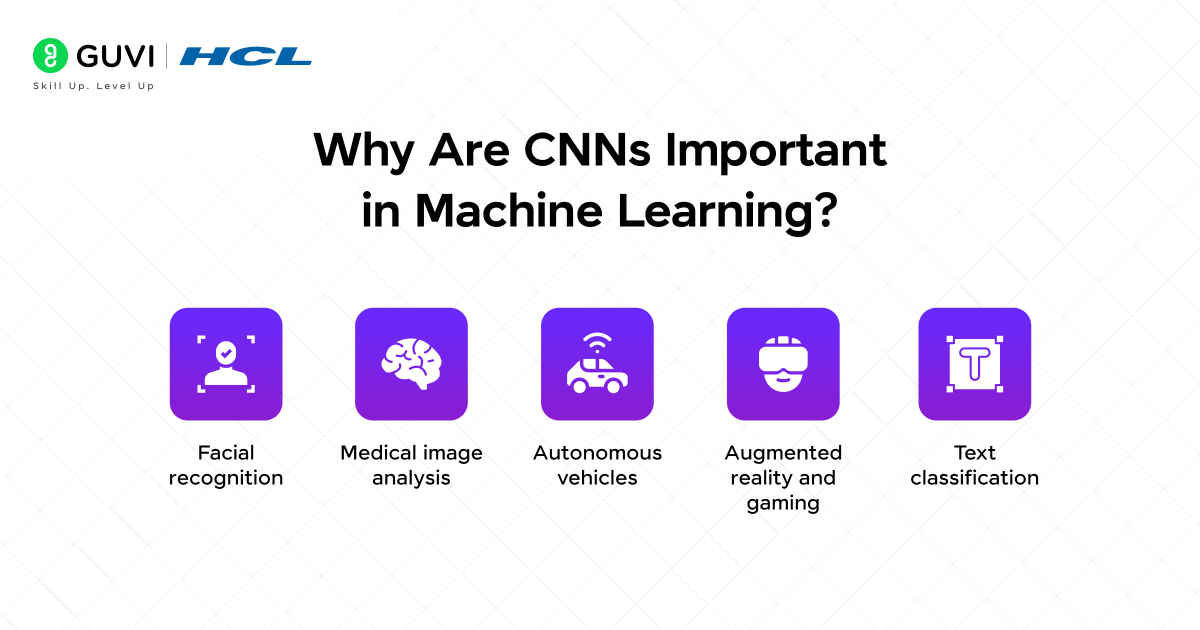
CNNs have revolutionized computer vision, a field that focuses on enabling machines to interpret and process images like humans. They’re crucial in areas such as:
- Facial recognition (used in smartphones and surveillance)
- Medical image analysis (detecting tumors, lung infections)
- Autonomous vehicles (object detection and navigation)
- Augmented reality and gaming
- Text classification (surprisingly, CNNs can also process sequential data)
Their ability to learn visual hierarchies, from low-level edges to complex object shapes, makes CNNs the go-to model for visual intelligence.
If you want to learn and master Deep Learning along with Neural Networks, read the blog –
How to become proficient in deep learning and neural networks in just 30 days!!
How Do CNNs Work?
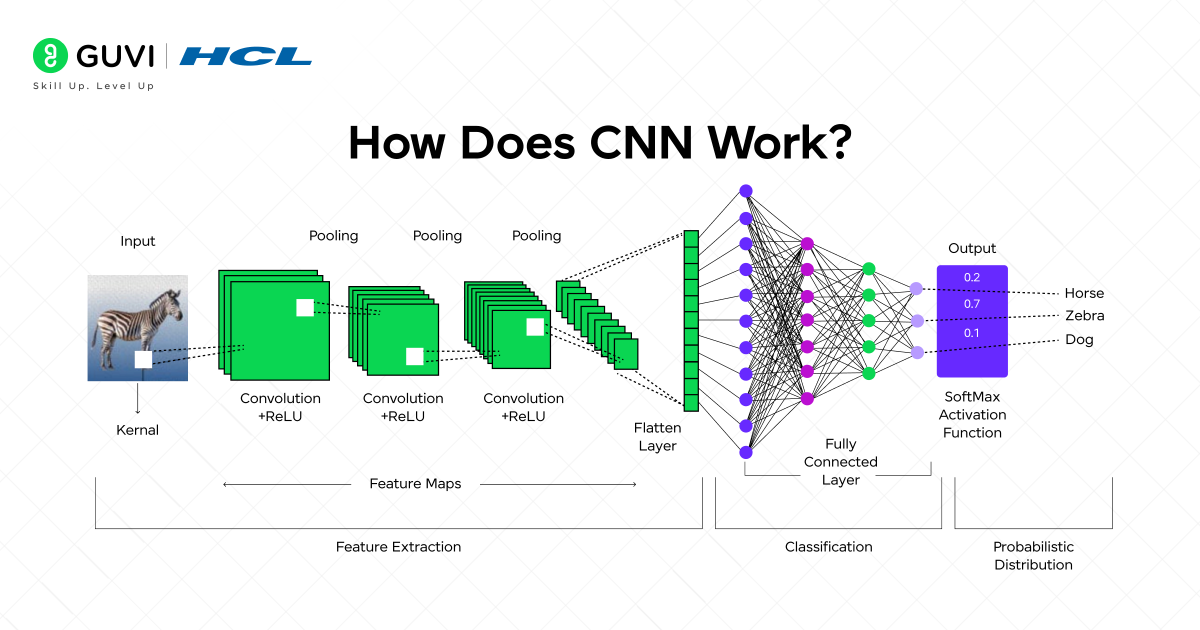
Convolutional Neural Networks may sound complex, but when broken down, they follow a logical step-by-step process. Their architecture is inspired by how the human visual cortex works, processing patterns from basic to complex. Here’s how it processes an image from input to prediction.
1. Input Layer
Every CNN starts with an input layer, where image data is fed into the network.
- The input image is represented as a matrix of pixel values.
- For grayscale images, it’s a 2D array (e.g., 28×28).
- For color images, it becomes a 3D array (e.g., 224x224x3 for RGB).
This layer doesn’t perform any computation—it just passes the image to the next stages.
2. Convolutional Layer
This is the core building block of a CNN. It applies filters (kernels) that slide over the input image, capturing essential visual patterns.
- A kernel might be 3×3 or 5×5 in size and detect features like edges, corners, or textures.
- The operation produces a feature map, which highlights where the pattern appears in the image.
- Each filter is trained to extract specific features from the input.
Think of it like scanning a picture with a magnifying glass, focusing on small regions at a time.
3. ReLU Activation Layer
After convolution, the feature maps go through a ReLU (Rectified Linear Unit) activation function. It introduces non-linearity by converting all negative values to zero.
Why is this important?
- Real-world data is non-linear.
- ReLU allows the network to learn complex patterns and interactions beyond linear relationships.
This step enhances the richness of the learned features without increasing the complexity.
4. Pooling Layer (Downsampling)
Now, we reduce the size of our data using a pooling operation. This makes the model faster and more robust.
- The most common is Max Pooling, which selects the maximum value from each patch of the feature map.
- Average Pooling can also be used, but Max Pooling tends to perform better in practice.
Pooling helps with:
- Reducing computation
- Controlling overfitting
- Retaining dominant features
This process is repeated multiple times—conv → ReLU → pooling—until a compact, meaningful representation is formed.
5. Fully Connected (Dense) Layer
After several layers of convolution and pooling, the data is flattened into a 1D vector and passed to fully connected layers.
- These layers act like a traditional neural network.
- They interpret the extracted features and make predictions.
Think of these layers as the decision-making component of CNNs.
6. Output Layer
The final output layer usually has:
- One node with sigmoid activation for binary classification
- Multiple nodes with softmax activation for multi-class classification
The result is a probability distribution, where the class with the highest probability becomes the prediction.
Learn all about Deep Learning through HCL GUVI’s FREE Self-Paced Deep Learning Fundamentals Online Course that teaches everything about Neural Networks to Artificial Intelligence, all from scratch!
Challenge Question
Which of the following layers helps in reducing the spatial dimensions of CNN’s feature maps?
A) Convolution Layer
B) Pooling Layer
C) Fully Connected Layer
D) ReLU Activation
Answer: B) Pooling Layer
Applications of CNNs
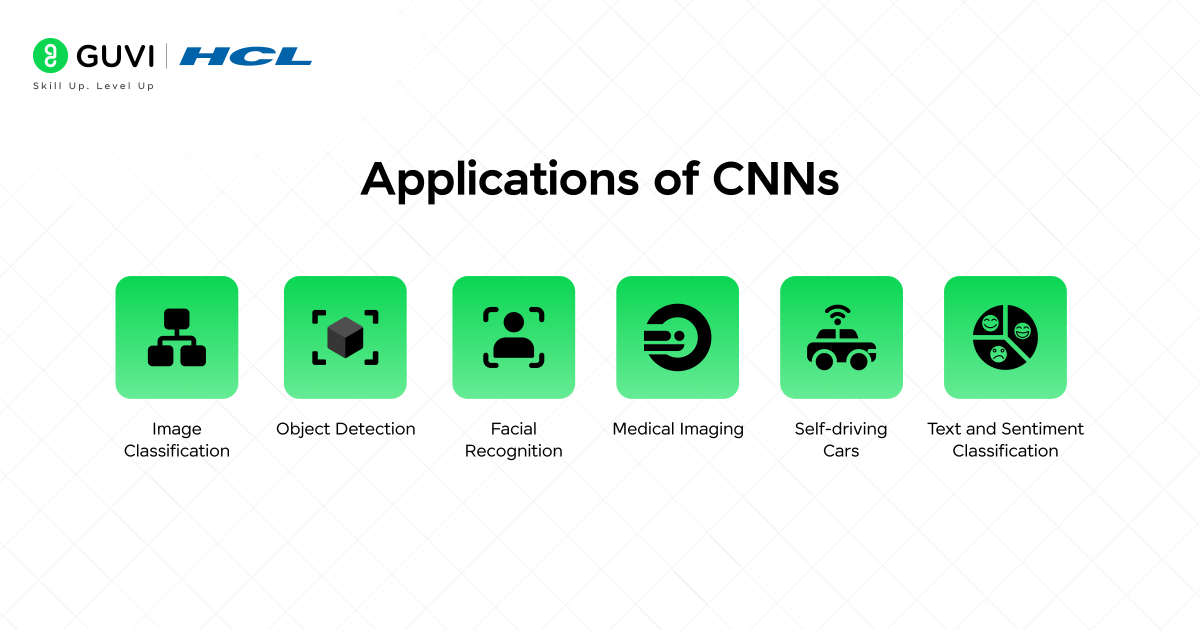
CNNs have become the go-to architecture for visual data problems across industries. From healthcare to autonomous driving, their ability to process and interpret visual patterns has led to revolutionary use cases.

1. Image Classification
Perhaps the most common use case, CNNs can classify entire images.
- For example, determining if an image is of a dog, a car, or a tree.
- This powers platforms like Google Photos or Pinterest’s visual search.
CNNs are trained on datasets like ImageNet, which has millions of labeled images.
2. Object Detection
Here, CNNs not only identify what’s in an image but also where it is.
- Models like YOLO (You Only Look Once) and SSD (Single Shot Detector) use CNNs for real-time detection.
- These are used in security surveillance, industrial inspection, and retail automation.
Also Read: Understanding Object Detection: A Comprehensive Guide
3. Facial Recognition
Facial recognition systems heavily rely on CNNs to detect and match faces.
- Used in phone unlock features, social media tagging, and border control.
- CNNs can also track facial emotions and expressions for behavioral analysis.
4. Medical Imaging
CNNs help in early disease detection by analyzing X-rays, MRIs, and CT scans.
- Identifying tumors, pneumonia, or diabetic retinopathy with high accuracy.
- Assists doctors by reducing diagnostic time and error.
5. Self-driving Cars
Autonomous vehicles use CNNs to:
- Detect pedestrians, vehicles, and traffic signs
- Recognize lanes and navigate in real time
Combined with sensors and lidar data, CNNs form the eyes of self-driving systems.
6. Text and Sentiment Classification
Surprisingly, CNNs can also be used in Natural Language Processing (NLP):
- Text classification (spam detection, intent recognition)
- Sentiment analysis of reviews or tweets
- CNNs treat text as 1D sequences and extract local patterns like phrases or expressions
This makes them great for fast and accurate language models in chatbots and customer feedback systems.
How to Train Your First CNN? (Beginner-Friendly Path)
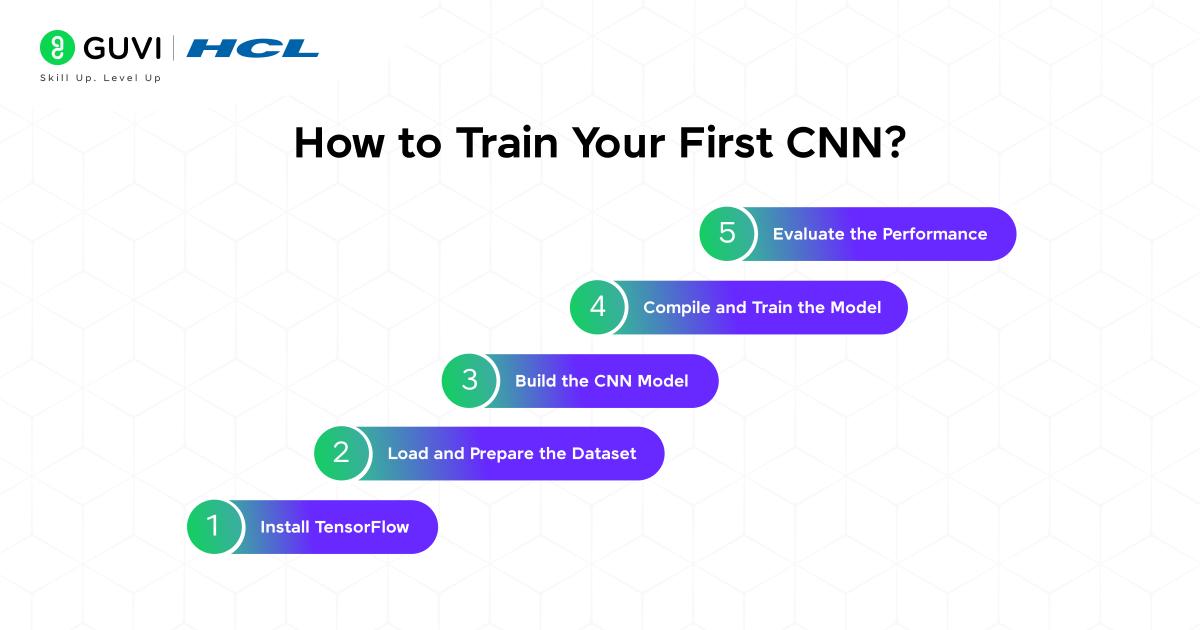
If you’re new to machine learning, training your first CNN can feel intimidating. But don’t worry! Libraries like TensorFlow and Keras make it surprisingly easy to get started.
Let’s build a CNN with Python that classifies handwritten digits using the MNIST dataset.
Step 1: Install TensorFlow
Start by installing TensorFlow, which comes bundled with Keras.
pip install tensorflow
Step 2: Load and Prepare the Dataset
from tensorflow.keras.datasets import mnist

# Load dataset

(x_train, y_train), (x_test, y_test) = mnist.load_data()

# Reshape and normalize input data

x_train = x_train.reshape(-1, 28, 28, 1).astype("float32") / 255

x_test = x_test.reshape(-1, 28, 28, 1).astype("float32") / 255
Step 3: Build the CNN Model
Here’s a simple architecture with one convolutional and pooling layer:
from tensorflow.keras.models import Sequential

from tensorflow.keras.layers import Conv2D, MaxPooling2D, Flatten, Dense

model = Sequential([

    Conv2D(32, (3, 3), activation='relu', input_shape=(28, 28, 1)),

    MaxPooling2D(pool_size=(2, 2)),

    Flatten(),

    Dense(128, activation='relu'),

    Dense(10, activation='softmax')

])
Step 4: Compile and Train the Model
model.compile(

    optimizer='adam',

    loss='sparse_categorical_crossentropy',

    metrics=['accuracy']

)

model.fit(x_train, y_train, epochs=5, batch_size=32)
The model will train for 5 epochs and start identifying digits with over 98% accuracy!
Step 5: Evaluate the Performance
test_loss, test_acc = model.evaluate(x_test, y_test)

print(f"Test accuracy: {test_acc:.2f}")
Now your model is ready to make predictions on new handwritten digits!
What You Just Learned:
- You created a CNN using Keras.
- You trained it to classify digits from 0 to 9.
- You evaluated its accuracy and made predictions.
This is the same basic structure you’ll use for more advanced CNN projects—just swap the dataset and tweak the model depth!
Advantages and Challenges of CNNs
While CNNs are powerful, they come with both benefits and drawbacks. Let’s look at both sides of the coin.
Advantages of CNNs
- Automatic Feature Extraction: No manual feature engineering required
- Parameter Efficiency: Fewer weights due to shared filters
- Translation Invariance: Small shifts in images don’t confuse the model
- Hierarchical Learning: Understands data from basic to complex features
Challenges of CNNs
- Data Hungry: CNNs require large labeled datasets to generalize well
- Computational Cost: Training CNNs can be slow and require GPUs
- Overfitting Risk: Without regularization or dropout, they can memorize the training data
- Black Box Nature: Hard to interpret why CNNs make a certain prediction
Despite these challenges, improvements like transfer learning, model compression, and explainable AI are making CNNs more accessible and transparent.
Future Scope of CNN in Machine Learning
CNNs are continuously evolving. Some promising directions include:
- Edge AI and On-device Vision: Running CNNs efficiently on mobile and IoT devices.
- Generative Models: CNNs are key in tools like GANs (used for image generation and deepfakes).
- Neuroscience-inspired Architectures: Next-gen CNNs that mimic even more of the brain’s learning system.
- Hybrid Models: CNN + RNN or CNN + Transformer for complex multimodal tasks.
As AI enters the mainstream, demand for CNN expertise will only rise.
Conclusion
In conclusion, CNNs (Convolutional Neural Networks) are the backbone of modern computer vision. Their ability to automatically extract features and understand image data has made them invaluable in everything from healthcare to autonomous driving.
If you’re starting your ML journey, CNNs are an exciting and rewarding concept to master. Start simple, experiment with datasets like MNIST or CIFAR-10, and build your intuition slowly. The best way to understand CNNs is to build one yourself.
FAQs
1. What makes CNN better than a regular neural network for images?
It scans images in small chunks using filters, picking up patterns like edges and shapes instead of processing every pixel individually — making it far more efficient for visual data.
2. What are the main layers in a CNN?
Convolution, activation (usually ReLU), and pooling. Each layer extracts and simplifies patterns before passing them forward — from simple edges to complex shapes.
3. Where is CNN actually used in real products?
Face unlock on phones, medical scan analysis, self-driving car vision systems, and photo tagging on social apps all run on this architecture.
4. Does training a CNN need a huge amount of data?
Usually yes, since it learns by seeing thousands of labeled examples — though transfer learning lets you start from a pre-trained model and need far less data.
5. Can CNN be used for anything besides images?
Yes — it’s increasingly applied to audio spectrograms, text classification, and even time-series data, wherever spatial or sequential patterns matter.
Success Stories

















Did you enjoy this article?