


Full Stack Development Articles
Full Stack Development Training for Professionals Looking to Move into Product-Based Companies
Claude for Architecture and Engineering Documentation
Freelancing as a Python Developer: Getting Your First Client

Get In Touch For Details! Request More Information
What Makes a Full Stack Development Program Industry-Relevant in 2027?
Nov 04, 2026 5 Min Read 22 Views
(Last Updated)
Two people finish a full stack course in the same month. One starts getting interview calls within weeks. The other sends fifty applications and hears nothing, even though the certificates look the same. The difference is rarely talent. It usually comes down to what the course actually taught.
So what actually makes a full stack development program industry relevant? It teaches the tools companies use today, makes you build and deploy real projects, covers DSA and system design, and shows you how to work with AI tools. It also gives you live mentors and real interview practice.
Below, we cover seven signs of a good full stack development program, how to spot an outdated one, questions to ask before you enrol, and a simple learning path for beginners.
Table of contents
- TL;DR Summary
- What is a Full Stack Development Program?
- Why an Industry-Relevant Full Stack Development Program Matters Going Into 2027
- 7 Signs of an Industry-Relevant Full Stack Development Program
- A Current Tech Stack
- Real Projects That Get Deployed
- DSA and System Design Basics
- Git, DevOps and Cloud Basics
- AI Skills Built In
- Live Mentors and Doubt Support
- Interview and Career Prep
- Outdated vs Industry-Relevant Full Stack Development Program
- How to Check a Full Stack Development Program Before You Enroll
- How HCL GUVI's Full Stack Development Course Matches These Signs
- A Simple Learning Path for a Full Stack Development Program
- Months 1 and 2: Web Basics
- Months 3 and 4: React and the Back End
- Months 5 and 6: DSA, Projects and Deployment
- Month 7 and Beyond: Interview Prep
- Common Mistakes When Choosing a Full Stack Development Program
- 💡 Did You Know?
- Conclusion
- FAQs
- What makes a full stack development program industry relevant?
- Which technologies should a full stack development program cover in 2027?
- How long does a full stack development program take?
- Can a beginner join a full stack development program?
- Is a certificate from a full stack development program enough to get a job?
TL;DR Summary
- What it is: An industry-relevant full stack development program teaches what companies hire for today, not what was popular five years ago.
- Seven signs: A current stack, deployed projects, DSA and system design, Git and cloud basics, AI skills, live mentors, and interview prep.
- Why now: Entry level hiring has slowed, so a full stack development program must leave you with proof of skill.
- Quick test: Ask to see the current syllabus and projects built by past learners before you pay.
- Next step: Score any full stack development program you like against the checklist below.
What is a Full Stack Development Program?
A full stack development program is a structured course that teaches you to build both sides of a web app. The front end is what users see and click. The back end is the server, the database, and the logic behind the screen.
So a full stack development program usually covers HTML, CSS, JavaScript, React, Node.js, Express, and a database like MongoDB or SQL. If the term is new to you, this guide on what is full stack development explains it in plain words.
If you want a program built around these ideas, HCL GUVI’s Full Stack Development course teaches the whole stack in live online classes with mentors, so you can ask a question the moment you get stuck instead of losing days to one bug.
Why an Industry-Relevant Full Stack Development Program Matters Going Into 2027
Here is what recent research says about hiring.
- Entry level hiring has slowed: An ICRIER study of 651 Indian IT firms found that hiring has moderated, mainly for entry level roles.
- Software roles held up best: The same study found software related teams saw the least slowdown.
- AI is part of the job: The Stack Overflow 2025 survey found that about half of professional developers use AI tools every day.
With fewer entry level openings, employers can be choosy. They look for working projects and current tools. Pay follows skills too, and you can see full stack developer salaries in India to see how widely they vary.
7 Signs of an Industry-Relevant Full Stack Development Program
A strong full stack development program should tick most of these seven signs.
1. A Current Tech Stack
Check the syllabus first. It should name the tools you see in job posts today.
- Front end: HTML, CSS, JavaScript, and React. See what is ReactJS for why it is so common.
- Back end: Node.js, Express, and REST APIs with login features.
- Databases: One SQL and one NoSQL option, such as MongoDB.
- Full picture: The MERN stack is still a popular combination.
2. Real Projects That Get Deployed
Watching videos does not make you a developer. Building things does.
- Several full apps: An e-commerce app or a booking system teaches login, payments, and data.
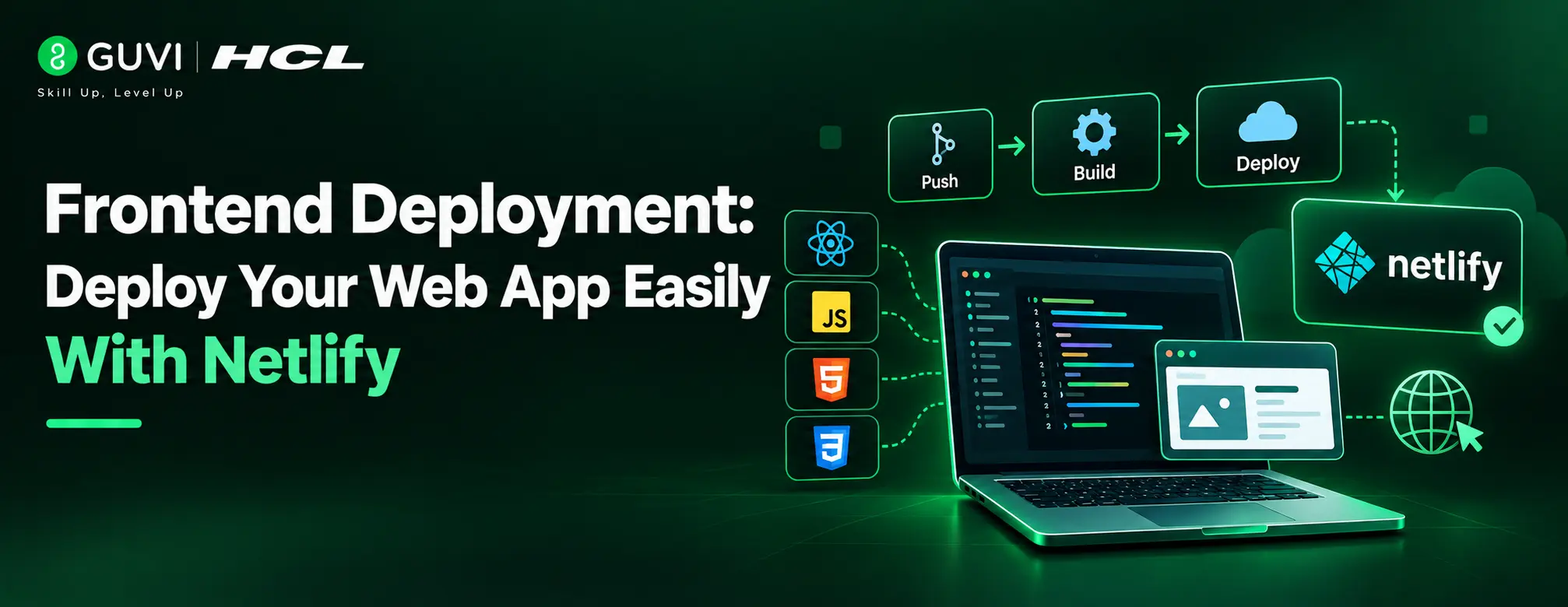
- Live deployment: The best projects run on a real URL. Here is a simple guide to frontend deployment with Netlify.
- Ideas to try: Browse these full stack web developer coding projects.
3. DSA and System Design Basics
Companies, especially product companies, also test how you think.
- DSA: Arrays, strings, hash maps, and recursion come up in coding rounds. Read the reasons to learn data structures and algorithms.
- System design: You may be asked to design a chat app. The beginner guide on what is system design is a gentle start.
4. Git, DevOps and Cloud Basics
Real teams save code in Git, test it automatically, and run it in the cloud.
- Git and GitHub: Learn to upload your project to GitHub.
- CI and CD: This overview of CI and CD explains how code ships automatically.
- Containers and cloud: Docker and a basic cloud platform like Amazon Web Services are common in teams.
5. AI Skills Built In
Developers now use AI tools to write, explain, and test code. A full stack development program that ignores AI is already behind.
- Use AI tools well: Here is a list of AI tools for developers worth knowing.
- Keep strong basics: AI can write code that looks right but is wrong, so you need the basics to catch mistakes.
- Build with AI: A simple chatbot that answers questions from a document shows employers you can add AI to an app.
6. Live Mentors and Doubt Support
Everyone gets stuck. What matters is how fast you get unstuck.
- Live classes: Recorded videos are fine for revision, but live sessions let you ask questions as they come up.
- Code reviews: A mentor who reads your code teaches you more than ten tutorials.
7. Interview and Career Prep
Skills only help if you can show them.
- Mock interviews and resume review: Practice builds confidence, and a clear resume gets more replies.
- GitHub help: Recruiters open your GitHub early, so it should look tidy.
- Honest promises: No program can guarantee a job. Be careful with any that does.

Outdated vs Industry-Relevant Full Stack Development Program
| Area | Outdated Program | Industry-Relevant Program |
|---|---|---|
| Tech stack | Old tools, little React or Node.js | React, Node.js, Express, a database |
| Projects | Small exercises | Several full apps, deployed live |
| Problem solving | Not covered | DSA and system design basics |
| AI | Ignored | Taught as a daily tool |
| Support | Recorded videos only | Live mentors and code reviews |
How to Check a Full Stack Development Program Before You Enroll
Ask these questions about any full stack development program before you pay.
- Can I see the full syllabus? It should name tools and show the plan week by week.
- When was it last updated? A syllabus unchanged for years is a warning sign.
- Can I see past student projects? Live links beat screenshots.
- Who answers doubts? Ask how fast, and who they are.
- What are the fees and refund terms? Get them in writing.
How HCL GUVI’s Full Stack Development Course Matches These Signs
- Current stack: HTML, CSS, JavaScript, React JS, Tailwind CSS, Node.js, Express.js, MongoDB, and REST APIs, so you learn what job posts ask for.
- Real projects: An e-commerce web app, an order management system, a cloud deployment pipeline, and an AI powered document Q and A chatbot, so you have apps to talk about.
- DSA and system design: Both are part of the program, so coding rounds feel familiar.
- DevOps and GenAI: You learn how apps ship and how AI fits in, instead of picking it up on the job.
- Live mentors: Online sessions with mentor support and recorded access, so help is there when you are stuck.
- Flexible and beginner friendly: Weekday and weekend batches, starting from programming basics.
- Certificates and career help: An IITM Pravartak certification, a complimentary MongoDB certification, mock interviews, and resume and GitHub review.
Want to see the syllabus yourself? Take a look at the HCL GUVI Full Stack Development course and pick the batch that fits your schedule.
A Simple Learning Path for a Full Stack Development Program
Months 1 and 2: Web Basics
Learn HTML, CSS, and JavaScript. This HTML and CSS guide for beginners is a friendly start.
Months 3 and 4: React and the Back End
Learn React, then build APIs with Node.js and Express and connect a database.
Months 5 and 6: DSA, Projects and Deployment
Practise DSA daily. Build and deploy two full apps, and learn Git, Docker, and basic cloud steps.
Month 7 and Beyond: Interview Prep
Do mock interviews and polish your resume. The full full stack developer roadmap shows every stage in more detail.
Common Mistakes When Choosing a Full Stack Development Program
- Picking on price alone: The cheapest program costs the most if you never finish it.
- Trusting the word “job-ready”: Check the syllabus and the projects instead.
- Ignoring DSA: It is the most common reason people fail coding rounds.
- Never deploying in a full stack development program: An app that only runs on your laptop proves little.
- Expecting a guaranteed job: Skills and effort decide offers, not promises.
💡 Did You Know?
- Git was created by Linus Torvalds in 2005 to manage the code of the Linux kernel.
- MongoDB got its name from the word “humongous” because it was built to handle very large amounts of data.
- About half of professional developers use AI tools every day, according to the 2025 Stack Overflow Developer Survey.
Conclusion
An industry-relevant full stack development program is not about fancy words on a landing page. It is about a current stack, deployed projects, DSA, Git and cloud basics, AI skills, live mentors, and honest interview prep.
Go through the seven signs, ask the questions above about every full stack development program on your list, and check the syllabus and projects before you pay.
If you want live classes, mentor support, and real projects in one place, HCL GUVI’s Full Stack Development course helps you build the skills employers look for as 2027 approaches, with mentors beside you at every step.
FAQs
1. What makes a full stack development program industry relevant?
A current tech stack, deployed projects, DSA and system design, Git and cloud basics, AI skills, live mentors, and interview prep.
2. Which technologies should a full stack development program cover in 2027?
HTML, CSS, JavaScript, React, Node.js, Express, a SQL and a NoSQL database, REST APIs, Git, and basic Docker and cloud. AI tools are a strong extra.
3. How long does a full stack development program take?
Most beginners need around 6 to 9 months of steady learning to be ready for junior roles.
4. Can a beginner join a full stack development program?
Yes. A good full stack development program starts from programming basics, and you do not need a computer science degree to begin. This look at whether full stack jobs depend on a CS degree explains more.
5. Is a certificate from a full stack development program enough to get a job?
A certificate helps your resume get noticed, but projects and interview skills decide offers. Pair it with a few deployed apps on GitHub.
Success Stories

About the Author
Jebasta
I translate the language of data into stories that anyone can understand. As a writer with a data science background, I simplify analytics, AI, and decision-making so beginners and enthusiasts can confidently explore the world of data.
View all posts by Jebasta
Connect with me @
















Did you enjoy this article?