


Full Stack Development Articles
Claude for Architecture and Engineering Documentation
Freelancing as a Python Developer: Getting Your First Client

Get In Touch For Details! Request More Information

Full-Stack Development in 2026: Is It Still Worth Learning in a Saturated Market?
Sep 29, 2026 8 Min Read 2933 Views
(Last Updated)
Full-stack development is not disappearing, but the definition of a job-ready full-stack developer has changed significantly. Knowing one frontend framework, one backend framework, and basic database operations is no longer enough to stand out in a crowded developer market.
Modern full-stack roles increasingly combine frontend engineering, backend APIs, databases, cloud deployment, testing, security, observability, and AI-assisted development. Companies still need developers who can understand an application end to end, but they expect greater technical depth and stronger production knowledge.
So, is full-stack dead in 2026? No. The role is becoming more technical, specialized, and closely connected with cloud, DevOps, system design, and AI. This guide examines what is actually changing, which skills matter now, and how developers can remain competitive as full-stack development evolves.
Table of contents
- Quick Answer
- Why Full-Stack Feels Saturated Today
- Is Full-Stack Dead? Job Market Data vs Reality (2026)
- What Companies Expect In The Future Of Full Stack Development
- The Shift From Generalist To T-Shaped Full-Stack Developers
- Are Specialized Roles Replacing Full-Stack Developers?
- Is Full-Stack Dead Or Just Evolving?
- Is Full-Stack Dead in India? What the Job Market Really Shows
- Full-Stack Salaries in India (2026): Are They Still Worth Pursuing
- Which Technologies Should Full-Stack Developers Learn in 2026?
- Is the MERN Stack Enough for Full-Stack Jobs in 2026?
- How Is AI Changing Full-Stack Development?
- What Makes a Full-Stack Developer Production-Ready?
- Conclusion
- FAQs
- Is full-stack development dead in 2026?
- Is full-stack development a good career in India in 2026?
- Will AI replace full-stack developers?
- What skills should a full-stack developer learn in 2026?
- Is MERN stack enough to get a full-stack developer job?
- Should full-stack developers specialize in one technology?
Quick Answer
Full-stack development is not dead in 2026, but basic full-stack skills are becoming less competitive.
- Demand remains: Companies still need end-to-end product developers.
- Basic MERN knowledge is not enough: Production skills now matter.
- AI changes workflows: Developers increasingly use AI for coding, testing, and debugging.
- Cloud skills matter: Deployment, containers, CI/CD, and observability strengthen full-stack profiles.
- Depth wins: Strong developers combine broad stack knowledge with expertise in one technical area.
Why Full-Stack Feels Saturated Today
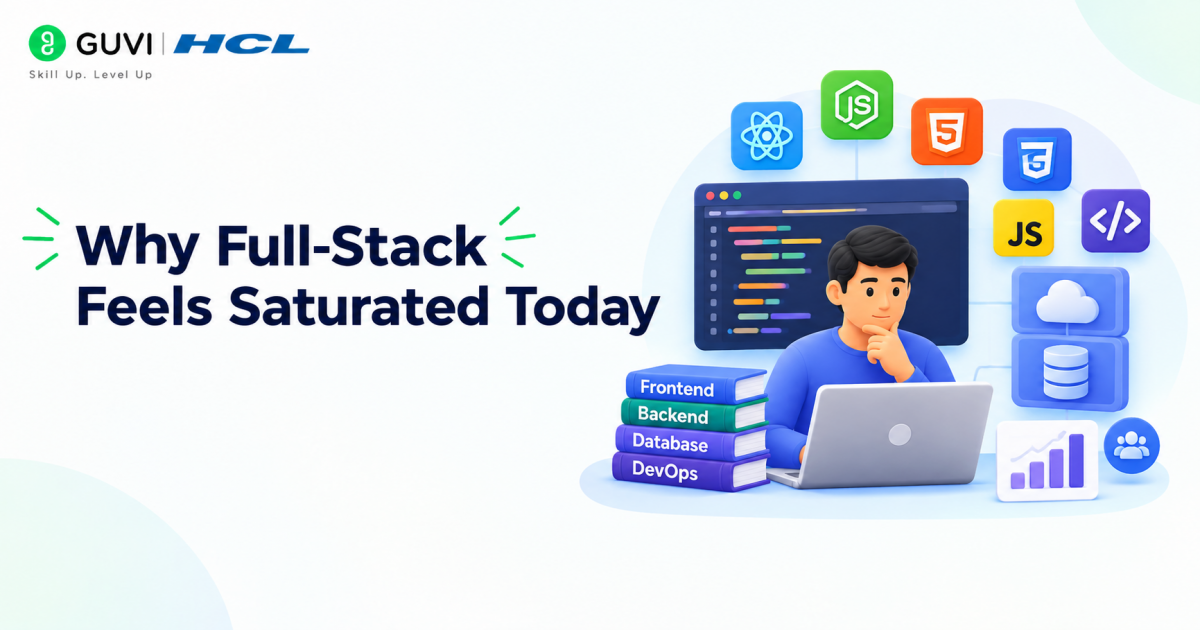
The idea that full-stack is dead mainly comes from what is happening at the entry level. Thousands of candidates now learn the same React, Node.js, Express, MongoDB, SQL, and basic cloud workflows through short courses, bootcamps, and online tutorials. As a result, recruiters often see similar resumes built around the same front-end and back-end stack combinations.
The real issue is not that companies no longer need full-stack developers. It is that basic stack familiarity has become easier to acquire, while employers increasingly look for production-level skills such as authentication, testing, API design, database optimization, cloud deployment, observability, performance, and system design.
- Rapid Growth Of Entry-Level Developers: More candidates now enter the market with similar React, Node.js, MongoDB, and SQL foundations, increasing competition for junior roles.
- Repetitive Portfolio Projects: Basic CRUD apps such as task managers, e-commerce clones, and note-taking tools often demonstrate syntax but not scalability, security, or architecture.
- Low Barrier To Claiming Full-Stack Skills: Building a frontend, connecting an API, and storing data is often presented as full-stack expertise even without knowledge of testing, deployment, caching, queues, or production monitoring.
- Lack Of Production Exposure: Many candidates have never handled real authentication flows, CI/CD pipelines, cloud infrastructure, database migrations, logging, or production incidents.
- Depth-Focused Hiring: Interviews increasingly test one area in greater detail, such as backend scalability, frontend performance, database design, or cloud deployment, instead of accepting shallow knowledge across the entire stack.
Tip: Build fewer but stronger projects that include authentication, role-based access, tests, deployment, monitoring, database optimization, and one clear scalability or performance challenge.
Do check out HCL GUVI’s IITM Pravartak Certified MERN Full Stack Developer Course with AI Integration – it focuses on building strong MERN fundamentals with industry relevance. It combines full stack development with practical AI concepts used in modern applications. The program emphasizes hands-on projects, system thinking, and scalable development. It is suitable for learners preparing for the future of full stack development.
Is Full-Stack Dead? Job Market Data vs Reality (2026)
The “full-stack is dead” narrative gets thrown around a lot online, but the actual 2026 data tells a more layered story. Here’s the myth compared against what’s really happening in the market right now:
| Common Claim | What the Data Actually Shows | What This Means for You |
|---|---|---|
| “Full-stack roles are disappearing” | The market for full-stack developers remains strong in 2026, with one snapshot citing nearly 7,900 open full-stack roles in the US alone | Roles aren’t shrinking, they’re widely available, though competition is real too |
| “Companies prefer specialists now” | 78% of companies report a preference for hiring full-stack developers over single-specialty frontend or backend developers | Being able to work across both frontend and backend is still a hiring advantage |
| “The market is too crowded, generalists can’t stand out” | Companies now expect full-stack developers to have one strong area, like frontend, backend, or cloud, along with broad working knowledge of the rest | Simply “knowing a bit of everything” isn’t enough, having one strong skill plus broad awareness matters |
| “Full-stack pays less due to oversupply” | In India, entry-level full-stack developers earn ₹4-7 LPA, mid-level ₹8-15 LPA, and senior developers or tech leads ₹18-30 LPA or more | Pay scales up meaningfully with experience, it’s not a flat or shrinking pay range |
| “AI is replacing full-stack developers” | AI integration is now expected, not optional, developers who can work with AI tools, APIs, and cloud-native systems stand out in hiring | Learning to use AI tools well is now part of the job, not a bonus skill |
| “The role itself is becoming outdated” | In-demand 2026 roles include Full-Stack Software Engineer, Senior Full-Stack Developer, and AI-Integrated Full-Stack Developer, with strong hiring in fintech, healthtech, and edtech | The job title isn’t dying, it’s branching into more specific, higher-value versions of itself |
What Companies Expect In The Future Of Full Stack Development
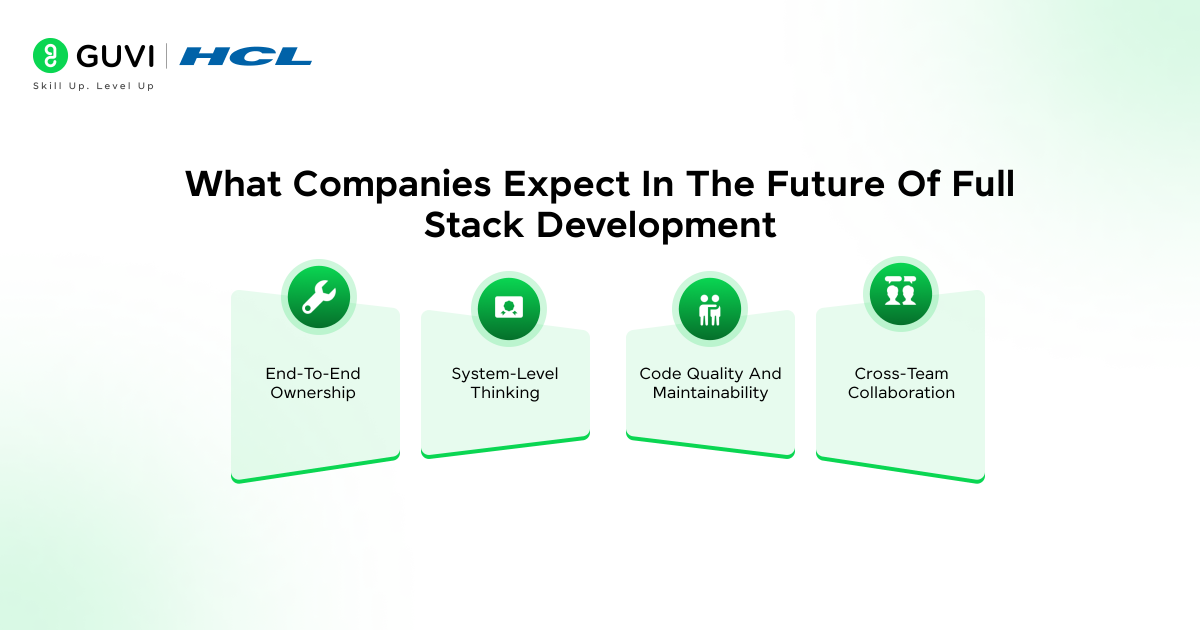
The future of full stack development depends less on knowing more frameworks and more on understanding how an application behaves as a complete system. Companies increasingly expect developers to connect frontend performance, backend architecture, database design, APIs, authentication, testing, cloud deployment, and monitoring instead of treating each layer as an isolated task.
Hiring also favors developers who can take a feature from requirement to production and explain the technical trade-offs behind their decisions. This means deciding how data should flow, where caching is useful, how failures are handled, how an API scales, and how the feature will be tested and monitored after deployment.
- End-To-End Ownership: Ability to design the UI flow, build APIs, model data, write tests, deploy the feature, and support it in production.
- System-Level Thinking: Understanding how frontend choices affect API load, how database queries influence latency, and how infrastructure decisions affect reliability and cost.
- Scalability And Performance: Knowledge of caching, pagination, asynchronous jobs, database indexing, load handling, and frontend optimization.
- Code Quality And Maintainability: Writing modular code, using clear abstractions, managing dependencies, documenting decisions, and keeping systems easier to extend.
- Production Reliability: Working with logging, monitoring, error tracking, retries, graceful failures, and deployment pipelines.
- Cross-Team Collaboration: Translating product requirements into technical solutions while working with designers, QA engineers, DevOps teams, and backend or frontend specialists.
Tip: During interviews, explain not only what architecture you would choose, but also why you would choose it, what trade-offs it introduces, and how you would monitor it in production.
💡 Did You Know?
- Searches for “is full stack dead” increase during hiring slowdowns rather than permanent market shifts.
- The future of full stack development increasingly overlaps with system design and DevOps.
- Developers with production debugging experience are shortlisted faster.
The Shift From Generalist To T-Shaped Full-Stack Developers
When people ask whether full stack is dead, they often confuse the decline of shallow generalists with the decline of the role itself. Modern full-stack developers are still expected to understand the complete application stack, but employers increasingly want deeper expertise in one area that can solve harder production problems.
This is the T-shaped model. The horizontal layer covers frontend, backend, databases, APIs, testing, deployment, and cloud basics. The vertical layer represents deeper expertise in one area such as backend scalability, frontend performance, database optimization, cloud infrastructure, or application security.
- Broad Stack Awareness: Understand how frontend components, APIs, application logic, databases, authentication, and deployment fit together.
- Deep Focus Area: Develop advanced capability in one domain such as React performance, Node.js architecture, database indexing, distributed systems, or cloud deployment.
- Better Technical Decisions: Depth helps developers choose appropriate caching strategies, data models, API patterns, and performance optimizations.
- Stronger Debugging Ability: T-shaped developers can trace issues across the stack while investigating one layer in greater technical detail.
Tip: Maintain end-to-end full-stack knowledge, but build one specialization deeply enough to solve production-level problems independently.
Are Specialized Roles Replacing Full-Stack Developers?
Specialized roles are growing, but they are not replacing full-stack developers across every type of company. The balance depends on product complexity, team size, traffic scale, security requirements, and how responsibilities are divided across engineering teams.
A large platform handling millions of users may need dedicated frontend, backend, database, security, DevOps, and site reliability engineers. A smaller SaaS startup may instead prefer one full-stack developer who can build the interface, create APIs, manage data, deploy features, and troubleshoot production issues.
- Large Enterprises: Specialists are often assigned to areas such as frontend architecture, backend services, security, data infrastructure, and platform engineering.
- Startups And Lean Teams: Full-stack developers are valuable because one engineer can contribute across multiple application layers and move features from idea to deployment faster.
- Hybrid Teams: Many product companies combine specialists with full-stack developers who connect systems, own complete features, and coordinate work across technical layers.
- Scaling Products: Teams may begin with generalists and introduce specialists as traffic, security, infrastructure, and performance requirements become more complex.
Full-stack and specialist roles therefore solve different engineering needs. One prioritizes breadth and feature ownership, while the other provides deeper expertise in technically demanding areas.
Is Full-Stack Dead Or Just Evolving?
Full-stack development is not disappearing. What is becoming less valuable is the older definition of a full-stack developer who knows basic React, Node.js, databases, and deployment without understanding how those systems behave in production.
Modern full-stack work increasingly includes API architecture, authentication, database design, testing, cloud deployment, observability, performance optimization, security, and AI-assisted development. Developers are expected to understand not only how to build a feature, but also how it scales, fails, gets monitored, and remains maintainable.
- Outdated Expectations: Basic framework syntax and tutorial projects no longer demonstrate enough technical depth.
- Modern Expectations: Employers look for architecture knowledge, production debugging, deployment skills, security awareness, and end-to-end ownership.
- AI-Assisted Development: Coding tools can accelerate routine implementation, but developers still need to validate code, identify architectural issues, and handle production failures.
- Career Longevity: Developers who continuously strengthen system design, cloud, performance, databases, and one deeper specialization remain better positioned as the role evolves.
The role is therefore shifting from “someone who can work on both frontend and backend” to “someone who can understand and deliver a complete production feature across multiple layers.”

Is Full-Stack Dead in India? What the Job Market Really Shows
The question “is full-stack dead in India?” usually reflects concerns about heavy entry-level competition, AI-assisted coding, and the growing number of developers learning the same technology stacks. However, the hiring picture described in the current market data shows that companies still recruit full-stack developers across startups, SaaS businesses, product companies, and Global Capability Centres.
A LinkedIn search currently shows more than 10,000 full-stack developer openings across India, while Naukri data cited in this guide indicates full-stack hiring is growing by around 30% year-on-year. The stronger opportunities are increasingly concentrated around developers who combine application development with deeper cloud, AI, system design, or production engineering skills.
- Startups: Often hire full-stack developers who can build UI components, APIs, databases, integrations, and deployments with smaller engineering teams.
- SaaS Companies: Look for developers who can work across multi-tenant applications, APIs, authentication, cloud infrastructure, and customer-facing product features.
- Global Capability Centres: Increasingly hire engineers for product development, cloud modernization, platform engineering, and end-to-end application ownership.
- AI And Cloud Skills: Full-stack roles that include AI integration, cloud deployment, API orchestration, and scalable backend systems can command stronger compensation.
- Experienced Roles: Profiles combining full-stack development with AI or cloud expertise are cited at around ₹20-50 LPA for experienced professionals.
The Indian full-stack market is therefore not disappearing. It is becoming more selective, with stronger opportunities shifting toward developers who can move beyond framework familiarity and demonstrate production-level engineering depth.
Full-Stack Salaries in India (2026): Are They Still Worth Pursuing
Refer to the table below for the current 2026 salary breakdown by experience level:
| Experience Level | Salary Range (Annual) | Notes |
|---|---|---|
| Entry-Level (0-1 years) | ₹1.96-8.28 LPA | Average sits around ₹4.04 LPA; wide range depending on company and city |
| Mid-Career (3-6 years) | ₹5.87-30 LPA | Average around ₹14.03 LPA; product companies and GCCs pay noticeably more |
| Experienced (6-8 years) | ₹8.19-40 LPA | Average around ₹22.88 LPA; this is where pay growth accelerates the most |
| Lead Full Stack Developer | ₹15.6-27.87 LPA | Average around ₹23 LPA, based on 76 salary reports on Glassdoor |
| Top Earners (90th Percentile, National) | Up to ₹21.2 LPA | Reflects the highest-paid full-stack roles across all experience levels combined |
Developers skilled with AI coding tools like GitHub Copilot and Cursor are seeing a 20-35% salary premium over traditional full-stack profiles, another clear sign that full-stack isn’t fading, it’s just paying more for a sharper skill set.
Which Technologies Should Full-Stack Developers Learn in 2026?
A modern full-stack developer does not need to master every technology. The stronger approach is to understand one reliable stack deeply while learning the supporting technologies required to take an application from code to production.
A practical 2026 full-stack technology stack can include:
- Frontend: JavaScript, TypeScript, React, Next.js, HTML, CSS, accessibility, and browser performance.
- Backend: Node.js, Java with Spring Boot, Python with FastAPI or Django, or another production-ready backend framework.
- Databases: PostgreSQL or MySQL for relational data, plus Redis for caching and fast temporary data access.
- APIs: REST, authentication, authorization, webhooks, and GraphQL where the use case requires it.
- Testing: Unit testing, integration testing, API testing, and end-to-end testing.
- Containers: Docker for reproducible development and deployment environments.
- Cloud: AWS, Azure, or Google Cloud fundamentals for hosting, storage, networking, and managed services.
- CI/CD: Automated testing, builds, deployment pipelines, and rollback strategies.
- Observability: Logging, metrics, tracing, error monitoring, and production debugging.
- AI Integration: LLM APIs, embeddings, retrieval-augmented generation, vector search, and AI-assisted development workflows.
The goal is not to collect technologies. It is to understand how the frontend, backend, database, infrastructure, and external services work together as one production system.
Is the MERN Stack Enough for Full-Stack Jobs in 2026?
MERN remains useful for learning end-to-end web development, but knowing only MongoDB, Express, React, and Node.js may not be enough for many production-focused full-stack roles.
A developer using MERN should also understand:
- TypeScript: For stronger type safety across frontend and backend code.
- SQL Databases: Many production applications still rely on relational data models and transactions.
- Authentication and Security: OAuth, JWT handling, access control, secure cookies, CORS, and common web vulnerabilities.
- Testing: Frontend, backend, integration, and API testing.
- Docker: For consistent local and production environments.
- Cloud Deployment: Hosting applications, databases, storage, and networking.
- CI/CD: Automating testing and deployment.
- Caching: Redis or similar technologies for frequently accessed data.
- Queues: Background processing for emails, jobs, notifications, and long-running tasks.
- Monitoring: Logs, metrics, traces, and application error tracking.
MERN can therefore remain the application stack, while these supporting technologies turn a tutorial-level developer into someone who can build and operate real software.
How Is AI Changing Full-Stack Development?
AI is changing how full-stack developers work more than removing the need for the role itself. Developers increasingly use AI tools for boilerplate generation, refactoring, documentation, test creation, debugging assistance, code explanation, and rapid prototyping.
The 2026 Stack Overflow Developer Survey found that 84% of respondents were using or planning to use AI tools in development, while 51% of professional developers reported daily use. However, developers remained cautious about accuracy. More respondents distrusted AI output than trusted it, which reinforces the need for human review and technical judgment.
This changes the value of a full-stack developer. Writing routine code becomes faster, but developers still need to understand:
- Architecture: Decide how services, APIs, databases, and frontend systems should interact.
- Verification: Detect incorrect or insecure AI-generated code.
- Debugging: Trace failures across application layers.
- Security: Protect authentication, data, dependencies, and infrastructure.
- Performance: Identify database, network, frontend, or backend bottlenecks.
- Production Operations: Deploy, monitor, troubleshoot, and maintain applications.
AI therefore raises the value of developers who can review, integrate, and operate software rather than simply generate code.
What Makes a Full-Stack Developer Production-Ready?
A production-ready full-stack developer can do more than make an application work locally. They understand what happens after the application reaches real users.
The key capabilities include:
- Deployment: Package and deploy applications using cloud platforms and containers.
- Database Design: Handle indexing, transactions, migrations, relationships, and query performance.
- Security: Protect credentials, validate input, manage permissions, and secure APIs.
- Testing: Build automated tests that catch regressions before deployment.
- Scalability: Understand caching, asynchronous processing, queues, and horizontal scaling.
- Reliability: Design appropriate error handling, retries, fallbacks, and graceful failure.
- Observability: Use logs, metrics, traces, and alerts to understand production behavior.
- Performance: Measure frontend load time, API latency, database queries, memory usage, and infrastructure bottlenecks.
- CI/CD: Move code safely from development through testing and deployment.
- Incident Debugging: Trace failures across frontend, backend, database, cloud, and third-party services.
Conclusion
Full stack development is not dead, but it has clearly evolved beyond basic framework knowledge and tutorial-based skills. The perception that full stack is dead comes mainly from increased competition and higher expectations, not from a lack of demand. Developers who understand systems, take ownership, and think beyond code continue to stay relevant in the market.
FAQs
1. Is full-stack development dead in 2026?
No. Full-stack development is evolving rather than disappearing. Companies still need developers who can work across frontend, backend, databases, APIs, and deployment, but they increasingly expect production-level skills, system thinking, and deeper expertise in at least one area.
2. Is full-stack development a good career in India in 2026?
Yes. Full-stack development remains relevant across Indian startups, SaaS companies, product businesses, and Global Capability Centres. Candidates with cloud, AI integration, system design, DevOps, or advanced backend skills can differentiate themselves in a competitive market.
3. Will AI replace full-stack developers?
AI is more likely to change full-stack workflows than completely replace developers. AI coding tools can accelerate code generation, testing, debugging, and documentation, but developers are still needed for architecture, security, performance, production debugging, and technical decision-making.
4. What skills should a full-stack developer learn in 2026?
A full-stack developer should understand frontend development, backend frameworks, APIs, SQL and NoSQL databases, authentication, testing, Git, Docker, cloud platforms, CI/CD, security, monitoring, and system design. AI API integration and AI-assisted development are also becoming increasingly useful.
5. Is MERN stack enough to get a full-stack developer job?
MERN provides a strong foundation, but MERN alone may not be enough for production-focused roles. Developers should also learn TypeScript, SQL, testing, authentication, Docker, cloud deployment, CI/CD, caching, monitoring, and basic system design.
6. Should full-stack developers specialize in one technology?
Yes. The modern full-stack developer is increasingly T-shaped, with broad knowledge across the application stack and deeper expertise in one area such as backend engineering, frontend performance, cloud infrastructure, databases, security, or AI integration.
Success Stories

About the Author
Vaishali
I'm a seasoned writer with four years of experience across technical, non-technical, and just about every genre or niche you can imagine. Adaptable and curious, I enjoy exploring new topics and making information engaging and easy to understand. Fueled by a steady stream of tea, I approach each project with creativity, reliability, and genuine enthusiasm for storytelling.
View all posts by Vaishali
Connect with me @


























Did you enjoy this article?