Every digital product, from e-commerce platforms and banking apps to social media and SaaS tools, depends on developers who connect the user experience with the technology behind it. Full-stack developers work across both sides, building interfaces, back-end systems, databases, APIs, and cloud deployments.
In 2026, the role also involves modern frameworks, AI-assisted development, cloud platforms, DevOps, and secure development. In fact, over 36% of respondents in Stack Overflow’s 2025 Developer Survey said they learned AI-enabled tools for work or career growth. This guide covers full stack developer roles, responsibilities, salary, and career growth.
TL;DR Summary
- A full stack developer builds and owns complete web applications — front-end, back-end, database, APIs, and deployment.
- Responsibilities scale with experience: freshers ship features, mid-level owns them end-to-end, seniors own architecture, tech leads own delivery and people.
- Core skills: JavaScript/TypeScript, a front-end framework (React/Angular), a back-end stack (Node.js/Python/Java), SQL + NoSQL, Git, and basic cloud/DevOps.
- Salary in India ranges from ₹4 LPA (fresher) to ₹35+ LPA (tech lead), with MERN, MEAN, and Java Full Stack as the main specialisations.
- AI tools (Copilot, Claude Code) are now part of the job, not a threat to it — they raise the bar on what “productive” means rather than replacing the role.
- Best fit for: people who want product ownership and don’t want to be boxed into just front-end or just back-end.
What Does a Full Stack Developer Actually Do?
A full stack developer works across different parts of a web application, from what users see on the screen to the systems that store and process data.
For example, imagine a typical Tuesday. You pick up a feature ticket to add a “Saved Addresses” option to an e-commerce checkout flow.
You might:
- Build the user interface in React
- Create the required API endpoint using Node.js
- Design or update a PostgreSQL table to store address details
- Connect the frontend, backend, and database
- Test the feature locally across different devices and browsers
- Fix issues, such as an address not saving correctly on mobile Safari
- Push the completed feature to a staging environment for QA
- Review a teammate’s pull request and suggest improvements to areas such as error handling
This is what full stack development often looks like in practice. You rarely spend the entire day working on just frontend or backend development.
Instead, you move between UI, application logic, databases, testing, deployment, and code reviews depending on what the feature requires.
Takeaway: Full stack developers work across the complete application, handling everything from user interfaces and APIs to databases, testing, and deployment as the feature demands.
Key Components of Full Stack Development
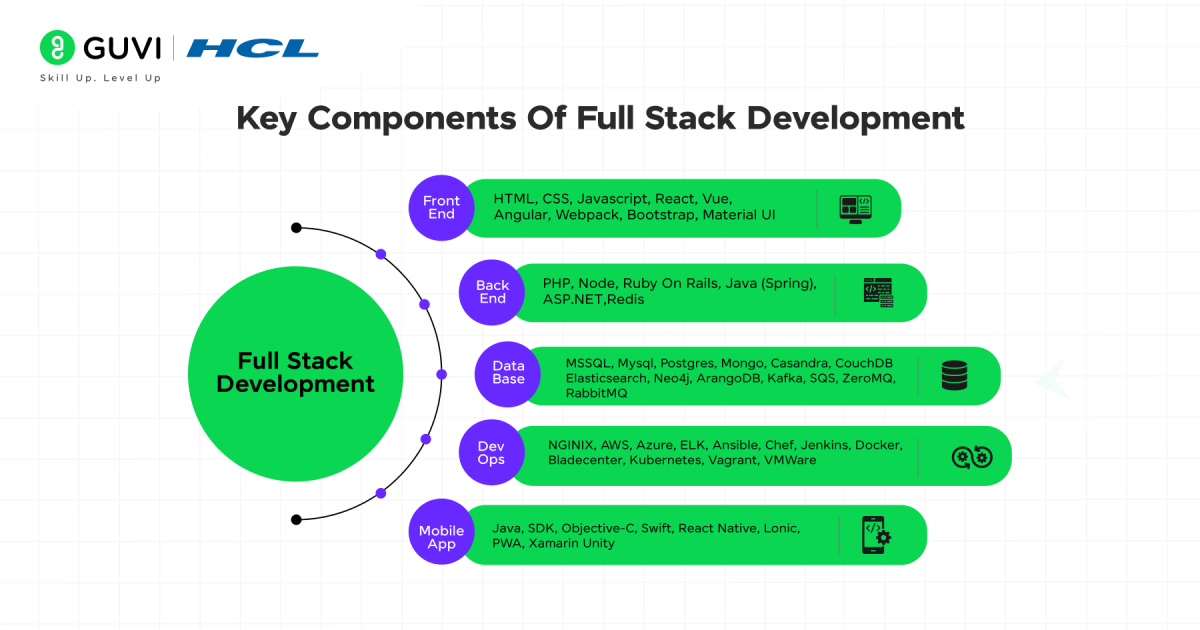
A full stack developer works across six layers of every application:
- Front-End Development: Everything the user sees and interacts with, built with HTML, CSS, JavaScript, and a framework like React, Angular, or Vue.js.
- Back-End Development: The logic layer: authentication, business rules, data processing, and API delivery, typically via Node.js (Express), Python (Django/FastAPI), or Java (Spring Boot).
- Database Management: Both relational (PostgreSQL, MySQL) and non-relational (MongoDB, Firebase, Redis) stores.
- API Development & Integration: Building REST/GraphQL endpoints and integrating third-party services (Razorpay, Stripe, Twilio, Google OAuth).
- Cloud Deployment & DevOps: Shipping and scaling apps using AWS/Azure/GCP, Docker, Kubernetes, and CI/CD pipelines.
- Security Implementation: OAuth 2.0, JWT, HTTPS, and input validation against SQL injection, XSS, and CSRF — built in, not bolted on.
Full Stack Developer Roles and Responsibilities by Experience Level
Full stack development is a career path, not one fixed job description. Here’s what actually changes as you go from fresher to tech lead.
Junior Full Stack Developer
Experience: 0–2 years | Salary (India): ₹4 – ₹8 LPA
You build features under guidance. The job at this stage is to learn fast and ship working code, not to be perfect.
- Building UI components with HTML, CSS, and JavaScript
- Implementing CRUD operations via APIs
- Fixing bugs across front-end and back-end code
- Writing basic unit tests, participating in code reviews
- Converting Figma designs into responsive pages
- Managing code with Git — branching, committing, pull requests
Typical stack: HTML5/CSS3/JS, React (basics), Node.js (Express) or Flask, MySQL/MongoDB (basic queries), Git, Postman.
Mid-Level Full Stack Developer
Experience: 2–5 years | Salary (India): ₹8 – ₹15 LPA
You own features end-to-end — from requirement to deployed code — and start mentoring juniors.
- Designing and building complete features independently
- Building and consuming REST/GraphQL APIs
- Optimising database queries, adding indexes, Redis caching
- Integrating third-party services (payments, storage, email)
- Writing unit and integration tests; reviewing juniors’ code
- Debugging production issues; contributing to architecture discussions
Typical stack: React/Vue + Redux/Zustand, Node.js/Django/Spring Boot, PostgreSQL/MongoDB/Redis, AWS/GCP basics, Docker basics, CI/CD.
What companies expect: you take a feature ticket and deliver it — API, database, UI — with minimal hand-holding.
Senior Full Stack Developer
Experience: 5–8 years | Salary (India): ₹15 – ₹30 LPA
You make architecture decisions and become the technical backbone of the team.
- Designing scalable architecture (microservices, serverless, or monolith)
- Leading high-impact features end-to-end
- Setting up and managing CI/CD pipelines
- Identifying and resolving production performance bottlenecks
- Mentoring junior/mid-level developers; running code reviews across the team
- Translating product requirements into technical tasks; writing RFCs and documentation
Typical stack: React/Next.js or Angular (advanced), Node.js/Spring Boot/Go/Python at scale, PostgreSQL + Elasticsearch, AWS (ECS, Lambda, RDS) + Terraform, Kubernetes, Datadog/New Relic.
What companies expect: you anticipate problems before they happen. Your decisions need to hold up for the next 2–3 years.
Full Stack Tech Lead
Experience: 7+ years | Salary (India): ₹18 – ₹35 LPA
You own the full software delivery lifecycle for a team — balancing technical depth with stakeholder management.
- Owning end-to-end technical delivery of a product or major module
- Breaking business requirements into technical sprints
- Coordinating across product, design, QA, DevOps, and data teams
- Making final calls on architecture, stack, and integrations
- Running sprint planning, reviewing critical code, presenting roadmaps to stakeholders
- Making rapid calls during production incidents
What companies expect: a tech lead isn’t just the best coder on the team — they make everyone around them more effective.
Explore: The best ways to learn full-stack development in 2026
Specialisations: MERN/MEAN & Java Full Stack
Two common specialisation paths worth knowing:
- MERN / MEAN Stack Developer (₹7–15 LPA) — JavaScript-only full stack. Both share Node.js + Express + MongoDB on the back-end; MERN uses React (startups, fast prototyping), MEAN uses Angular (enterprise, structured codebases).
- Java Full Stack Developer (₹8–17 LPA) — Java/Spring Boot back-end with React or Angular front-end. Heavily used in banking, fintech, and insurance, where enterprise-grade security and stability matter more than speed of iteration.
Full comparison: MEAN Stack vs MERN Stack — Which Should You Learn?
Is Full Stack Development Right for You?
Before you spend months learning toward this, check whether the role actually fits how you like to work.
This role is a good fit if:
- You’d rather own a feature completely than hand off half of it to someone else
- You get bored specialising in only UI or only backend logic
- You’re comfortable being “good enough” across many tools instead of expert in one
- You want the flexibility to work at a startup, a product company, or freelance
This role is probably NOT for you if:
- You want to go deep on one thing (pixel-perfect UI, or database internals) → consider a dedicated Front-End or Back-End Developer path instead
- You want to design systems and user experience, not code them → look at UI/UX Design
- You want to work with data and models more than applications → look at Data Analyst or Data Scientist
- You dislike context-switching between multiple layers of a codebase in the same day
If you’re still unsure, the “day in the life” section above is the most honest test — if that Tuesday sounded appealing rather than exhausting, this is a reasonable bet.
What Tools Do Full Stack Developers Use?
Full stack developers use a combination of development, testing, database, deployment, and collaboration tools because they work across multiple layers of an application. The exact toolkit varies depending on the technology stack and organisation.
| Area | Common Tools and Technologies | How They Are Used |
|---|---|---|
| Code Editors | Visual Studio Code, IntelliJ IDEA, WebStorm | Writing and managing application code |
| Front End | React, Angular, Next.js, Tailwind CSS | Building responsive user interfaces |
| Back End | Node.js, Express, Spring Boot, Django, FastAPI | Creating server-side logic and application services |
| Databases | PostgreSQL, MySQL, MongoDB, Redis | Storing, querying, and managing application data |
| API Development | Postman, Swagger, GraphQL | Building, documenting, and testing APIs |
| Version Control | Git, GitHub, GitLab | Managing code changes and team collaboration |
| Testing | Jest, Cypress, Playwright, JUnit, PyTest | Testing frontend and backend functionality |
| Containers | Docker, Kubernetes | Packaging and running applications consistently |
| Cloud & Deployment | AWS, Azure, GCP, Vercel | Hosting and deploying applications |
| CI/CD | GitHub Actions, Jenkins | Automating testing and deployment workflows |
| Monitoring | Datadog, New Relic | Tracking application performance and production issues |
| AI Coding Tools | GitHub Copilot, Cursor, Claude Code | Assisting with coding, debugging, and repetitive development tasks |
Full stack developers do not need to master every tool at once. Beginners can start with one frontend framework, one backend technology, a database, Git, and basic deployment before expanding their toolkit.
Full Stack Developer Career Growth: Where Can the Role Lead?
A full stack developer’s responsibilities usually expand from building individual features to owning complete applications, making architecture decisions, and eventually leading technical delivery. Your current role breakdown already follows this progression from junior developer to tech lead.
| Career Stage | Typical Experience | Main Focus |
|---|---|---|
| Junior Full Stack Developer | 0–2 years | Build smaller features, fix bugs, test code, and learn the complete stack |
| Mid-Level Full Stack Developer | 2–5 years | Own features from frontend to database and deployment |
| Senior Full Stack Developer | 5–8 years | Design solutions, improve architecture, review code, and mentor developers |
| Full Stack Tech Lead | 7+ years | Lead technical delivery, architecture decisions, and cross-team development |
| Principal / Staff Engineer | 8+ years | Solve complex engineering problems and influence technical direction |
| Engineering Manager | 8+ years | Manage development teams, delivery, and engineering processes |
| Head of Engineering / CTO | 10+ years | Guide broader technology strategy and engineering decisions |
After gaining senior-level experience, full stack developers can generally choose between two directions:
Technical path: Senior Full Stack Developer → Staff/Principal Engineer → Architect → Technical Leadership
Management path: Senior Full Stack Developer → Tech Lead → Engineering Manager → Head of Engineering / CTO
Full stack experience can also open paths into solution architecture, cloud engineering, DevOps, product engineering, consulting, or freelance development, depending on the skills a developer chooses to deepen.
Full Stack Developer Salary in India (2026)
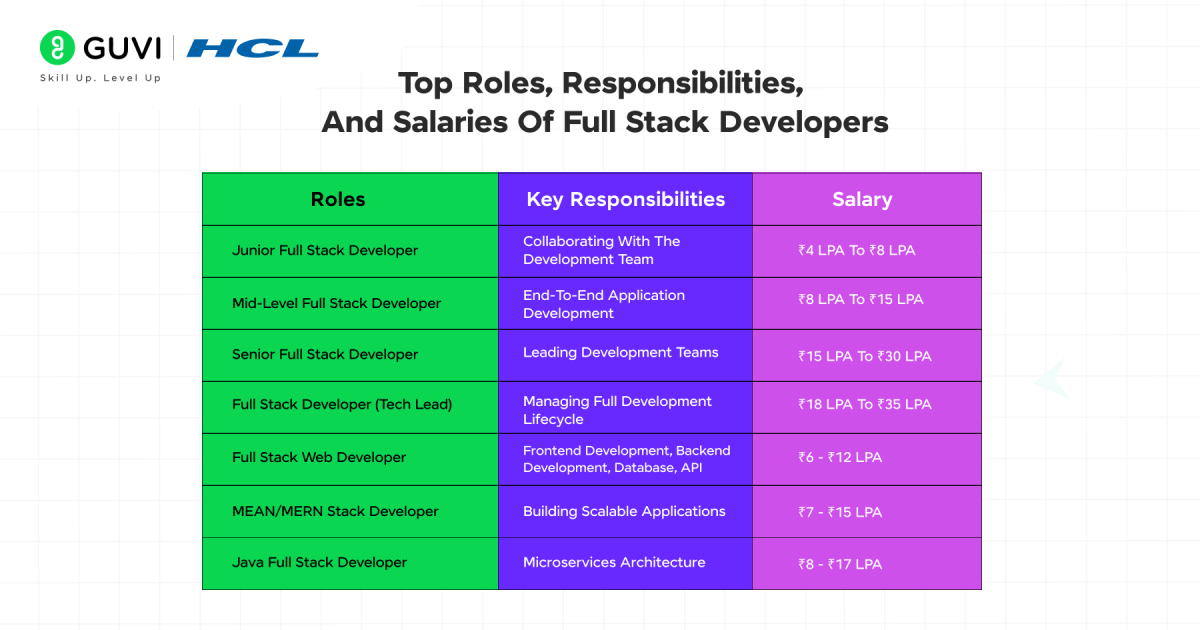
| Role | Experience | Salary Range (India) |
|---|---|---|
| Junior Full Stack Developer | 0–2 years | ₹4 – ₹8 LPA |
| MEAN / MERN Stack Developer | 1–4 years | ₹7 – ₹15 LPA |
| Java Full Stack Developer | 2–5 years | ₹8 – ₹17 LPA |
| Mid-Level Full Stack Developer | 2–5 years | ₹8 – ₹15 LPA |
| Senior Full Stack Developer | 5–8 years | ₹15 – ₹30 LPA |
| Full Stack Tech Lead | 7+ years | ₹18 – ₹35 LPA |
Skills You Actually Need in 2026
| Layer | What to learn | Why it matters |
|---|---|---|
| Front-end | HTML5, CSS3, JavaScript (ES6+), React or Angular, TypeScript | TypeScript is now expected in most production codebases, not optional |
| Back-end | Node.js + Express, or Python (Django/FastAPI), or Java (Spring Boot) | Pick one language and go deep before spreading wide |
| Databases | PostgreSQL/MySQL (SQL) + MongoDB/Redis (NoSQL) | Most real apps use both — SQL for structure, NoSQL for flexibility/caching |
| Testing | Jest/PyTest/JUnit, Cypress/Playwright | Employers notice test coverage before they notice UI polish |
| Security | OAuth 2.0, JWT, input validation, OWASP Top 10 basics | Security is now a baseline expectation, not a specialist add-on |
| AI-assisted coding | GitHub Copilot/Cursor, Claude Code, ChatGPT for debugging | Using these well is now a measurable productivity skill, and shows up in job descriptions |
The right skill set helps full stack developers work confidently across frontend, backend, databases, APIs, and development tools.
Read More about Skills Required to Become a Full Stack Developer
Once you understand the key skills, the next step is building them through hands-on practice. Explore GUVI’s Full Stack Development course to learn the technologies, tools, and practical workflows used in real-world full stack development.
HCL GUVI’s Full Stack Development Course
How to Become a Full Stack Developer
To become a full stack developer, start with HTML, CSS, and JavaScript, then learn a frontend framework such as React. Next, build your backend skills with Node.js, Java, Python, or another server-side language, along with databases, APIs, Git, and deployment basics. Practice by building complete projects that connect the frontend, backend, and database.
For a step-by-step learning path, recommended technologies, project ideas, and career preparation tips, follow our Full Stack Developer Roadmap. It can help you understand what to learn at each stage and how to move towards job-ready full stack development skills.
Full Stack vs Front-End vs Back-End Developer
Many beginners confuse these three roles. Here’s the clearest way to think about it: a front-end developer builds what users see, a back-end developer builds the systems that power it, and a full stack developer does both and connects the layers between them.
| Dimension | Front-End Developer | Back-End Developer | Full Stack Developer |
|---|---|---|---|
| What they build | UI, layouts, interactions | Servers, APIs, databases | Both, end to end |
| Languages | HTML, CSS, JavaScript, React | Node.js, Python, Java, PHP | All of the above |
| Key tools | Figma, Tailwind CSS, React | Django, Spring Boot, PostgreSQL | React + Node.js + MongoDB + AWS |
| Salary in India | ₹4–12 LPA | ₹5–18 LPA | ₹4–35+ LPA |
| Best suited for | Visual, UI-focused thinkers | Logic and data enthusiasts | Versatile, product-minded builders |
| Deployment role | Front-end assets only | Manages servers and infra | Owns the full deployment pipeline |
Will AI Replace Full Stack Developers?
Short answer: no — but the role is changing. AI tools like GitHub Copilot and Claude Code can generate boilerplate, suggest fixes, and build basic components fast. What they can’t do:
- Understand the business context behind a feature request
- Make architecture decisions with long-term consequences for a live product
- Debug complex production issues spanning multiple systems
- Lead a team or communicate tradeoffs to non-technical stakeholders
- Solve genuinely novel problems with no existing pattern to copy
Developers most at risk are the ones who only write repetitive, low-complexity code without understanding why it works. The ones who’ll thrive are using AI as a multiplier while focusing their own effort on system design and product ownership.
Common Mistakes Beginners Make
- Learning everything at once: React, Node, Python, and three databases in parallel. Pick one front-end framework and one back-end language, get genuinely confident, then expand.
- Skipping JavaScript fundamentals for frameworks: React without solid JS (closures, promises, event loop) leads to brittle code. Spend the four weeks first.
- Building only tutorial clones: calculator apps and Netflix UI copies don’t stand out. Build something that solves a real problem, even a small one.
- Ignoring tests and version control: A handful of unit tests and a clean commit history signal professional readiness more than a flashy UI.
- Never deploying projects: A project that only runs locally isn’t a portfolio piece. Deploy it, get a live URL.
Conclusion
Full stack development remains one of the most versatile career paths in tech, you’re not just writing code, you’re turning ideas into complete, working products. As AI, cloud, and modern frameworks reshape the day-to-day, the developers who combine strong fundamentals with problem-solving and product thinking will have the clearest advantage.
If the self-assessment above matched how you like to work, the next step is simple: pick one stack, build one real project, and start there.
FAQs
What does a full stack developer do?
A full stack developer builds complete web applications, front-end, back-end, databases, APIs, and deployment rather than specialising in just one layer.
What are the main responsibilities of a full stack developer?
Designing user interfaces, developing server-side logic, managing databases, building APIs, testing applications, and maintaining security across the stack.
Is full stack development a good career in 2026?
Yes. Demand stays high because companies need developers who can build and manage complete applications without needing a specialist for every layer.
Which full stack technology stack is best to learn?
MERN, MEAN, and Java Full Stack are the most in-demand. MERN/MEAN suit startups and fast iteration; Java Full Stack suits enterprise, banking, and fintech environments.
Do full stack developers need to learn AI tools?
Yes, AI coding tools are now a baseline productivity skill, not an optional extra, and increasingly show up by name in job descriptions.
Is full stack development right for someone who prefers specialising in one area?
Not ideally – if you’d rather go deep on UI or backend logic alone, a dedicated Front-End or Back-End Developer path is a better fit than full stack.
What is the salary of a full stack developer in India?
Salaries range from around ₹4 LPA for freshers to ₹35+ LPA for experienced tech leads, depending on stack, city, and company type.