


Full Stack Development Articles
How to Move from Technical Documentation to Fullstack Development
How Can an ERP Consultant Build a Career in Full Stack Development?
Can a Business Analyst Transition into a Technical Development/FSD Role?
How Can a Database Administrator Transition into Full Stack Development?

Get In Touch For Details! Request More Information
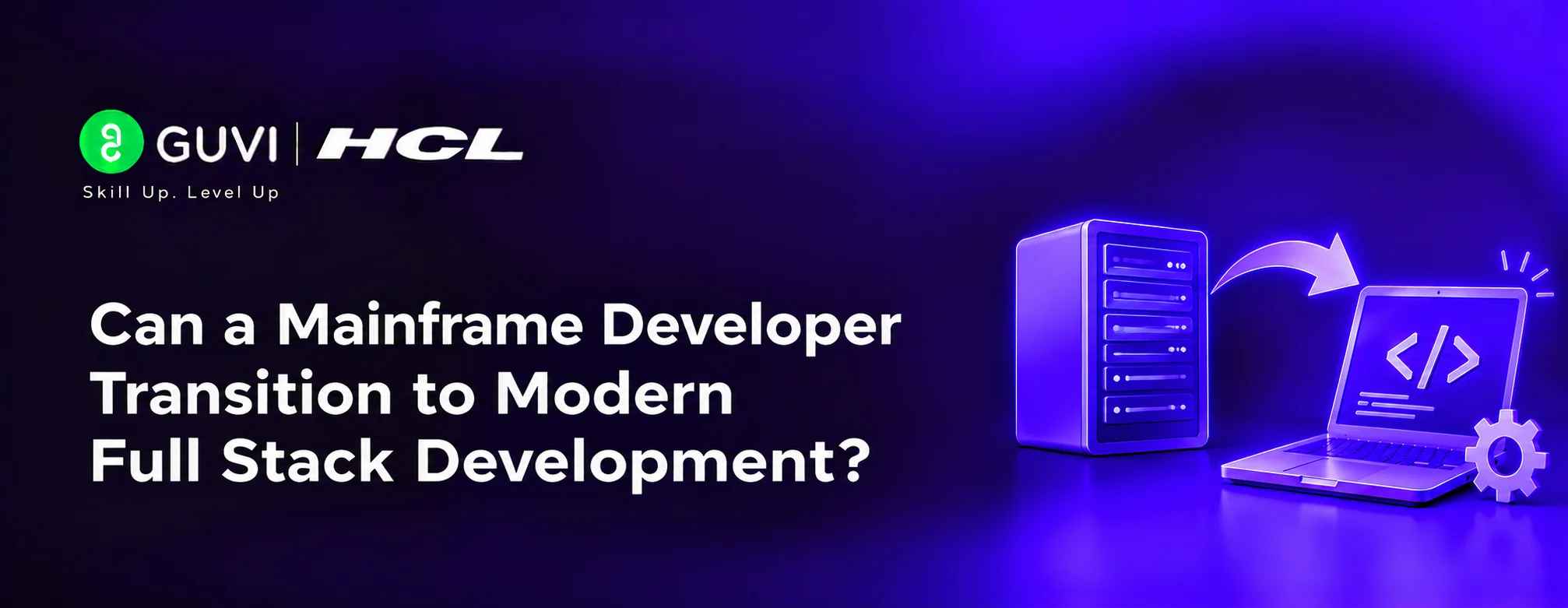
Can a Mainframe Developer Transition to Modern Full Stack Development?
Nov 16, 2026 4 Min Read 60 Views
(Last Updated)
You write COBOL that moves real money, tune overnight JCL and debug abends few developers have heard of. Yet talk of React, REST or cloud deployments still feels foreign.
Yes, a mainframe developer can transition to modern full stack development, and the move is more natural than it looks. Going from mainframe developer to full stack developer means pairing your batch, transaction and data skills with JavaScript or Java web stacks, which most professionals manage in 9 to 12 months.
Inside this mainframe developer to full stack developer guide: how mainframe concepts map to modern tools, the mainframe modernization skills worth learning, a 6 step full stack development roadmap, salary ranges, hybrid career paths and the traps to avoid.
Table of contents
- TL;DR Summary
- What is Mainframe Developer to Full Stack Developer?
- Mainframe Concepts and Their Modern Equivalents
- 💡 Did You Know?
- Mainframe Modernization Skills to Learn
- A 6 Step Full Stack Development Roadmap for Mainframe Developers
- Pick Your Modern Language (Months 1 to 2)
- Learn Git and Modern Tooling (Month 2)
- Build Backend APIs (Months 3 to 5)
- Add the Frontend (Months 5 to 7)
- Deploy to the Cloud (Months 7 to 8)
- Portfolio and Job Hunt (Months 9 to 12)
- Salary: Mainframe vs Full Stack Developer
- Hybrid Paths Worth Knowing
- Projects That Show Both Worlds
- Learn Modern Full Stack With Mentors
- Common Mistakes Mainframe Developers Make
- Thinking Mainframe Skills Are Obsolete
- Learning Too Many Stacks
- Skipping Git and CI/CD
- Avoiding the Frontend
- Not Exploring Hybrid Roles
- Conclusion
- FAQs
- Can a mainframe developer become a full stack developer?
- How long does mainframe to modern development take?
- Which mainframe modernization skills should I learn first?
- Is Java or MERN better for mainframe developer to full stack developer learners?
- What does a full stack development roadmap look like for mainframe developers?
TL;DR Summary
- What it is: Mainframe developer to full stack developer covers a COBOL, JCL, CICS or DB2 professional learning to build modern web applications, covering the browser interface, server APIs, databases and cloud deployment.
- Short answer: Yes. Mainframe developers already understand enterprise logic, data and reliability, so within 9 to 12 months of practice they can work as full stack developers or as hybrid modernization developers.
- Your edge: In mainframe developer to full stack developer shifts, transaction thinking and production discipline carry over.
- Natural stack: Java with Spring Boot and React, or MERN, suits most mainframe developer to full stack developer learners.
- Next step: Rewrite one COBOL program’s logic as a REST API, your first mainframe developer to full stack developer build.
What is Mainframe Developer to Full Stack Developer?
Mainframe developer to full stack developer means going from building backend programs on IBM Z systems to building complete web apps that users open in a browser.
- Mainframe world: COBOL programs, JCL batch jobs, CICS transactions, DB2 tables and green screen interfaces.
- Full stack world: React screens, Node.js or Spring Boot APIs, cloud databases and automated deployments.
- What connects them: both handle business rules, data and users, only the tools and release speed differ.
Many enterprises still run core systems on mainframes while building new apps around them, which is why mainframe to modern development is such a practical career path.
Want structured support for this switch? Enrolling in the HCL GUVI Full Stack Development Course helps you learn the modern web stack through mentor led sessions and hands on builds, turning your enterprise experience into skills hiring managers can see.
Mainframe Concepts and Their Modern Equivalents
Nearly every mainframe idea has a modern counterpart. This mapping makes the mainframe developer to full stack developer jump feel familiar.
| Mainframe concept | Modern full stack equivalent |
|---|---|
| COBOL programs | Java, JavaScript or Python services |
| CICS online transactions | REST APIs handling requests |
| JCL batch jobs | Scheduled jobs and CI/CD pipelines |
| DB2 tables | PostgreSQL, MySQL or MongoDB |
| Copybooks | Data models, schemas and DTOs |
| ISPF editor | VS Code and modern IDEs |
| Endevor or Changeman | Git and pull requests |
| Green screen BMS maps | React components and forms |
- What feels new is speed: small changes ship daily, not in quarterly releases.
💡 Did You Know?
- COBOL was designed in 1959 by a committee called CODASYL, with Grace Hopper’s earlier work as a major influence.
- IBM announced the System/360 mainframe family in April 1964.
Mainframe Modernization Skills to Learn
These mainframe modernization skills help you work on both sides, which keeps your options open during the mainframe developer to full stack developer shift.
| Skill | Why it matters | Approx. time |
|---|---|---|
| Java or JavaScript | Most modern enterprise code uses one of them | 6 to 7 weeks |
| Git and GitHub | Replaces library management tools | 1 to 2 weeks |
| REST APIs | Exposes business logic to web and mobile apps | 3 to 4 weeks |
| React | Replaces green screens with web interfaces | 6 to 8 weeks |
| Cloud basics | Where new apps are deployed | 3 to 4 weeks |
| CI/CD and DevOps | Automated build, test and release | 2 to 3 weeks |
- Java is often the smoothest bridge, and these reasons Java is still relevant explain why enterprises keep investing in it.
- Learn how a DevOps pipeline works, since it is the modern cousin of your JCL job streams.
A 6 Step Full Stack Development Roadmap for Mainframe Developers
This full stack development roadmap fits about 8 to 10 hours a week alongside mainframe project work.
1. Pick Your Modern Language (Months 1 to 2)
- Choose Java for enterprise work or JavaScript for MERN as your first mainframe developer to full stack developer language.
- Prefer Python first? A Python basics to web frameworks roadmap works too.
2. Learn Git and Modern Tooling (Month 2)
- Swap ISPF for VS Code and Endevor for Git.
- Practise branching and pull requests daily.
3. Build Backend APIs (Months 3 to 5)
- Build REST APIs with Spring Boot or Express.js.
- Start with this Spring Boot project step by step guide if you chose Java.
- Rewrite a COBOL interest or billing calculation as an endpoint, a classic mainframe developer to full stack developer exercise.
4. Add the Frontend (Months 5 to 7)
- Learn HTML, CSS and JavaScript, then React, the biggest new area in mainframe developer to full stack developer learning.
- Understand components and state with an intro to what ReactJS is.
5. Deploy to the Cloud (Months 7 to 8)
- Learn what AWS cloud computing is and deploy one mainframe developer to full stack developer project.
- Set up a basic pipeline after understanding CI/CD.
6. Portfolio and Job Hunt (Months 9 to 12)
- Ship three projects that show both web skills and enterprise thinking.
- Apply for full stack, Java backend and modernization roles.
| Step | Months | Outcome |
|---|---|---|
| Modern language | 1 to 2 | Confident in Java or JavaScript |
| Git and tooling | 2 | Daily Git habit |
| Backend APIs | 3 to 5 | A working REST service |
| Frontend | 5 to 7 | React app using your API |
| Cloud | 7 to 8 | One deployed app with CI/CD |
| Portfolio | 9 to 12 | Applications and interviews |

Salary: Mainframe vs Full Stack Developer
For mainframe developer to full stack developer shifts, pay by experience in India looks like this.
| Experience | Mainframe Application Developer | Full Stack Developer |
|---|---|---|
| 2 years | ₹3.7 Lakhs to ₹8 Lakhs | ₹2.2 Lakhs to ₹12.9 Lakhs |
| 3 years | ₹4 Lakhs to ₹8 Lakhs | ₹3 Lakhs to ₹16.3 Lakhs |
| 4 years | ₹4.1 Lakhs to ₹14 Lakhs | ₹3.5 Lakhs to ₹20 Lakhs |
Note: Salary figures may change over time as users update their reported data. Please refer to the linked source for the latest salary ranges.
- Mainframe floors are steadier, while full stack ceilings run higher at each level shown.
Hybrid Paths Worth Knowing
You do not have to leave mainframes behind completely. Some of the best mainframe to modern development roles mix both worlds.
- Modernization developer: Wraps COBOL logic in REST APIs so web and mobile apps can use it.
- Java backend developer in banking: Builds services that call mainframe systems.
- Migration engineer: Helps move workloads to cloud platforms, often using microservices architecture.
These roles value your mainframe depth while you grow modern skills, making the mainframe developer to full stack developer path less risky.
Projects That Show Both Worlds
Recruiters want proof in any mainframe developer to full stack developer portfolio. These projects highlight your enterprise background.
- Banking dashboard: A React app showing accounts and transactions from a Spring Boot or Node.js API.
- Batch to API converter: Take a nightly batch calculation and expose it as an on demand REST endpoint.
- Loan EMI calculator service: Business logic you know well, now with a web UI and tests.
Learn Modern Full Stack With Mentors
Moving from green screens to React is easier with guidance. A course keeps your mainframe developer to full stack developer plan on track.
When you join the HCL GUVI Full Stack Development Course, you get:
- Flexible classes: 130+ hours of live online learning, with recordings for release weekends and weekday or weekend timing.
- Tools covered: HTML, CSS, JavaScript, React, Tailwind CSS, Node.js, Express.js, MongoDB, Mongoose, Postman, REST APIs, DSA, system design, DevOps and GenAI.
- Real projects: A cloud deployment pipeline, an AI chatbot that answers questions from documents, an ecommerce web application and an order management system.
- Hiring support: Resume review, one to one mock interviews, and portfolio and GitHub guidance.
- Certifications: IITM Pravartak certification and a complimentary MongoDB certification.
- Language choice: Classes run in Telugu, Hindi, Tamil and English, beginning with programming fundamentals.
To plan your cloud growth after the course, the AWS roadmap and career guide shows which certifications and services to target.
Common Mistakes Mainframe Developers Make
1. Thinking Mainframe Skills Are Obsolete
- Your data and batch knowledge is valuable. Lead with it in mainframe developer to full stack developer interviews.
2. Learning Too Many Stacks
- Pick Java with React or MERN, not both, early in your mainframe developer to full stack developer journey.
3. Skipping Git and CI/CD
- Teams expect Git and automated pipelines from day one of mainframe developer to full stack developer work.
4. Avoiding the Frontend
- Mainframe developer to full stack developer candidates need UI skills, so build at least two React apps.
5. Not Exploring Hybrid Roles
- Modernization roles can be the fastest way into full stack teams. Read up on Java developer roles and responsibilities to see where you fit.
Conclusion
The mainframe developer to full stack developer journey builds on decades of enterprise discipline. Learn a modern language, add APIs, React and cloud, and use hybrid roles if you want a smoother path.
For live mentors, real projects and placement support behind your switch, enrolling in the HCL GUVI Full Stack Development Course helps you go from green screens to modern web apps with confidence.
FAQs
1. Can a mainframe developer become a full stack developer?
Very much so. Your grip on business logic, data and production systems makes the mainframe developer to full stack developer shift realistic. Add modern languages, APIs and frontend skills.
2. How long does mainframe to modern development take?
A mainframe developer to full stack developer change usually takes about a year, often 9 to 12 months. Those who already know some Java or SQL tools often move faster.
3. Which mainframe modernization skills should I learn first?
Start with Java or JavaScript, Git and REST APIs. These mainframe modernization skills help you in both full stack and hybrid roles.
4. Is Java or MERN better for mainframe developer to full stack developer learners?
Java with Spring Boot suits enterprise and banking roles, while MERN fits startups and product companies.
5. What does a full stack development roadmap look like for mainframe developers?
A good full stack development roadmap covers a modern language, Git, backend APIs, React, cloud deployment and a portfolio over 9 to 12 months.
Success Stories

About the Author
Jebasta
I translate the language of data into stories that anyone can understand. As a writer with a data science background, I simplify analytics, AI, and decision-making so beginners and enthusiasts can confidently explore the world of data.
View all posts by Jebasta
Connect with me @




















Did you enjoy this article?