


Career Articles
AI/ML Skills Gap 2026: Why Companies Can't Find Job-Ready Talent
20 AI/ML Interview Questions Recruiters Can Use Without a Tech Background - Best Guide
How Industry-Backed AI/ML Bootcamps Are Changing the AI/ML Hiring Pipeline - Best Guide 2026
From IT Support to AI Engineer: A Realistic Career Switch Guide 2026


Get In Touch For Details! Request More Information

Java Developer Roles and Responsibilities: A Complete Guide for 2026 (With Job Description + Day-in-the-Life)
Jun 04, 2026 12 Min Read 7619 Views
(Last Updated)
Java has been the backbone of enterprise software development for over three decades, and in 2026 it remains one of the most hired programming languages in India and across the world. From Spotify’s backend infrastructure and Netflix’s content delivery systems to banking platforms at JPMorgan and Barclays, Java powers some of the most critical and high-traffic systems on the planet. If you are planning a career as a Java developer or want to understand what the role truly involves, this guide gives you the complete, up-to-date breakdown of java developer roles and responsibilities across every experience level and specialization.
This blog covers everything from the day-to-day duties and technical responsibilities to the skills required, salary expectations sourced from Glassdoor and AmbitionBox, career growth paths, and practical advice for excelling in java developer roles and responsibilities in 2026. Whether you are a fresher deciding on a career path or a mid-level developer planning your next move, everything you need is here.
Table of contents
- TL;DR Summary
- An Introduction Into What Does a Java Developer Do?
- Java Then vs. Now
- Core Java Developer Roles and Responsibilities in 2026
- 1) Designing and developing Java applications
- 2) Managing Java and Java EE application development
- 3) Writing and Reviewing Clean, Testable Code
- 4) Implementing CI/CD Pipelines and DevOps Integration
- 5) Working with Microservices and Cloud-Native Architecture
- 6) Database Design and Management
- 7) Security and Performance Optimization
- 8) Collaborating with Cross-Functional Teams
- 9) Mentoring Junior Developers and Conducting Code Reviews
- 10) Staying Current with the Java Ecosystem
- Java Developer Roles and Responsibilities by Specialization
- Backend Java Developer
- Java Full Stack Developer
- Java Enterprise Developer
- Java DevOps Engineer
- What Does a Java Developer's Day Actually Look Like?
- Morning: Standups, Planning, and Picking Up Work
- Mid-Morning to Afternoon: Deep Work and Coding
- Afternoon: Code Reviews and Collaboration
- End of Day: Wrap Up and Learning
- Sample Java Developer Job Description
- Job Title: Java Developer (Mid Level)
- Essential Skills for Java Developer Roles and Responsibilities
- Core Technical Skills
- Advanced Skills That Increase Salary in 2026
- Soft Skills That Matter
- Java Developer Salary in India in 2026
- Salary by Experience Level
- Salary by City
- Java Developer Career Path in 2026
- Career Progression by Level
- Java Career Tracks Beyond Core Development
- Java developer roadmap: What's changing in the next 5 years?
- 💡 Did You Know?
- Final Thoughts
- Frequently Asked Questions
- What tools are essential for a Java developer?
- How does Java support microservices architecture?
- Is Java still relevant for Android development?
- How does serverless computing impact Java development?
- What is the average learning curve for new Java developers?
TL;DR Summary
Java developer roles and responsibilities include designing and developing scalable Java applications, managing Java EE enterprise systems, writing clean testable code, implementing CI/CD pipelines, working with Spring Boot and Hibernate, collaborating across teams, optimizing performance, handling security, and staying current with cloud-native and microservices practices. On a typical day, Java developers attend standups, write and review code, manage pull requests, fix bugs, and sync with product and DevOps teams. Salaries range from ₹3,20,000 for freshers to ₹25,00,000 or more for senior architects, depending on skills and company type.
An Introduction Into What Does a Java Developer Do?
Before getting into the specific java developer roles and responsibilities, it helps to understand what the role means in practice and how it has evolved over time.
A Java developer is a software professional who designs, builds, tests, and maintains applications using the Java programming language. Java developers work across a wide range of domains including web application development, enterprise backend systems, Android applications, cloud-native microservices, and financial technology. The scope of java developer roles and responsibilities has expanded significantly over the past decade as applications have grown more distributed, cloud-dependent, and security-sensitive.
In the late 1990s and early 2000s, Java developers primarily built standalone desktop applications and early web portals. Today, they manage the full software development lifecycle across complex distributed systems, working alongside DevOps engineers, data teams, frontend developers, and product managers to deliver products that scale to millions of users. Understanding this evolution is important because it explains why java developer roles and responsibilities now extend so far beyond writing code.
Java Then vs. Now
| Earlier Java Developer Role (Pre-2015) | Modern Java Developer Role (2026) |
|---|---|
| Building standalone desktop and web applications | Designing cloud-native microservices and distributed systems |
| Simple JDBC-based database access | ORM frameworks like Hibernate and Spring Data JPA |
| Manual deployment and server configuration | CI/CD pipelines with Jenkins, GitHub Actions, Docker |
| Monolithic application architecture | Microservices with Spring Boot, Kubernetes orchestration |
| Limited security focus | DevSecOps practices, OWASP compliance, secrets management |
| Java SE and Java EE basics | Spring ecosystem, reactive programming, cloud SDKs |
Core Java Developer Roles and Responsibilities in 2026
The following sections cover every major responsibility that appears consistently in Java developer job descriptions across India’s top IT companies, product startups, and global enterprises in 2026.
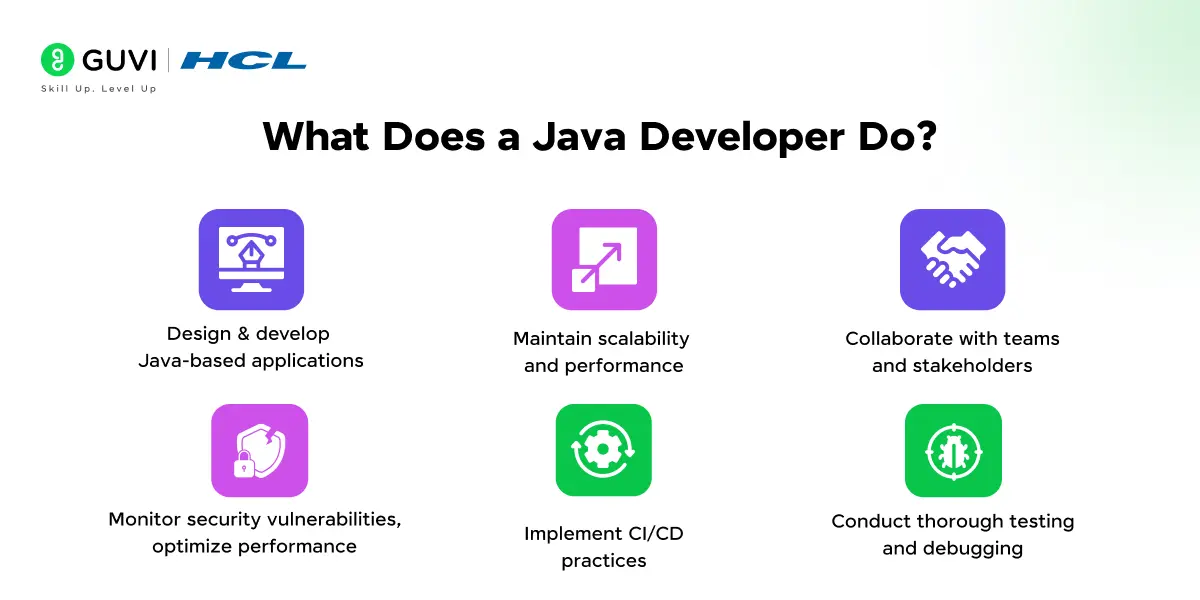
Let’s dive into detail to understand what all will count for a Java developer job profile:
1) Designing and developing Java applications
This is the most fundamental of all java developer roles and responsibilities. You write Java code that powers real applications, whether that is a banking portal, a shopping website, or a hospital management system.
- Understand requirements first: Before writing a single line of code, Java developers read through project requirements, user stories, and technical specs to understand what exactly needs to be built.
- Design the structure: You plan how different parts of the application will talk to each other. Think of it like drawing a blueprint before building a house.
- Write clean, working code: The actual coding happens here. You build features using Java and frameworks like Spring Boot, making sure the code is readable and easy for your teammates to maintain.
- Test what you build: After coding, you write unit tests using JUnit to make sure each part of your code behaves exactly as expected.
- Refactor regularly: Good developers go back and improve old code to make it faster and easier to read. This is called refactoring, and it keeps the codebase healthy over time.
Also read | Getting Started With Java: Essential Concepts and Techniques
2) Managing Java and Java EE application development
This responsibility mostly applies to senior and lead Java developers. Java EE (Enterprise Edition) is a version of Java designed for large-scale business systems used by banks, hospitals, and government organizations.
- Handle high-traffic systems: Enterprise applications need to serve thousands of users at the same time without slowing down. Senior developers design systems that can handle this load smoothly.
- Integrate multiple services: Big companies have many internal tools and databases. Java developers connect all these systems so they can share data reliably.
- Ensure scalability: As the business grows, the application should grow with it. Seniors plan the architecture so the system does not break when user numbers double or triple.
- Migrate legacy systems: Many older Java EE applications are being moved to modern Spring Boot microservices. Java developers handle this transition carefully to avoid downtime.
3) Writing and Reviewing Clean, Testable Code
Writing code that works is the minimum expectation. Writing code that is clean, readable, and easy for others to test and maintain is what separates good Java developers from great ones.
- Follow coding standards: Every team has style guides and naming conventions. Java developers follow these to keep the codebase consistent.
- Apply SOLID principles: These are five simple design rules that help you write code that is easy to change without breaking other parts of the application.
- Write unit and integration tests: Tests are automated checks that verify your code does what it is supposed to do. Tools like JUnit and Mockito are standard for this in Java.
- Conduct code reviews: Mid-level and senior developers read through their teammates’ code before it gets merged, giving feedback and catching bugs early.
- Reduce technical debt: This means fixing old messy code before it becomes a bigger problem later.
HCL GUVI’s blog on Java interview questions and answers covers the types of code quality questions interviewers commonly ask and is worth reading alongside this guide.
4) Implementing CI/CD Pipelines and DevOps Integration
CI/CD stands for Continuous Integration and Continuous Deployment. In simple terms, it means automating the process of testing and releasing code so that new features reach users faster and with fewer bugs. This is one of the most in-demand java developer roles and responsibilities in 2026.
- Set up automated builds: Tools like Jenkins or GitHub Actions automatically compile and test your code every time you push a change. No more manual deployments.
- Run tests automatically: Every commit triggers the full test suite so bugs are caught before they reach production.
- Build Docker images: Java developers package their applications into Docker containers, which run the same way on every machine regardless of the environment.
- Deploy to cloud environments: Once code passes all tests, it is deployed automatically to AWS, Azure, or Google Cloud without anyone pressing a button manually.
- Shift left on testing: This simply means catching bugs as early as possible in the development process, rather than discovering them at the end. Read HCL GUVI’s guide on CI/CD pipelines if you want to understand this in more depth.
5) Working with Microservices and Cloud-Native Architecture
Instead of building one big application, modern teams split it into many small services that each do one job well. This approach is called microservices, and it is now the standard pattern for large Java applications in 2026.
- Design service boundaries: You decide which part of the application becomes its own service. For example, payments, notifications, and user profiles might each be separate services.
- Build REST APIs with Spring Boot: Each microservice exposes an API so other services can communicate with it. Spring Boot makes this fast and straightforward.
- Handle inter-service communication: Services need to talk to each other reliably. Java developers use REST APIs or message queues like Apache Kafka for this.
- Deploy using Docker and Kubernetes: Each service runs inside a Docker container. Kubernetes manages all those containers, scaling them up or down based on traffic.
- Monitor and log everything: In a microservices system, something can go wrong in any one of dozens of services. Developers set up logging and monitoring from day one so issues are spotted quickly.
6) Database Design and Management
Every application stores data somewhere. Java developers are responsible for designing the database, writing queries to read and write data efficiently, and making sure performance does not degrade as data grows.
- Design database schemas: You plan the structure of tables and relationships before any data is stored. A good schema design prevents a lot of problems later.
- Write SQL queries: Java developers write queries to fetch, update, and delete data. Slow queries are one of the most common causes of poor application performance.
- Use ORM tools: Hibernate and Spring Data JPA let you work with database records as Java objects, which reduces the amount of raw SQL you need to write and makes the code easier to read.
- Optimize performance: This means adding indexes to speed up queries, analyzing slow query logs, and redesigning schemas when the data volume grows.
- Choose the right database: Senior developers decide whether a relational database like PostgreSQL or MySQL, or a NoSQL database like MongoDB, is the right fit for each use case.
7) Security and Performance Optimization
With data breaches and cyberattacks increasing every year, security has become one of the non-negotiable java developer roles and responsibilities at every experience level in 2026.
- Implement authentication and authorization: Java developers use Spring Security to control who can log in and what each user is allowed to do inside the application.
- Follow OWASP guidelines: OWASP is a globally recognized standard for web application security. Developers follow it to protect against common attacks like SQL injection and cross-site scripting.
- Manage secrets safely: API keys, passwords, and database credentials must never be hardcoded in code. Tools like HashiCorp Vault or AWS Secrets Manager store them safely.
- Profile the JVM: Performance issues in Java often come from how the JVM manages memory. Developers use profiling tools to find memory leaks and slow garbage collection cycles.
- Implement caching: Frequently accessed data is stored in a fast cache using Redis or Memcached so the database does not get overloaded with repeated queries.
- Optimize API response times: Developers measure how long each API takes to respond and tune the code, queries, and infrastructure until performance meets the target.
8) Collaborating with Cross-Functional Teams
Java development is never a solo activity. One of the most important but often overlooked java developer roles and responsibilities is working effectively with people across different functions.
- Work with product managers: PMs explain what the business needs. Java developers translate those needs into technical solutions and push back when something is not feasible.
- Partner with designers: UI/UX designers decide how the product looks. Java developers make sure the backend APIs provide exactly the data the frontend needs to display.
- Coordinate with QA engineers: Testers find bugs. Java developers fix them quickly and clearly document what changed so QA can verify the fix.
- Sync with DevOps teams: Developers hand off applications to DevOps for deployment and work together to resolve environment and configuration issues.
- Update stakeholders: Senior developers present progress, risks, and technical decisions to managers and business leads in simple, clear language.
9) Mentoring Junior Developers and Conducting Code Reviews
This responsibility kicks in at the mid-level and grows as you become more senior. Mentoring is not just about being nice. It directly improves code quality, team productivity, and your own leadership profile.
- Onboard new team members: You help new joiners understand the codebase, development workflow, and team conventions so they can contribute quickly.
- Review pull requests: Before code is merged into the main branch, senior developers read through it carefully to catch bugs, suggest improvements, and ensure consistency.
- Share knowledge proactively: This includes writing internal documentation, running knowledge-sharing sessions, and answering questions from juniors without making them feel bad for asking.
- Give constructive feedback: Great code reviewers point out what is wrong and explain why, helping the author grow rather than just rejecting the code.
10) Staying Current with the Java Ecosystem
Java is not a static language. New versions, frameworks, and tools come out regularly, and developers who stop learning quickly become outdated.
- Follow Java LTS releases: Java 17 and Java 21 introduced features like virtual threads, records, sealed classes, and pattern matching. Knowing these puts you ahead of most candidates in interviews.
- Track Spring Boot updates: Spring Boot releases major versions frequently. Staying on a supported version means your application gets security patches and performance improvements automatically.
- Learn emerging tools: Tools like GraalVM (for faster startup), Testcontainers (for better integration testing), and Spring AI (for embedding AI capabilities) are becoming mainstream in java developer roles and responsibilities at top companies.
- Participate in the community: Following Java developer communities on LinkedIn, attending local meetups, and reading tech blogs keeps you informed about what skills are actually in demand before the job market reflects them.
Java Developer Roles and Responsibilities by Specialization
Java developer roles and responsibilities vary significantly depending on the specialization a developer chooses. Here is how the role breaks down across the most common tracks.
1. Backend Java Developer
Backend Java developers focus on server-side application logic, REST API development, database management, and system integration. This is the most common Java developer specialization in India and is the standard entry point for most Java careers.
- Primary responsibilities: Building and maintaining REST APIs with Spring Boot, handling authentication and authorization, managing database access layers, writing unit and integration tests, optimizing API performance.
- Core tools: Java (17 or 21), Spring Boot, Spring Security, Hibernate, PostgreSQL or MySQL, Redis, JUnit, Mockito, Docker, Git.
2. Java Full Stack Developer
Java Full Stack developers handle both backend Java development and frontend development, typically using React or Angular on the client side alongside Spring Boot on the server. This specialization commands higher salaries because of the breadth of skills required.
- Primary responsibilities: Designing and building end-to-end features from database to UI, managing deployment pipelines, integrating third-party APIs, and owning feature delivery independently.
- Core tools: Java, Spring Boot, React.js or Angular, HTML, CSS, JavaScript, MongoDB or PostgreSQL, Docker, Git.
3. Java Enterprise Developer
Enterprise Java developers work on large-scale systems for banking, insurance, healthcare, and logistics companies. These systems process millions of transactions daily and require deep expertise in Java EE, messaging systems, and high-availability architecture.
- Primary responsibilities: Managing distributed transaction processing, integrating legacy systems, ensuring regulatory compliance, designing for fault tolerance and disaster recovery.
- Core tools: Java EE, Spring Batch, Apache Kafka, IBM MQ, Oracle Database, Kubernetes, Ansible.
4. Java DevOps Engineer
Java developers who specialize in DevOps bring their application knowledge together with infrastructure automation skills. This is one of the fastest-growing profiles within java developer roles and responsibilities in 2026. HCL GUVI’s guide on DevOps tools covers the tooling landscape for this track.
- Primary responsibilities: Building and maintaining CI/CD pipelines for Java applications, managing containerized Java deployments on Kubernetes, configuring cloud infrastructure with Terraform, implementing monitoring and alerting.
- Core tools: Jenkins, GitHub Actions, Docker, Kubernetes, Terraform, Prometheus, Grafana, AWS or Azure.
What Does a Java Developer’s Day Actually Look Like?
Reading a list of responsibilities is one thing. Understanding what a Java developer actually does from morning to evening on a regular workday makes everything far more concrete, especially if you are a beginner trying to picture yourself in this role.
Here is a realistic picture of a typical day in a mid-level Java developer’s life at a product-based company in India in 2026.
Morning: Standups, Planning, and Picking Up Work
The day usually starts with a daily standup meeting, which is a short 10 to 15 minute team sync where every developer answers three questions: what did I do yesterday, what am I working on today, and is anything blocking me. This is the heartbeat of Agile teams and a direct reflection of the collaboration responsibility in java developer roles and responsibilities.
After standup, the developer opens their task board (usually Jira or Linear), picks up the next ticket in the sprint, reads through the requirements, and plans their approach before writing a single line of code. This planning step is what separates fast developers from those who end up rewriting the same feature three times.
- Standup meeting: Share progress, flag blockers, align with the team on priorities for the day.
- Ticket review: Read the acceptance criteria carefully so you know exactly what done looks like before you start.
- Design thinking: Sketch out the approach, identify any edge cases, and check if the task touches any shared services that could affect other teams.

Mid-Morning to Afternoon: Deep Work and Coding
This is the core productive block of the day. Most experienced developers protect this window fiercely because context switching kills productivity. The developer is writing Java code, building or modifying REST APIs with Spring Boot, writing SQL queries, or working on a new microservice.
Every so often they run the test suite locally to make sure nothing is broken. When the feature is complete, they push the code to a feature branch on Git, open a pull request, write a clear description of what changed and why, and tag teammates for review.
- Feature development: Write clean Java code for the current sprint task, following the team’s coding standards and using the agreed framework.
- Unit testing: Write JUnit tests alongside the code, not after, so every function is covered before the pull request is opened.
- Git workflow: Commit often with clear messages, push to a feature branch, and keep the branch up to date with the main branch to avoid merge conflicts.
- Pull request: Open a PR with a clear description, link it to the Jira ticket, and tag the right reviewers.
Afternoon: Code Reviews and Collaboration
While waiting for PR feedback, most Java developers use the afternoon to review their teammates’ pull requests. This is one of the most underrated parts of java developer roles and responsibilities. A thorough review takes 20 to 40 minutes per PR and involves reading the code for logic errors, security issues, performance problems, and style violations.
Afternoons also tend to fill up with short sync calls, design discussions, or quick conversations with QA engineers about a bug that showed up in testing.
- Code review: Read through a colleague’s pull request carefully, leave specific and constructive comments, and approve or request changes.
- Bug triage: If QA reports a failing test or unexpected behaviour in staging, investigate the root cause and push a fix within the same sprint.
- Design discussion: Join a quick meeting to discuss how a new feature should be architected before anyone starts building it.
End of Day: Wrap Up and Learning
Most developers spend the last 30 minutes of their workday updating their ticket status, responding to any async comments on their pull request, and if time allows, reading a tech blog, watching a conference talk, or experimenting with a new library. Continuous learning is not optional in this role, and developers who make it a daily habit stay ahead of the market.
- Ticket update: Move the task to the correct status in Jira so the team has an accurate view of sprint progress.
- Async communication: Reply to Slack messages, PR comments, and email threads that came in during the deep work block.
- Learning time: Even 20 minutes a day reading about Java 21 features, Spring Boot updates, or system design concepts compounds enormously over a year.
Sample Java Developer Job Description
This is what a real Java developer job description looks like at a mid-to-large product company or IT services firm in India in 2026. If you are a fresher, use this to understand exactly what skills to build. If you are already working, use it to benchmark your current profile and identify gaps.
Job Title: Java Developer (Mid Level)
About the Role
We are looking for a skilled Java Developer to join our backend engineering team. You will be responsible for designing, building, and maintaining high-performance Java applications that serve millions of users. You will work closely with frontend engineers, DevOps teams, and product managers to deliver reliable, scalable features on time.
Key Responsibilities
These responsibilities directly reflect the core java developer roles and responsibilities expected at the mid level in 2026.
- Design and develop scalable backend services and REST APIs using Java and Spring Boot.
- Write clean, well-documented, and testable code following SOLID principles and team coding standards.
- Implement and maintain unit and integration tests using JUnit and Mockito to ensure code reliability.
- Participate in code reviews, providing constructive feedback and ensuring quality standards are met across the team.
- Collaborate with frontend and DevOps teams to integrate services and support CI/CD pipeline workflows.
- Troubleshoot and resolve production issues quickly, including performance bottlenecks and security vulnerabilities.
- Design and optimize database schemas and queries for PostgreSQL or MySQL.
- Contribute to technical design discussions and help evaluate architectural approaches for new features.
- Stay current with Java ecosystem updates and proactively suggest improvements to existing systems.
Required Skills and Qualifications
- 2 to 5 years of hands-on experience in Java development.
- Strong understanding of Core Java (OOP, multithreading, collections, exception handling, Java 8 streams).
- Proficiency in Spring Boot, Spring MVC, Spring Security, and Hibernate or Spring Data JPA.
- Experience designing and consuming RESTful APIs.
- Working knowledge of SQL and relational databases (PostgreSQL or MySQL preferred).
- Familiarity with Git-based version control and collaborative pull request workflows.
- Basic experience with Docker and understanding of containerized application deployment.
- Exposure to CI/CD tools such as Jenkins or GitHub Actions.
Good to Have (Not Mandatory for Freshers)
- Experience with microservices architecture and Spring Cloud.
- Knowledge of cloud platforms (AWS, Azure, or GCP).
- Familiarity with Apache Kafka or RabbitMQ for event-driven communication.
- Experience with Kubernetes for container orchestration.
- Understanding of reactive programming with Spring WebFlux.
Soft Skills
- Clear written and verbal communication in English.
- Ability to work independently and take ownership of assigned tasks.
- Collaborative mindset with a willingness to give and receive feedback.
- Problem-solving approach to production incidents and technical challenges.
What We Offer
- Competitive salary aligned with market rates (see our salary section below for current benchmarks).
- Flexible or hybrid work arrangements.
- Learning and development budget for certifications and courses.
- Clear career progression from mid-level to senior and lead roles.
If you are preparing to apply for roles matching this description, HCL GUVI’s guide on Java developer resume tips will help you present your profile in a way that directly maps to what hiring managers are looking for.
Essential Skills for Java Developer Roles and Responsibilities
Understanding java developer roles and responsibilities is only half the picture. Knowing what skills you need to perform those responsibilities well is what drives hiring decisions and salary negotiations. The tables below break it down clearly by skill category and experience level.
Core Technical Skills
| Skill | What It Means | Level Required |
|---|---|---|
| Core Java (OOP, Collections, Streams) | Fundamentals of the language including classes, data structures, and the Java 8 Stream API | All levels |
| Spring Boot | The most in-demand Java framework for building REST APIs and backend services fast | All levels |
| Spring Security | Handles authentication, authorization, and protection against common web attacks | Mid and above |
| Hibernate / Spring Data JPA | Maps Java objects to database tables so you write less raw SQL | All levels |
| SQL and Relational Databases | Writing queries, designing schemas, and optimizing performance in PostgreSQL or MySQL | All levels |
| Git and Pull Request Workflows | Version control, branching, and collaborative code review using Git and GitHub or GitLab | All levels |
| RESTful API Design | Building and consuming APIs that follow standard HTTP conventions | All levels |
| Docker | Packaging applications into containers so they run the same in every environment | Entry and above |
Advanced Skills That Increase Salary in 2026
| Skill | What It Means | Level Required |
|---|---|---|
| Microservices with Spring Cloud | Breaking apps into independent services with service discovery and circuit breakers | Mid and above |
| Cloud Platforms (AWS / Azure / GCP) | Deploying and managing Java applications on cloud infrastructure | Mid and above |
| Kubernetes | Orchestrating containers at scale, managing deployments and auto-scaling | Senior and above |
| Reactive Programming (Spring WebFlux) | Building non-blocking, high-throughput applications using reactive streams | Senior and above |
| Apache Kafka | Event-driven communication between microservices using message queues | Mid and above |
| Performance Profiling (VisualVM / JProfiler) | Diagnosing JVM memory leaks, slow GC cycles, and CPU bottlenecks in production | Senior and above |
Soft Skills That Matter
| Soft Skill | Why It Matters |
|---|---|
| Clear communication | Needed for code reviews, design discussions, stakeholder updates, and incident reports |
| Problem-solving mindset | Production bugs and architectural decisions both require calm, logical reasoning under pressure |
| Continuous learning | Java’s ecosystem moves fast. Developers who stop learning fall behind within 2 to 3 years |
| Mentoring ability | Expected at senior level. Directly affects team quality and your chances of promotion |
Java Developer Salary in India in 2026
Salary is one of the most commonly searched topics related to java developer roles and responsibilities. Here is what the numbers actually look like across experience levels and cities in 2026.
Salary by Experience Level
The national average for a Java Developer in India is ₹5,00,000 per year, with top earners at the 90th percentile reporting up to ₹11,05,000. Java developers at product-based companies and fintech firms consistently earn 40 to 60 percent more than those at service-based companies at the same experience level.
| Experience Level | Average Annual Salary (India) |
|---|---|
| Fresher / Entry Level (0 to 2 years) | ₹3,20,000 to ₹5,00,000 |
| Junior (2 to 4 years) | ₹5,00,000 to ₹7,00,000 |
| Mid Level (4 to 7 years) | ₹7,00,000 to ₹10,00,000 |
| Senior (7 to 10 years) | ₹10,00,000 to ₹15,00,000 |
| Lead / Architect (10+ years) | ₹15,00,000 to ₹25,00,000+ |
Salary by City
The average Java Developer salary in Bangalore is ₹6,70,000 per year, making it the highest-paying city for this role in India. Entry-level developers in Bangalore start at around ₹3.8 LPA.
| City | Average Annual Salary |
|---|---|
| Bangalore | ₹6,70,000 |
| Hyderabad | ₹6,00,000 to ₹7,50,000 |
| Pune | ₹5,50,000 to ₹7,00,000 |
| Chennai | ₹5,00,000 to ₹6,50,000 |
| India National Average | ₹5,00,000 |
For a full breakdown by company, specialization, and city, HCL GUVI’s Java developer salary guide has the most current data.
Java Developer Career Path in 2026
Understanding the career progression available through java developer roles and responsibilities helps you plan your learning and experience strategically. Java offers one of the clearest career ladders in software engineering.
Career Progression by Level
| Stage | Title | Experience | Focus Areas |
|---|---|---|---|
| Entry Level | Junior Java Developer | 0 to 2 years | Core Java, Spring Boot basics, Git, SQL, unit testing |
| Mid Level | Java Developer / Software Engineer | 2 to 5 years | Microservices, CI/CD, API design, code reviews |
| Senior Level | Senior Java Developer / Tech Lead | 5 to 8 years | Architecture, performance, mentoring, cloud deployment |
| Lead | Java Architect / Engineering Lead | 8 to 12 years | System design, cross-team strategy, technology decisions |
| Principal | Principal Engineer / CTO Track | 12+ years | Org-wide technical vision, platform engineering, hiring |
Java Career Tracks Beyond Core Development
Java developer roles and responsibilities naturally evolve into several distinct specialization tracks, each with strong demand and competitive salary growth in 2026.
- Java Full Stack: Adding React or Angular frontend skills to Spring Boot backend expertise. The single most common career expansion path for Java developers at Indian companies.
- Cloud Architecture: Deepening expertise in AWS, Azure, or GCP with a focus on designing and deploying cloud-native Java systems at scale.
- DevOps and Platform Engineering: Combining Java knowledge with CI/CD, Kubernetes, and infrastructure automation, one of the fastest-growing and highest-paid tracks in 2026.
- Data Engineering: Applying Java and Spark together to build large-scale data pipelines, which is in high demand at analytics-driven companies in finance and e-commerce.
- Engineering Management: Transitioning from technical leadership to people management after establishing credibility as a senior or lead Java developer.
Java developer roadmap: What’s changing in the next 5 years?
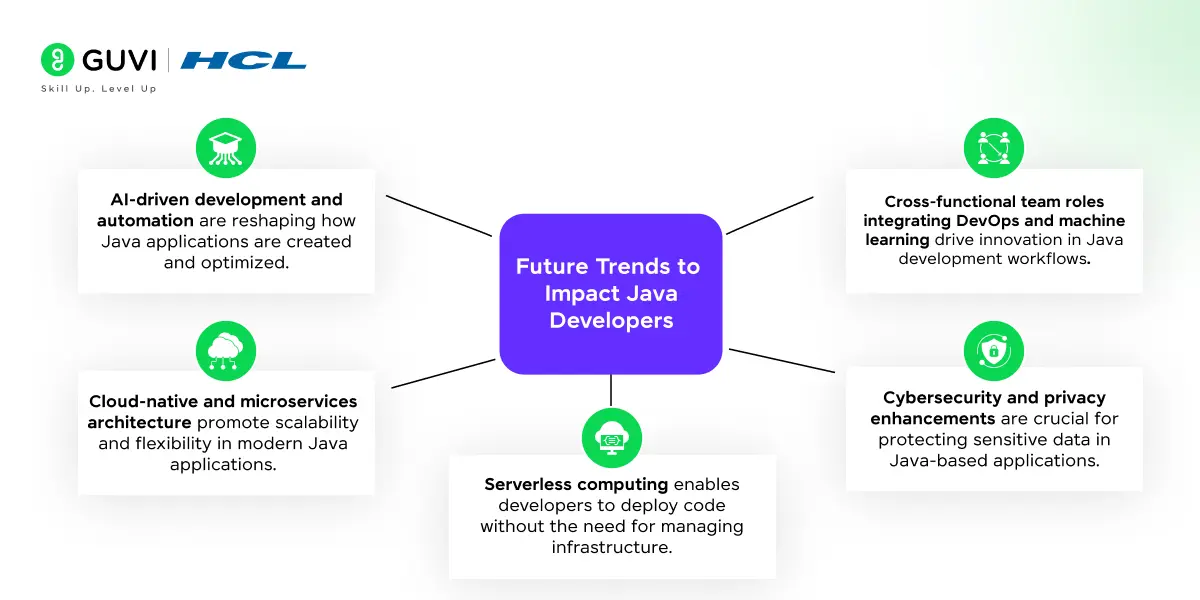
Java developer roles and responsibilities are not static. Here is where the role is heading and what skills will matter most in the years ahead.
- AI Integration: Tools like Spring AI and Langchain4j now let Java developers embed AI features directly into applications. Developers who understand how to connect Java backends to AI APIs (AWS Bedrock, Azure OpenAI) will command the highest salaries in the market.
- Reactive and Event-Driven Systems: Spring WebFlux and Apache Kafka are replacing traditional request-response patterns at high-throughput companies. Reactive programming will become a standard expectation rather than a bonus skill.
- Cloud-Native and Serverless: 85% of organizations are expected to adopt cloud-native architectures. Java developers will need to build for AWS Lambda, GraalVM native images, and infrastructure-as-code environments by default.
- Platform Engineering: Large teams are building internal developer platforms so engineers can deploy and monitor services without DevOps involvement. Java developers who understand platform tooling will move into some of the most senior and best-paid roles available.
Know More About | How to Become a Java Developer: A Detailed Roadmap
💡 Did You Know?
- Java was originally named Oak after a tree outside James Gosling’s office and was renamed Java in 1995, inspired by Java coffee from Indonesia.
- Java 21 introduced Virtual Threads, enabling applications to handle millions of concurrent connections with far lower memory usage and improved scalability.
- Used by over 30% of professional developers worldwide and powering more than 3 billion devices, Java remains one of the most widely adopted programming languages across industries.
Final Thoughts
As we look ahead, the role of a Java Developer is poised for substantial evolution. From the integration of AI and automation to the growing importance of cloud-native and microservices architectures, Java developers will need to adapt to keep pace with these technological shifts.
As a Java developer, the ideal way to remain competitive is by expanding your skill set and consistently upskilling yourself with industry trends. HCL GUVI offers a Certified Java Beginners Course that’ll help you strengthen your front-end and back-end fundamentals, as well as build a foundation in database management. You can consider enrolling in our course to experience some top-notch learning with hands-on skills, as well as comprehensive placement guidance. Get ready to master what the future holds for JAVA!
Frequently Asked Questions
1. What tools are essential for a Java developer?
Aside from Java itself, tools like Docker (for containerization), Kubernetes (for cloud management), and CI/CD tools like Jenkins are important to get hold of for ensuring scalability, automation, and seamless development workflows.
2. How does Java support microservices architecture?
Java, with frameworks like Spring Boot and Micronaut, supports the development of microservices by enabling lightweight, modular applications that can be independently developed, deployed, and maintained.
3. Is Java still relevant for Android development?
While Kotlin has become increasingly popular, Java still remains highly relevant for Android development, particularly for legacy systems and certain libraries still built in Java.
4. How does serverless computing impact Java development?
Serverless computing allows Java developers to deploy applications without managing the underlying infrastructure, which enhances scalability and reduces costs but may require a deeper understanding of cloud functions and event-driven architectures.
5. What is the average learning curve for new Java developers?
Learning Java can take several months for beginners, but mastering advanced topics like multithreading, memory management, and enterprise solutions may take 1-2 years, depending on your prior programming experience.
Success Stories

About the Author
Jebasta
I translate the language of data into stories that anyone can understand. As a writer with a data science background, I simplify analytics, AI, and decision-making so beginners and enthusiasts can confidently explore the world of data.
View all posts by Jebasta
Connect with me @










Did you enjoy this article?