


Full Stack Development Articles
Claude for Architecture and Engineering Documentation
Freelancing as a Python Developer: Getting Your First Client

Get In Touch For Details! Request More Information
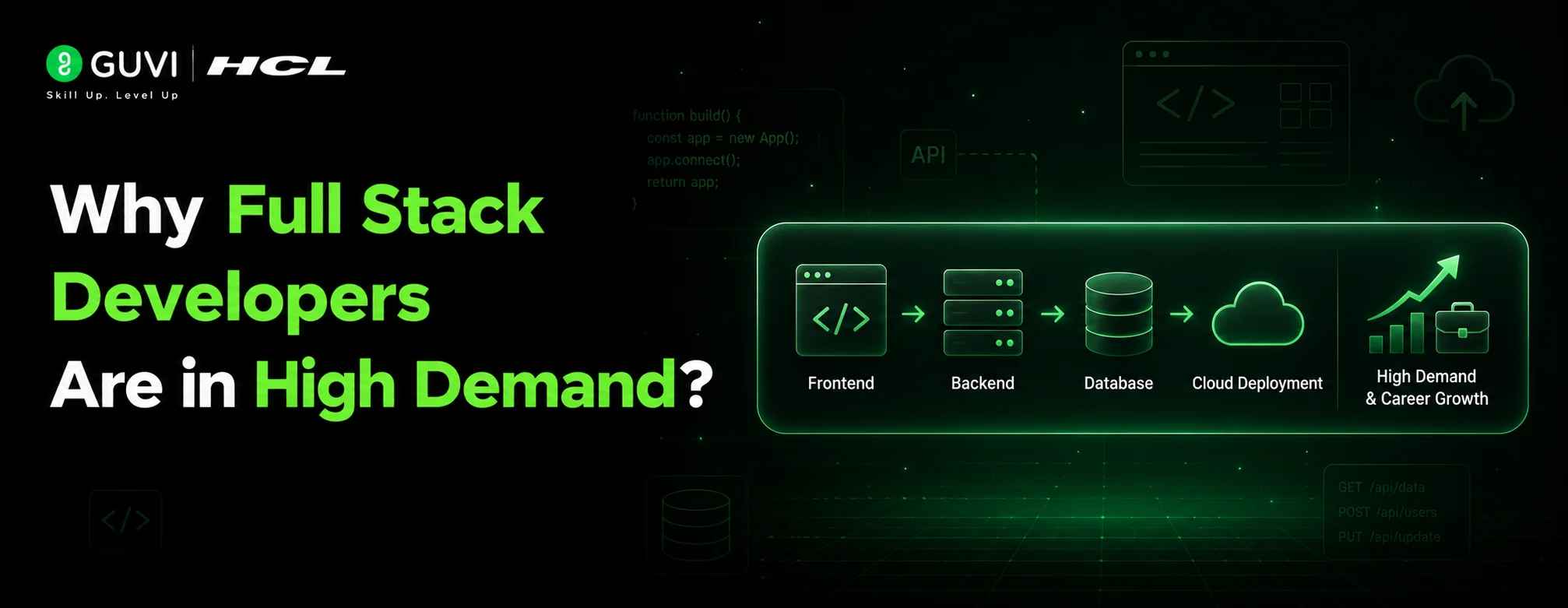
Why Full Stack Developers Are in High Demand in 2026?
Jul 22, 2026 7 Min Read 438 Views
(Last Updated)
Table of contents
- TL;DR:
- Introduction
- What Is a Full Stack Developer?
- Why Are Full Stack Developers in High Demand?
- Companies Want Faster Product Development
- Digital Transformation Is Expanding Across Every Industry
- AI Is Changing Development, Not Replacing Developers
- Why Startups Prefer Full Stack Developers?
- Product Companies and GCCs Are Hiring More Full Stack Developers
- Latest Hiring Trends for Full Stack Developers
- Top Business Benefits of Hiring Full Stack Developers
- Faster Collaboration
- Lower Development Costs
- Easier Maintenance
- Better Product Understanding
- Industries Creating the Highest Demand for Full Stack Developers
- Software as a Service (SaaS)
- Financial Technology (FinTech)
- Healthcare Technology (HealthTech)
- E-commerce
- Artificial Intelligence
- Education Technology (EdTech)
- Logistics and Supply Chain
- Government and Public Services
- Real-World Example: How Startups Benefit from Full Stack Developers
- What Does the Future Hold for Full Stack Developers?
- Ready to Build an Industry-Relevant Full Stack Development Career?
- Final Words
- Frequently Asked Questions
- Why are Full Stack Developers in high demand in 2026?
- Which industries hire the most Full Stack Developers?
- Why do startups prefer hiring Full Stack Developers?
- How is AI influencing the demand for Full Stack Developers?
- Do product-based companies hire more Full Stack Developers than service-based companies?
- Why are Full Stack Developers valuable to businesses?
- Is the demand for Full Stack Developers expected to grow after 2026?
- What business trends are driving the demand for Full Stack Developers?
- Are Full Stack Developers in demand globally or only in India?
- What makes Full Stack Development a future-proof career?
TL;DR:
- Full Stack Developers are among the most in-demand technology professionals in 2026 because businesses need engineers who can build, deploy, and maintain complete web applications.
- The growing adoption of AI, cloud computing, SaaS, and digital transformation across industries has significantly increased the demand for versatile developers who can work across the entire software development lifecycle.
Introduction
Software companies are hiring faster than ever, but they now want developers who can work across the full technology stack. That is a major reason the Full Stack Developer role is growing so quickly.
According to the U.S. Bureau of Labor Statistics, employment for software developers is expected to grow much faster than the average occupation through the next decade.
Likewise, Stack Overflow’s Developer Survey consistently shows that JavaScript, HTML/CSS, SQL, and Python, core technologies used in Full Stack Development, remain among the most widely used programming technologies.
If you’re considering a Full Stack Development Career, understanding why employers value these professionals can help you make smarter learning decisions.
In this article, we’ll explore the key factors driving the demand for Full Stack Developers in 2026, the industries hiring them, the business benefits they bring, and why this role remains one of the strongest career opportunities in today’s technology landscape.
What Is a Full Stack Developer?
A Full Stack Developer is a software engineer who builds and maintains both the front end (user interface) and the back end (server-side logic) of web applications.
They also work with databases, APIs, cloud platforms, and deployment pipelines, enabling them to manage the complete software development lifecycle.
This broad technical understanding makes Full Stack Developers highly valuable because they can collaborate effectively with designers, DevOps engineers, QA teams, and product managers while also solving end-to-end technical problems.
Before exploring why Full Stack Developers are in such high demand, it helps to understand what Full Stack Development actually involves, including the technologies, responsibilities, and development process.
Read our complete guide on What is Full Stack Development? to build a strong foundation before diving deeper.
Why Are Full Stack Developers in High Demand?
Full Stack Developers are in high demand because they can build complete software applications, reduce development costs, improve collaboration, and accelerate product delivery. Their expertise across front-end, back-end, databases, cloud platforms, and deployment makes them highly valuable to startups and enterprises alike.
So, what is driving this growing demand? Let’s explore the key factors.
1. Companies Want Faster Product Development
Speed has become one of the biggest competitive advantages in today’s digital economy. Businesses are expected to deliver new capabilities in weeks.
Traditional software development often involves separate teams for front-end development, back-end engineering, database management, and deployment.
While this approach works well for large organizations, it can also create communication gaps, longer development cycles, and increased project costs.
Full Stack Developers help eliminate many of these bottlenecks.
Because they understand multiple layers of an application, they can contribute across the entire development process instead of waiting for work to move between specialized teams.
Organizations benefit through:
- Faster feature development
- Reduced communication overhead
- Quicker bug resolution
- Improved collaboration between engineering teams
- Shorter product release cycles
- Greater engineering flexibility
For startups and fast-growing companies, this versatility is especially valuable.
Instead of hiring multiple specialists during the early stages of product development, they can rely on smaller engineering teams capable of building complete, production-ready applications.
As businesses continue prioritizing speed, Full Stack Developers have become essential to modern software delivery.
2. Digital Transformation Is Expanding Across Every Industry
Every industry is becoming a technology industry.
- Banks are launching digital payment platforms.
- Hospitals are developing telemedicine applications.
- Retail companies are investing in AI-powered shopping experiences.
- Manufacturers are adopting Industrial IoT.
- Educational institutions continue expanding online learning platforms.
Each of these digital initiatives requires professionals capable of building complete applications.
As a result, Full Stack Jobs continue to grow across sectors, making Full Stack Development one of the most versatile career paths available today.
Some of the fastest-growing industries hiring Full Stack Developers include:
| Industry | Why Full Stack Developers Are Needed |
| SaaS | Build and scale cloud-based software products |
| FinTech | Develop secure financial applications and payment platforms |
| HealthTech | Create patient portals, healthcare systems, and telemedicine solutions |
| E-commerce | Improve online shopping experiences and platform performance |
| EdTech | Build learning management systems and assessment platforms |
| Artificial Intelligence | Develop AI-powered products and integrate machine learning features |
| Cloud Computing | Build cloud-native applications and scalable services |
| Logistics | Optimize supply chains through digital platforms |
| Government Services | Modernize public digital infrastructure |
As organizations continue investing in digital products, demand for professionals who can build complete software systems is expected to remain strong.
3. AI Is Changing Development, Not Replacing Developers
One of the biggest misconceptions today is that AI will eliminate software development jobs. The reality is quite different.
AI coding assistants like GitHub, Copilot and ChatGPT have significantly improved developer productivity by automating repetitive tasks like generating boilerplate code, writing documentation, suggesting unit tests, and debugging common issues.
However, building production-ready software requires far more than writing code.
Organizations still depend on experienced Full Stack Developers to:
- Design scalable application architectures
- Select the right technology stack
- Build secure authentication systems
- Integrate third-party services and APIs
- Optimize application performance
- Review and validate AI-generated code
- Ensure compliance, security, and reliability
- Translate business requirements into technical solutions
Rather than replacing developers, AI is allowing engineering teams to build software faster.
This increased productivity is encouraging businesses to launch more digital products, experiment with AI-powered features, and accelerate innovation, all of which create additional demand for skilled Full Stack Developers.
Developers who know how to combine software engineering fundamentals with AI-assisted development are becoming particularly valuable in today’s job market.
Companies increasingly evaluate developers based on their ability to solve business problems rather than just write code. Understanding product thinking, databases, APIs, cloud deployment, and user experience often gives Full Stack Developers a significant advantage in the hiring process.
4. Why Startups Prefer Full Stack Developers?
For startups, every hiring decision directly impacts product development, budget, and growth. Unlike large enterprises with dedicated front-end, back-end, DevOps, and QA teams, startups typically operate with lean engineering teams where every developer is expected to contribute across multiple areas.
This is where Full Stack Developers become a strategic advantage.
Instead of assigning different specialists to build a single feature, startups often rely on Full Stack Developers who can take ownership of an entire feature from designing the user interface to developing APIs, managing databases, and deploying the application.
This approach enables startups to:
- Launch Minimum Viable Products (MVPs) more quickly.
- Reduce hiring and operational costs.
- Minimize communication delays between teams.
- Respond faster to customer feedback.
- Release product updates more frequently.
For example, an early-stage SaaS startup building a project management platform may have only three or four engineers. A Full Stack Developer in such a team can develop the dashboard, create backend services, integrate authentication, connect databases, and deploy the application to the cloud. This flexibility allows startups to move quickly without compromising product quality.
As startup ecosystems continue expanding globally, the demand for versatile software engineers continues to rise.
5. Product Companies and GCCs Are Hiring More Full Stack Developers
The rapid growth of product-based companies and Global Capability Centers (GCCs) has significantly increased demand for Full Stack Developers.
Unlike service-based organizations that often work on client-specific projects, product companies continuously enhance and maintain their own software platforms. This requires developers who understand the complete product lifecycle and can contribute to features from concept to deployment.
Full Stack Developers are well-suited to this environment because they can:
- Build end-to-end product features.
- Work closely with product managers and designers.
- Improve application performance.
- Resolve production issues quickly.
- Deliver continuous product updates.
At the same time, India has become one of the world’s fastest-growing destinations for GCCs, with multinational companies expanding engineering operations to develop global products, AI solutions, and cloud platforms.
These engineering centers increasingly seek professionals who possess broad technical expertise rather than narrow specialization.
Common employers include:
- SaaS companies
- FinTech platforms
- E-commerce organizations
- Enterprise software providers
- AI startups
- Global technology companies
- Digital consulting firms
As organizations continue investing in cloud-native software and digital products, Full Stack Developers remain among their most sought-after engineering hires.
Now that you understand why Full Stack Developers are in high demand, the next step is learning the right skills and technologies.
Our Full Stack Developer Roadmap walks you through every stage of the learning journey from HTML, CSS, and JavaScript to React, backend development, databases, cloud deployment, AI integration, and building a job-ready portfolio.
Latest Hiring Trends for Full Stack Developers
Recruitment patterns clearly show that organizations increasingly value developers who can work across multiple technologies.
| Industry | Hiring Demand | Why Full Stack Developers Are Needed |
| SaaS | 5/5 | Rapid feature development and product scaling |
| FinTech | 5/5 | Secure, end-to-end application development |
| E-commerce | 4/5 | Customer experience and platform optimization |
| Healthcare | 4/5 | Digital health applications and patient portals |
| AI Startups | 5/5 | Integrating AI into production applications |
| Manufacturing | 3/5 | Smart factory dashboards and automation |
| EdTech | 4/5 | Online learning platforms and assessment systems |
These trends indicate that demand isn’t limited to technology companies.
Organizations across industries are actively investing in digital products, creating abundant opportunities for professionals pursuing a Full Stack Development Career.

Top Business Benefits of Hiring Full Stack Developers
Organizations don’t hire Full Stack Developers simply because they know multiple programming languages. They hire them because versatile engineers can deliver measurable business value.
Faster Collaboration
A developer familiar with both front-end and back-end systems can communicate effectively across teams, reducing delays caused by handoffs.
Lower Development Costs
Early-stage startups and small businesses often reduce hiring costs by employing developers capable of handling multiple stages of application development.
Easier Maintenance
When the same engineer understands the entire architecture, debugging and maintaining applications becomes significantly more efficient.
Better Product Understanding
Full Stack Developers often see the “big picture.” Instead of focusing on isolated modules, they understand how design, business logic, databases, APIs, and deployment work together to create a successful product.
Industries Creating the Highest Demand for Full Stack Developers
As digital transformation continues across industries, Full Stack Developers are finding opportunities in nearly every sector.
Some of the biggest recruiters include:
Software as a Service (SaaS)
SaaS companies continuously release new features and updates. Full Stack Developers help accelerate development while maintaining scalable cloud applications.
Financial Technology (FinTech)
Banks, payment platforms, and investment firms require secure web applications, APIs, authentication systems, and digital payment infrastructure.
Healthcare Technology (HealthTech)
Healthcare organizations are investing in patient portals, telemedicine platforms, electronic medical records, and AI-powered diagnostic tools.
E-commerce
Online retailers depend on high-performance applications to manage customer experiences, inventory systems, payment processing, and personalized recommendations.
Artificial Intelligence
AI companies need developers who can integrate machine learning models into production-ready applications.
Rather than building AI algorithms themselves, many Full Stack Developers work on deploying AI-powered features that customers interact with daily.
Education Technology (EdTech)
Online learning platforms continue expanding through virtual classrooms, assessments, learning management systems, and AI-assisted education tools.
Logistics and Supply Chain
Digital tracking systems, warehouse automation, route optimization, and fleet management platforms all require scalable software solutions.
Government and Public Services
Governments worldwide continue digitizing citizen services, creating opportunities for developers to build secure, accessible, and scalable digital platforms.
Want to see Full Stack Development in action?
From e-commerce platforms and banking applications to social media networks and healthcare systems, Full Stack Developers build the software millions of people use every day. Explore these real-world Full Stack Development applications to understand how businesses leverage full-stack technologies across industries.
Real-World Example: How Startups Benefit from Full Stack Developers
A fintech startup building a digital payments platform.
Instead of hiring separate front-end, back-end, and deployment engineers during its early stages, the company recruits two experienced Full Stack Developers.
Together, they can:
- Design responsive customer dashboards.
- Develop secure payment APIs.
- Integrate third-party payment gateways.
- Manage cloud deployment.
- Fix production bugs quickly.
- Release product updates faster.
This reduces development costs while accelerating product launches, a major competitive advantage for startups.
The same approach is commonly seen across SaaS, EdTech, HealthTech, and e-commerce companies, where speed and agility are critical.
According to Stack Overflow’s Developer Survey, JavaScript continues to rank among the world’s most widely used programming languages. Since JavaScript powers both front-end frameworks and Node.js on the back end, mastering it significantly strengthens your Full Stack Development Career.
What Does the Future Hold for Full Stack Developers?
The future of Full Stack Development remains exceptionally strong.
As businesses continue building cloud-native, AI-powered, and data-driven applications, organizations need developers who understand complete software systems rather than isolated technologies.
Several emerging trends are expected to shape demand over the coming years:
- Artificial Intelligence integration
- Cloud-native development
- Microservices architecture
- Serverless computing
- Progressive Web Applications (PWAs)
- Edge computing
- API-first development
- Low-code and no-code integrations
- AI agents and intelligent automation
Instead of focusing solely on writing code, modern developers are expected to integrate AI services, design scalable architectures, optimize cloud infrastructure, and deliver seamless digital experiences.
Those who continuously learn new technologies while strengthening their software engineering fundamentals will remain highly employable throughout the coming decade.
Ready to Build an Industry-Relevant Full Stack Development Career?
If you’re looking for a structured way to learn industry-standard technologies, build hands-on projects, and receive mentorship from experienced professionals, explore the HCL GUVI Full Stack Development Career Program.
The program is designed to help learners strengthen practical Full Stack Skills, work on real-world applications, and prepare confidently for modern software development roles.
Final Words
The demand for Full Stack Developers continues to rise because businesses need professionals who can build, deploy, and maintain complete software applications in an increasingly digital world.
Their ability to work across the entire development lifecycle makes them valuable to startups, product companies, and global enterprises alike.
As AI, cloud computing, and digital transformation reshape the software industry, organizations are increasingly seeking developers who can combine technical versatility with strong problem-solving skills.
For aspiring professionals, Full Stack Development remains one of the most promising and future-ready career paths in 2026 and beyond.
Frequently Asked Questions
1. Why are Full Stack Developers in high demand in 2026?
Full Stack Developers are in high demand because they can build, deploy, and maintain complete web applications across the entire technology stack. Their ability to work on both front-end and back-end development helps businesses reduce development time, improve collaboration, and accelerate product delivery.
2. Which industries hire the most Full Stack Developers?
Full Stack Developers are widely hired across industries such as SaaS, FinTech, HealthTech, EdTech, e-commerce, artificial intelligence, cloud computing, logistics, manufacturing, and government digital services. As digital transformation accelerates, demand continues to grow across both technology and non-technology sectors.
3. Why do startups prefer hiring Full Stack Developers?
Startups often operate with smaller engineering teams and limited budgets. Hiring Full Stack Developers allows them to build complete applications faster, reduce hiring costs, and quickly adapt to changing business requirements without relying on multiple specialists.
4. How is AI influencing the demand for Full Stack Developers?
AI is increasing the demand for Full Stack Developers by enabling businesses to build smarter applications and automate repetitive tasks. While AI coding tools improve developer productivity, organizations still rely on developers to design software architecture, integrate AI features, ensure security, and maintain production-ready applications.
5. Do product-based companies hire more Full Stack Developers than service-based companies?
Yes. Product-based companies often prefer Full Stack Developers because they can own features from development to deployment, collaborate across teams, and continuously improve products. However, service-based companies also hire Full Stack Developers for projects requiring end-to-end application development.
6. Why are Full Stack Developers valuable to businesses?
Businesses value Full Stack Developers because they can contribute throughout the software development lifecycle. Their versatility improves collaboration, reduces project handoffs, accelerates product releases, simplifies maintenance, and helps organizations deliver digital solutions more efficiently.
7. Is the demand for Full Stack Developers expected to grow after 2026?
Yes. The demand is expected to remain strong as businesses continue investing in AI, cloud computing, SaaS platforms, automation, and digital transformation. Emerging technologies such as serverless computing, microservices, and AI-powered applications are further increasing the need for Full Stack Developers.
8. What business trends are driving the demand for Full Stack Developers?
Several trends are contributing to the growing demand, including digital transformation, cloud adoption, AI integration, rapid SaaS growth, expansion of Global Capability Centers (GCCs), startup innovation, and the increasing need for faster software delivery.
9. Are Full Stack Developers in demand globally or only in India?
Full Stack Developers are in demand worldwide. Countries including the United States, Canada, the United Kingdom, Germany, Australia, and India continue to hire Full Stack Developers across startups, multinational corporations, and Global Capability Centers to support modern software development.
10. What makes Full Stack Development a future-proof career?
Full Stack Development is considered a future-ready career because it combines expertise across front-end development, back-end systems, databases, cloud technologies, and APIs. As organizations increasingly build integrated digital products, developers with end-to-end development skills are expected to remain highly valuable.
Success Stories

About the Author
Hashmithaa
Hi, I’m Hashmithaa — a content writer with a love for words. Writing isn’t just what I do; it’s how I connect, communicate, and create meaning in a noisy digital world. And if my words help someone make a better decision, learn something new, or feel more confident, then I’ve done my job well.
View all posts by Hashmithaa
Connect with me @


































Did you enjoy this article?