


Full Stack Development Articles
Claude for Architecture and Engineering Documentation
Freelancing as a Python Developer: Getting Your First Client


Get In Touch For Details! Request More Information

Full Stack Development Training for Professionals Looking to Move into Product-Based Companies
Nov 03, 2026 6 Min Read 46 Views
(Last Updated)
If you work in IT services, you can probably build a working web app. You know React, you can write an API, and your team trusts you with deadlines. Then you apply to a product company, and the interview asks something different: solve this coding puzzle in 40 minutes, then design the app for a million users.
That gap is exactly what the right full stack development training for professionals closes. Product companies do not hire for the tools you know. They hire for how you think about data structures, system design, and building things that last. A good programme trains those skills while you keep your job.
Here is what we will cover: what product companies look for, where service developers fall short, what good training covers, how to choose it, a six month plan, and pay. By the end, you will know how to pick full stack development training for professionals that leads to interviews.
Table of contents
- TL;DR Summary
- What is Full Stack Development Training for Professionals?
- Product-Based vs Service-Based Companies: Why It Matters for Full Stack Development Training for Professionals
- What Product Companies Expect From Full Stack Development Training for Professionals
- Where Developers Fall Short Before Full Stack Development Training for Professionals
- What Good Full Stack Development Training for Professionals Should Cover
- How to Choose the Best Full Stack Development Training for Professionals
- How HCL GUVI's Course Fits Full Stack Development Training for Professionals
- A Six Month Plan for Full Stack Development Training for Professionals
- Month 1: Fill the Fundamentals Gap
- Month 2: DSA and a Strong Front End
- Month 3: Back End and Databases
- Month 4: System Design Basics
- Month 5: Projects and Deployment
- Month 6: Interview Practice and Applications
- What the Job Market Says
- Pay After Full Stack Development Training for Professionals in India
- 💡 Did You Know?
- Common Mistakes in Full Stack Development Training for Professionals
- Conclusion
- FAQs
- What is full stack development training for professionals?
- How long does full stack development training for professionals take?
- Can a service company developer move to a product-based company?
- Do I need DSA for a product company full stack role?
- Is full stack development still a good career choice in 2027?
TL;DR Summary
- What it is: Full stack development training for professionals is a structured programme that builds front end, back end, and problem solving skills while you keep working.
- Why product companies: Full stack development training for professionals aimed at product roles pays off because they usually offer more ownership, newer tech, and higher pay ranges than service roles.
- What they test: Data structures and algorithms, system design, a deployed project, and strong full stack basics.
- Your gap: Most service company developers have the tools but lack DSA depth and system design practice.
- What to look for: In full stack development training for professionals, look for live mentoring, DSA and system design in the syllabus, real projects, and interview practice.
- Time needed: About 6 months at 8 to 10 hours a week.
- Next step: Pick one weak area, such as DSA, and start this week.
What is Full Stack Development Training for Professionals?
Full stack development training for professionals is a course built for people who already work, usually in IT, and want to grow their full stack skills for better roles. It covers both the front end and back end, and it adds the problem solving and design skills that interviews at product companies test.
The difference from a beginner course is focus. Good full stack development training for professionals does not spend weeks on HTML basics. It spends that time on data structures, system design, deployment, and projects you can talk about in an interview.
If that is what you need, HCL GUVI’s Full Stack Development Zen Class runs as live online classes with weekday and weekend batches, so you can learn after work and keep your salary.
Product-Based vs Service-Based Companies: Why It Matters for Full Stack Development Training for Professionals
Before planning, it helps to see what is really different. Here is the simple version.
| Factor | Service-Based Company | Product-Based Company |
|---|---|---|
| What they sell | Software work for clients | Their own product |
| Your work | Build to a client’s spec | Own features in a live product |
| Interviews | Tools and project experience | DSA, system design, problem solving |
| Tech choices | Often fixed by the client | Often chosen by the team |
| Growth | Tied to projects and clients | Tied to product impact |
Neither is better for everyone. But if you want ownership and the chance to shape a product, full stack development training for professionals aimed at product roles is worth the effort.
What Product Companies Expect From Full Stack Development Training for Professionals
Hiring teams at product companies look at a few things again and again.
- Data structures and algorithms: Coding rounds are common. Strong basics in arrays, hash maps, trees, and recursion matter. This guide on why learn data structures and algorithms explains the reason.
- System design: You may be asked to design a chat app or a URL shortener. They want to see how you think about scale, databases, and trade offs.
- A deployed project: A live app on a real URL proves you can finish things.
- Strong full stack basics: JavaScript, React, Node.js, a database, and REST APIs should feel natural.
- Ownership and communication: They want people who explain choices and take responsibility.
- Comfort with AI coding tools: Using tools like Copilot well is becoming a normal skill.
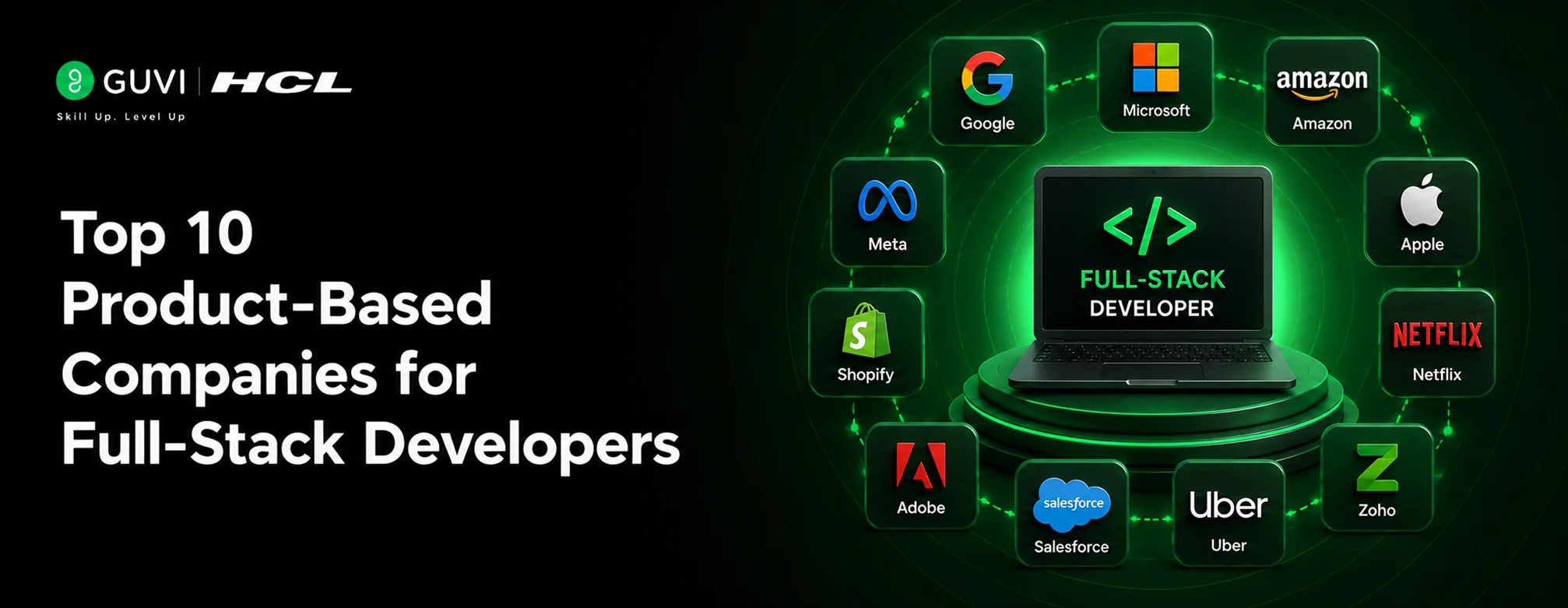
Interviews often have three to four rounds: a coding round, one or two technical or design rounds, and a culture fit conversation. The list of product based companies for full stack developers shows who hires and what they ask.
Where Developers Fall Short Before Full Stack Development Training for Professionals
Most gaps are fixable in a few months. These are the common ones.
- DSA practice: Daily work rarely needs it, so the skill fades.
- System design: You build to a design someone else made, so you never practise making one.
- Depth in one stack: Many work across tools without going deep in any.
- Public proof: Client work is private, so there is little to show on GitHub.
- Interview habit: After years in a job, you may not have practised interviews at all.
Full stack development training for professionals works best when it targets exactly these gaps, instead of repeating what you already know.
What Good Full Stack Development Training for Professionals Should Cover
Use this as your syllabus checklist for any full stack development training for professionals.
- Front end: HTML, CSS, JavaScript, and React, including state and routing. See this guide on what is ReactJS if you need a refresher.
- Back end: Node.js, Express, REST APIs, and authentication.
- Databases: SQL and a NoSQL option like MongoDB, with practice from SQL queries with examples.
- DSA: Regular problem solving with feedback, not a one week crash course.
- System design: Design practice with real trade offs.
- Deployment and DevOps: Git, CI and CD, cloud basics. This overview of CI and CD is a good start.
- Projects: At least a few full apps, plus one deployed capstone.
- Career prep: Mock interviews, resume review, and GitHub guidance.
How to Choose the Best Full Stack Development Training for Professionals
Run every full stack development training for professionals option through these checks before you pay.
- Live teaching: Live classes with doubt support beat recordings you never finish.
- Schedule: Weekday evening or weekend batches that fit your work.
- DSA and system design: If these are missing, the training will not get you through product interviews.
- Project quality: Ask for examples of what past learners built.
- Mentors: Ask who they are and how fast they answer.
- Certificate: A recognised name helps your resume get past the first screen.
- Clear terms: Fees, refund rules, and EMI options should be written down.
- No guarantees: Be careful with any programme that promises a job.
For more options to compare, see the list of best full stack development online courses and the review of the top full stack development certification courses.
How HCL GUVI’s Course Fits Full Stack Development Training for Professionals
Here is how HCL GUVI’s Full Stack Development course lines up. Confirm the latest details in the course page before you decide.
- Live classes: Online live sessions with mentor support. For you, that means answers when you are stuck, instead of losing days to one bug.
- Flexible batches: Weekday and weekend options. For you, that means learning around your job.
- Full stack tools: React, Node.js, Express, MongoDB, and REST APIs. For you, that means the stack product teams use.
- DSA and system design: Included in the programme. For you, that means practising the exact things interviews test.
- DevOps, GenAI, and deployment: Covered as the programme progresses. For you, that means skills teams now ask for.
- Projects: Includes an e-commerce web app, a cloud deployment pipeline, and an AI powered document Q and A chatbot. For you, that means real projects to talk about.
- Certificates: An IITM Pravartak certification and a complimentary MongoDB certification. For you, that means credentials on your resume.
- Career support: One to one mock interviews, resume review, and GitHub and portfolio guidance. For you, that means practice before real interviews.
- Languages: English, Tamil, Hindi, and Telugu. For you, that means hard topics in a language you think in.
The course page lists 6 and 9 month formats, so confirm the schedule and fees there. To start with a plan, you can also read the full stack developer roadmap.

A Six Month Plan for Full Stack Development Training for Professionals
This plan for full stack development training for professionals assumes 8 to 10 hours a week. Change it to match your batch.
1. Month 1: Fill the Fundamentals Gap
Review JavaScript properly and start daily DSA practice with easy problems. Learn the MERN stack if you have not used it.
2. Month 2: DSA and a Strong Front End
Move to medium DSA problems. Build one clean React project with state and routing.
3. Month 3: Back End and Databases
Build APIs with Node.js and Express. Add a database and authentication.
4. Month 4: System Design Basics
Study how apps scale: caching, load balancing, and database choices. Design two or three small systems on paper.
5. Month 5: Projects and Deployment
Finish and deploy two full apps. Ideas are in this list of full stack web developer coding projects. Keep your code tidy with Git and GitHub.
6. Month 6: Interview Practice and Applications
Do mock interviews, polish your resume, and apply. Review your DSA weekly.
Want this plan with live mentors and project reviews? HCL GUVI’s Full Stack Development Zen Class gives you the schedule, the mentors, and the reviews, so your evenings go into learning instead of planning.
What the Job Market Says
Before you invest, it helps to know what employers want right now.
- Entry level hiring has slowed: An ICRIER study of 651 IT firms found hiring has moderated, mainly at entry level.
- Software roles held up well: The same study found software teams saw the least slowdown of any business function.
- Experience helps: Mid level developers are in a better spot than freshers, as long as their skills are current.
- Proof wins interviews: With fewer openings, a deployed project and strong DSA stand out.
If you are wondering whether this field is still worth it, this look at whether full stack is dead covers the question directly.
Pay After Full Stack Development Training for Professionals in India
Pay depends on your company, city, skills, and experience. As a reference, senior software engineers in India average about ₹20 LPA, though the range is wide.
- Product companies often pay more: Ranges at product firms are usually higher than at service firms for the same experience.
- Skills drive offers: DSA, system design, and shipped projects move your offer more than the label on any full stack development training for professionals.
- Specialising helps: Cloud, DevOps, and AI skills open better roles over time.
- Negotiation matters: A strong interview process and competing offers raise your pay.
Treat any single number as a rough guide and check live listings before you plan.
💡 Did You Know?
- Flipkart started in 2007 as an online bookstore, founded by two former Amazon employees. Today, it is one of India’s largest e-commerce companies.
- Node.js was released in 2009, allowing developers to use JavaScript for back-end development too. This made it possible to build both the front end and back end using a single language.
- Zoho began in 1996 under the name AdventNet. Today, it develops a wide range of its own software products in-house.
Common Mistakes in Full Stack Development Training for Professionals
- Learning only new tools in full stack development training for professionals: Product interviews test DSA and design more than tool names.
- Skipping DSA in full stack development training for professionals: It is the most common reason professionals fail coding rounds.
- No deployed project: A live app on a real URL proves you can finish things.
- Choosing full stack development training for professionals on price alone: The cheapest training costs the most if you never finish.
- Ignoring the schedule of your full stack development training for professionals: A batch that clashes with work will not last.
- Expecting a guaranteed job: No honest programme can promise one. Skills and effort decide offers.
Conclusion
The right full stack development training for professionals closes the exact gap between service work and product interviews: DSA, system design, strong projects, and interview practice. You do not need to quit your job. You need a plan, a good programme, and steady weekly effort.
Check every full stack development training for professionals option against the list in this blog, and confirm the schedule and fees in writing.
A few focused months of full stack development training for professionals now can put you in the interview room at the product companies you want. You can also check the do full stack jobs need a CS degree guide if you are unsure about your background.
If you want live classes, mentor support, DSA and system design, and real projects while you keep working, HCL GUVI’s Full Stack Development Zen Class is worth a serious look.
FAQs
1. What is full stack development training for professionals?
Full stack development training for professionals is a course for working people, usually in IT, that builds front end, back end, DSA, and system design skills in a format that fits around a job, with live classes and projects.
2. How long does full stack development training for professionals take?
Most working people need about 6 months of full stack development training for professionals at 8 to 10 hours a week to be ready for product company interviews.
3. Can a service company developer move to a product-based company?
Yes. Many do it by building DSA and system design skills, shipping a deployed project, and practising interviews. Experience in a service company still counts.
4. Do I need DSA for a product company full stack role?
Yes, in most cases. coding rounds are common, so regular DSA practice matters as much as your knowledge of React or Node.js.
5. Is full stack development still a good career choice in 2027?
Yes. Full stack development training for professionals still pays off, since software related teams held up better than other functions in hiring, and developers who combine strong fundamentals with AI tools stand out.
Success Stories

About the Author
Jebasta
I translate the language of data into stories that anyone can understand. As a writer with a data science background, I simplify analytics, AI, and decision-making so beginners and enthusiasts can confidently explore the world of data.
View all posts by Jebasta
Connect with me @































Did you enjoy this article?