


MERN Articles
A Guide to Explore MERN Stack Developer Salary in 2026
30 MERN Stack Interview Questions and Answers 2026 for Freshers & Experienced Developers
The Next Generation of Frontend Tools: Why Vite is Leading the Way
The Evolution of React Hooks: From Concept to Modern Practices

Get In Touch For Details! Request More Information

Complete MERN Stack Guide for Beginners in 2026: Roadmap + Projects
Sep 09, 2026 7 Min Read 28335 Views
(Last Updated)
Modern web applications need a responsive frontend, a reliable backend, and a database that can handle growing user data. The MERN stack brings all these layers together using JavaScript, making it one of the most practical choices for aspiring full-stack developers.
MongoDB manages the data, Express.js and Node.js power the backend, and React.js builds the user interface. This shared JavaScript ecosystem makes development more consistent across the complete application.
This beginner-friendly MERN stack guide explains the skills, tools, and learning order required to get started. It also covers:
- What a MERN stack developer does
- Skills required for MERN development
- A step-by-step learning roadmap
- Portfolio projects for practical experience
- MERN stack career opportunities and salaries
Read the complete guide to understand how the MERN stack works and how to begin your full-stack development journey.
TL;DR
The MERN stack combines MongoDB, Express.js, React.js, and Node.js to build complete JavaScript web applications. Beginners should learn JavaScript fundamentals first, then progress through backend, database, frontend, testing, and deployment.
- MongoDB stores application data in flexible documents.
- Express.js helps developers build routes and REST APIs.
- React.js creates reusable and interactive user interfaces.
- Node.js runs JavaScript on the server.
- Portfolio projects and deployment help demonstrate job-ready MERN skills.
Table of contents
- What is MERN Stack?
- How to Get Started with the MERN Stack?
- Skills Required to Become a MERN Stack Developer
- MERN Stack Learning Roadmap: What to Learn in What Order
- Learn HTML and CSS
- Strengthen JavaScript Fundamentals
- Learn Git and GitHub
- Learn Node.js
- Learn Express.js
- Learn MongoDB
- Learn React.js
- Connect the Frontend and Backend
- Learn Authentication and Security
- Learn Testing and Deployment
- MERN Stack Components at a Glance
- What Does a MERN Stack Developer Do?
- MERN Stack Project Ideas for Portfolio: Beginner to Advanced
- Beginner Projects
- Intermediate Projects
- Advanced Projects
- MERN vs MEAN vs PERN vs MEVN: Which Stack to Learn in 2025?
- Choose MERN When
- Choose MEAN When
- Choose PERN When
- Choose MEVN When
- Which Stack Should Beginners Learn?
- Salary of a MERN Stack Developer
- Conclusion
- FAQs
- Is MERN stack in demand in 2026?
- Can I learn the MERN stack in 1 month?
- What is the highest salary in MERN?
- Is MERN good for beginners?
What is MERN Stack?
The MERN stack is a popular and powerful stack of technologies used for building modern web applications. It is an acronym that stands for:
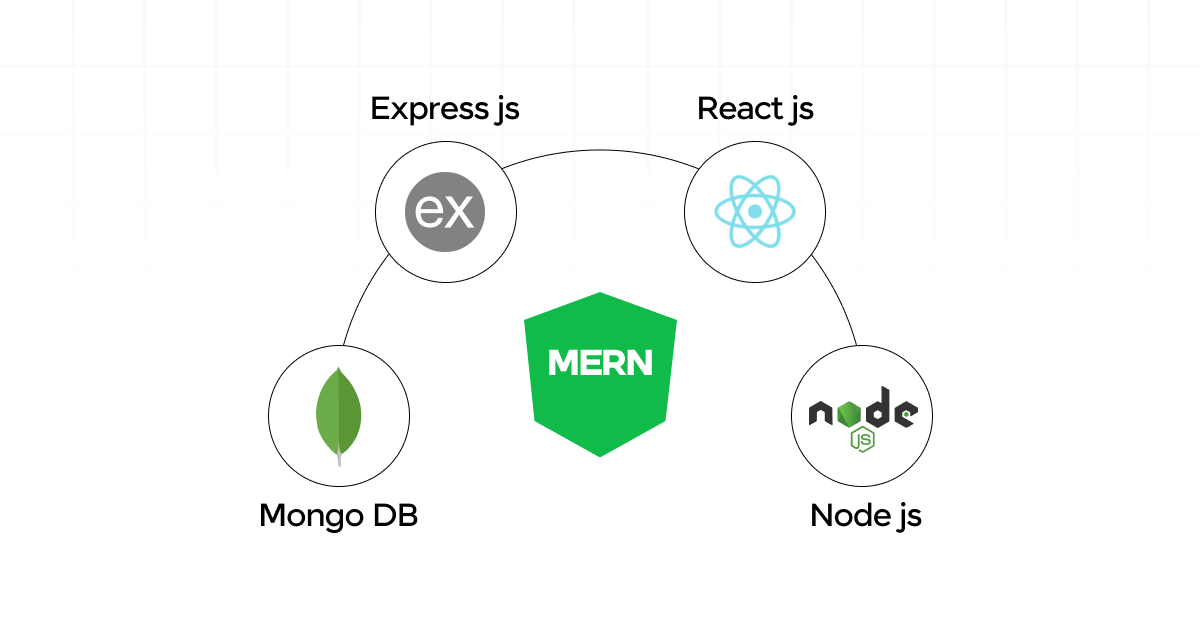
- MongoDB: MongoDB is a NoSQL database that stores data in a flexible, JSON-like format. It provides scalability and flexibility, making it suitable for handling large volumes of data and diverse data types. MongoDB is often used as the backend database in MERN stack applications.
- Express.js: Express.js is a minimal and flexible web application framework for Node.js. It provides a robust set of features for building web servers and APIs quickly and easily. Express.js simplifies the process of handling HTTP requests, defining routes, and implementing middleware, making it an essential component of the backend in MERN stack applications.
- React.js: React.js is a JavaScript library developed by Facebook for building user interfaces. It enables developers to create reusable UI components and build single-page applications (SPAs) with a declarative and component-based approach. React.js provides efficient rendering and state management capabilities, making it a popular choice for the frontend in MERN stack applications.
- Node.js: Node.js is a runtime environment for executing JavaScript code outside the browser. It allows developers to build scalable and high-performance server-side applications using JavaScript. Node.js is used as the backend runtime in MERN stack applications, enabling server-side logic and interaction with databases like MongoDB.
By combining MongoDB, Express.js, React.js, and Node.js, the MERN stack provides a full-stack JavaScript solution for developing modern web applications. It offers advantages such as code reusability, efficient data handling, and a seamless development experience across the frontend and backend. Developers and businesses widely adopt the MERN stack for building robust and scalable web applications.
Before diving into the next section, ensure you’re solid on full-stack development essentials like front-end frameworks, back-end technologies, and database management. You can look for a detailed Full Stack Development career program, you can join HCL GUVI’s Full Stack Development Career Program with Placement Assistance. You will be able to master the MERN stack (MongoDB, Express.js, React, Node.js) and build real-life projects.
How to Get Started with the MERN Stack?
Now that you have enough knowledge about the MERN Stack, you must have an understanding on how to get started with it. Follow the below-mentioned steps and get yourself started with building a MERN Stack application:
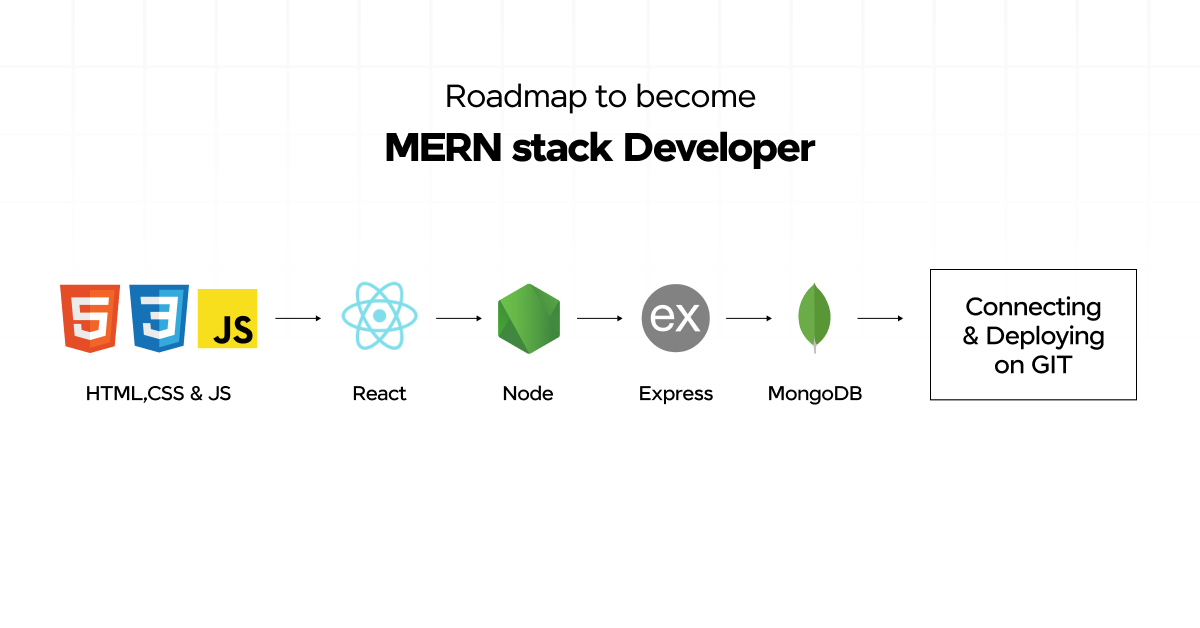
- Learn HTML, CSS, and JavaScript thoroughly
- Have a thorough understanding of MongoDB, ExpressJS, React, and NodeJS
- Explore about APIs, testing, and deployment
- Work on a few basic project ideas
- Move to slightly advanced-level project ideas.
Skills Required to Become a MERN Stack Developer
Mastering these skills will empower you to develop full-stack web applications using the MERN stack effectively. Let us now understand the skills required to become a MERN stack developer:
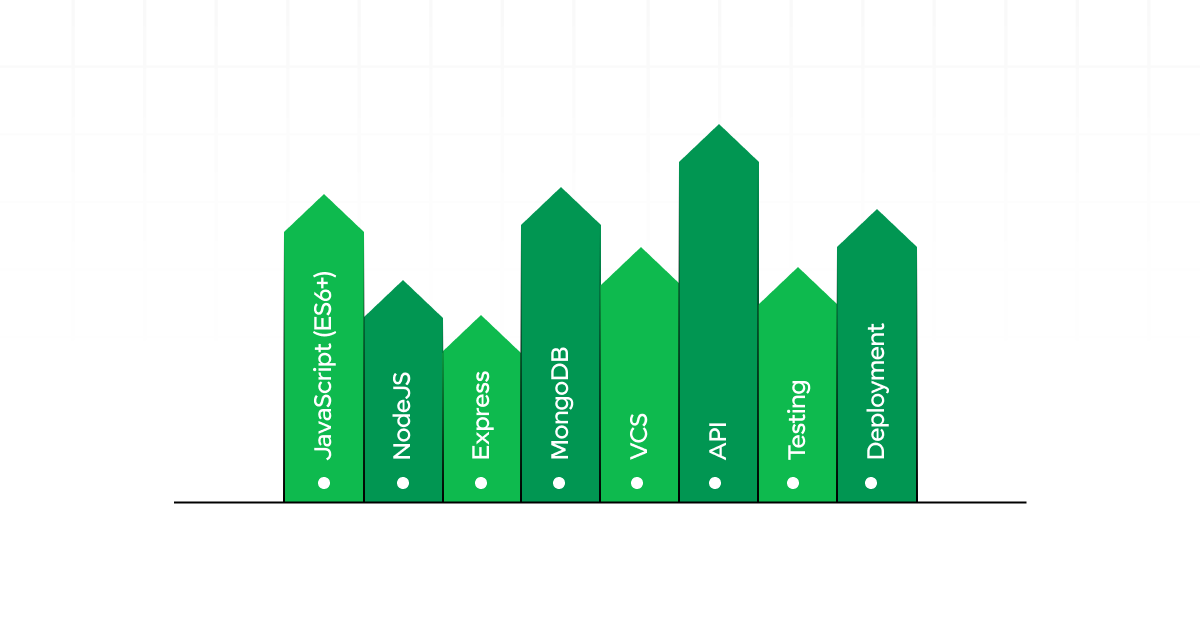
- JavaScript (ES6+):
- Strong understanding of JavaScript fundamentals.
- Knowledge of ES6+ features like arrow functions, classes, destructuring, etc.
- Node.js:
- Proficiency in building server-side applications using Node.js.
- Understanding of event-driven programming and asynchronous programming concepts.
- Express.js:
- Familiarity with Express.js, a web application framework for Node.js.
- Ability to create RESTful APIs and handle HTTP requests/responses.
- React.js:
- Mastery of React.js for building dynamic and interactive user interfaces.
- Experience with state management libraries like Redux or context API.
- MongoDB:
- Expertise in MongoDB, a NoSQL database used with Node.js applications.
- Understanding of CRUD operations, indexing, and aggregation pipelines.
- HTML/CSS:
- Proficient in HTML for structuring web pages and CSS for styling.
- Knowledge of responsive design principles and CSS preprocessors like Sass or Less.
- Version Control Systems:
- Experience with Git for version control and collaboration.
- Understanding of Git workflows like branching, merging, and pull requests.
- RESTful APIs:
- Ability to design and consume RESTful APIs using JSON for data exchange.
- Understanding of HTTP methods (GET, POST, PUT, DELETE) and status codes.
- Testing:
- Experience with testing frameworks like Jest for unit testing React components.
- Knowledge of integration testing and end-to-end testing frameworks like Cypress.
- Deployment:
- Understanding of deploying MERN stack applications to platforms like Heroku, AWS, or Netlify.
- Familiarity with Docker for containerization and continuous integration/continuous deployment (CI/CD) pipelines.
- Problem-solving and Debugging:
- Strong problem-solving skills to troubleshoot issues in both frontend and backend code.
- Proficiency in using browser developer tools and debugging Node.js applications.
- Security:
- Awareness of common security threats and best practices for securing web applications.
- Implementation of measures like input validation, authentication, and authorization.
MERN Stack Learning Roadmap: What to Learn in What Order

Learning all four MERN technologies together can become confusing. Beginners should follow a clear order and build small projects after every stage.
1. Learn HTML and CSS
Start with the building blocks of web pages.
Focus on:
- Semantic HTML
- Forms and tables
- CSS selectors
- Flexbox and Grid
- Responsive web design
- Media queries
Build a responsive portfolio website before moving to JavaScript.
2. Strengthen JavaScript Fundamentals
JavaScript is used across the entire MERN stack. A weak JavaScript foundation can make React and Node.js difficult to understand.
Learn:
- Variables and data types
- Functions and scope
- Arrays and objects
- DOM manipulation
- Events
- Promises
- Async and await
- ES6 modules
- Error handling
Build small applications such as a calculator or task manager.
3. Learn Git and GitHub
Version control helps developers track code changes and collaborate with other team members.
Learn how to:
- Create repositories
- Commit changes
- Work with branches
- Merge code
- Resolve conflicts
- Create pull requests
Push every project to GitHub with a clear README file.
4. Learn Node.js
Node.js allows JavaScript to run outside the browser. It provides the runtime required to build the server side of a MERN application.
Focus on:
- Node.js modules
- NPM packages
- File-system operations
- Environment variables
- Event-driven programming
- Asynchronous operations
- Basic HTTP servers
Build a command-line application before moving to Express.js.
5. Learn Express.js
Express.js simplifies backend development with Node.js. It helps developers build APIs and handle HTTP requests.
Learn:
- Routing
- Middleware
- Request and response objects
- RESTful API design
- Error-handling middleware
- Input validation
- Authentication basics
Create a REST API for users, products, or tasks.
6. Learn MongoDB
MongoDB stores application information in flexible JSON-like documents.
Focus on:
- Collections and documents
- CRUD operations
- Data modelling
- Indexes
- Aggregation pipelines
- MongoDB Atlas
- Mongoose schemas
- Validation and relationships
Connect your Express.js API to MongoDB and store real application data.
7. Learn React.js
React.js helps developers create reusable and interactive user interfaces.
Learn:
- JSX
- Functional components
- Props and state
- Event handling
- Forms
- Conditional rendering
- React Hooks
- React Router
- Context API
- API integration
Build the frontend only after understanding JavaScript fundamentals.
8. Connect the Frontend and Backend
Connect the React frontend to the Express and Node.js backend using REST APIs.
Practise:
- Sending HTTP requests
- Handling loading states
- Displaying API data
- Submitting forms
- Managing errors
- Using environment variables
- Configuring CORS
This stage turns separate frontend and backend applications into a complete MERN project.
9. Learn Authentication and Security
Most production applications require secure user accounts.
Study:
- Password hashing
- JSON Web Tokens
- Cookies
- Authentication middleware
- Authorisation
- Input sanitisation
- Rate limiting
- Secure environment variables
Never store passwords as plain text.
10. Learn Testing and Deployment
A complete MERN developer should know how to test and deploy an application.
Learn:
- Unit testing
- API testing
- React component testing
- Production builds
- Cloud databases
- Frontend deployment
- Backend deployment
- Basic CI/CD workflows
The recommended order is:
HTML and CSS → JavaScript → Git and GitHub
→ Node.js → Express.js → MongoDB → React.js
→ Full-Stack Integration → Security → Testing and Deployment
MERN Stack Components at a Glance
| MERN Component | Purpose | Time to Learn | Best Resource |
| MongoDB | Stores application data in flexible documents | 2–3 weeks | MongoDB documentation and MongoDB University |
| Express.js | Builds backend routes, middleware, and REST APIs | 2–3 weeks | Express.js official documentation |
| React.js | Creates reusable and interactive user interfaces | 4–6 weeks | React official documentation |
| Node.js | Runs JavaScript on the server and handles backend operations | 3–4 weeks | Node.js official documentation |
These timelines assume that the learner already understands JavaScript. Beginners may need two or three months to build a strong JavaScript foundation before learning the MERN components.
What Does a MERN Stack Developer Do?
A MERN stack developer primarily focuses on building web applications using the MERN stack, which consists of four key technologies: MongoDB, Express.js, React.js, and Node.js. Here’s what a MERN stack developer typically does:

- Design and Develop Web Applications: MERN stack developers create dynamic and interactive web applications by leveraging the capabilities of MongoDB, Express.js, React.js, and Node.js.
- Backend Development with Node.js and Express.js: They work on the server side of the application, using Node.js along with the Express.js framework to handle HTTP requests, manage routes, and interact with databases like MongoDB.
- Database Management with MongoDB: MERN stack developers design and implement databases using MongoDB, a NoSQL database system. They perform tasks such as schema design, data modeling, querying, indexing, and managing database operations.
- Frontend Development with React.js: They build the user interface of web applications using React.js, a JavaScript library for building reusable UI components. This involves creating components, managing state, handling user interactions, and implementing features to ensure a smooth user experience.
- RESTful API Development: MERN stack developers create RESTful APIs using Express.js to enable communication between the frontend and backend components of the application. They define routes, handle HTTP requests, and send appropriate responses in JSON format.
- Integration of Frontend and Backend: They integrate the frontend and backend components of the application to ensure seamless communication and data flow between the client-side and server-side.
- Testing and Debugging: MERN stack developers write tests to ensure the reliability and functionality of their code. They also debug and troubleshoot issues that arise during development, both on the frontend and backend.
- Deployment and Maintenance: After development, they deploy web applications to servers or cloud platforms such as Heroku, AWS, or Azure. They also perform maintenance tasks, monitor performance, and apply updates or fixes as needed to keep the application running smoothly.
- Continuous Learning and Improvement: MERN stack developers stay updated with the latest trends, technologies, and best practices in web development. They continuously learn new skills, experiment with different tools and frameworks, and strive to improve their proficiency in building robust and scalable web applications.
Overall, MERN stack developers play a crucial role in the development lifecycle of web applications, from conceptualization and design to implementation, deployment, and maintenance. They leverage their expertise in MongoDB, Express.js, React.js, and Node.js to create modern, feature-rich, and high-performing web applications that meet the requirements of clients and users.
MEAN vs MERN: Career Growth & Salary
MERN Stack Project Ideas for Portfolio: Beginner to Advanced

Portfolio projects should demonstrate more than interface design. A strong MERN project should include a working database and backend API.
Beginner Projects
1. Personal Task Manager
Build a task application that allows users to create and update tasks. They should also be able to delete completed tasks.
Core Features:
- Task creation
- Status updates
- Search and filters
- MongoDB storage
- Responsive React interface
Build job-ready MERN stack skills with HCL GUVI’s Full Stack Development Course. Learn MongoDB, Express.js, React, Node.js, frontend development, backend APIs, databases, deployment workflows, and real-world project building through structured training designed for beginners aiming to become full-stack developers in 2026.
2. Personal Expense Tracker
Create an application that records income and expenses. Display spending patterns through charts.
Core Features:
- Expense categories
- Monthly summaries
- Transaction history
- Data visualisation
- Form validation
3. Notes Application
Build a notes application with search and category features.
Core Features:
- Create and edit notes
- Delete notes
- Search by keyword
- Category filters
- MongoDB persistence
Intermediate Projects
4. Full-Stack Blogging Platform
Develop a blogging application where users can publish and manage articles.
Core Features:
- User registration
- JWT authentication
- Rich-text editor
- Comments
- Author dashboard
- Image upload
5. E-Commerce Application
Build an online store with product and order management.
Core Features:
- Product catalogue
- Shopping cart
- User authentication
- Payment integration
- Order tracking
- Admin panel
6. Job Application Tracker
Create a platform that helps users manage job applications.
Core Features:
- Application stages
- Company records
- Interview reminders
- Notes and documents
- Search and filters
- Progress dashboard
Advanced Projects
7. Real-Time Chat Application
Build a messaging platform that supports real-time conversations.
Core Features:
- Private messaging
- Group conversations
- Online status
- Message notifications
- File sharing
- Socket-based communication
8. Learning Management System
Develop a platform where instructors can publish courses and monitor learners.
Core Features:
- Instructor and learner roles
- Course creation
- Video lessons
- Assessments
- Progress tracking
- Payment integration
9. Project Management Platform
Create a collaborative platform for managing team projects.
Core Features:
- Workspaces
- Task assignment
- Role-based access
- Comments
- File uploads
- Activity history
10. AI-Powered Knowledge Assistant
Build a MERN application that answers questions from uploaded documents.
Core Features:
- Document upload
- User authentication
- AI API integration
- Conversation history
- Source-linked answers
- Usage limits
An advanced project should include security and testing. It should also be deployed so recruiters can test it.
MERN vs MEAN vs PERN vs MEVN: Which Stack to Learn in 2025?
These stacks use different databases or frontend frameworks. The best choice depends on the type of applications you want to build.
| Stack | Technologies | Main Strength | Best Suited For |
| MERN | MongoDB, Express.js, React.js, Node.js | Flexible frontend development with a large React ecosystem | Beginners, startups, and modern web applications |
| MEAN | MongoDB, Express.js, Angular, Node.js | Structured development through Angular | Enterprise applications and larger teams |
| PERN | PostgreSQL, Express.js, React.js, Node.js | Relational database support with React | Applications requiring structured data and complex relationships |
| MEVN | MongoDB, Express.js, Vue.js, Node.js | Simpler frontend learning experience | Beginners who prefer Vue over React |
Choose MERN When
MERN is suitable when you want to learn React and use JavaScript across the application.
It works well for:
- SaaS applications
- E-commerce platforms
- Social applications
- Dashboards
- Portfolio projects
Choose MEAN When
MEAN is suitable for developers targeting Angular-based enterprise roles.
Angular provides a more structured framework. However, it may have a steeper learning curve for beginners.
Choose PERN When
PERN is useful when the project requires relational data and strong database consistency.
PostgreSQL works well for:
- Financial systems
- Inventory applications
- Booking platforms
- Business management software
Choose MEVN When
MEVN is suitable for learners who find Vue.js easier than React or Angular.
Vue has a gentle learning curve and works well for small or medium-sized applications.
Which Stack Should Beginners Learn?
MERN remains a practical choice for beginners who want to build JavaScript-based full-stack applications. React also provides a large ecosystem and broad learning support.
PERN can be a stronger option when the learner wants to develop SQL skills. MEAN may suit developers targeting Angular-specific roles.
Do not choose a stack only because it is popular. Check the technologies mentioned in the jobs you want before deciding.
Salary of a MERN Stack Developer
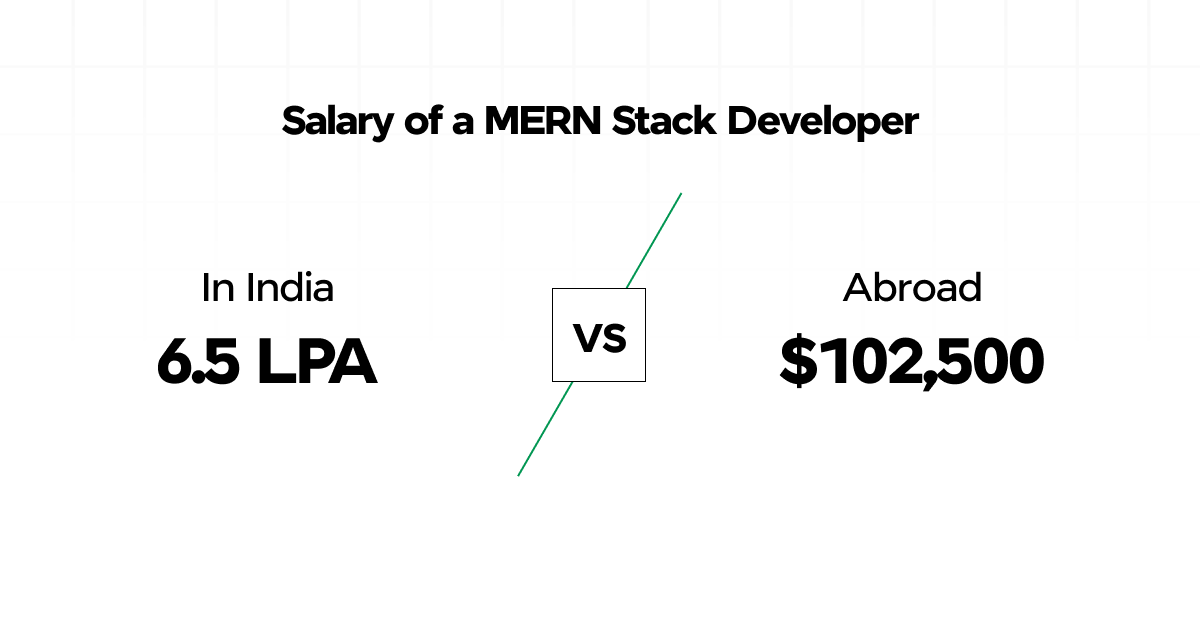
The salary of a MERN stack developer can vary significantly based on factors such as location, experience, skill level, and the specific company or industry. Here’s a general overview of the average salary range for MERN stack developers in India and abroad:
| Salary of a MERN Stack Developer | Fresher | Experienced |
| In India | INR 6.5 LPA | INR 9.1 LPA |
| In Abroad | $102,500 | $164,500 |
Conclusion
Now that you have a clear understanding of MERN stack development, the best way to move forward is by turning your knowledge into practical experience. Build real-world applications, strengthen your frontend and backend skills, and keep up with current development practices. A strong portfolio of MERN projects can help you demonstrate your abilities and confidently apply for full-stack development roles.
FAQs
Is MERN stack in demand in 2026?
Yes, MERN Stack is an in-demand IT profession in 2026 and will be in the upcoming years. The reasons are using a single programming language in the entire process, being scalable, having remote work opportunities, and a lot more.
Can I learn the MERN stack in 1 month?
Before you learn MERN Stack, you need to be thorough with JavaScript. If you’re an experienced JavaScript programmer, you’ll be easily grasping the fundamentals in a few months. However, you need rigorous practice and hands-on experience to become a professional MERN Stack developer.
What is the highest salary in MERN?
The highest salary of a MERN Stack developer in India is ₹18 LPA, which also varies on factors like skills, experience, location, etc.
Is MERN good for beginners?
Yes, it is one of the best stack for beginners to start their web development journey. Although there are various reason which proves it is good for beginners, the most prominent one being JavaScript which is used for both frontend and backend development.
Success Stories

About the Author
Vaishali
I'm a seasoned writer with four years of experience across technical, non-technical, and just about every genre or niche you can imagine. Adaptable and curious, I enjoy exploring new topics and making information engaging and easy to understand. Fueled by a steady stream of tea, I approach each project with creativity, reliability, and genuine enthusiasm for storytelling.
View all posts by Vaishali
Connect with me @

Did you enjoy this article?
Comments

























best