


Career Articles
Capgemini Exceller Technical Assessment 2026: AI + Technical - Best Guide
Cognizant GenC Elevate Exam Pattern & Syllabus for Freshers 2026 - Best Guide
Capgemini Exceller Placement Papers and Solutions 2026 - Best Guide
How to Pass the Accenture Recruitment Process 2026/27: The Complete Guide


Get In Touch For Details! Request More Information
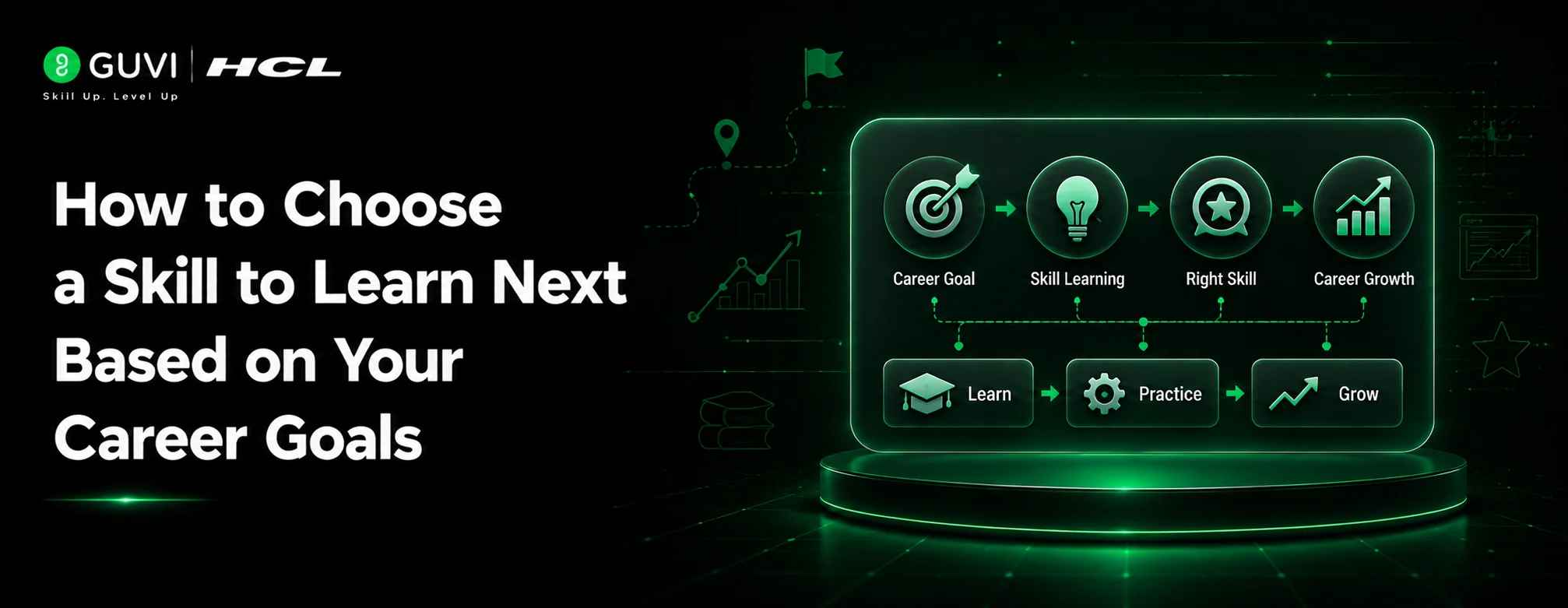
How to Choose a Skill to Learn Next Based on Your Career Goals – Best Guide 2026
Jul 20, 2026 10 Min Read 465 Views
(Last Updated)
Table of contents
- TL;DR
- Which Skill Should You Learn Next?
- What Should Determine the Skill You Choose?
- Career relevance
- Employer demand
- Your current skill gap
- Prerequisites
- Proof potential
- Learning effort
- How Should Your Career Goal Change Your Skill Choice?
- First-job goal
- Promotion goal
- Career-switch goal
- Freelancing goal
- How to Choose a Skill to Learn: A 7-Step Framework
- Step 1: Define one career outcome
- Step 2: Select the target role or responsibility
- Step 3: Study 15 to 20 relevant job descriptions
- Step 4: Complete a skill gap analysis
- Step 5: Identify the bottleneck skill
- Step 6: Check prerequisites and proof
- Step 7: Commit to one learning sprint
- How Can You Compare Several Skills Objectively?
- Example: Aspiring data analyst
- How to Choose a Skill to Learn When You Are Still Unsure
- Should You Learn a Technical, Tool, Domain, or Soft Skill?
- Foundation skill
- Role-specific skill
- Tool skill
- Domain skill
- Transferable skill
- How Does the Framework Work in Real Career Situations?
- Example 1: Fresher targeting data analytics
- Example 2: Developer seeking promotion
- Example 3: Marketer moving into product management
- Example 4: Working professional seeking freelance income
- How Can You Test a Skill Before Committing?
- Day 1: Understand the work
- Day 2: Complete a beginner lesson
- Day 3: Attempt a small task
- Day 4: Review the difficulty
- Day 5: Speak to a practitioner
- Day 6: Review the career value
- Day 7: Decide
- How Do You Build a 90-Day Upskilling Plan?
- Days 1–30: Build the foundation
- Days 31–60: Apply the skill
- Days 61–75: Get feedback
- Days 76–90: Create proof
- Review the outcome
- Common Mistakes When Choosing a Skill
- Following trends without checking role relevance
- Learning several skills at the same time
- Skipping prerequisites
- Choosing a course before choosing the skill
- Measuring progress through certificates alone
- Choose a Career-Focused Learning Path With HCL GUVI
- Conclusion
- FAQs
- How do I decide which skill to learn next?
- How do I choose a skill to learn when I have many interests?
- Should I learn a high-income skill or follow my interest?
- Which skill should a fresher learn first?
- Should I learn technical or soft skills next?
- How many skills should I learn at one time?
- How long should I spend learning one skill?
- How can I know whether a skill is in demand?
- What should I do after completing a course?
TL;DR
To understand how to choose a skill to learn, begin with the career outcome you want rather than the latest trending course. Define your target role or next responsibility, study its repeated skill requirements, compare them with your current abilities, and identify the gap that most limits your progress. Then assess each option for career relevance, employer demand, prerequisites, learning effort, and the proof you can build. Choose one skill for a focused learning sprint, apply it through a project or workplace task, and review your decision after 30 to 90 days.
Learning more does not always mean moving closer to your career goal. Understanding how to choose a skill to learn helps you avoid collecting unrelated courses, tools, and certificates that do not improve your employability or performance.
The right next skill should solve a specific career problem. It may help you qualify for a role, perform your current work better, earn a promotion, change careers, or create a new source of income.
Your decision on how to choose a skill to learn should therefore be based on evidence from your target career, not only social-media trends or course advertisements.
This guide gives you a practical method to select, test, prioritise, and apply one useful skill at a time.
Which Skill Should You Learn Next?
The next step in how to choose a skill to learn is that you should learn the skill that closes the most important gap between your current ability and your next career goal.
It is not necessarily:
- The highest-paying skill
- The newest technology
- The skill your friend is learning
- The longest certification
- The most popular course
- The easiest skill to complete
For example, an aspiring data analyst may be attracted to machine learning because it sounds advanced. However, SQL may be the better next skill when most target roles require database querying and the learner cannot yet analyse structured data independently.
A front end developer may consider learning another JavaScript framework. If their actual goal is to become a senior engineer, system design, testing, performance, accessibility, or technical communication may create more value.
The correct question is not:
What skill is popular right now?
Ask:
Which skill will remove the biggest obstacle between where I am and where I want to go?
What Should Determine the Skill You Choose?
A useful decision in how to choose a skill to learn will balance career relevance with realistic execution.
Evaluate every option using these six factors.
1. Career relevance
The skill should connect directly with your next intended outcome.
A skill is highly relevant when it:
- Appears in your target role
- Supports an important responsibility
- Helps you meet an eligibility requirement
- Improves a weakness affecting your current performance
- Opens a realistic next career step
If you cannot explain how the skill supports your goal, it is probably not the best immediate priority.
2. Employer demand
As a stepping stone in your journey of how to choose a skill to learn first look for evidence that the skill you are willing to learn, is required in the market you want to enter.
LinkedIn’s 2026 India skills analysis identifies fast-growing areas across AI and automation, data, IT and cybersecurity, business growth, and people leadership. The specific skills vary by function, which shows why learners should study their target role rather than follow one universal list.
Check:
- Target job descriptions
- Company career pages
- Recruiter posts
- Professional communities
- Interview experiences
- Industry reports
- People already doing the role
Demand matters, but it should not be the only factor. A skill can be popular and still be irrelevant to your chosen path.
While evaluating market demand, also consider the skills that remain valuable as AI advances, particularly abilities that support judgement, problem-solving, communication, and responsible decision-making.
3. Your current skill gap
A skill gap is the difference between what the target role requires and what you can currently demonstrate and the best part of your journey of how to choose a skill to learn.
Create three lists:
- Skills you can use independently
- Skills you understand but cannot apply confidently
- Skills you have not learned
The middle list often contains the best next opportunity. Strengthening partial knowledge can produce a useful career result faster than beginning an unrelated subject from zero.
4. Prerequisites
In how to choose a skill to learn, some skills depend on foundations that must come first.
Examples include:
- Learn SQL before advanced data engineering
- Learn programming fundamentals before complex frameworks
- Learn networking basics before advanced cloud security
- Learn statistics before predictive modelling
- Learn user research before advanced product experimentation
- Learn written communication before executive storytelling
Skipping prerequisites may make the advanced topic feel unnecessarily difficult.
5. Proof potential
Then while how to choose a skill to learn always choose a skill you can demonstrate.
Useful proof may include:
- A deployed project
- A GitHub repository
- A case study
- A dashboard
- A campaign report
- A certification
- A writing sample
- A process improvement
- A workplace result
- A reviewed open-source contribution
6. Learning effort
A valuable skill must also fit your available time, money, energy, and current responsibilities.
Consider:
- Hours available each week
- Expected time to reach a usable level
- Cost of courses or software
- Access to mentors or practice
- Availability of projects
- Whether the skill can be applied immediately
Your available schedule, need for mentorship, and preferred learning environment can also help you choose between online and offline tech upskilling.
While you decide how to choose a skill to learn, do not choose only the easiest option. Choose the highest-value option you can realistically complete.
EY’s Future of Pay 2026 report found that nearly half of surveyed organisations in India were moving towards skills-based pay models. This means employees with relevant, demonstrable capabilities are increasingly more likely to receive differentiated pay and career opportunities than those relying only on job titles or qualifications.
How Should Your Career Goal Change Your Skill Choice?
Your how to choose a skill to learn roadmap must have priorities which also change depending on whether your immediate focus is getting a job or building a long-term career.
Different career goals require different skill priorities.
| Career Goal | Skill to Prioritise | Evidence to Check | Best Proof |
| Get your first job | Core skills repeatedly required in entry-level roles | Job descriptions and assessments | Beginner project or internship task |
| Earn a promotion | Skill connected to the next level’s responsibilities | Internal role expectations and manager feedback | Workplace result or expanded responsibility |
| Change careers | Foundational skill that enables the transition | Target-role descriptions and professional interviews | Transition project or case study |
| Move into leadership | Communication, decision-making, delegation, and business understanding | Leadership responsibilities in target roles | Team initiative or mentored project |
| Start freelancing | Skill tied to a problem clients pay to solve | Freelancer listings and client conversations | Service sample and client outcome |
| Increase income | Scarce skill that creates measurable business value | Salary data and role demand | Revenue, efficiency, or cost-saving result |
| Become a specialist | Deeper capability within an existing field | Senior job descriptions and expert communities | Advanced project, publication, or contribution |
| Build career flexibility | Transferable skills used across several roles | Multiple role families | Cross-functional project |
First-job goal
Freshers learning how to choose a skill to learn should usually prioritize foundations and job-readiness.
A student targeting backend development may gain more from Java, SQL, APIs, Git, testing, and one complete project than from beginning several advanced cloud platforms simultaneously.
Promotion goal
In order to learn how to choose a skill to learn, you must keep in mind that, A promotion often requires a different category of skill.
A software developer moving towards a senior role may need system design, code review, mentoring, estimation, and stakeholder communication rather than another beginner programming course.
Ask your manager:
- What responsibilities belong to the next level?
- Where does my current performance fall short?
- Which capability would allow me to take on more ownership?
- What evidence would demonstrate readiness?
Career-switch goal
Career switchers should identify transferable strengths before beginning from zero.
Professionals considering technology can compare tech jobs suitable for career switchers before deciding which foundational skill deserves their attention first.
A teacher moving into instructional design already has experience with learning objectives, communication, content structure, and learner feedback. They may need design tools and digital learning methods rather than an entirely new professional identity. This shows different paths require different approach in how to choose a skill to learn.
Freelancing goal
Freelancers should prioritise skills tied to a clear client outcome.
“Learning digital marketing” is broad. “Learning local SEO for small healthcare clinics” creates a clearer service, audience, and portfolio opportunity.
Developers who want to earn independently can use this guide to start freelancing as a developer in India after building a skill they can package into a clear service.
How to Choose a Skill to Learn: A 7-Step Framework
Use the following process whenever several skills compete for your attention.
Step 1: Define one career outcome
Write one specific outcome for the next six to twelve months.
If you are still unsure about your long-term direction, first find a career field that matches your strengths and goals before selecting a specialised skill.
Examples:
- Get an entry-level data analyst role
- Move from support engineer to cloud operations
- Qualify for a senior frontend developer position
- Start freelance UI design work
- Become eligible for product-management interviews
- Improve performance in my current sales role
Avoid vague goals such as “become successful” or “learn technology.”
Step 2: Select the target role or responsibility
A career goal becomes useful only when connected to actual work.
Identify:
- Target job title
- Industry
- Experience level
- Preferred company type
- Main responsibilities
- Expected outputs
“Move into data” is broad.
If you have not yet selected a target role, explore different career options in India and shortlist fields that match your interests, strengths, education, and preferred type of work.
“Become an entry-level marketing analyst in an e-commerce company” gives you a clearer skill target.
Step 3: Study 15 to 20 relevant job descriptions
Create a simple spreadsheet.
Record:
- Skill
- Number of mentions
- Whether it is required or preferred
- Expected proficiency
- How the skill is used
- Related tools
- Evidence requested
Do not count every keyword equally.
A skill mentioned under core responsibilities matters more than one appearing in a long optional-tools list. This is exactly how to choose a skill to learn.
Step 4: Complete a skill gap analysis
Compare the repeated requirements with your current abilities.
Use four levels:
| Level | Meaning |
| 0 | No knowledge |
| 1 | Understand basic concepts |
| 2 | Can use with guidance |
| 3 | Can complete common tasks independently |
| 4 | Can solve unfamiliar problems and explain decisions |
A skill required at Level 3 should not be marked complete because you watched an introductory tutorial.
Step 5: Identify the bottleneck skill
The bottleneck is the gap that blocks progress even when your other abilities are strong.
For an aspiring analyst, it may be SQL.
For a developer seeking senior responsibilities, it may be system design.
For a marketer seeking management, it may be campaign analytics or stakeholder communication.
For a career switcher, it may be domain knowledge rather than a tool.
Step 6: Check prerequisites and proof
Before selecting the skill, ask:
- Do I have the required foundation?
- Can I practise it without waiting for a job?
- Can I build credible evidence?
- Can I reach a useful level in my available time?
- Will the skill remain relevant to my broader career direction?
A skill with high demand but no practical learning path may not be the right immediate choice.
Step 7: Commit to one learning sprint
Choose one main skill for 30 to 90 days.
Define:
- Learning outcome
- Weekly schedule
- Practice task
- Final project
- Feedback method
- Completion date
- Review date
This does not mean ignoring every other ability. It means giving one career-critical skill enough focus to produce visible progress. This is one of the most important steps in your roadmap of how to choose a skill to learn.
How Can You Compare Several Skills Objectively?
Use the Career Skill Scorecard when you have three or four possible choices.
Score each factor from 1 to 5.
| Criterion | Question | Weight |
| Career relevance | Does it directly support my next role or responsibility? | ×3 |
| Market evidence | Is it repeatedly requested in credible job postings? | ×2 |
| Skill-gap urgency | Is this gap currently blocking my progress? | ×2 |
| Proof potential | Can I build visible evidence of the skill? | ×2 |
| Prerequisite readiness | Do I have the foundation needed to learn it? | ×1 |
| Learning feasibility | Can I reach a useful level with my available resources? | ×1 |
| Personal interest | Am I willing to practise it consistently? | ×1 |
Multiply each score by its weight and add the results.
The maximum score is 60.
Example: Aspiring data analyst
A learner is comparing SQL, Python, and Power BI.
| Criterion | SQL | Python | Power BI |
| Career relevance ×3 | 15 | 12 | 12 |
| Market evidence ×2 | 10 | 8 | 8 |
| Skill-gap urgency ×2 | 10 | 6 | 8 |
| Proof potential ×2 | 8 | 8 | 10 |
| Prerequisite readiness ×1 | 5 | 3 | 5 |
| Learning feasibility ×1 | 5 | 3 | 4 |
| Personal interest ×1 | 4 | 5 | 4 |
| Total | 57 | 45 | 51 |
SQL becomes the first priority.
Power BI can follow because it turns the analysis into visible portfolio evidence. Python remains valuable but does not need to be the immediate first step.

How to Choose a Skill to Learn When You Are Still Unsure
When two options receive similar scores, choose the skill that:
- Unlocks the other skill
- Appears in more core responsibilities
- Can produce useful proof sooner
- Helps across more than one target role
- Can be tested at lower cost
Do not spend several months trying to make a perfect decision.
A sensible skill learned and applied will create more information than endless comparison.
If the confusion is about the career direction itself rather than two individual skills, use this process to change career paths when you lack clarity before building a detailed learning roadmap.
Should You Learn a Technical, Tool, Domain, or Soft Skill?
Career gaps are not always technical.
The right next step may belong to one of four categories.
Foundation skill
A foundation supports many later capabilities.
Examples:
- Programming logic
- Statistics
- Writing
- Research
- Financial literacy
- Communication
- Data fundamentals
Choose a foundation when advanced topics repeatedly feel confusing.
Role-specific skill
A role-specific skill directly supports core work.
Examples:
- SQL for a data analyst
- User research for a UX designer
- Test automation for a QA engineer
- Financial modelling for an analyst
- Technical SEO for a search specialist
Choose it when you are trying to qualify for or improve within a defined role.
Tool skill
A tool helps you apply a broader capability.
Examples:
- Tableau
- Figma
- Jira
- Git
- Docker
- Salesforce
- Excel
Do not confuse knowing a tool with understanding the work it supports.
Learning Figma does not automatically teach product design. Learning Tableau does not automatically teach data analysis.
Domain skill
Domain knowledge helps you apply other abilities in a specific industry.
Examples:
- Banking risk
- Healthcare workflows
- E-commerce metrics
- Supply-chain operations
- SaaS customer retention
- Manufacturing quality systems
Domain knowledge becomes increasingly important as you move beyond beginner execution.
Transferable skill
Transferable skills remain useful across roles.
Examples:
- Problem-solving
- Communication
- Project planning
- Stakeholder management
- Negotiation
- Leadership
- Critical thinking
A transferable skill may be the best choice when your technical ability is strong but your work is not creating wider influence.
Technical learners should also assess the soft skills for tech professionals that influence teamwork, workplace communication, problem-solving, adaptability, and career growth.
How Does the Framework Work in Real Career Situations?
Example 1: Fresher targeting data analytics
An engineering graduate wants a data analyst job in a Bengaluru GCC.
They initially consider machine learning because it appears modern. After reviewing entry-level job descriptions, they find repeated requirements for Excel, SQL, dashboarding, data cleaning, and business communication.
Their first learning sequence becomes:
- SQL
- Excel-based analysis
- Power BI
- Business case study
- Python
- Advanced analytics later
The sequence is based on employability and prerequisites rather than prestige.
Example 2: Developer seeking promotion
A React developer wants to become a senior frontend engineer.
They already build features independently. Their feedback shows that they struggle with application architecture, performance, accessibility, estimation, and communication during code reviews.
Learning another frontend framework would add breadth but not remove the promotion bottleneck.
Their next skill becomes frontend system design, supported by a project that documents architecture, performance decisions, test coverage, and accessibility.
Example 3: Marketer moving into product management
A digital marketer wants to move into an associate product role.
Their transferable strengths include customer understanding, campaign analysis, communication, and experimentation.
The gaps are:
- Product discovery
- Prioritisation
- User stories
- Product metrics
- Stakeholder management
They do not begin by learning advanced coding. They build a product case study, interview users, define a problem, prioritise features, and measure a small experiment.
Example 4: Working professional seeking freelance income
A finance executive wants a side income.
Instead of selecting a broad field such as web development, they evaluate abilities closer to their experience.
They choose financial-dashboard creation using Excel and Power BI because it combines existing domain knowledge with a marketable service.
The resulting portfolio shows a cash-flow dashboard, budget tracker, and management report for a fictional small business.
How Can You Test a Skill Before Committing?
Use a seven-day skill test before purchasing a long programme or building a six-month plan.
Day 1: Understand the work
Study what people actually do with the skill.
Look at:
- Tasks
- Deliverables
- Tools
- Challenges
- Entry requirements
- Career paths
Day 2: Complete a beginner lesson
Choose one reliable introductory resource.
The goal is not mastery. It is to understand the basic language and workflow.
Day 3: Attempt a small task
Examples:
- Write five SQL queries
- Create one dashboard
- Design one mobile screen
- Draft one SEO content brief
- Build one API endpoint
- Prepare one project plan
Day 4: Review the difficulty
Ask:
- Did the challenge feel meaningful?
- Was I curious enough to continue?
- Which foundation was missing?
- Could I imagine practising this regularly?
Day 5: Speak to a practitioner
Ask someone working in the field:
- How is the skill used?
- What do beginners misunderstand?
- What level do employers expect?
- What proof creates credibility?
Day 6: Review the career value
Return to your job-posting spreadsheet and score the skill.
Day 7: Decide
Choose one of three actions:
- Commit now
- Build a prerequisite first
- Reject the skill for the current goal
Testing prevents you from confusing interest in a topic with interest in doing the work.
Learning a skill connected to a clear career goal can create more meaningful progress than choosing a skill only because it is trending. Career-aligned skills are easier to practise through relevant projects, demonstrate to employers, and apply in real workplace situations.
How Do You Build a 90-Day Upskilling Plan?
Once you select the skill, turn the decision into a practical learning roadmap.
Days 1–30: Build the foundation
Focus on:
- Core concepts
- Essential terminology
- Basic exercises
- Common workflows
- Frequent errors
Your goal is to complete small tasks without copying every step.
Days 31–60: Apply the skill
Build one practical project.
Choose a project connected to the target role rather than a random tutorial.
For example:
- SQL analysis of an e-commerce dataset
- Landing-page redesign based on user feedback
- Automated test suite for a small application
- Social-media campaign plan with performance metrics
- Cash-flow dashboard for a small business
Days 61–75: Get feedback
Ask for feedback from:
- Mentor
- Working professional
- Manager
- Peer community
- Open-source maintainer
- Potential user
Do not ask only whether the project looks good.
Ask what is incorrect, incomplete, unrealistic, or difficult to understand.
Days 76–90: Create proof
Prepare:
- Resume bullet
- Portfolio page
- GitHub repository
- Case study
- Demo
- Certificate, if relevant
- Interview explanation
Your final goal is not “course completed.”
It is:
I can perform this skill at a useful level and show evidence.
Review the outcome
At the end of 90 days, ask:
- Did the skill improve my work?
- Did it qualify me for more roles?
- Can I demonstrate it?
- What feedback did I receive?
- What skill now limits my next step?
The answer becomes the starting point for your next learning decision.
Common Mistakes When Choosing a Skill
1. Following trends without checking role relevance
A trending skill may have strong market demand but no direct connection with your career goal.
Fix: Validate it against target job descriptions and responsibilities before committing.
2. Learning several skills at the same time
Dividing attention across five unrelated subjects often produces shallow knowledge and unfinished courses.
Fix: Choose one primary skill and one supporting ability for each learning sprint.
3. Skipping prerequisites
Advanced topics feel harder when the underlying concepts are weak.
Fix: Identify the foundation skill that makes the target skill easier to understand and apply.
4. Choosing a course before choosing the skill
Learners sometimes purchase an attractive course and then try to justify how it fits their career.
Fix: Define the goal, identify the skill, and only then compare learning resources.
5. Measuring progress through certificates alone
A certificate confirms course completion, not necessarily practical capability.
Fix: Connect every course with exercises, a project, feedback, and visible proof.
Choose a Career-Focused Learning Path With HCL GUVI
Knowing how to choose a skill to learn helps you avoid investing time in a programme that does not match your career direction.
HCL GUVI Zen Career Programs offer career-oriented learning paths across full-stack development, data science, AI and machine learning, UI/UX design, DevOps, cloud, business analytics, VLSI, and other technology fields.
Begin by identifying the role you want and the skill gap blocking your progress. You can then select a programme whose curriculum, projects, and career support align with that specific outcome rather than choosing only by popularity.
Conclusion
Understanding how to choose a skill to learn begins with one clear career goal. Study the responsibilities and repeated requirements of your target role, compare them with your current abilities, and identify the gap that most limits your progress. Prioritise skills with strong career relevance, real demand, suitable prerequisites, manageable learning effort, and clear proof potential. Test the skill before making a large commitment, then follow a focused 30- to 90-day learning sprint. Your learning plan does not need to be permanent. Review it regularly as your experience, interests, opportunities, and job requirements change.
FAQs
1. How do I decide which skill to learn next?
Define your next career goal, study the repeated requirements of the target role, and compare them with your current abilities. Choose the skill gap that most directly blocks your progress.
2. How do I choose a skill to learn when I have many interests?
Score each option for career relevance, demand, prerequisites, proof potential, learning effort, and interest. Select the highest-value skill for one short learning sprint rather than trying to study everything together.
3. Should I learn a high-income skill or follow my interest?
Consider both. A skill should have credible career value, but you also need enough interest to practise it consistently and become competent.
4. Which skill should a fresher learn first?
A fresher should begin with the core skill repeatedly required for the target entry-level role. Foundations, practical projects, communication, and interview readiness usually matter more than collecting advanced tools.
5. Should I learn technical or soft skills next?
Choose based on your current bottleneck. Build technical knowledge when you cannot perform the core work, and strengthen soft skills when communication, teamwork, judgement, or leadership limits your impact.
6. How many skills should I learn at one time?
Focus on one primary skill and, when necessary, one closely related supporting skill. This makes it easier to practise deeply and complete useful evidence.
7. How long should I spend learning one skill?
Spend enough time to reach a usable level and complete practical proof. A focused skill may take 30 to 90 days, while complex professional capabilities can require several learning cycles.
8. How can I know whether a skill is in demand?
Review recent job descriptions, company career pages, recruiter content, industry reports, and conversations with working professionals. Look for repeated responsibilities rather than isolated keywords.
9. What should I do after completing a course?
Apply the skill through a project or workplace task, get feedback, document the result, update your resume or portfolio, and reassess the next gap in your career plan.
Success Stories

About the Author
Reemsha Khan
Always been a storyteller at heart. Now, I turn complex topics into simple, easy-to-understand stories through content. Hope you find it helpful.
View all posts by Reemsha Khan
Connect with me @












Did you enjoy this article?