


Web Development Articles
How to Use Firebase Firestore for Real-Time Data in Web Apps
Web Designing Roadmap 2026: Best Guide to Become a Successful Web Designer


Get In Touch For Details! Request More Information

Web Developer Salary as a Fresher in 2026: A Complete Guide
Sep 16, 2026 6 Min Read 6507 Views
(Last Updated)
Thinking about starting your career in web development and wondering if the money is worth it? You’re not alone. Web developer salary as a fresher in India is one of the most searched career questions among tech graduates, and the answers vary wildly depending on who you ask.
Web developer salary as a fresher in India typically ranges from ₹2.5 LPA to ₹6 LPA, depending on your city, tech stack, and the type of company you join. That range isn’t random, it’s driven by a handful of specific, controllable factors.
This article breaks down the actual numbers, what drives them, and what you can do from day one to earn more.
Table of contents
- TL;DR Summary
- Why Web Development is Still a High-Demand Career in 2026
- What is the Average Web Developer Salary as a Fresher in India?
- Web Developer Salary Growth: Fresher to Senior
- How Web Developer Salaries Compare to Other Tech Roles
- Does Your Web Development Specialization Affect Your Fresher Salary?
- Frontend Developer
- Backend Developer
- Full Stack Developer
- Which Role Offers Better Salary Potential?
- What Factors Actually Affect Your Fresher Salary?
- Web Developer Salary at Startups vs MNCs
- So, Which is Better for a Fresher?
- How to Increase Your Web Developer Salary as a Fresher
- Build Projects That Solve Real Problems
- Build Skills Beyond the Basics
- Expand into Full-Stack Development
- Get Certified with Industry-Backed Programs
- Contribute to Open Source
- Start Freelancing Early
- Be Strategic About Your First Company
- Common Mistakes Freshers Make That Hurt Their Salary
- Conclusion
- FAQs
- What is the average web developer salary as a fresher in India?
- Which skills give freshers the highest web developer salary?
- How can a fresher increase their web developer salary quickly?
- Is web development a good long term career in India?
- Do I need a computer science degree to become a web developer in India?
- What is the salary difference between front end and full stack developers in India?
TL;DR Summary
- What it is: the starting pay for a web developer’s first job in India, typically ₹2.5 LPA to ₹6 LPA depending on skills, city, and company type
- Metro cities that pay best: Bangalore, Delhi NCR, and Mumbai consistently lead, with Hyderabad and Chennai close behind
- What moves the needle most: your tech stack. Full stack developers with React.js or Node.js skills earn significantly more than developers who only know HTML and CSS
- Timeline to grow: with a strong portfolio and the right certifications, you can meaningfully accelerate your salary within 12 to 18 months
- Why it matters: India’s web development hiring hasn’t slowed down, making it one of the most consistently in-demand tech careers right now
Why Web Development is Still a High-Demand Career in 2026
Web development is not slowing down anytime soon. Every business, from local startups to global enterprises, needs a functioning web presence. Add to that the surge in e-commerce, SaaS platforms, and mobile-first design, and you have a field where skilled developers are constantly in short supply.
NASSCOM, India’s IT industry body, consistently points to sustained, high-volume demand for web development professionals through 2026 and beyond. That’s not just a statistic, it means companies are actively hiring, and freshers with the right skills are getting offers faster than ever.
The rise of progressive web apps, AI integrations, and cloud-based platforms has also expanded what web developers are expected to build. This means more specialization, and specialization means higher pay.
What is the Average Web Developer Salary as a Fresher in India?
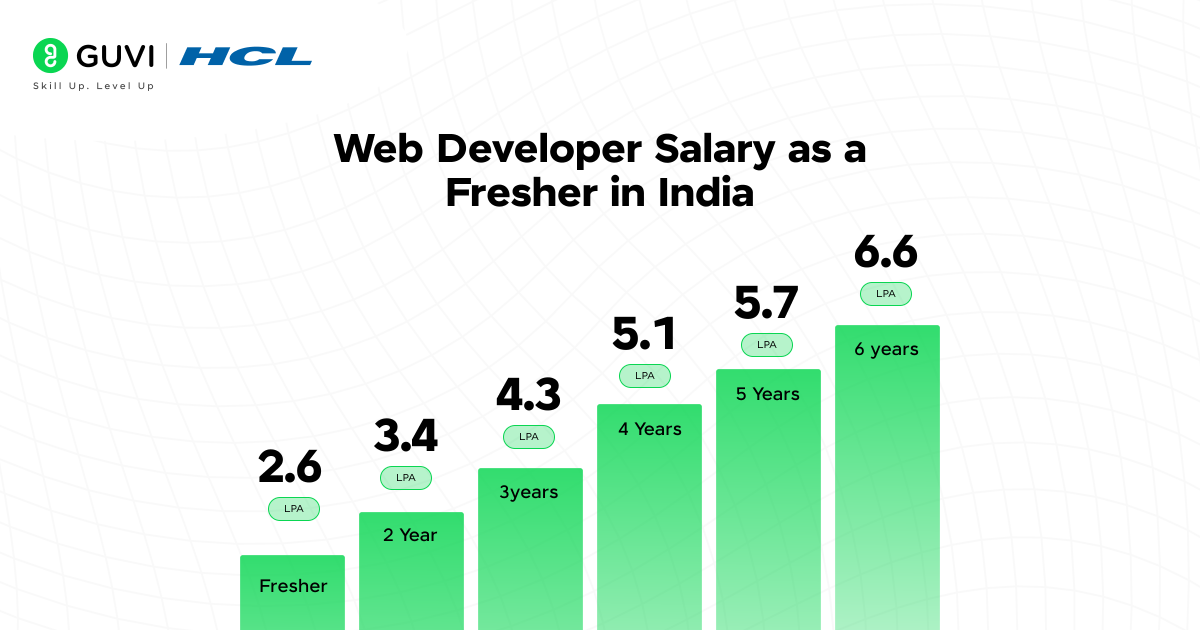
Freshers entering web development in India typically see a web developer salary as a fresher between ₹2.5 LPA and ₹6 LPA as a starting point. That range exists because your pay depends heavily on where you work, what you know, and who you work for.
Here’s an accurate city-wise breakdown based on current market data:
| City | Average Fresher Salary (per year) |
|---|---|
| Bangalore | ₹3.5 Lakhs |
| Delhi NCR | ₹3.4 Lakhs |
| Mumbai | ₹3.3 Lakhs |
| Hyderabad | ₹3.3 Lakhs |
| Chennai | ₹3.0 Lakhs |
| Pune | ₹2.8 Lakhs |
Bangalore, Delhi NCR, and Mumbai consistently sit at the top of this list, they’re India’s largest tech hubs, with the highest concentration of both product companies and IT services majors competing for talent.
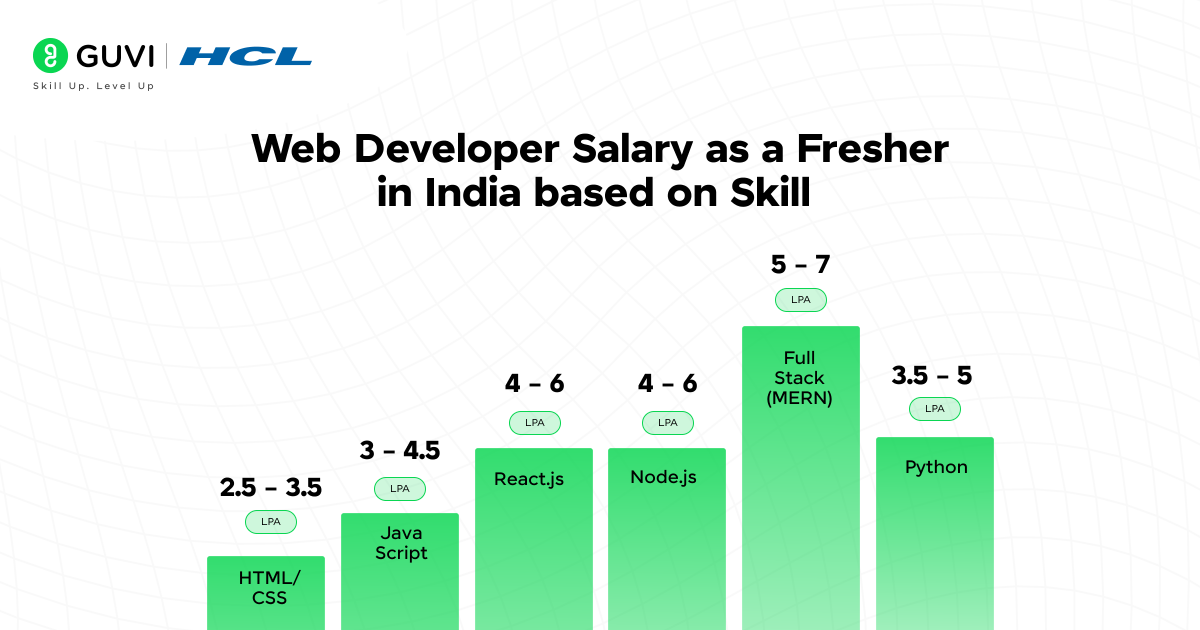
Now here’s what matters even more than your city: your tech stack. Developers who know React.js, Node.js, or full-stack development consistently land higher offers than those who only know basic HTML and CSS.
| Skill Level | Typical Fresher Salary |
|---|---|
| HTML, CSS, basic JavaScript | ₹2.5 to ₹3.5 LPA |
| React.js or Angular | ₹3.5 to ₹5 LPA |
| Full Stack (MERN or MEAN) | ₹4 to ₹6 LPA |
| Full Stack with Cloud or DevOps | ₹5.5 to ₹7+ LPA |
Web Developer Salary Based on Skill Level
According to LinkedIn job data, full stack developers earn up to 40% more than front end only developers at the fresher level in India. Learning one backend framework alongside your front end skills can meaningfully change your first offer.
Web Developer Salary Growth: Fresher to Senior
The fresher figures above are just the starting point. Here’s roughly how web developer pay scales with experience in India.
| Experience Level | Typical Salary Range |
|---|---|
| Fresher (0-1 years) | ₹2.5 to ₹6 LPA |
| Junior (1-3 years) | ₹5 to ₹9 LPA |
| Mid-level (3-5 years) | ₹8 to ₹15 LPA |
| Senior (5+ years) | ₹15 to ₹25+ LPA |
This is exactly where a web developer salary as a fresher starts to move fastest: the jump from fresher to junior tends to be the steepest percentage increase.
This is largely because your first year is when you go from “unproven” to “demonstrated,” a working portfolio and real production experience change how recruiters see you almost overnight.
How Web Developer Salaries Compare to Other Tech Roles
If you’re weighing a web developer salary as a fresher against other entry points into tech, here’s how fresher salaries typically compare.
| Role | Typical Fresher Salary (India) |
|---|---|
| Web Developer (Frontend only) | ₹2.5 to ₹3.5 LPA |
| Web Developer (Full Stack) | ₹4 to ₹6 LPA |
| Data Analyst | ₹3 to ₹7 LPA |
| Software Engineer (General, Service-based) | ₹3.5 to ₹5 LPA |
| Software Engineer (Product-based) | ₹6 to ₹12 LPA |
Web development sits in a genuinely competitive spot for freshers, especially once you move into full-stack territory, though product-company software engineering roles (which often require deeper computer science fundamentals) still lead at the very top end.
Does Your Web Development Specialization Affect Your Fresher Salary?
Your web developer salary as a fresher can be influenced by the role you choose, but your job title alone does not determine your pay. For freshers, employers also consider your tech stack, project portfolio, internships, problem-solving skills, location, and the complexity of the role.
Frontend Developer
Frontend developers build the user-facing parts of websites and web applications. A front-end developer’s salary as a fresher can improve as you move beyond HTML and CSS and develop practical skills in JavaScript, React or Angular, responsive design, Git, and API integration.
Backend Developer
Backend developers work on server-side logic, databases, APIs, authentication, and application functionality. Knowledge of technologies such as Node.js, Python, Java, SQL/NoSQL databases, and REST APIs can help freshers qualify for more specialized backend roles.
Full Stack Developer
Full stack developers work across both the frontend and backend of an application.
A full stack developer’s salary as a fresher can vary widely depending on how well you can actually work across both sides of the stack. Simply knowing several technologies is less valuable than being able to build, deploy, and explain complete applications.
Which Role Offers Better Salary Potential?
There is no fixed rule that frontend, backend, or full stack always pays the most. A fresher with strong React skills and an impressive portfolio, for example, may earn more than someone with superficial full-stack knowledge.
Instead of choosing a specialization only for its expected salary, focus on developing strong, demonstrable skills in one area first. You can then expand your stack as you gain experience.
What Factors Actually Affect Your Fresher Salary?
Before you benchmark your salary expectations, you need to understand what drives the numbers. Several variables are at play here, and knowing them helps you negotiate smarter.
| Factor | How It Impacts Pay |
|---|---|
| Location | Top metro cities pay more due to higher demand and cost of living |
| Tech Stack | React, Node.js, and full stack skills command premium pay |
| Educational Background | CS or IT graduates may get slightly better starting packages |
| Portfolio and Projects | A strong GitHub profile directly influences offer letters |
| Company Size | MNCs offer stability; startups may offer faster hikes and equity |
| Prior Internship Experience | Candidates with internships are preferred and often paid more |
What Factors Actually Affect Your Fresher Salary?
Web Developer Salary at Startups vs MNCs
When comparing web developer salary as a fresher in India, the type of company you join is an important factor to consider. Startups and MNCs can differ not only in starting pay but also in responsibilities, learning opportunities, benefits, and career growth.
| Factor | Startups | MNCs |
|---|---|---|
| Starting Salary | Can vary significantly depending on funding, size, and role | Often follows more structured salary bands |
| Role & Responsibilities | Freshers may work across multiple technologies and functions | Roles are generally more clearly defined |
| Learning Exposure | Often faster and broader due to smaller teams | More structured training and established processes |
| Benefits | May include ESOPs or performance-linked incentives | Often includes structured benefits and allowances |
| Career Growth | Can be fast in rapidly growing companies | Usually follows more defined promotion cycles |
| Job Stability | Can vary depending on the startup’s stage and financial position | Generally more predictable in established organisations |
A quick comparison between web developer salary at startups vs MNCs
So, Which is Better for a Fresher?
Don’t choose between a startup and an MNC based on salary alone.

A startup may give you broader responsibilities and faster exposure, while an MNC may offer structured training, established processes, and greater predictability.
For your first web development job, the quality of the role, the technologies you’ll work with, mentorship, and opportunities to build strong experience can matter just as much as the initial package.
How to Increase Your Web Developer Salary as a Fresher
This is where most guides on web developer salary as a fresher fall short. Knowing the salary range is one thing. Knowing how to move up within it from day one is what actually matters. Here are the most effective levers you can pull.
1. Build Projects That Solve Real Problems
Employers do not just want to see that you know React. They want to see what you have built with it.
Focus on projects like e-commerce sites with payment integration, task management tools, or portfolio sites with live functionality. Host everything on GitHub and deploy it publicly. A live project always beats a code snippet on a resume.
2. Build Skills Beyond the Basics
HTML, CSS, and JavaScript are a strong starting point, but additional skills can make your profile more competitive. Depending on your chosen path, learn a framework like React or Angular, work with APIs and Git, and build experience deploying functional applications.
3. Expand into Full-Stack Development
Once you’re comfortable with frontend development, learning a backend technology such as Node.js, Django, or Java along with databases like MongoDB or MySQL can broaden the roles you qualify for. Focus on building complete applications rather than simply adding more technologies to your resume.
4. Get Certified with Industry-Backed Programs
This is one of the more reliable ways to move your web developer salary as a fresher upward quickly: certifications from recognized platforms add credibility, especially for freshers who lack work experience.
HCL GUVI’s Full Stack Development programme is built around real projects and comes with placement assistance, which directly impacts the kind of roles you get access to.
Freshers with at least one prior internship receive job offers 2x faster than those without any work experience, according to a 2024 Naukri hiring trends report.
5. Contribute to Open Source
Open source work is another lever for growing your web developer salary as a fresher: GitHub activity is now a standard part of technical hiring.
Even small contributions like fixing bugs or writing documentation on an open source project show you can work with real codebases and collaborate with distributed teams. It is one of the fastest credibility builders for a fresher.
6. Start Freelancing Early
Platforms like Upwork and Fiverr let you build a portfolio while earning. Freelance projects also teach you client communication, project scoping, and delivery under deadlines, skills that set you apart in job interviews. Even two or three completed freelance projects can noticeably improve your offer.
7. Be Strategic About Your First Company
Your first job shapes your next two. Startups offer faster learning curves and more ownership, while larger companies provide structured mentorship and steady packages. Neither is wrong. But going in with a clear goal, whether that is learning speed or salary stability, helps you pick the right environment.
Common Mistakes Freshers Make That Hurt Their Salary
Many freshers undermine their own earning potential before they even step into an interview, quietly capping their web developer salary as a fresher before negotiations even begin. Here are the most common mistakes and how to avoid them.
1. Staying only on the front end: Many beginners stop at HTML, CSS, and basic JavaScript. Employers in 2026 expect at least foundational backend exposure. Even a small Node.js or Python project significantly strengthens your profile.
2. Skipping the portfolio: A resume without live projects is just a list of claims. Build, deploy, and link at least three projects before you start applying. Your GitHub profile matters more than your college grades to most tech recruiters.
3. Ignoring soft skills in interviews: Technical ability gets you shortlisted, but communication skills close the offer. Many freshers lose salary negotiation ground by being unprepared to talk about their work confidently. Practice explaining your projects out loud.
4. Accepting the first offer without negotiating: Freshers often assume the first number is final. It rarely is. If you have certifications, projects, and internship experience, you have leverage. A polite counteroffer backed by specifics almost always works.
5. Not upskilling continuously: Web development moves fast. Freshers who stop learning after landing a job fall behind quickly. Set aside even one hour per week to learn something new, a new framework, a new tool, or a new concept.
Conclusion
Starting out as a web developer in India, a web developer salary as a fresher in the ₹2.5 to ₹6 LPA range is real, and so is the ceiling beyond it.
What separates freshers who move up fast from those who plateau early is not luck. It is the deliberate choice to go full stack, build real projects, and treat every freelance gig or internship as a portfolio asset.
The demand for web developers in India is not slowing down, and neither is the opportunity to grow. If you are willing to keep learning, your web developer salary as a fresher is just the starting line, not the ceiling.
FAQs
1. What is the average web developer salary as a fresher in India?
Freshers in web development earn between ₹2.5 LPA and ₹6 LPA on average. Salary varies based on skills, city, and company type, with metro cities and full stack developers sitting at the higher end.
2. Which skills give freshers the highest web developer salary?
Full stack skills using the MERN stack (MongoDB, Express.js, React, Node.js) or MEAN stack consistently attract higher fresher packages. React.js alone can push your offer from the ₹2.5 to ₹3 LPA range up to ₹4 to ₹5 LPA.
3. How can a fresher increase their web developer salary quickly?
Build a strong portfolio of real deployed projects, earn an industry recognized certification, and gain internship or freelance experience before applying. These three steps alone separate high offer candidates from average applicants.
4. Is web development a good long term career in India?
Yes. With India’s ongoing digital transformation, the demand for skilled web developers is structurally strong through at least 2030. Specializing in full stack, cloud, or AI integrated development increases both longevity and earning potential.
5. Do I need a computer science degree to become a web developer in India?
No. Most companies hire based on demonstrated skills and portfolio projects rather than degrees. Structured programmes with placement support have helped thousands of non CS graduates break into web development.
6. What is the salary difference between front end and full stack developers in India?
Front end only developers typically earn ₹2.5 to ₹3.5 LPA at the fresher level. Full stack developers with MERN or MEAN skills earn ₹4 to ₹6 LPA and above. The gap widens significantly with experience.
Success Stories

About the Author
Jebasta
I translate the language of data into stories that anyone can understand. As a writer with a data science background, I simplify analytics, AI, and decision-making so beginners and enthusiasts can confidently explore the world of data.
View all posts by Jebasta
Connect with me @




























Did you enjoy this article?