


Full Stack Development Articles
Best Full Stack Development Training Programs for Career Switchers
Best Full Stack Developer Courses for Working Professionals in India
How Can a Software Maintenance Engineer Move into Modern Application Development?
Can a Mainframe Developer Transition to Modern Full Stack Development?


Get In Touch For Details! Request More Information
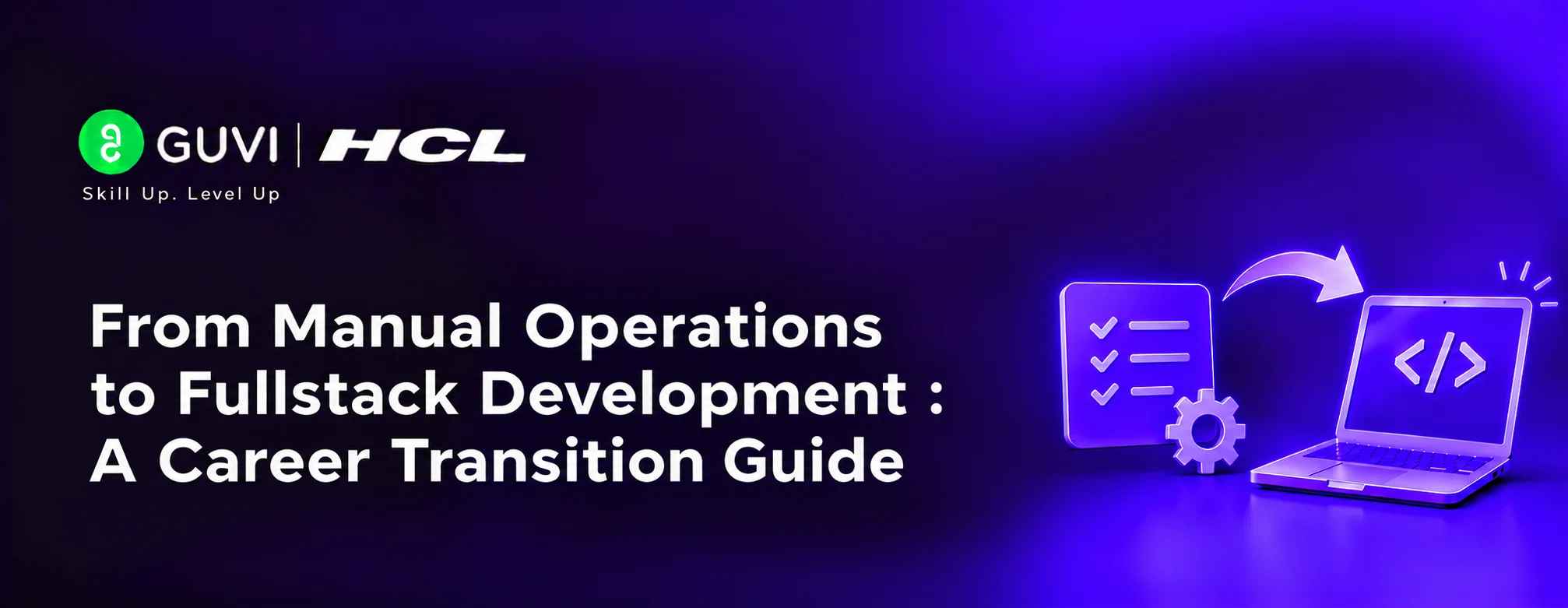
From Manual Operations to Fullstack Development : A Career Transition Guide
Nov 18, 2026 4 Min Read 47 Views
(Last Updated)
Your day probably runs on spreadsheets, trackers, emails and repeated checklists. You keep processes moving, yet a voice keeps asking why so much of it is still done by hand.
Yes, you can move from manual operations to full stack development, even without a technical degree. Your process thinking, eye for errors and comfort with data already match how developers work, and most learners become job ready within a year of consistent practice.
This manual operations to full stack development guide shows how operations tasks map to coding skills, why automation is a smart first step, a 6 step roadmap, project ideas from your own job, salaries and the traps that slow learners down.
Table of contents
- TL;DR Summary
- What is Manual Operations to Full Stack Development?
- How Operations Skills Map to Coding
- Why Start with Automation
- Skills You Need for Full Stack Development
- 💡 Did You Know?
- A 6 Step Roadmap from Operations to Development
- Learn Web Basics
- Master JavaScript Through Automation
- Build Screens with React
- Add a Backend and Database
- Build Your Portfolio
- Prepare and Apply
- Project Ideas from Your Operations Job
- Salary: Operations Executive vs Full Stack Developer
- Learn Full Stack Development with Expert Mentors
- Common Mistakes to Avoid
- Believing You Are Too Non Technical
- Quitting Your Job Too Early
- Collecting Certificates Without Projects
- Hiding Your Operations Background
- Applying Only for Senior Titles
- Conclusion
- FAQs
- Can a manual operations professional switch to full stack?
- How long does an operations professional to software developer switch take?
- Do I need a degree to move from non technical to software engineering?
- What should I learn first for manual operations to full stack development?
- Is a software engineering career transition worth it after 30?
TL;DR Summary
- What it is: Manual operations to full stack development is a career switch where someone handling back office, process or data tasks learns to build complete web applications, from screens to servers and databases.
- Short answer: Yes, it is possible. With around a year of structured learning and a few real projects, an operations professional can land junior full stack roles.
- Your edge: Manual operations to full stack development learners already understand workflows, rules and the pain of repetitive work.
- First win: Start manual operations to full stack development by automating one boring task from your job.
- Proof matters: Recruiters hire from projects, so your manual operations to full stack development portfolio should solve real operations problems.
What is Manual Operations to Full Stack Development?
Manual operations to full stack development means moving from running business processes by hand to building the software that runs them.
- Operations work: Data entry, report preparation, reconciliations, order tracking, vendor follow ups and SOP based tasks.
- Full stack work: Building the frontend users click, the backend logic, the database and the deployment.
- The link: Every SOP you follow is a set of steps a program could run.
This makes the path a natural software engineering career transition rather than a leap into the unknown. If you are still learning the basics, this explainer on what full stack development is covers each layer simply.
Want a guided path for this switch? Enrolling in the HCL GUVI Full Stack Development Course puts you on a mentor led track that teaches coding from the fundamentals, so your operations know how becomes the base for real web apps.
How Operations Skills Map to Coding
You are less of a beginner than you think. This table shows how manual operations to full stack development builds on what you do daily.
| Operations task | Matching developer skill |
|---|---|
| Following SOPs step by step | Writing logic and algorithms |
| Excel formulas and lookups | Conditions, loops and functions |
| Reconciling two reports | Data validation and comparisons |
| Maintaining trackers | Designing database tables |
| Filling the same forms daily | Building web forms that save data |
| Escalating exceptions | Error handling in code |
- Excel users can even try Python in Excel to see code working on familiar data.
- The new parts of manual operations to full stack development are syntax, debugging and thinking in reusable pieces.
Why Start with Automation
Many people in manual operations to full stack development journeys quit because the first months feel abstract. Automating your own work fixes that.
- Pick one task: A daily report, a copy paste job or a status email you send every morning.
- Script it: Use JavaScript or Python to read data, clean it and produce the output.
- Measure it: Note the hours saved each week, a strong line for any manual operations to full stack development resume.
This quick win keeps motivation high and gives the operations professional to software developer move a story employers enjoy hearing.
Skills You Need for Full Stack Development
These skills cover the full manual operations to full stack development journey. Learn them in sequence so each layer makes sense.
| Skill | Purpose | Time needed |
|---|---|---|
| HTML and CSS | Page structure and design | 3 to 4 weeks |
| JavaScript | Logic and interactivity | 6 to 8 weeks |
| React | Modern user interfaces | 5 to 6 weeks |
| Node.js and Express | Server side code and APIs | 5 to 6 weeks |
| MongoDB or SQL | Saving records | 3 to 4 weeks |
| Git and deployment | Version control and going live | 2 weeks |
- Begin with this beginner guide to HTML and CSS before touching frameworks.
- See the wider list of full stack developer skills once the basics feel steady.
- Understand daily roles and responsibilities of full stack developers so you know what the job really involves.
💡 Did You Know?
- The world’s first website, built by Tim Berners-Lee at CERN, went live in 1991 and explained the World Wide Web project itself.
- Brendan Eich created the first version of JavaScript in about 10 days in 1995 while working at Netscape.
A 6 Step Roadmap from Operations to Development
Follow this manual operations to full stack development roadmap while you keep your current job.
| Step | Focus | Timeline |
|---|---|---|
| 1 | Web basics | Months 1 to 2 |
| 2 | JavaScript and automation | Months 2 to 4 |
| 3 | Frontend with React | Months 4 to 5 |
| 4 | Backend and database | Months 6 to 7 |
| 5 | Portfolio projects | Months 8 to 10 |
| 6 | Interviews and applications | Months 10 to 12 |
1. Learn Web Basics
Build simple pages with HTML and CSS. Recreate a form you fill at work as practice.
2. Master JavaScript Through Automation
Learn variables, loops and functions, then automate one real task from your job.
3. Build Screens with React
Turn your tracker into a React dashboard with filters and search.
4. Add a Backend and Database
Write APIs in Node.js and Express, and store records in MongoDB.
5. Build Your Portfolio
Create two or three manual operations to full stack development projects, publish the code on GitHub and deploy each one.
6. Prepare and Apply
Practise JavaScript questions and explain your manual operations to full stack development story in one minute.

Need a shorter schedule? This 6 month full stack learning plan for career changers shows a faster version.
Project Ideas from Your Operations Job
The best manual operations to full stack development portfolio uses problems you have lived through.
- Order tracker: Add, update and search orders with status colours and filters.
- Reconciliation tool: Upload two files and highlight mismatched records.
- Leave and shift planner: A team calendar with requests and approvals.
- Vendor follow up board: Reminders, due dates and notes in one place.
Need more ideas? Pick a starter from these JavaScript project ideas and give it an operations twist.
Salary: Operations Executive vs Full Stack Developer
Pay comparison for the manual operations to full stack development move in India.
| Experience | Operations Executive | Full Stack Developer |
|---|---|---|
| 1 year | ₹1.4 Lakhs to ₹4.2 Lakhs | ₹1.2 Lakhs to ₹10 Lakhs |
| 2 years | ₹1.5 Lakhs to ₹4.5 Lakhs | ₹2.2 Lakhs to ₹12.9 Lakhs |
| 3 years | ₹1.7 Lakhs to ₹5 Lakhs | ₹3 Lakhs to ₹16.3 Lakhs |
| 4 years | ₹1.8 Lakhs to ₹5.1 Lakhs | ₹3.5 Lakhs to ₹20 Lakhs |
Note: Salary figures may change over time as users update their reported data. Please refer to the linked source for the latest salary ranges.
- The upper end for full stack developers grows much faster with experience, which is why the manual operations to full stack development switch attracts many operations staff.
Learn Full Stack Development with Expert Mentors
Moving from non technical to software engineering is easier with structure, feedback and deadlines.
When you sign up for the HCL GUVI Full Stack Development Course, you receive:
- Beginner friendly start: Classes in English, Tamil, Hindi and Telugu that open with programming fundamentals.
- Flexible schedule: 130+ hours of live online sessions in weekday or weekend batches, with recordings for busy days.
- Full toolkit: HTML, CSS, JavaScript, React, Tailwind CSS, Node.js, Express.js, MongoDB, Mongoose, Postman, REST APIs, DSA, system design, DevOps and GenAI.
- Hands on projects: An order management system, an ecommerce web application, a cloud deployment pipeline and an AI chatbot that answers questions from documents.
- Support system: Mentors and one to one doubt solving whenever you get stuck.
- Interview readiness: One to one mock interviews, resume review, and portfolio and GitHub guidance.
- Certificates: IITM Pravartak certification with a complimentary MongoDB certification.
Common Mistakes to Avoid
1. Believing You Are Too Non Technical
Process discipline and data accuracy are real strengths. The non technical to software engineering gap is about practice, not talent.
2. Quitting Your Job Too Early
Keep your income until you have projects and interview calls. A manual operations to full stack development switch works best in parallel.
3. Collecting Certificates Without Projects
Certificates help, but in manual operations to full stack development hiring, recruiters open your GitHub and live demos first.
4. Hiding Your Operations Background
Mention the processes you improved in your manual operations to full stack development story. It shows you understand users and business rules.
5. Applying Only for Senior Titles
As an operations professional to software developer, target junior developer, trainee or internal tools roles first. This guide on tech jobs with no experience lists entry points to aim for.
Conclusion
Manual operations to full stack development is a realistic software engineering career transition for anyone who already thinks in processes and data. Start by automating one task, learn the stack step by step, and build projects from problems you know well.
Stories of a non CS graduate becoming a full stack developer and broader advice to change careers with no experience prove the path works for people like you.
Ready to begin? Joining the HCL GUVI Full Stack Development Course turns months of practice into a job ready portfolio, with mentor reviews and interview preparation built in.
FAQs
1. Can a manual operations professional switch to full stack?
Absolutely. Many people make the manual operations to full stack development move with structured learning, steady practice and a portfolio of real projects.
2. How long does an operations professional to software developer switch take?
Most manual operations to full stack development learners take around a year of evening and weekend study. Daily practice and early projects can shorten this.
3. Do I need a degree to move from non technical to software engineering?
No. Employers increasingly check skills, GitHub projects and interview performance, though a degree can help in some companies.
4. What should I learn first for manual operations to full stack development?
Start with HTML, CSS and JavaScript. Then add React, Node.js, Express and MongoDB.
5. Is a software engineering career transition worth it after 30?
Yes. Age matters far less than skills and projects, and your operations experience gives you useful business knowledge.
Success Stories

About the Author
Jebasta
I translate the language of data into stories that anyone can understand. As a writer with a data science background, I simplify analytics, AI, and decision-making so beginners and enthusiasts can confidently explore the world of data.
View all posts by Jebasta
Connect with me @


























Did you enjoy this article?