


Career Articles
Accounting to Data Analytics: Is It Time to Switch? A Step-by-Step Roadmap
Customer Support to Data Analyst: Skills and Career Transition Roadmap You Need to Know
MIS Reporting to Data Analytics: Is It a Good First Step From BPO?

Get In Touch For Details! Request More Information
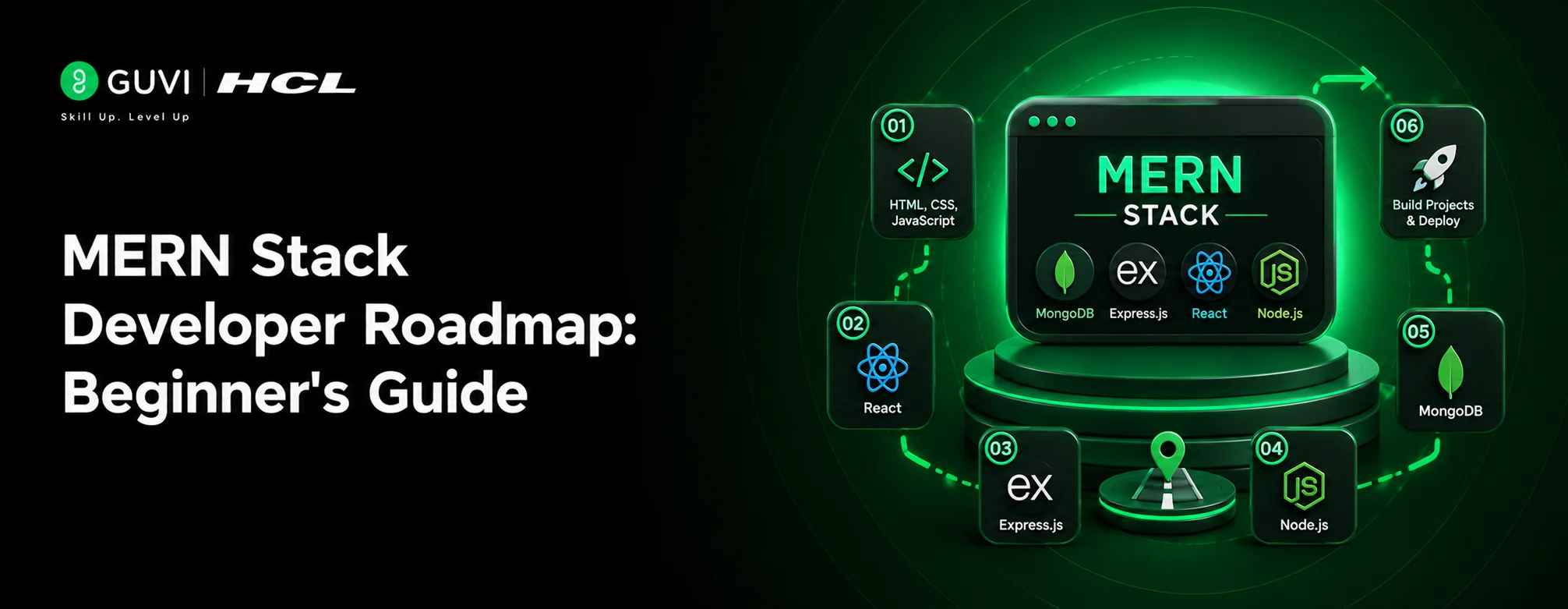
MERN Stack Developer Roadmap 2026: Beginner’s Guide
Aug 18, 2026 4 Min Read 4710 Views
(Last Updated)
Quick definition: MERN stack development means building web applications using MongoDB, Express.js, React, and Node.js, all in JavaScript. It is one of the fastest ways for a beginner in India to become job-ready as a full stack developer.
In this blog, we’ll discover the entire hype story behind it! We’ll walk you through a practical, no-fluff MERN Stack Developer career roadmap that can take you from beginner to job-ready in a structured and strategic way. This guide will help you chart a confident path forward.
Table of contents
- TL;DR Summary
- What is MERN Stack?
- MERN vs Other Full Stack Options
- MERN Stack Developer Career Roadmap
- Stage 1: Learn Web Development Basics
- Stage 2: Master the Front End with React
- Stage 3: Learn the Back End with Node.js and Express
- Stage 4: Work with MongoDB
- Stage 5: Add Authentication and Security
- Stage 6: Version Control and Deployment
- Stage 7: Build Real Projects
- MERN Stack Developer Salary in India 2026
- Common Mistakes Beginners Make
- Wrapping Up
- FAQs
- What is the MERN stack, and why is it popular?
- Is MERN stack still in demand in India in 2026?
- Can I use the MERN stack for mobile app development?
- Are there any prerequisites before starting with the MERN stack?
- How long does it take to become a MERN stack developer?
TL;DR Summary
- MERN stands for MongoDB, Express.js, React, and Node.js, four JavaScript technologies used together to build full stack web apps.
- You can go from beginner to job-ready in 4 to 6 months with consistent practice.
- Freshers in India typically start between ₹3.5 LPA and ₹6 LPA, with mid-level developers earning ₹6 to ₹12 LPA.
- The roadmap covers web basics, React for the front end, Node.js and Express for the back end, MongoDB for data, authentication, deployment, and real projects.
- You don’t need to learn a new language at any stage. It’s JavaScript from your database to your browser.
What is MERN Stack?
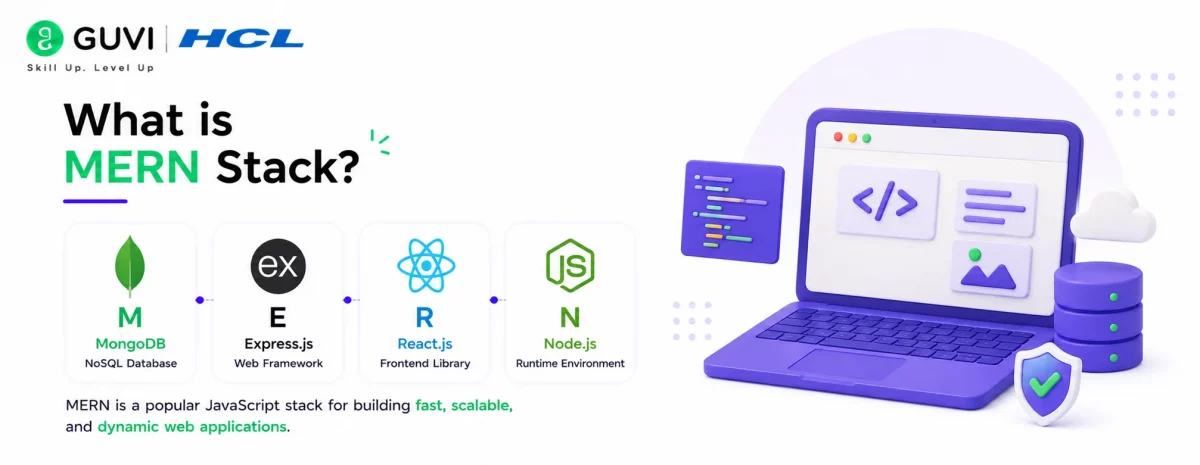
The MERN Stack is a collection of four powerful technologies that help developers build modern, full-featured web applications, all using one single programming language: JavaScript.
MongoDB – A NoSQL database, Express.js – A lightweight backend framework, React.js – A frontend library for dynamic UI, and Node.js – A server-side runtime environment.
You use one language, JavaScript, across your entire application. That’s what makes MERN a popular starting point if you’re new to full stack development. You’re not switching between Python for the backend and JavaScript for the frontend. It’s one language, four tools, and a much shorter learning curve.
MERN vs Other Full Stack Options
If you’re deciding between MERN and other popular stacks, here’s how they compare for someone starting out in 2026.
| Factor | MERN Stack | MEAN Stack | Java Full Stack |
|---|---|---|---|
| Core language | JavaScript (all layers) | JavaScript (all layers) | Java + JavaScript |
| Frontend framework | React | Angular | React or Angular |
| Learning curve | Moderate, beginner-friendly | Steeper, Angular has more concepts | Steep, needs Java fundamentals first |
| Job openings in India | High, especially startups | Moderate | High, mostly enterprise and product companies |
| Fresher salary range | ₹3.5 to ₹6 LPA | ₹3 to ₹5.5 LPA | ₹4 to ₹7 LPA |
| Best suited for | Startups, SaaS products, freelancing | Enterprise apps needing strict structure | Large enterprises, banking, product companies |
React currently has a larger job market share in India than Angular, which is part of why MERN sees more entry-level openings than MEAN.
MERN Stack Developer Career Roadmap
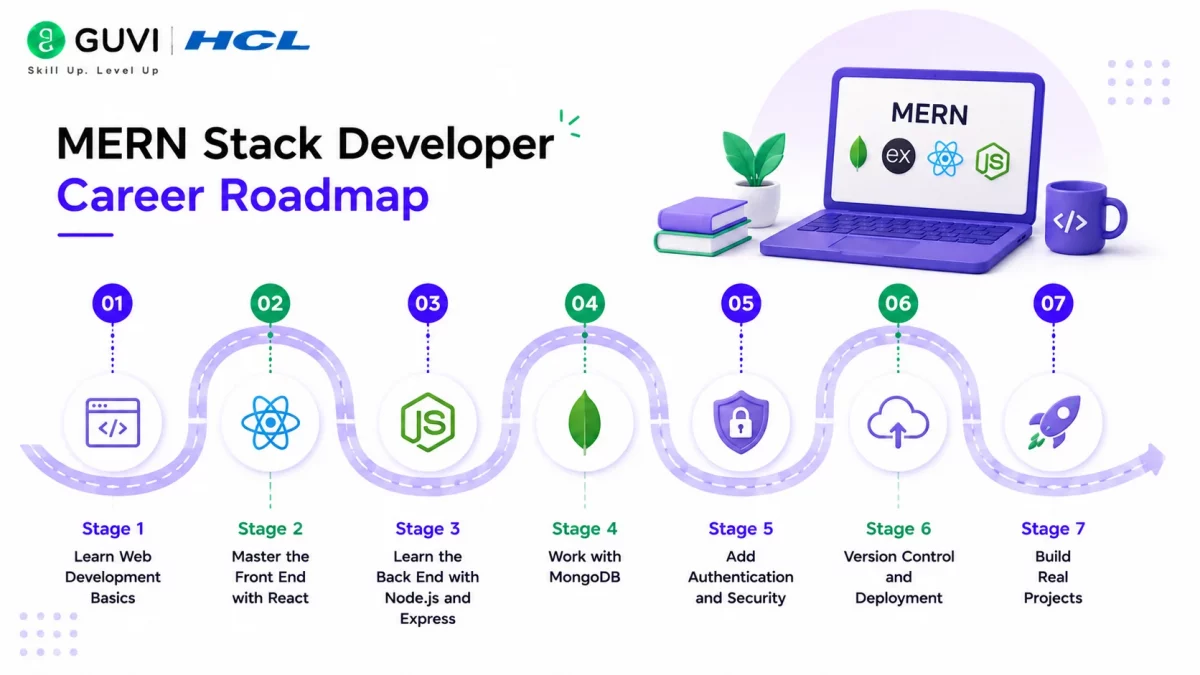
This roadmap is your step-by-step guide to becoming a MERN Stack Developer. It covers the exact skills and tools you need from basic web development to building powerful full-stack applications using MongoDB, Express.js, React, and Node.js.
Let’s dive into each stage of the journey.
Stage 1: Learn Web Development Basics
Start with HTML and CSS to structure and style web pages. Then move to JavaScript, covering variables, functions, arrays, and ES6+ features like async/await and arrow functions.
Set up Git, GitHub, and VS Code early. You’ll use all three daily once you start building.
Tip: Build a small to-do app or portfolio page while you learn.
Stage 2: Master the Front End with React
React remains the most in-demand JavaScript library for building user interfaces, and React 19 is the current stable version most companies use in 2026. Learn JSX, components, state, and props first.
Once you’re comfortable, move to React Router for navigation, Hooks for state and side effects, and a state management tool if your app grows complex. TailwindCSS is now the default styling choice at most companies, so it’s worth learning alongside plain CSS.
Tip: Try rebuilding a simple version of an app you use daily, like a notes app or a movie list.
Stage 3: Learn the Back End with Node.js and Express
Node.js lets you run JavaScript on the server. Node.js 24 is the current LTS release, so that’s what you should install. Learn how modules work, how to manage packages with npm, and how the file system works.
Express.js simplifies building APIs on top of Node. Learn routing, middleware, and error handling. Once you’re comfortable, learn how to structure a backend using the MVC pattern and how to build RESTful APIs properly.
Stage 4: Work with MongoDB
MongoDB is a NoSQL database that stores data as flexible documents instead of rigid tables. Learn CRUD operations first, then move to Mongoose, the ODM library that lets you define schemas for your data.

MongoDB 8.x and Mongoose 9.x are the current versions in active use, so build with those rather than following older tutorials that reference outdated syntax.
Stage 5: Add Authentication and Security
Every real application needs to know who’s using it. Learn JWT for token-based login, bcrypt for password hashing, and basic protections against common attacks like XSS and CSRF.
Tip: Build a login system with separate admin and user roles. This single project teaches most of what you need here.
Stage 6: Version Control and Deployment
You already know Git basics from Stage 1. Now learn to deploy full applications using Vercel or Render for the frontend, and Render or Railway for the backend, since Heroku’s free tier is no longer available. Understand the basics of CI/CD so your deployments update automatically when you push code.
Stage 7: Build Real Projects
This is where everything comes together. Build an e-commerce app, a task manager, or a chat app using Socket.io for real-time features. Then put together a portfolio site that showcases your best two or three projects with clean GitHub READMEs and live demo links.
Recruiters look at your GitHub before they look at your resume, so treat this stage seriously.
MERN Stack Developer Salary in India 2026
| Experience Level | Salary Range (Annual) |
|---|---|
| Fresher (0 to 2 years) | ₹3.5 to ₹6 LPA |
| Mid-level (2 to 5 years) | ₹6 to ₹12 LPA |
| Senior (5+ years) | ₹12 to ₹22 LPA and above |
Bangalore and Hyderabad tend to pay above the national average for MERN roles, while remote positions with metro-based companies can help developers in smaller cities close that gap.
Read More: 7 MERN Stack Best Practices You Should Follow
Common Mistakes Beginners Make
- Skipping JavaScript fundamentals: Jumping straight into React without solid JavaScript knowledge makes debugging painful later. Spend real time on the basics first.
- Learning React and Node in isolation: Many learners treat frontend and backend as separate tracks and never connect them. Build a project that uses both from day one.
- Ignoring deployment: A project that only runs on your laptop doesn’t count as a portfolio piece. Deploy everything you build.
- Ending your resume with tutorials, not projects: Tutorial completion doesn’t demonstrate skill to recruiters. Original projects, even small ones, do.
Ready to build these skills with guided projects and placement support? Explore HCL GUVI’s Full Stack Development Course, where you’ll master MongoDB, Express.js, React, and Node.js through real, guided projects.
Wrapping Up
The MERN stack is still one of the most practical ways to break into web development in 2026, mainly because it lets you learn one language and apply it everywhere in your application. Freshers who complete real projects and deploy them consistently tend to move faster than those who only complete tutorials.
Start with the basics, build as you go, and don’t rush past the fundamentals. The roadmap above is your structure. What you build along the way is what actually gets you hired.
FAQs
What is the MERN stack, and why is it popular?
MERN stands for MongoDB, Express.js, React, and Node.js. It’s popular because you use one language, JavaScript, across the entire application, which shortens the learning curve for beginners.
Is MERN stack still in demand in India in 2026?
Yes. React and Node.js together remain one of the most requested skill combinations in Indian full stack job postings.
Can I use the MERN stack for mobile app development?
Yes. While the MERN stack is primarily for web applications, React Native, a framework based on React.js, allows for mobile app development, which can integrate with Node.js and MongoDB for backend services.
Are there any prerequisites before starting with the MERN stack?
A basic understanding of HTML, CSS, and JavaScript is essential. Familiarity with Git and version control systems is also beneficial.
How long does it take to become a MERN stack developer?
Most learners with consistent daily practice become job-ready in 4 to 6 months, depending on prior programming experience.
Success Stories

Did you enjoy this article?
Comments















Thank you for sharing such valuable insights in this blog post! I found the content very informative and well-presented. The way you explained The Complete MERN Stack Developer Career Roadmap made it so much easier to understand. I’m looking forward to exploring more of your posts. Keep up the great work